Feeds:
Posts
Comments

Posts Tagged ‘literary’

Photo: Wigtown, Scotland, Book Festival.

Book lovers who are traveling this year may want to think about visiting one of the “book towns” profiled recently in National Geographic. Ashley Packard collected seven that sound charming.

“1. In the Welsh village of Hay-on-Wye, where sheep outnumber people and books spill onto the streets, a quiet revolution began. Antiquarian and academic Richard Booth inadvertently launched a global movement when he began filling the empty buildings of Hay-on-Wye with secondhand books.

“What started as a single decision in 1961 to fill his sleepy hometown with secondhand books to sell in numerous empty buildings, turned into the birthplace of a global literary mecca uniting villages, bibliophiles, and dreamers alike. …

“Hay-on-Wye became the first ever ‘book town,’ supporting patrons who flocked to the shops. Booth, who crowned himself ‘King of Hay,’ inspired others to turn literature into lifelines for their little towns and villages. As word of his success spread, more towns around the world embraced the concept for their communities. Before long, the International Organization of Book Towns was formed in April 2001, though it had existed without the official designation for decades prior.

“The organization aims to raise public awareness of book towns through online information and a biennial International Book Town Festival. It supports rural economies by facilitating knowledge exchange among booksellers and businesses, encouraging the use of technology, and helping to preserve and promote regional and national cultural heritage on a global scale.

“By definition, a book town is ‘a small, preferably rural, town or village in which secondhand and antiquarian bookshops are concentrated.’ … Today, there are dozens of towns with the designation, from Pazin, Croatia, to Featherson, New Zealand. These selected and approved locations take pride in their history, scenic beauty, and contributions to the literary world. …

“2. In a small village tucked away in the hilly countryside of Belgium, Redu is now celebrating its 41st anniversary since becoming the second book town in 1984. This idyllic village is described as, ‘fragrant with the scent of old paper.’ … It, along with its hamlets Lesse and Séchery, were recently added to the ‘Most Beautiful Villages in Wallonia‘ list in July 2024.

“3. [In Scotland] nestled on a hill overlooking the sea along a rugged coastline, woodlands, and forests, lies Wigtown, celebrating 20 years as ‘Scotland’s Book Town.’ … It has 16 different types of book shops, many secondhand, that participate in an annual Spring Weekend in early May, a community festival in July, a market every Saturday from April through late September, and the annual Wigtown Book Festival in late September through early October. The 10-day literary celebration was founded in 1999 and now features more than 200 events, including music, theater, food, and visual arts. 

“4. Turup [in Denmark] is situated 37 miles north of the Danish capital of Copenhagen, between the sea and a fjord, and has a population of 374 people. Here, locals put out the best and most high-quality secondhand books from donations out for sale along the rural roads of the 10 different shops (if you can call them that) for purchase. These ‘bookshops’ include a garage, a workman’s hut, a disused stable, a bookshelf on a farm entrance, and even a newly restored railway station. Some of these stalls process transactions on a self-help and honesty basis where customers leave their change in a jar in exchange for their purchases. The Torup Book Town Association hosts an annual Nordic Book Festival with book readings from authors, contemporary short films, cultural events, and more. 

“5. Surrounded by stunning landscapes, rolling hills, and vineyards is the quaint town of Featherston [New Zealand] … became officially recognized as a book town in 2018. It is famously known for the annual book festival held in May. They have initiatives dedicated to fostering community growth, inspire reading, writing, and idea-sharing across Wairarapa and Aotearoa, New Zealand.

“6. Offering year-round bookstalls and literary festivals, the village of St-Pierre-de-Clages is home to Switzerland’s only book village. ‘Le Village Suisse du Livre,’ translated to ‘The Swiss Book Village,’ is home to a large secondhand market, along with authors, thematic exhibitions, activities for children, and a renowned Book Festival that has been hosted every last weekend of August since 1993. … This festival takes place over three days and attracts visitors from all over French-speaking Switzerland and neighbors. It offers insight into book professions such as calligraphy and old printing techniques, a welcoming space for writers and publishing houses to meet, and various artists to display their work.

“7. The former garrison town of Wünsdorf [in Germany] is known as ‘book and bunker city’ due to the historical sites, buildings, book shops, cafes and tea rooms, and lively cultural life. Nestled about 12 miles south of Berlin, the town offers year-round events, readings, exhibitions, military vehicle meetings, and currently five different bunker and guided tours. Wünsdorf was established as an official member of the International Organization of Book Towns in 1998 thanks to its three large antiquarian shops that boast of a wide array of literary treasures on topics such as poetry, philosophy, classical literature, and many more.”

More at National Geographic, here. Great photos, as you would expect from National Geographic.

Read Full Post »

Art: Christina Chung.
A Chaucer fantasy.

What soothes you? Things like a massage, granola, walking, or reading generally work for me. Today, I’m delighting in a literary essay. I’m glad Camille Ralphs wrote at the Poetry Foundation about “how Chaucer remade language.” Good-bye for now to November 2024.

Ralphs says, “Chaucer’s works are very much of their moment, and perhaps required some distance from their context and coevals for their worth to be apparent. Ezra Pound observed that ‘Chaucer had a deeper knowledge of life than Shakespeare.’ If Chaucer hadn’t played so many roles in the medieval city, he likely couldn’t have written so expansively.

“He was the son of a vintner and grew up in London’s Vintry Ward, where he was formed and informed from the start by a babel of trades and trade-offs. He became a page in the house of the Countess of Ulster, a squire in the King’s household, a soldier, a controller of customs in the port of London, a justice of the peace, and Clerk of the King’s works. The Canterbury Tales owes some debt to the genre of ‘estates satire,’ which tallies different social classes and professions and elucidates both their importance to the state and their deficiencies. … Yet there is more reality to Chaucer’s characters than that.

“Who else could have imagined such a motley ensemble but someone who had jostled with the many flavors of humanity? The medleyed voices of the Miller, who can break down doors by running at them with his head; the ‘gat-toothed,’ half-deaf Wife of Bath, who rides astride in bright red stockings; the Canon alchemist, so sweaty from the ride that his horse is a lather of suds; the ‘ful vicious’ Pardoner with his jar of dubious holy ‘pigges bones’; and the garlic-loving Summoner, with a face so pimply ‘children were aferd’ — Chaucer knew them all.

“As Mary Flannery argues in her authoritative and diverting monograph Geoffrey Chaucer: Unveiling the Merry Bard (Reaktion Books, 2024), the mercenary assets of ‘The Shipman’s Tale,’ in which a merchant’s wife offloads a difficult financial situation by insisting she’ll repay her husband with sex (‘By God, I wol nat paye yow but abedde!’) must come from Chaucer’s roving through ‘warehouses, docks and markets.’ Works such as The Book of the Duchess (1368) — probably penned on the death of Blanche of Lancaster, the wife of John of Gaunt (it also circulated under the title ‘The Deth of Blaunche’) — could only be written by a man who’d worked in ‘palaces and great houses in England and on the Continent.’

“For a writer to be all things to all men, he must know a bit about things, and a lot about men — not to mention a lot about language and literature. Had Chaucer not been born into a mercantile environment and had the opportunity to mingle with Italians by the Thames, he may have struggled with Italian, and had he not spent so much time around nobility, he may not have learned French.

“His narratives are mostly borrowed from Latin and Romance-language sources (including Boccaccio’s DecameronOvid’s Metamorphoses, and the Roman de la Rose by Guillaume de Lorris and Jean de Meun). His forms and genres almost all derive from French minstrel romances and fabliaux (bawdy medieval stories), and, more granularly, from the verse structures of poets such as Guillaume de Machaut, from whom Chaucer stole the seven-line form now known as ‘rime royal‘ or the ‘Chaucerian stanza.’ And he may never have thought about writing in English had he not observed how Dante elevated Florence’s vernacular in his Commedia (1321), a technique Chaucer noticed while in Tuscany for diplomatic work.  …

“Chaucer never claims to be inspirited by God or gods, nor does he ever refer to himself as a ‘poet’ or ‘author.’ This may result from his ‘distinctive self-deprecation,’ in Flannery’s terms, though comic exaggerations of the scribbler’s incompetence are found in Machaut too, as the scholar Colin Wilcockson notes.

“Such modesty was a way of keeping or getting out of trouble with those who might be offended by his bawdy side, or who might chide his literary aspirations — like his efforts to wash his hands of his own writings. In the Miller’s Prologue, for example, he ‘makes his audience responsible for whether they enjoy his work.’

‘In the Prologue to The Legend of Good Women (c. 1387), the God of Love and his wife Alceste chastise Chaucer with a list of his works (Chaucer later updated the Prologue to include recent works, assuring the record was correct), and the Man of Law’s Prologue from The Canterbury Tales offhandedly abuses Chaucer’s rhyme before giving another catalogue. The ‘retraction’ at the Tales’ end, in which Chaucer — apocryphally from his deathbed — asks God to forgive him for his ‘translaciouns and enditynges of worldly vanitees,’ fulfils the same role. …

“In her painstaking biography Chaucer: A European Life (2019), Turner argues that Chaucer’s writings must proceed from some sort of democratic impulse. … This, perhaps, is Chaucer’s great innovation in our literature, surpassing even the invention of the decasyllabic English line that found its way to iambic pentameter: a level narrative playing field, inviting interaction and discussion.”

If you’d enjoy leaving 2024 for another world, there’s lots more at the Poetry Foundation, here. No paywall.

Read Full Post »

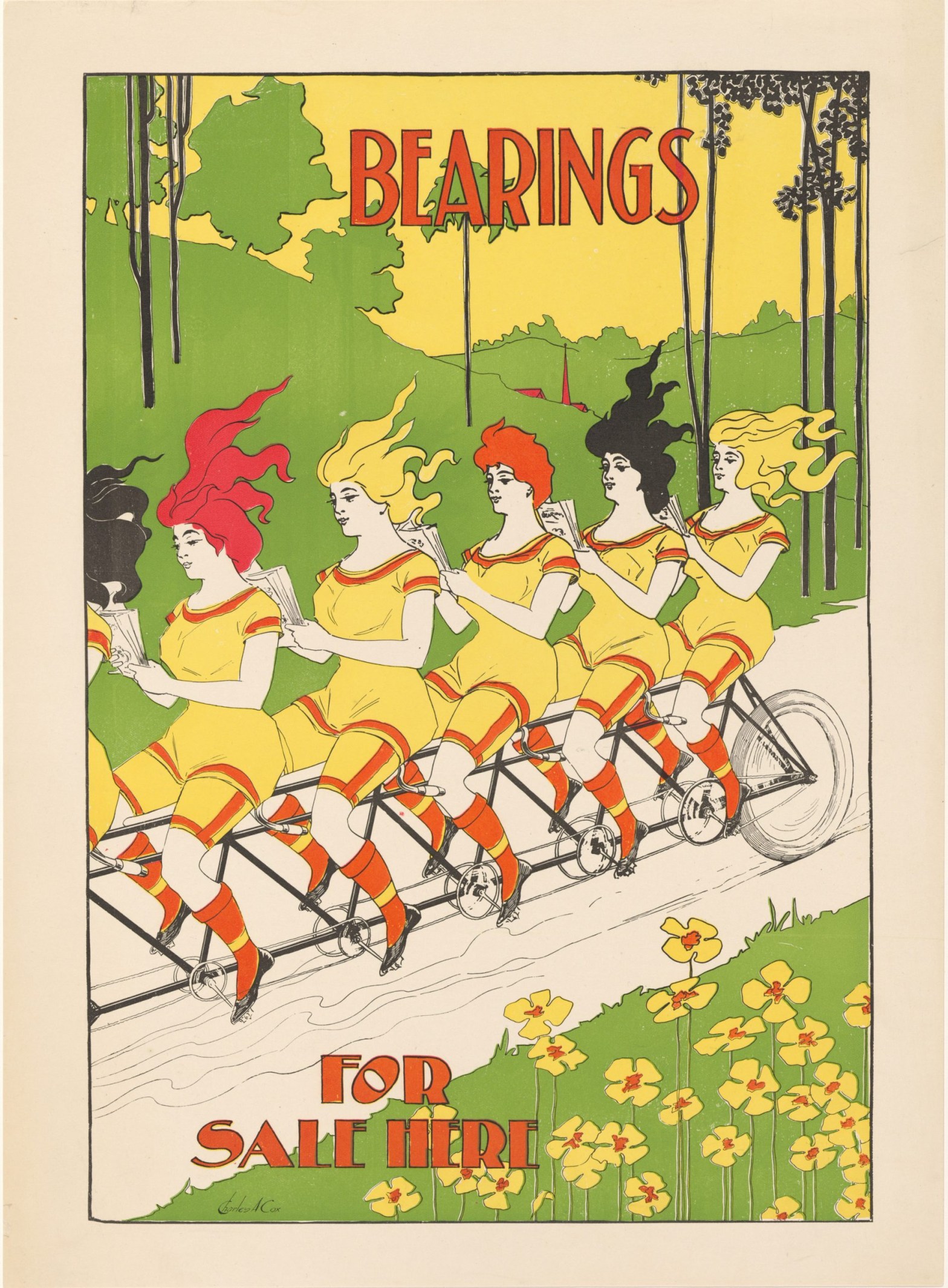
Art: Charles Arthur Cox, “Bearings” (1896), via Hyperallergic.
Art Nouveau posters often reflect both a love of books and young women enjoying more freedom.

Do you like the Art Nouveau, a style identified as roughly 1890 to 1910 in Europe? After reading about the literary posters of that time, my already considerable appreciation for it is has only increased.

Sarah Rose Sharp writes at Hyperallergic about a recent exhibition at the Metropolitan Museum of Art in New York.

“The literary poster occupies a special place at the intersection of American art history and literature. Advances in color printing technology at the end of the 19th century made way for a flood of colorful and intricately detailed materials, often in the form of handbills and posters, which were suddenly more affordable as a vehicle to advertise the latest books, magazines, periodicals, and other forms of literature.

“Accompanying an eponymous exhibition at the Metropolitan Museum of Art, The Art of the Literary Poster: The Leonard A. Lauder Collection illuminates the expansive genre through several examples culled from the titular collection, accompanied by essays on the form by exhibition curator Allison Rudnick, scholar Jennifer A. Greenhill, paper conservator Rachel Mustalish, historian Shannon Vittoria, and Lauder himself. …

“Both historically astute and visually delightful, the book captures the influence of the Art Nouveau movement on printed materials at the turn of the century, as well as showcases the evolution of graphic design as innovations in multi-color plate printing that allowed text and imagery to come together in increasingly complex ways. Vittoria’s essay highlights the particular power of literary posters as a genre ‘by women, for women,’ noting that American illustration was one of the few professions young women were encouraged to pursue at the time.

” ‘As male artists and critics worked to defeminize illustration by minimizing women’s contributions to the field, female artists and advocates saw the potential of the visual arts, particularly printed media, to advance the campaign for women’s suffrage,’ Vittoria writes. ‘The art poster became a potent tool in this struggle.’

“Turn-of-the-century literary journals like Lippincott’s Monthly Magazine and Harper’s were some of the first publications to avail themselves of this new technology, with cover art featuring thoroughly modern Gibsonesque girls riding bikes, snuggling cats, and of course, reading. Though the magazine and visual digest Bradley, His Book was only published between 1896 and ’97, the cover works by Art Nouveau illustrator and film director William H. Bradley, its publisher, are dazzling examples of the intricacies made newly possible in literary art posters. …

“In her catalog essay, Rudnick examines a cover of the July 1896 issue of Lippincott’s as the essence of the burgeoning form. Created by Joseph J. Gould Jr., the image features a woman in a day suit equipped with the exaggerated sleeve caps and narrow skirt of the era, perched calmly on a bike with a straw hat on her head, which partially obscures the masthead’s bold red letters. She is biking out of a richly blue background, presumably off to enjoy the copy of Lippincott’s held against the handlebars in her right hand.  ‘The poster itself represented something new: an advertisement that looks and functions like a work of art,’ Rudnick writes, ‘an image made for public consumption in which commercialism and culture coalesce.’

“The distinctive print also captures the spirit of new possibilities for women, as a cavalcade of unbothered women on bikes became the visual heralds of the era’s first-wave feminism that paved the way for women’s movements of the following century. A 1911 ‘Votes for Women‘ poster by artist and educator Bertha Margaret Boyé, chosen as the winner of a poster competition held by the San Francisco College Equal Suffrage League, embodies this renewed sense of possibility as a woman in flowing yellow robes stands before a landscape displaying the titular banner. Behind her, the rising orange sun halos her head, giving the effect of saintliness while hinting at the dawning of new opportunities.

“Full of aplomb women on bikes with literary and political ambitions (and, of course, cats), The Art of the Literary Poster gathers inarguably beautiful printed materials that — even beyond their political and promotional implications — demonstrate the elegance, interests, and aesthetics of a pivotal moment in art history.”

Check out the gorgeous collection of posters at Hyperallergic, here. No firewall. Subscriptions encouraged. And for those interested in learning more about Art Nouveau in general, see at Wikipedia, here.

Read Full Post »


022319-literary-bridhouse-Grimm-Tales

Jaimee Leigh sells books at the Barrow Bookstore in Concord, Massachusetts, but during after hours, she makes literature-themed birdhouses designed for actual birds. 

Betsy Levinson was the editor of the Concord Journal for many years and was responsible for the majority of the articles, writing with exceptional grace and insight. Nowadays, she contributes as a stringer, and I see her byline most often on infomercials for local real estate, which don’t interest me as much. But in a recent front page article she did herself proud. And when I went to the locale to take pictures, I could see that other readers had been inspired to follow up, too.

This is what she reported for the Journal. “Jaimee Leigh sells books at her sister Aladdine Joroff’s shop Barrow Bookstore in Concord, but a talent for creating one-of-a-kind birdhouses keeps her busy during her hours away from the shop.

“The birdhouses aren’t just functional, either. Her creations are pieces of art, each one designed around a work of literature.

“For instance, the roof of her ‘The Hobbit’-inspired birdhouse has glow-in-the-dark lettering on the roof in the same original font that J.R.R. Tolkein made for his books.

“Then there is the suet bird cage, inspired by Henry David Thoreau’s ‘Civil Disobedience,’ which she noted was written from a Concord jail cell where he was ordered after refusing to pay taxes. Leigh inscribed words from the book inside. …

“It was four years ago that the idea of making a book-themed birdhouse came to Leigh. She was visiting her godmother in Sligo, Ireland, and attended a creative arts competition as a fundraiser for a storied estate there. She made a ‘memory box’ featuring seashells found in the area, photos and poetry. Though it wasn’t a birdhouse, it inspired her to create ‘similar things for the bookstore in Concord.’ …

″Each birdhouse ‘aims to summarize the essence of a book or story,’ Leigh wrote.

They are sealed from the elements on the outside, but she leaves the interior free of chemicals or noxious fumes that might hurt the birds.

“She bores holes of different sizes to accommodate larger or smaller birds. Recently she started fitting inch-wide ’emergency egress steps’ inside the house in case the bird finds the inside too smooth and can’t get a toehold or clawhold to get out. Leigh’s careful about using a perch on the outside because sometimes predator birds can lurk outside. …

“She has shipped birdhouses to South Korea, Canada and Texas. Others are scattered around the floor-to-ceiling stacks of books at the shop. She has donated houses to local charities for fundraising auctions. Each one can take 60 to 80 hours to complete, she said. … For information, email Leigh at barrowbookstore@gmail.com, or visit barrowbookstore.com.”

More at the Concord Journal, here.

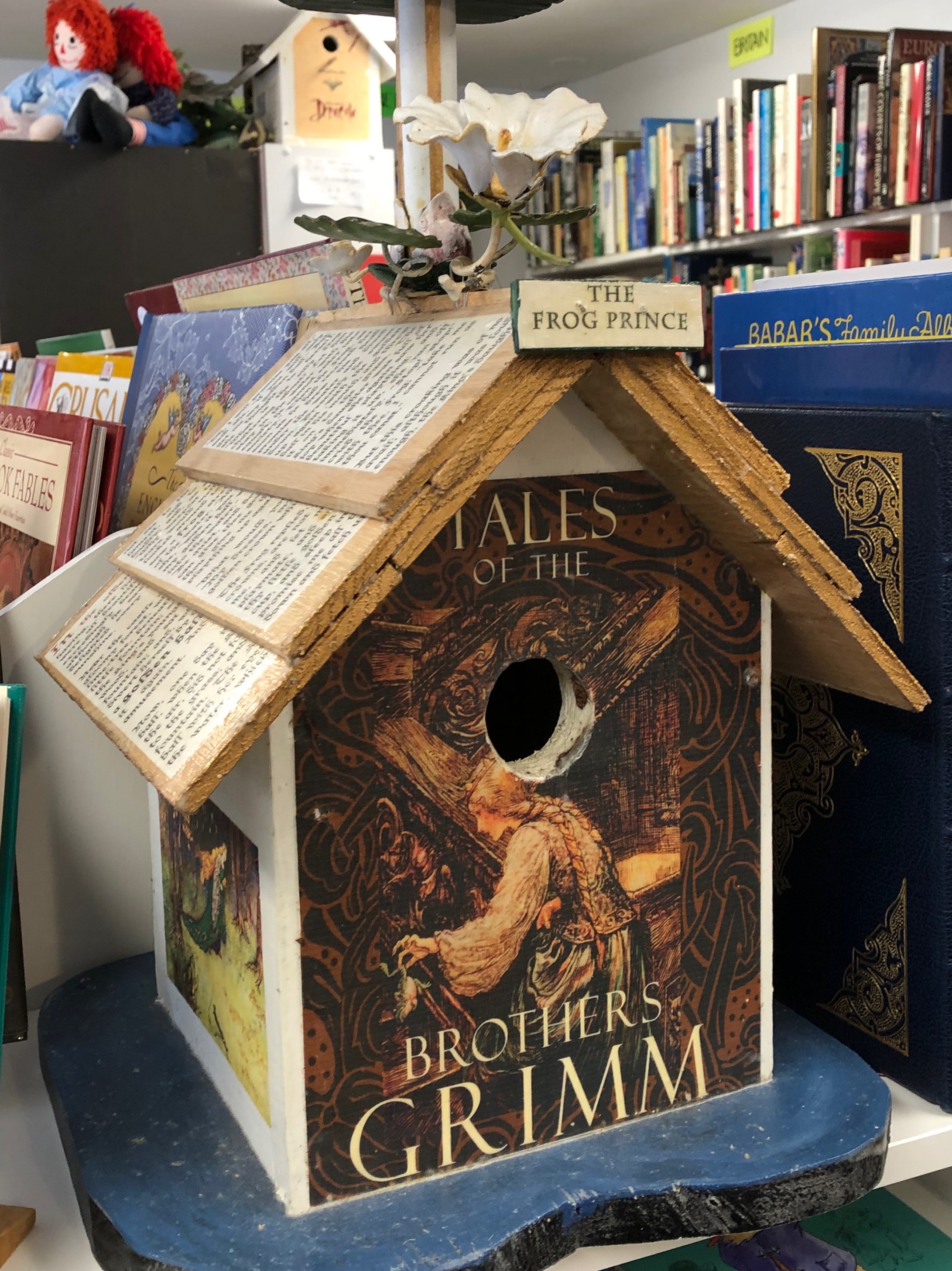
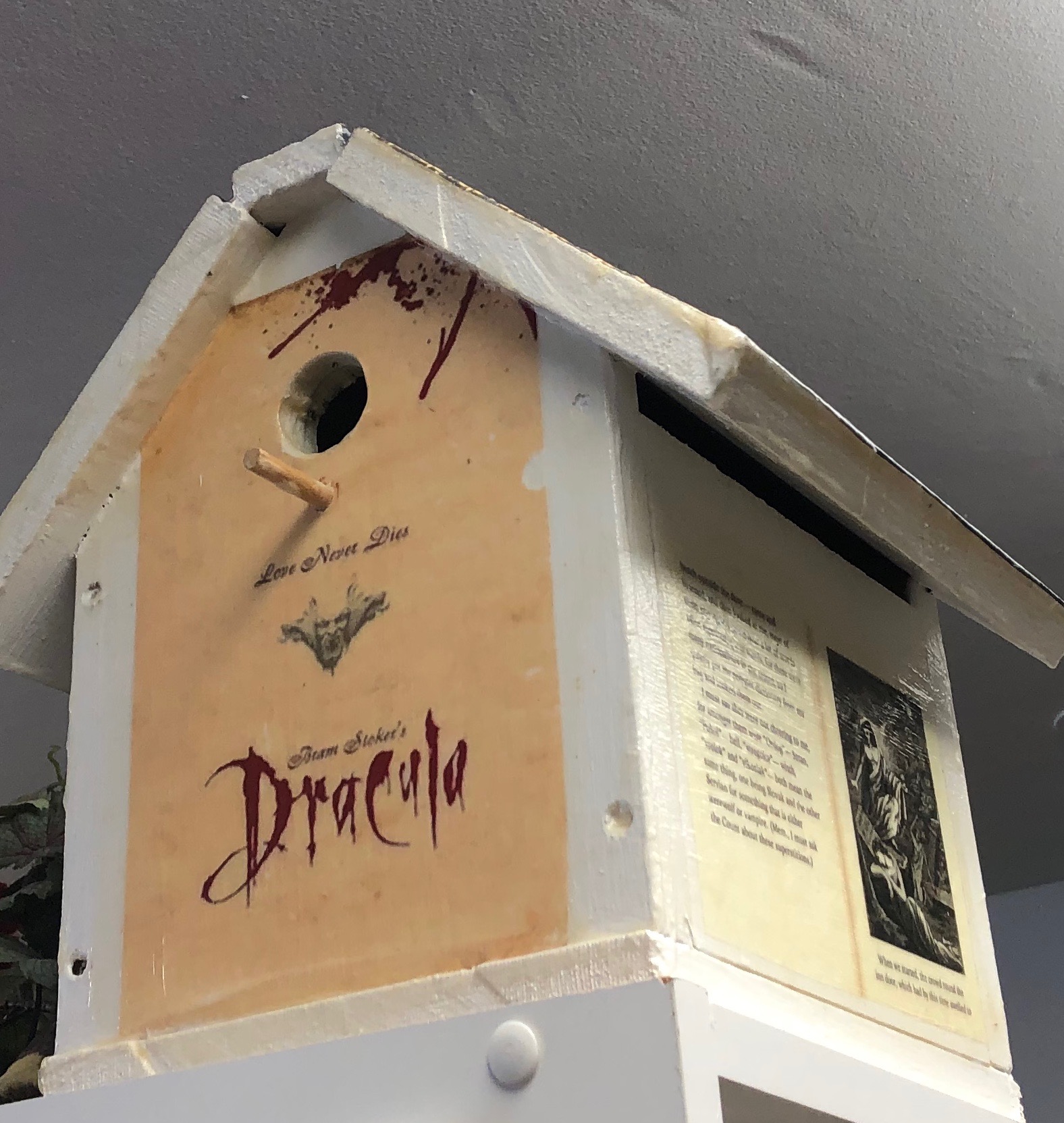
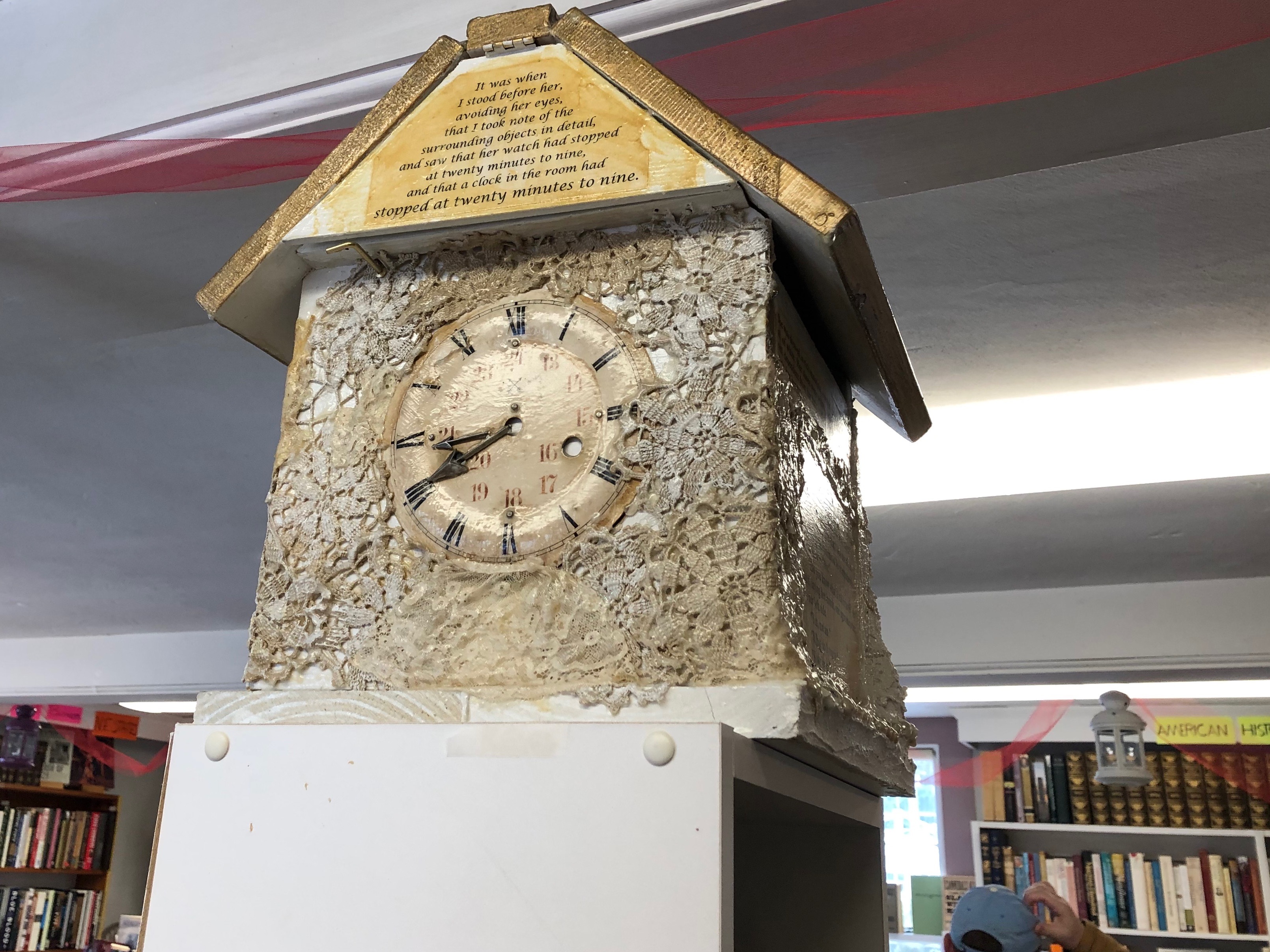
I took pictures of birdhouses featuring the Brothers Grimm, Dracula, and Great Expectations. Regarding the latter, note that Miss Havisham’s wedding dress is evoked by lace, and the clock is stopped at the moment her bridegroom ditched her, twenty minutes to nine.

022319-literary-birdhouse-Dracula

022319-Havisham-frozen-clock-wedding-lace-birdhouse


Read Full Post »

Illustration: Ben Kirchner
Raduan Nassar was 48 and at the height of his literary fame when, in 1984, he announced his retirement. He wanted to become a farmer.

I liked a recent article in the New Yorker about a Brazilian who left the writing life to become a farmer. Did literary perfectionism stress him out too much, or did farming just seem more real?

Alejandro Chacoff has the story.

“In 1973, the Brazilian writer Raduan Nassar quit his job. After six years as editor-in-chief at the Jornal do Bairro, an influential left-wing newspaper that opposed Brazil’s military regime, [he left] and spent a year in his São Paulo apartment, working twelve hours a day on a book, ‘crying the whole time.’ In ‘Ancient Tillage,’ the strange, short novel he wrote, a young man flees his rural home and family, only to return, chastened and a little humiliated, to the place of his childhood.

“ ‘Ancient Tillage’ was published in 1975, to immediate critical acclaim. … In 1978, a second novel appeared in print; Nassar had written the first draft of ‘A Cup of Rage’ in 1970, while living in Granja Viana, a bucolic neighborhood on the outskirts of the city. It, too, was received euphorically, winning the São Paulo Art Critics’ Association Prize (ACPA). …

Last year, Nassar’s two novels were translated into English for the first time, for the Penguin Modern Classics Series. …

“Nassar was forty-eight and at the height of his literary fame when, in 1984, he gave an interview with Folha de São Paulo, the country’s biggest daily newspaper, in which he announced his retirement. He wanted to become a farmer. … The following year, he bought a property of roughly sixteen hundred acres and began to plant soy, corn, beans, and wheat. …

“Nassar said that farming had always been his main occupation, whereas writing had ‘just been another activity.’ But his life in agriculture did not begin smoothly.

“ ‘For the first six years, we got killed; there were only losses.’ … Like his characters, he appears to have found solace in manual labor. ‘My life now is about doing, doing, doing,’ he told an interviewer, in 1996, when asked how he was faring after his literary retirement. …

“Both [Luiz Schwarcz, the editor-in-chief of Companhia das Letras, the country’s main publishing house,] and [Antonio Fernando de Franceschi, a poet and critic who became a close friend of Nassar’s,] believe that Nassar’s decision to quit came not from a waning of interest but from literary perfectionism. ‘He’s a guy who devotes himself so much to the craft that I think it’s hard for him to feel rewarded,’ Schwarcz said.” More here.

I intend to track down his books.

Read Full Post »

Thank you, Gwarlingo, for tweeting this. Looks like there’s hope for us all.

“All your excuses are invalid,” says Dustin Kurtz in an article at the Melville House site about “the seventy-five year old winner of a prize for emerging writers.

“The semiannual Akutagawa prize was awarded in Japan this past Wednesday, and this season’s winner was Natsuko Kuroda. The Akutagawa prize, begun in 1935, is awarded for stories published in newspapers or magazines by new or emerging authors. Kuroda is seventy-five years old.

“Her story, ‘ab Sango’ (it can be previewed and purchased here) is unusual in that it uses no pronouns for its young principle characters, and is written horizontally across the page from left to right, rather than the standard top to bottom. The result is strange and beautiful, and hints at a genealogy of Popper-esque fairy tale formulae, of mathematics or of sociology, and all of which is given subtle cultural freight by Kuroda’s horizontal lines. But again — because it bears repeating — this intriguing emerging writer is seventy-five years old.

“Kuroda is in fact the oldest writer ever to be given the Akutagawa prize, and she is nearly as old as the prize itself. Ryunosuke Akutagawa, the award’s namesake and perhaps Japan’s most celebrated story writer, famously killed himself when he was less than half her current age.

“Upon receiving the prize, Kuroda said, ‘Thank you for discovering me while I am still alive.’ ” More.

Photograph: Melville House, an independent book publisher in Brooklyn, NY.

Read Full Post »