Feeds:
Posts
Comments

Posts Tagged ‘livestock’

Photo: Suzanne and John’s Mom.
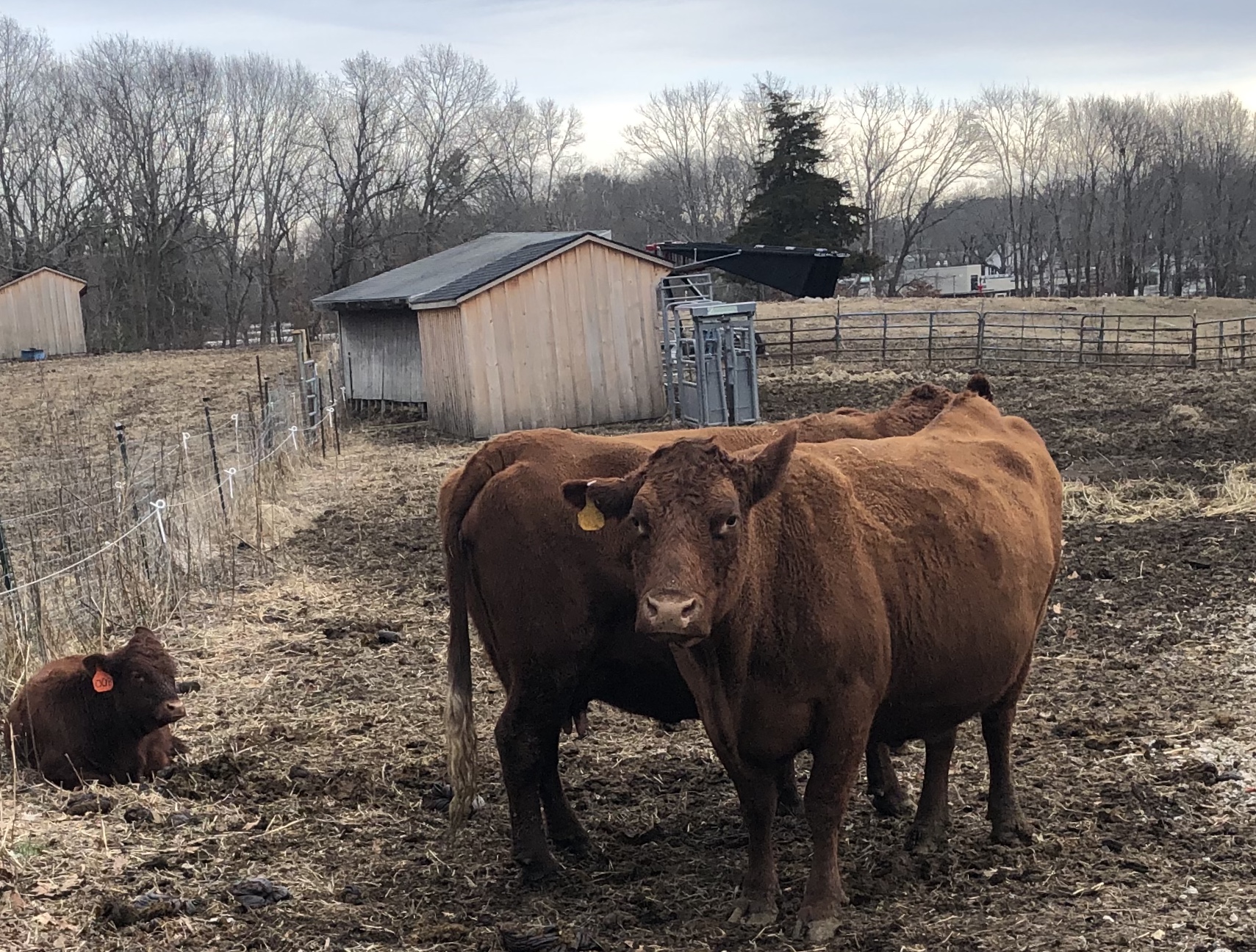
Cattle at Codman Farms, Lincoln, Mass. “Cows are often described as climate change criminals,” says Grist, “because of how much planet-warming methane they burp.” But, Grist adds, raising ruminants can also lead to deforestation, making alternatives to meat doubly important.

The other day at dinner, my husband regaled Sally and me with the latest on Europe’s use of mealworms as alternative proteins. The idea of eating mealworms — straight, no chaser — was not appealing to me even though I know they often sneak into the packaged nut and grain products we buy at the store. Which is why I freeze those products for 24 hours. I suppose I eat frozen mealworms that way, but it’s inevitable.

Grist magazine reported recently on the damage that livestock agribusinesses do to the planet when they cut down trees to graze more animals.

Max Graham says, “To feed the world’s growing appetite for meat, corporations and ranchers are chopping down more forests and trampling more carbon-sequestering grasslands to make room for pastures and fields of hay. … The greenhouse gases unleashed by this deforestation and land degradation mean food systems account for one-third of the world’s human-generated climate pollution.”

At Nature magazine I learned that alternative proteins are gaining traction in France, of all unlikely places. The focus is not on eating insects straight.

Rachael Pells writes at Nature about “the world’s largest vertical insect farm — home to at least 3 trillion mealworm beetles (Tenebrio molitor). The company’s chief executive and co-founder, Antoine Hubert, says that the beetles have a good life, as far as being an insect goes. Each of their stacked plastic trays is kept at an optimal 60% humidity and a balmy 25–27 °C. Nutrition, growth and moisture levels are all recorded for analysis, and human visitors are allowed to inspect the trays only from a distance — to prevent contamination of this prized ecosystem.

“The beetles are raised in this way from larvae to adult, at which point they meet a quick death in steam before being harvested into oil, protein and fertilizer.

“Insects have come under the spotlight over the past few years, as scientists seek alternative sources of protein to feed the rapidly expanding global population. A direct nutritional comparison shows that edible insect species have greater protein potential than do conventional meat products — 100 grams of mealworm larvae produces 25 g of protein, whereas 100 g of beef contains 20 g of protein. Insects also have a high food-conversion ratio when compared with livestock.

“To produce the same amount of protein, for example, crickets require around six times less feed than do cattle, four times less than sheep, and half that of pigs and chickens. But various attempts by companies to market insects as a mainstream food source in Europe and North America have fallen flat and largely been dismissed as a fad. And some researchers have concerns about the effects on the environment, ranging from whether escaped insects might disrupt local ecosystems to the impact of insect ‘factories.’ So why farm insects at all?

” ‘The world is facing a huge food sustainability crisis,’ explains Huber, an environmental engineer. ‘Insect protein is one very realistic and obvious solution to mitigating some of those challenges,’ he says.

“With the global population expected to reach almost 10 billion by 2050, United Nations forecasters have warned that food production will also need to increase by as much as 70%.

“However, because mealworm burgers are, at the moment, unlikely to sell out in your local supermarket, Ÿnsect grows insects for animal feed. This is given to fish, pigs and poultry, taking the pressure off conventional agricultural land use.

“The use of vertical farming has grown rapidly over the past few years, spurred on, in part, by advances in LED lighting, the cost of which fell by 94% between 2008 and 2015. Several start-ups (including Infarm in Berlin and Aerofarms in Newark, New Jersey) use the system to produce vegetables such as lettuce for human consumption. And the global market of the vertical-farming industry is expected to grow from US$3.7 billion in 2021 to $10.5 billion in 2026.

“Meanwhile, sales of plant-based alternatives to meat that are designed to reduce the demand for cattle farming — an industry responsible for 65% of all livestock emissions — seem to be stalling. When meat-substitute company Beyond Meat in El Segundo, California, went public on the stock market in 2019, its share price rose by 163%. But after the initial excitement, sales slowed, and they have remained about the same since 2020.”

As with most innovations, there are caveats. Get the details at Nature, here. And for a report on livestock and deforestation, check out Grist, here. No paywalls for either one.
Read Full Post »

Photo: Suzanne and John’s Mom.
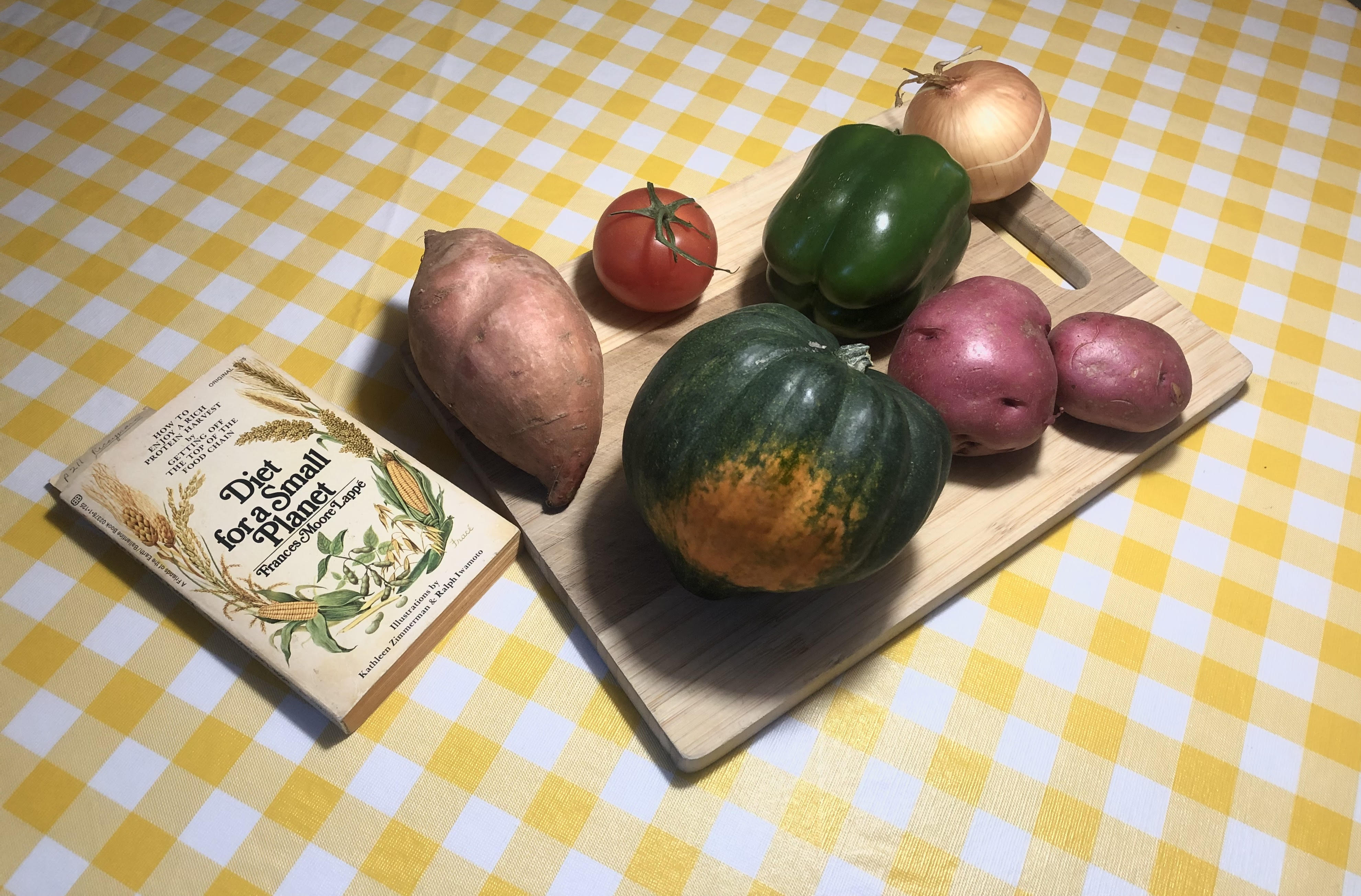
Frances Moore Lappé, author of Diet for a Small Planet, founded the Small Planet Institute, which focuses on social solutions to environmental, hunger, and political challenges.

The environmental radio show Living on Earth is staying on top of concerns about our global food system and the role it plays in “environmental crises like global warming and water pollution even as it fails to adequately feed billions of people.” Diet for a Small Planet author Frances Moore Lappé recently joined host Steve Curwood to discuss how “embracing the plant world in our diets connects to climate, health, and democracy.”

“STEVE CURWOOD: Our present food system is polluting and wasteful. For starters, about a third is thrown away, tossed from kitchens and plates in rich places and spoiled where people can’t afford to refrigerate. And many industrial growing systems pollute and waste as well, using too much water, land and chemicals in ways that also add to climate disaster. Yet around the world more than 2 billion people are food insecure.

“Fifty years ago Frances Moore Lappé wrote the bestselling Diet for a Small Planet in a bid to address the hunger crisis, and along the way she seeded a plant-centered food revolution in the kitchens of America. She joins me now from Belmont, Massachusetts. … Frankie, just to be clear, what is a plant-centered diet?

“FRANCES MOORE: Well, it’s embracing the plant world. When I moved from meat, you know I grew up in Texas cow town, right. So people said oh you’re giving up so much and I said, no, no, no, it’s the plant world that has all the taste differences, the color, the shapes, the textures, you know, it’s where all the yummy stuff is. And so for me being plant centered is I don’t follow recipes a lot but going into the kitchen and looking, you know, seeing what’s there and finding out spices and herbs I love and for example, I turned a basic beans and rice dish into an Italian dish by just changing the herbs that are used in it. It’s called Roman Rice and Beans in Diet for a Small Planet. …

“CURWOOD: So what’s changed in the last 50 years since you wrote Diet for a Small Planet? …

“MOORE: We’re sort of moving in two directions at once because we’ve got it now we know what to do and all over the world, people are aligning with nature to grow our food [but] the dominant extractive approach that is so dangerous and so unnecessary is still going strong. …

“Our food system globally contributes about 37% of greenhouse gas emissions and about 40% of that is from the livestock sector. So that’s a huge contribution. And now I’m calling it a plant- and planet-centered diet because if we really addressed this crisis and grew a healthy plant-centered diet, that would cut the agricultural greenhouse gas emissions by about two-thirds. A professor at the University of Minnesota calculated that it would be the equivalent to removing basically all the vehicles off the planet.

“CURWOOD: Now, people listening to us need to be reassured that you’re not saying you can never eat meat, you’re just telling us to make it a rare occasion. …

“MOORE: I really want to be big tent and to welcome people if they are eager to align with their body because there’s a lot of evidence that this plant-centered stuff is really good for us. … Any step we can take, I celebrate.

“CURWOOD: Now, the meat production industry has gone to great lengths to concentrate operations. …

“MOORE: What woke me up at age 26 [was] that I saw meat production as a protein factory in reverse. Consider this, we use about 80% of our agricultural land to produce livestock, but they give to us only 18% of our calories. So right there, that is pretty darn inefficient and for beef, one estimate says that of the grains fed to livestock we get about 3% to 5% of the calories and protein that we eat from all of that grain that gets fed to livestock in this country. So it’s really hard to imagine anything less efficient. …

“CURWOOD: Tell me a little bit more about the the health risk of red meat.

“MOORE: Well, I was actually shocked to learn recently that the WHO, the World Health Organization, has deemed red meat a probable carcinogen. And when I looked into it a bit that has to do with heme iron in red meat. … And then on processed meat, the WHO has deemed processed meat a carcinogen. …

“CURWOOD: Why [is] the food we eat is also linked to the health of our democracy in your view? …

“MOORE: Our democracy [is] the taproot crisis and we also have a living-planet crisis and we also have an economic crisis [of] concentration of wealth, but the taproot is democracy, because that is the way that we make decisions together to solve problems. [If] we’re going to solve these huge problems of our environment and the impact of farming on climate change, which is quite significant, we have to have democracy. And what we have now I think of as a very corrupted form because private interests those who are benefiting very much from fossil fuels and from the meat-production industry and [they] have tremendous power in Washington. There are now 20 corporate lobbyists in Washington for every single person that you and I elect to represent us in Washington. That is problematic, that is what I call a corrupted system, and that’s why I think it’s so important, Steve, we’ve got to solve these problems, and we’ve got to have democracy to solve them.”

More on that at Living on Earth, here. No firewall.

Read Full Post »

After my two half-Swedish grandchildren were off breast milk — or even before — they started on bottles of a ground-up oat concoction that I’m told all Swedish children drink rather than cow’s milk. Välling. We can’t get along without it.

So the following story from the Guardian is not as curious to me as it might be to others.

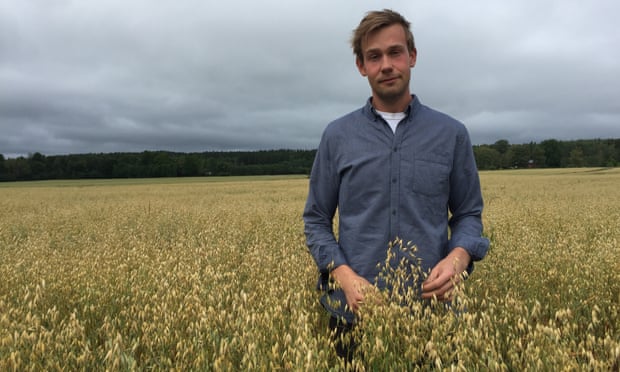
Tom Levitt reports, “Adam Arnesson, 27, is not your usual milk producer. For starters, he doesn’t have any dairy cattle. Our first photo opportunity is in the middle of one of his fields of oats.

“Until last year all these oats went into animal feed, either sold or fed to the sheep, pigs and cows he rears on his organic farm in Örebro county, central Sweden.

“With the support of Swedish drinks company Oatly, they are now being used to produce an oat milk drink …

“ ‘The natural thing for us would be to increase our livestock numbers, but I don’t want a factory,’ he says. ‘The number of animals has to be emotionally right so I know each of them.’ …

“The rearing of livestock and meat consumption accounts for 14.5% of global greenhouse gas (GHG) emissions. Alongside carbon emissions from deforestation (for pasture or crops to feed animals), the livestock sector is also the single biggest human-related source of methane (from cattle) and nitrous oxide emissions (from fertiliser and manure), two particularly potent greenhouse gases. …

“ ‘I had a lot of arguments on social media with other farmers, because I thought what Oatly was doing could bring better opportunities to our sector,’ says Arnesson, who decided to contact the company in 2015 to see if they could help him switch away from livestock. …

“After the first year of producing oats, analysis by researchers at the Swedish University of Agricultural Sciences found that Arnesson’s farm was producing double the amount of calories for human consumption per hectare and had halved the climate impact of each calorie produced. …

“ ‘I don’t want to take pride from having a tractor or producing 10 tonnes of wheat or a sow with 10 piglets, but in feeding and preserving the planet – that is one of the big things I want as a farmer to be involved in changing,’ says Arnesson.

“Oatly said it plans to work with three more farmers to demonstrate the environmental benefits of switching from livestock to more crop production. But Arnesson says livestock farmers need government support in order to do so in large numbers.”

More at the Guardian , here.

Photo: Tom Levitt for the Guardian 
Adam Arnesson in a field of oats at his organic farm in Örebro country, Sweden.

Read Full Post »

Photograph: Leah Nash for the NY Times
Tyler and Alicia Jones on their farm in Corvallis, Ore.

I’ve blogged before about young people who are attracted to farming. Here, I wrote about a friend’s great niece raising organic chickens on a farm in Connecticut.

At the same time, I have been reading about the phenomenon. For example, Dawn Thilmany and S. Sureshwaran wrote in a publication called Choices about “Innovations to Support Beginning Farmers and Ranchers.” And the USDA has increased the numbers of programs they have for beginners.

Recently, Isolde Raftery wrote in the NY Times about a young farming couple in Corvallis, Oregon.

“For years, Tyler Jones, a livestock farmer,” Raftery wrote, “avoided telling his grandfather how disillusioned he had become with industrial farming.

“After all, his grandfather had worked closely with Earl L. Butz, the former federal secretary of agriculture who was known for saying, ‘Get big or get out.’

“But several weeks before his grandfather died, Mr. Jones broached the subject. His grandfather surprised him. ‘You have to fix what Earl and I messed up,’ Mr. Jones said his grandfather told him.

“Now, Mr. Jones, 30, and his wife, Alicia, 27, are among an emerging group of people in their 20s and 30s who have chosen farming as a career. Many shun industrial, mechanized farming and list punk rock, Karl Marx and the food journalist Michael Pollan as their influences. The Joneses say they and their peers are succeeding because of Oregon’s farmer-foodie culture, which demands grass-fed and pasture-raised meats. …

“Garry Stephenson, coordinator of the Small Farms Program at Oregon State University, said he had not seen so much interest among young people in decades. ‘It’s kind of exciting,’ Mr. Stephenson said. ‘They’re young, they’re energetic and idealist, and they’re willing to make the sacrifices.’ ” Read more.

Check out the National Young Farmers Coalition, here.

Read Full Post »