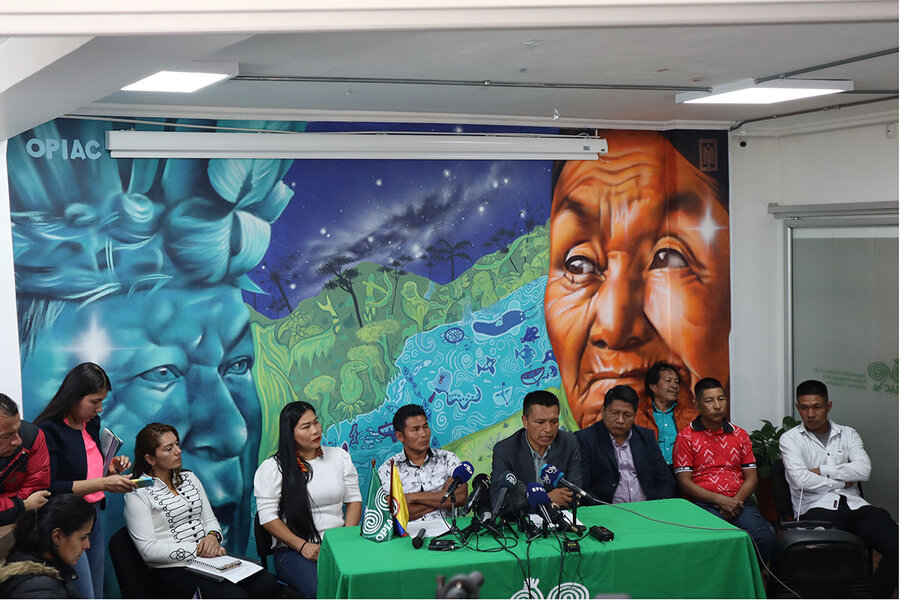
Photo: Mie Hoejris Dahl.
An indigenous leader and indigenous guards and family members of four lost children meet at the office of the National Organization of Indigenous People of the Colombian Amazon, in Bogotá, Colombia, June 15, 2023.
You may have heard about the kids who were in a plane crash in the jungle and survived largely because of their indigenous skills. Today I share a story about how an unusual collaboration among searchers led to their being found.
Mie Hoejris Dahl reports at the Christian Science Monitor, “Few things have united the Colombian population like the recent successful rescue of four young Indigenous children following a deadly plane crash – and their ability to survive alone in the jungle for 40 days.
“The story of Lesly Jacobombaire Mucutuy, Soleiny Jacobombaire Mucutuy, Tien Ranoque Mucutuy, and Cristin Ranoque Mucutuy, who ranged in age from 11 months to 13 years at the time of the crash, grabbed hearts and headlines [recently] for their incredible resilience. The plane wreck killed all three adults on board, but against great odds, the children survived alone in the jungle by tapping into ancestral education about the animals, edible plants, and survival tactics in the wild jungle.
“Their survival is an inspiration, but the saga also put a spotlight on challenges faced by Colombia’s Indigenous populations, who fight to preserve their culture amid historical marginalization. …
“A promising thread has emerged in the days since the children’s discovery, which is the unparalleled, collaborative search efforts by the Colombian military and Indigenous guards that led to their rescue in the first place.
“It has many here looking to what the future of respect and partnership might look like between the government and Indigenous communities.
“ ‘This was a lesson … to look for commonalities’ between the government and Indigenous groups, says Rufina Román, a leader in the National Organization of Indigenous People of the Colombian Amazon, a nongovernmental organization. ‘We are going to need to rely on joint action for many other issues … like climate change’ and environmental protection. …
“On May 15, two weeks after an engine failure caused a flight carrying three adults and the four children to crash in the dense Amazon jungle, rescuers found the front part of the plane stuck between trees in the southern Colombian state of Caquetá. The pilot, an Indigenous leader, and the children’s mother were found dead.
“Although the search team saw signs of life – a baby bottle, half-eaten fruit, and dirty diapers – the children were nowhere to be found.
“The Colombian government deployed search-and-rescue planes and helicopters, as well as land and river teams to the crash site. They scoured for the kids in an area of about 1,650 miles and used sound systems to play a recording of the children’s grandmother speaking in their native language, Huitoto, telling them that people were looking for them and that they should stay in one place.
“The children kept moving, some close to them speculate out of fear of who exactly was looking for them. Armed dissident guerrilla groups are a threat for many Indigenous communities in the jungle.
“But even so, the search was challenging from the start.
“ ‘It’s a very remote zone that requires special capacity,’ says Pedro Sánchez, the general who led the government search operation. Some 16 hours of rain a day, humidity, dense vegetation, and dangerous animals make the terrain hard to penetrate even for the country’s best-trained soldiers. It’s hopeless trying to see anything from the air due to tree coverage, and it’s hard from the ground, too. …
“Eventually, General Sánchez authorized Indigenous volunteers from across the country to participate in the operation: a decision that almost certainly saved the children’s lives.
“ ‘Without them, we still wouldn’t have found the kids,’ he says of the approximately 80 Indigenous volunteers.
“Working with the guard helped multiply eyes and ears on the ground, but also contributed important, deep-seated knowledge about the jungle. Spiritual knowledge, too, General Sánchez says.
“He describes the collaboration as ‘very fluid,’ which stands in contrast to the historical mistrust between Indigenous people and the government’s armed forces. Indigenous communities are often stigmatized as uneducated, violent, and out of touch with modern society. And the absence of the state in many of these remote communities, lack of public services like roads and running water or electricity, and few security measures in a region overrun by armed groups mean that many mistrust and feel abandoned by the state. …
“There’s hope that the unprecedented collaboration that took place between the armed forces and the Indigenous guard in Operation Hope, as the rescue mission was dubbed, can blaze a new path for relations between the government and Indigenous groups here.
“When the soldiers and Indigenous guards were deep in the jungle, on several occasions their technology, like GPS satellites and compasses, stopped working. ‘What do you say?’ General Sánchez asked the Indigenous guards.
“That simple question was ‘something spectacular,’ says Janer Quina, regional coordinator of the Indigenous guard in Cauca … who participated in the search. It contrasts with his experience with non-Indigenous Colombians in the past. Historical knowledge around nature, for example, is often met with skepticism from outsiders, he says. …
“In the long, emotional search, the soldiers and Indigenous guards shared food, personal questions, and survival techniques. Indigenous guards shared ancestral knowledge, like medicinal plants, while soldiers taught them to use their high-tech equipment. … What was perhaps even more surprising was the kids’ ability to survive in such precarious conditions.
“ ‘We taught them how to survive in the Amazon jungle,’ says Eliecer Muñoz, one of the Indigenous rescuers, of the education that children in many remote Indigenous communities are brought up with about plants, animals, and how to construct a shelter. …
“Thus, ‘Lesly [the 13-year-old] knew what to do,’ says Ms. Román, including which plants or insects were edible and how to care for a baby without any of the tools many Westerners rely on, like formula or a crib.’ “
More at the Monitor, here. No firewall.

 Suzanne's Mom's Blog