Feeds:
Posts
Comments

Posts Tagged ‘maasai’

Photo: Lenny Rashid Ruvaga.
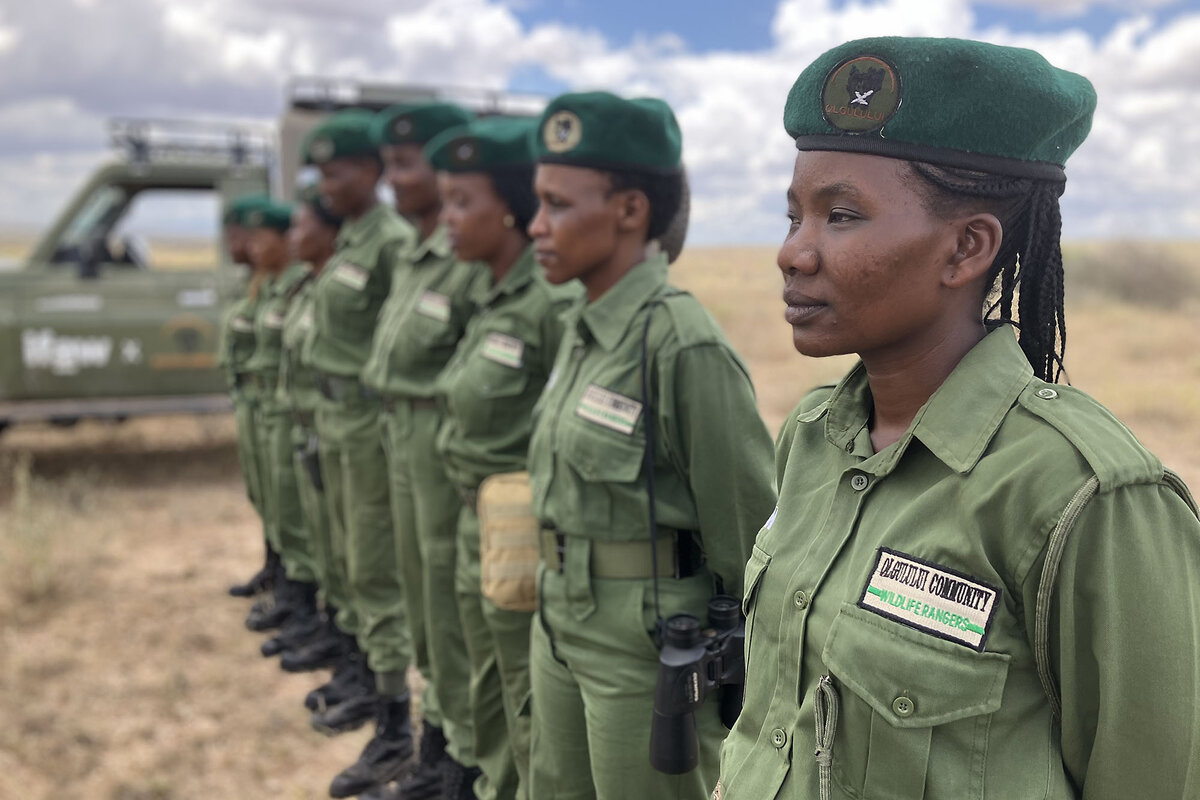
Senior Sgt. Purity Lakara (foreground) stands with members of Team Lioness at the Olgulului-Ololorashi Group Ranch. They make up Kenya’s first all-woman ranger force.

Maasai women are breaking out of traditional subservient roles, with some especially adventurous females deciding to serve as conservation rangers.

Lenny Rashid Ruvaga writes at the Christian Science Monitor, “The breakthrough was a bottle of water. For three days, wildlife ranger Everlyne Merishi had been embedded with a group of Maasai morans, or hunters. It was mid-2023, and they were searching for lions that had killed several of their cattle near this national park at the foot of Mount Kilimanjaro. For the Maasai, cows are sacred and considered members of their families. The men wanted vengeance. 

“Mrs. Merishi understood that feeling, because she is Maasai herself. That is also why she was convinced there could be a less destructive solution. 

“The group had already walked about 25 miles that day when members stopped, exhausted, for a break. Mrs. Merishi and her team began to pass around bottles of water. As the hunters drank, their faces softened and they mustered weak smiles. 

“Mrs. Merishi remembers walking over to a group where one of the leaders sat. ‘I told them that I understood their pain and that an injustice had occurred, but I promised that we would ensure that the authorities would relocate these two lions,’ she says. 

“Mrs. Merishi is part of an all-woman ranger unit working on Maasai lands near Amboseli National Park in southern Kenya. That’s rare: Globally, women account for only 3% to 11% of all park rangers. Team Lioness, as the Kenyan unit is known, was formed in 2019, part of a worldwide movement to increase those numbers. 

“These efforts are important, experts say, because they challenge stereotypes – but also because they help conservation efforts reach a wider audience. In the Amboseli area, for instance, the Lionesses have been particularly effective among the ranger teams at connecting with locals like the Maasai. 

“ ‘It’s astonishing to see the incredibly positive ripple effect of employing women from local communities and the benefits on their lives and their communities at large,’ says Holly Budge, the founder of World Female Ranger Week and a longtime advocate for women in wildlife protection. …

“The commander of Team Lioness, Sgt. Purity Lakara, has dreamed of this life since she was a child. 

“She grew up in a Maasai village approximately 30 miles from here. Her community placed heavy value on living in harmony with both animals and nature. And when she saw wildlife rangers patrolling the area, she was awed by the sense of authority they projected. There was one problem though: ‘They were all men,’ she says. 

“Meanwhile, girls like her were expected to get married young and settle into a domestic life. … But Mrs. Lakara’s parents were determined that she should get an education, and her timing was fortuitous. 

“In 2013, Africa’s first all-woman ranger unit, the Black Mambas, was formed in South Africa, and others soon followed in countries such as Zimbabwe and Congo. Supporters of the trend argued that women were more approachable and were able to communicate more easily with other women in the communities where they worked.  

“The idea to form an all-woman ranger team in Amboseli came up in 2019. It was the brainchild of a female Maasai elder named Kirayian Katamboi and the International Fund for Animal Welfare, a global charity. 

“At the time, Mrs. Lakara had just finished high school. When village elders called a meeting to pitch the new ranger unit, ‘my heart leapt for joy,’ she says. She became one of its founding members.

“Today, Team Lioness is made up of 17 women, each of whom has completed a three-month training in ecology, first aid, and ‘bushcraft’ – or the art of talking to people about conservation. They live for stretches of 21 days at a simple base camp with concrete floors and a sheet iron roof in the Olgulului-Ololorashi Group Ranch, as the Maasai land surrounding Amboseli National Park is known. 

“Each morning, the rangers patrol the surrounding area on foot, walking about 12 miles as they look for signs of poaching and survey the wildlife in the area.  The women are also responsible for managing occasional conflicts between locals and the animals, which usually flare up when lions or cheetahs from Amboseli cross into Maasai villages and kill cattle. 

“In the past, these situations often led to tensions between park rangers, who didn’t take kindly to attempts to kill the offending wildlife, and communities, who often felt authorities wanted to protect animals but didn’t care about the people they harmed. 

“However, the honest communication style of Team Lioness and other ranger units from Maasai communities has helped gain trust. They explain the law and people’s rights – like their right to be compensated for cattle killed by big cats from the park. …

“The rangers also give back to the community in other ways. In April 2022, they started a school outreach program where they hope to inspire students – particularly girls – to stay in school and pursue careers in conservation. 

“ ‘I beam with joy when I hear the students say, “I want to be like Ranger Lakara or Ranger Merishi,” ‘ Mrs. Lakara says. ‘It means that they see us as role models.’”

More at the Monitor, here.

Read Full Post »

People from the Maasai community, one of the oldest tribes in East Africa, live in a semi-nomadic state and have had to go to the UN to try to preserve a pastoral way of life.

I love reading about other cultures. Today’s article is about Maasai people living in Tanzania. It is unfortunately a worrisome story, the only upbeat aspect being that forums exist where indigenous people can fight for rights and that they are starting to use those resources.

Joseph Lee’s Grist article was reprinted at Salon.

“In Tanzania, the Indigenous Maasai face an ongoing, violent campaign to evict them from their lands and make way for protected conservation areas and hunting reserves. [In April, several were] in New York to ask the U.N. Permanent Forum on Indigenous Issues, or UNPFII, to tell Tanzania to stop taking their cattle, remove its security forces, establish a commission to investigate disputed lands and displaced people, and allow international human rights monitors to visit without restrictions. 

” ‘We, the Maasai people of Loliondo and Ngorongoro in Tanzania, are fighting against the Tanzanian government and wildlife trophy hunters who are threatening our livelihood, culture, ancestral wisdom, legacy, and basic human rights,’ Edward Porokwa, executive director of the Pastoralists Indigenous Non Governmental Organization’s Forum, said. …

“The Maasai land conflict in Tanzania is focused on two main areas: the Ngorongoro Conservation Area and Loliondo. The Ngorongoro Conservation Area is a UNESCO World Heritage Site that attracts over half a million visitors every year for safaris to see the park’s ‘Big 5’ game — elephants, lions, leopards, buffalo, and rhinoceros. Around 80,000 Indigenous Maasai call the park home, but have faced decades of government efforts to push them off their land.

“In a statement delivered at the Permanent Forum, Porokwa said that, since June 2022, the government has closed four nursery schools, nine water sources, and six mobile health clinics. The government says that Maasai are voluntarily leaving the area for resettlement sites, but the Maasai say that they are essentially being forced out. ‘It is a forceful relocation by ensuring that people don’t get the basics,’ Porokwa said. ‘They are there to die.’ 

“And in Loliondo, which is legally demarcated Maasai village land, state security forces shot at Maasai in a violent campaign to drive them from their lands [in June 2022]. In the attack, dozens of Maasai were injured and many fled across the nearby border to Kenya for medical attention. At least two dozen others were arrested, while some were not permitted to leave their homes. 

“[Nine] United Nations experts raised concern about forced evictions and resettlement plans, but the Maasai representatives at the United Nations say that the government has not changed its approach. … Tanzania has taken or killed over 600,000 of their cows and demanded over $2.5 million in fines for grazing. This is all part of what Maasai say is a massive campaign to destroy their pastoralist way of life. 

“At the Permanent Forum, a representative from the Tanzanian government pushed back on the Maasai’s claims, pointing to the East African Court of Justice’s 2022 dismissal of an eviction case brought by the Maasai, stating that the Maasai could not prove their claims about violent evictions. …

“In January, the African Commission on Human and Peoples’ Rights conducted a monitoring visit to investigate the situation. But Maasai community organizations say that at every step, the visit was controlled by the government. Commission representatives were shepherded around by state security forces who intimidated Maasai and excluded them from some meetings. Some Maasai waited for hours to speak with the Commission, only for them to never show up. While the Commission’s final report on the visit did express concern about the situation, it also commended Tanzania’s commitment to protecting human rights. The Commission also recommended starting new consultations with the Maasai, as well as addressing their concerns about the resettlement program. 

“In December, José Francisco Calí Tzay, the United Nations Special Rapporteur on the rights of indigenous peoples was scheduled for a week-long visit to Tanzania, but the visit was indefinitely postponed. Maasai leaders believe that the visit was scuttled out of concern that the Special Rapporteur would not be given full access to investigate. …

“With few options remaining, the Maasai have turned to the Permanent Forum to raise their concerns. Briane Keane is the director of Land is Life, an international organization that works with Indigenous peoples, including providing travel funding, medical assistance, and security assessments to the Maasai. Keane says that the United Nations is an important platform for the Maasai. ‘It’s a place where they can be heard. The government of Tanzania is not listening,’ he said. 

“The Maasai hope that international pressure may convince the government to finally listen to their concerns. But speaking out on the international level also comes with risks for the Maasai. Several leaders who spoke out against government abuses were forced to flee the country for their safety

” ‘Indigenous peoples are the most among the most criminalized peoples of the world,’ said Keane. ‘There’s people being thrown in jail. There are threats. So it’s very dangerous work sticking up for your rights when you’re as marginalized as the Maasai are in Tanzania.’ “

Man, if your gripe is against the government, you really don’t want the government’s security forces leading the tour for the human rights inspectors! That should be a given. More at Grist, here. No firewall.

Read Full Post »

Not everyone can be an inventor, but inventors can be found everywhere.

“Richard Turere, 13, doesn’t like lions. In fact, he hates them. Yet this bright Maasai boy has devised an innovative solution that’s helping the survival of these magnificent beasts — by keeping them away from humans.

“Living on the edge of Nairobi National Park, in Kenya, Turere first became responsible for herding and safeguarding his family’s cattle when he was just nine. But often, his valuable livestock would be raided by the lions roaming the park’s sweet savannah grasses, leaving him to count the losses. …

“So, at the age of 11, Turere decided it was time to find a way of protecting his family’s cows, goats and sheep from falling prey to hungry lions …

” ‘One day, when I was walking around,’ he says, ‘I discovered that the lions were scared of the moving light.’

“Turere realized that lions were afraid of venturing near the farm’s stockade when someone was walking around with a flashlight. He put his young mind to work and a few weeks later he’d come up with an innovative, simple and low-cost system to scare the predators away.

“He fitted a series of flashing LED bulbs onto poles around the livestock enclosure, facing outward. The lights were wired to a box with switches and to an old car battery powered by a solar panel.

“They were designed to flicker on and off intermittently, thus tricking the lions into believing that someone was moving around carrying a flashlight.

“And it worked. Since Turere rigged up his ‘Lion Lights,’ his family has not lost any livestock to the wild beasts, to the great delight of his father and astonishment of his neighbors.

“What’s even more impressive is that Turere devised and installed the whole system by himself, without ever receiving any training in electronics or engineering. …

Paula Kahumbu, executive director of the Kenya Land Conservation Trust …  helped him get a scholarship at Brookhouse International School, one of Kenya’s top educational institutions, where he started last April. …

” ‘One thing that’s unique about Richard is that if you give him a problem, he’ll keep working at it until he can fix it. [He] doesn’t give up; he doesn’t find things too difficult; he’s not afraid of being unable to do something and I think this is why he is such a good innovator — because he’s not worried that it might not work, he’s going to try and do it anyway.’ ”

More here. And you can catch Richard’s TED Talk here. (Yes, he got on TED Talk!)

Photo: CNN

Read Full Post »