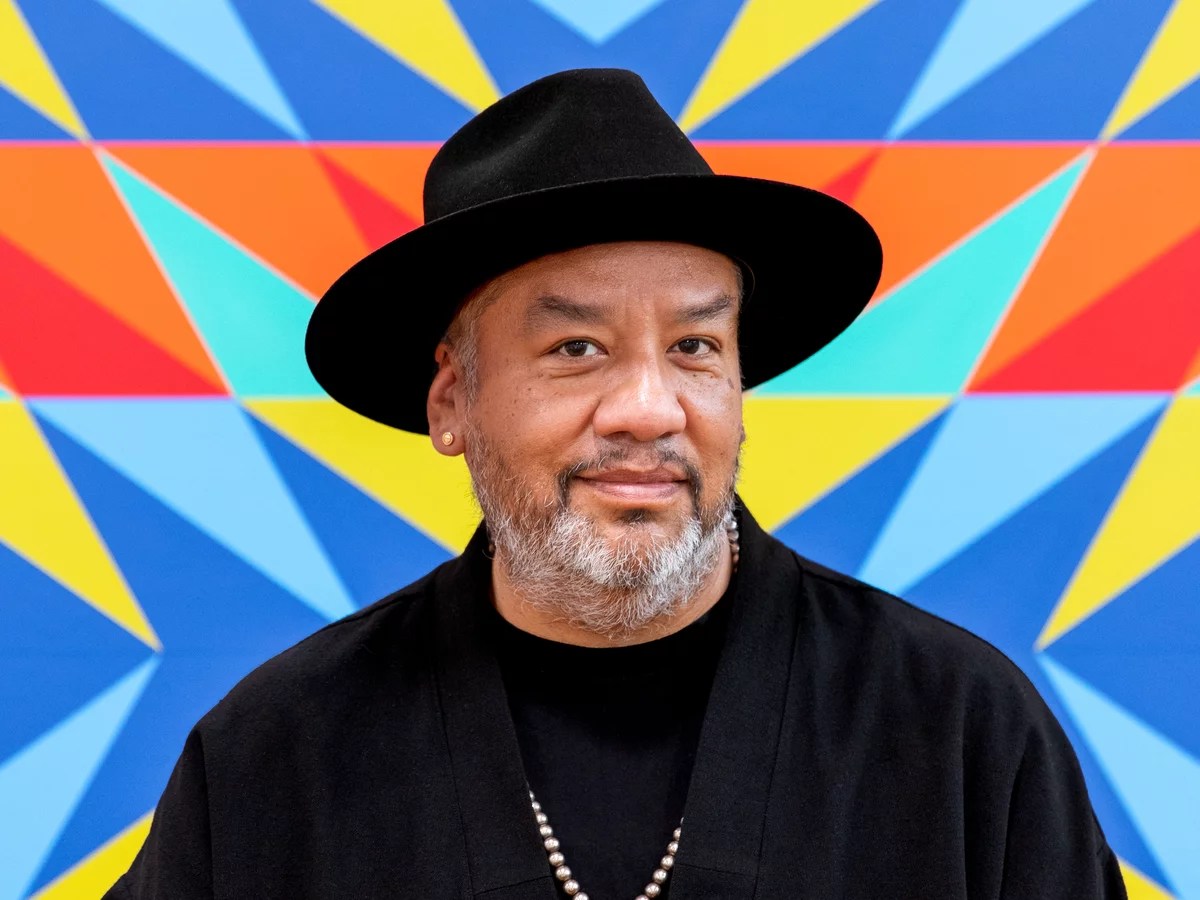
Photo: Brian Barlow.
Artist Jeffrey Gibson will represent the U.S. at the Venice Biennale in 2024, the first Indigenous artist to have a solo exhibition in the U.S Pavilion at the international art event.
One doesn’t think of State Department functionaries as knowing who in the US art community would be best to represent the country in an international exhibition, but if they tap knowledgable consultants and look at recipients of MacArthur “genius” grants, that should help them decide.
Chloe Veltman writes at National Public Radio (NPR), “The U.S. State Department has selected an Indigenous artist to represent the country at the 2024 Venice Biennale.
“Jeffrey Gibson, a member of the Mississippi Band of Choctaw Indians and of Cherokee descent, will be the first such artist to have a solo exhibition in the U.S. Pavilion at the prestigious international arts event.
“That’s according to a statement this week from the U.S. Department of State’s Bureau of Educational and Cultural Affairs, the government body responsible for co-curating the U.S. Pavilion, alongside Oregon’s Portland Art Museum and SITE Santa Fe in New Mexico. …
“The last time Indigenous artists appeared in the U.S. Pavilion at the Biennale was in 1932 — and that was in a group setting, as part of a mostly Eurocentric exhibition devoted to depictions of the American West. …
“Said Kathleen Ash-Milby, curator of Native American Art at the Portland Art Museum, and one of the co-commissioners of Jeffrey Gibson’s work in the U.S. Pavilion at the Venice Biennale, ‘It grouped native people together and didn’t really focus on their individuality as much. There were Navajo rugs on the floor. There were displays of jewelry. Many of the artists were not named.’
“Ash-Milby, who is also the first Native American curator to co-commission and co-curate an exhibition for the U.S. Pavilion at the Venice Biennale, told NPR her team selected Gibson because of the artist’s wide-ranging, inclusive and critical approach to art-making.
” ‘His work is multifaceted. It incorporates all sorts of different types of media,’ the curator, a member of the Navajo Nation, said. ‘But to me, what’s most important is his ability to connect with both his culture and different communities, and bring people together. At the same time, he has a very critical lens through which he looks at our history as Americans and as world citizens. Pulling all those things together in the practice of an American artist is really important for someone who’s going to represent us on a world stage.’
“Born in Colorado and based in New York, Gibson, 51, focuses on making work that fuses together American, Native American and queer perspectives. In a 2019 interview with Here and Now, Gibson said … ‘There’s this gap historically about these histories existing on the same level and being valued culturally. … My goal is to force them into the contemporary canon of what’s considered important.’
“A MacArthur ‘Genius’ Grant winner, Gibson has had his work widely exhibited around the country. Major solo exhibitions include one at the Portland Art Museum last year and, in 2013, at Boston’s Institute of Contemporary Art. His work is in the collections of high-profile institutions like the Museum of Modern Art in New York, the San Francisco Museum of Modern Art and the National Gallery of Art. Gibson participated in the 2019 Whitney Biennial. …
“The details of Gibson’s contribution for the 2024 Biennale are mostly under wraps. Curator Ash-Milby said the artist is working on a multimedia installation with the title ‘the space in which to place me’ — a reference to a poem by the Lakota poet Layli Long Soldier.”
Check out his art at NPR, here. No paywall.
See also Mark Trecka’s comments on poet Long Soldier at the Los Angeles Review of Books: “In ‘Three,’ Long Soldier writes: ‘This is how you see me the space in which to place me / The space in me you see is this place / To see this space see how you place me in you / This is how to place you in the space in which to see.’ The lines of this poem form a box on the page, in which the negative space is the center of attention.”

 Suzanne's Mom's Blog