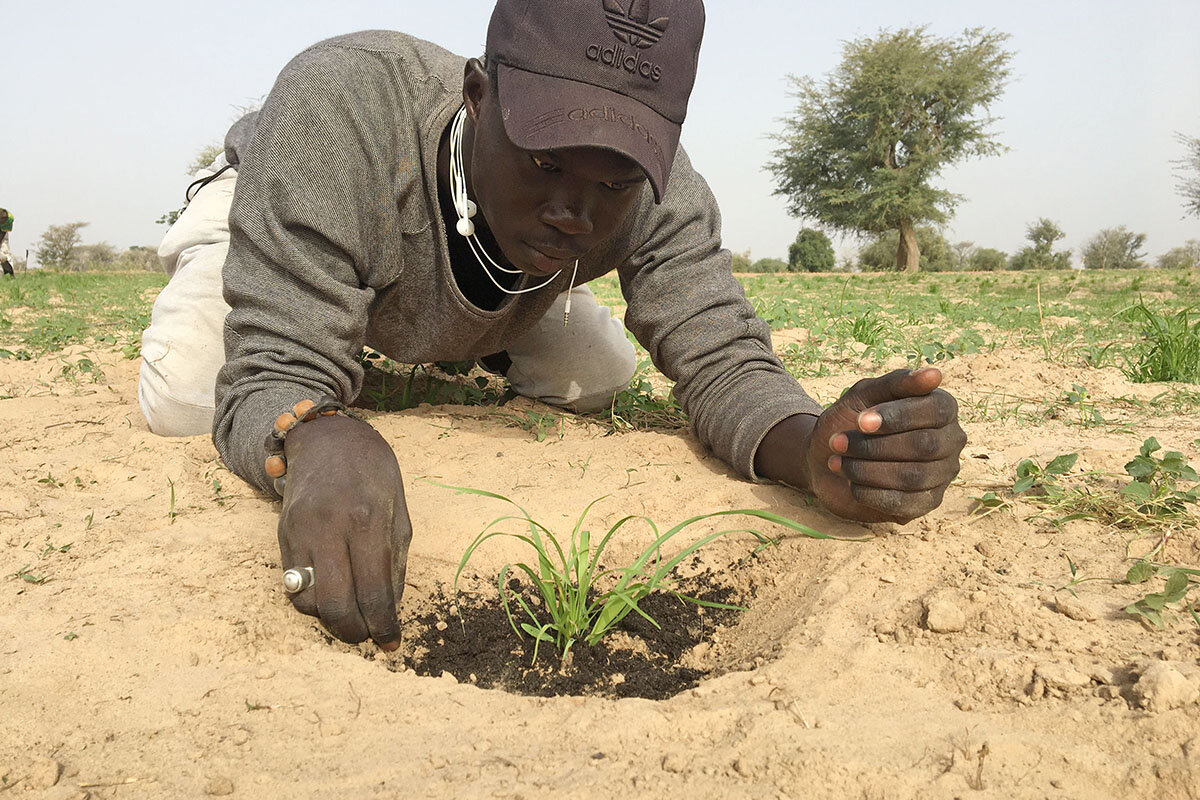
Photo: Jack Thompson.
From the Christian Science Monitor: “Farmers in Ndiob, Senegal, are experimenting with ‘zaï’ planting pits, an ancient practice to conserve moisture even during acute droughts.”
With climate change and drought in Africa affecting crop yields, some farmers are adopting ancient techniques for conserving water.
Jack Thompson writes at the Christian Science Monitor, “Rain is like alchemy for farmer Thialla Badiane in the Sahel region of Senegal. Suddenly, it transforms dusty dunes into rich verdure, barren plains into crop-laden fields.
“But rain is increasingly scarce here on the edge of the Sahara desert. Temperatures are rising by 50% more than the global average and threatening Mr. Badiane’s most precious resource to feed himself and his seven children.
“Annual rainfall could drop by 38% in Senegal in the coming decades, a threat to the way of life for the nation’s 8 million farmers. Already the growing climate emergency means rainfall has become more unpredictable, water scarcer, and droughts longer.
“So in Mr. Badiane’s hometown of Ndiob, hundreds of farmers seeking to combat those effects have revived an ancient farming technique – with a 21st-century twist. ,,,
“Mr. Badiane [drills] repeatedly into the thick crust of the earth with a giant motor-powered corkscrew, leaving a pattern of perfectly spaced holes. In one hectare, he will drill 10,000 holes for his millet seeds, a planting technique known as zaï.
“Originally from neighboring Burkina Faso, zaï is the traditional technique of making small indentations in the ground that capture rainfall and increase the fertility of the soil. It’s painstaking work, but a lot easier than digging the holes by hand with a hoe. …
“Millet has been making waves on the international stage … because the crop can grow on arid land, can survive extreme heat, and is high in protein and micronutrients.
“And with his modern take on an ancient practice, Mr. Badiane has increased his yield of millet by 50% – though research shows zaï can triple production. If it were to become widespread, this Indigenous technique could help farmers become more resilient to a changing climate. …
Zaï combats [water runoff] by creating pockets for the water, making sure it doesn’t run off and take nutrients and minerals with it.
“This is the ambition of Ndiob’s Mayor Oumar Ba, renowned in Senegal for his commitment to agroecology, a form of sustainable farming based on millennia of Indigenous knowledge and innovation. …
“Across the continent, many officials, scientists, and ordinary citizens are already looking to adapt. Faced with increasingly unpredictable weather in Ndiob, Mr. Ba traveled to Burkina Faso, a landlocked nation that gets even less rain than Senegal, to search for ways to beat intensifying drought. Four years ago, he brought back zaï.
“ ‘Before, it used to rain consistently for five months; it would start in June and end in November,’ says the mayor’s agricultural advisor, Mame Kor Faye. ‘Now, not one farmer can tell you when the season will start.’ …
“Drought is a vicious circle for farmers: As rainfall decreases, the soil compresses. When it finally does rain, the dehydrated, packed land cannot absorb the water and the top layer of fertile topsoil washes away. … ‘Zaï is a solution to this scarcity of water and to restore the fertility of our soils,’ Mr. Faye says.
“For Mr. Badiane, the planting plots are a double win. Under the burning November sun, he bends over each small pit and delicately places a handful of rich, dark fertilizer. It’s a far smaller amount than he used when he composted his entire field.
“Prices of fertilizer have skyrocketed since Russia, the world’s top exporter, invaded Ukraine and supplies were squeezed. Since then, animal manure, an alternative to chemical fertilizer, has been in short supply.
“ ‘The reason zaï interested me is because I wanted to save on organic manure,’ Mr. Badiane says. ‘Before, you didn’t have to pay for manure – livestock herders would give it to you. Now it’s hard to find, and you have to pay.’
“ ‘When the rain falls on the manure, it retains the humidity that the plant needs,’ says Isidore Diouff, an agronomist from the Senegalese nongovernmental organization Enda Pronat and who has been leading the zaï experiments in Ndiob. He kneels down to inspect a newly planted seed in its pit. ‘You can go 20 days without rain, and the pit will still be damp.’
” ‘Four months later, Mr. Badiane admires his ready-to-be-harvested, fingerlike plants. Nurtured by the moist soil, their soaring leaves tower over the 6-foot-tall farmer. Assessing the plant’s density and weight, Mr. Badiane predicts a good yield.”
More at the Monitor, here. No firewall. Subscriptions encouraged.

 Suzanne's Mom's Blog