Feeds:
Posts
Comments

Posts Tagged ‘mark morris’

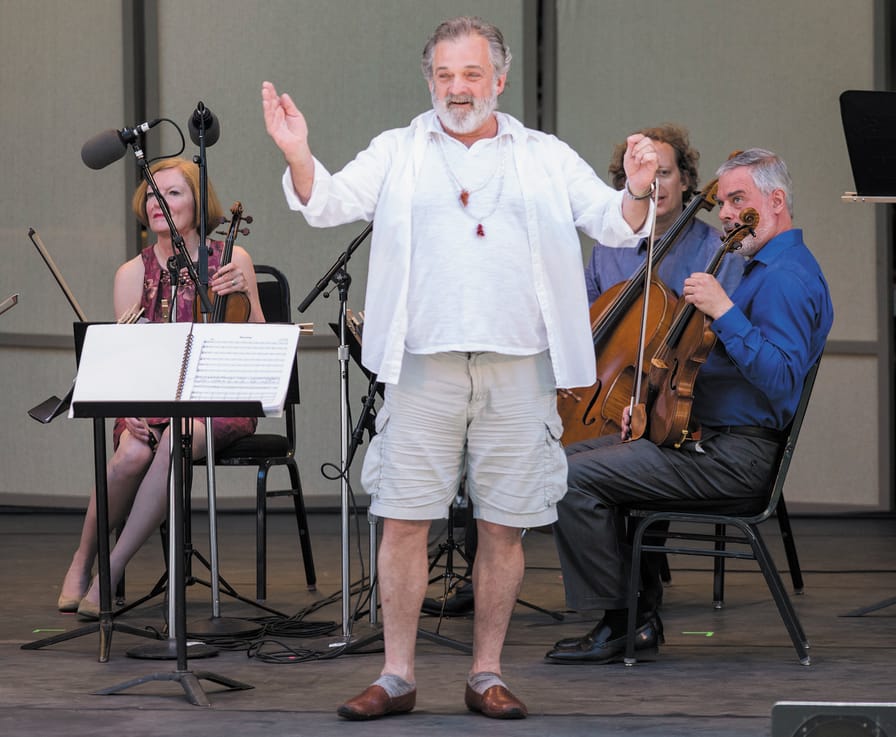
Photo: The Nation.
Choreographer Mark Morris at the Ojai Music Festival.

Many people know Mark Morris as a great choreographer, but much of his success has depended on his devotion to teaching his dancers.

Alastair Macaulay wrote recently about this side of Morris at the New York Times. “New York City has often been called the world’s dance capital. One good reason is that a number of the world’s foremost choreographers not only lived and worked in New York, but also taught class here. Martha Graham, George Balanchine, Merce Cunningham and many others helped to lure dancers to the city.

“Fewer and fewer of today’s top dance-makers carry on that tradition. The foremost exception is Mark Morris. … While there have been seasons when his choreographic inspiration has dipped, his performers have almost invariably looked wonderful. This is a tribute to how he and his teaching colleagues prepare them each day.

“The dancers don’t present themselves as virtuosos. And they’re all such distinct individuals — each exuding what seems natural — that it’s easy to make the mistake of thinking they don’t share training. But it’s precisely their schooling with Morris, whose company, the Mark Morris Dance Group, was established in 1980, that makes them look so natural.

“ ‘I first taught when I was 13 — Spanish sevillanas — and first taught ballet in my later teens,’ Morris, 66, said in an interview at the Union Square Cafe. ‘As an adult, I used to teach modern or jazz or ballet. I would take class all over the city, which is how I met so many fabulous people: We were all dancing together. And when I gave workshops, I’d ask the most talented people to come back and be in my next piece.’ …

“ ‘It’s just the last year or two I’ve cut back,’ he said. He now shares teaching assignments with company alumni. Surprisingly, for a modern-dance master, he teaches a ballet class, with a live pianist. The dancers start by standing at the barre, bringing more and more parts of the body into play with each exercise. Then, after about 40 minutes, they work without support in the center of the room. Finally they move expansively across the room, in phrases involving turns and jumps.

“It’s ballet — though with a difference or two. Like other modern-dance choreographers (he particularly credits Hannah Kahn), Morris will sometimes ask his dancers to articulate and bend the spine in ways largely foreign to ballet — they alternate convex and concave shapes of the spine at the barre — and to phrase in irregular counts. And there’s no work on pointe: the dancers are barefoot or in socks or soft shoes. …

“The Morris class is ‘a very pure form of ballet that strives to be stripped of its affectations,’ Billy Smith, a dancer who joined the company in 2010, wrote in an email. ‘We do use our torsos in a more “modern” way than maybe a ballet company would in class. But at the core our classes are very much oriented toward the purity of ballet technique.’ …

“Morris, an invariably entertaining talker, speaks exuberantly to his dancers, between exercises — about what’s on television, about an unmissable Broadway show (and about the long lines for the ladies room in Broadway theaters), about New York traffic gridlock, about Olive Oyl. But this spiel isn’t just a one-way Morris event: He wants his dancers to be people with lives and interests, not just dance executants, and he enjoys their repartee. …

“Sam Black, who became a full-time Morris dancer in 2005 and is now the company director sharing the teaching assignments, will give his stage farewell during the Joyce season. In an interview at the Mark Morris Dance Center in Brooklyn in July, he recalled how he used to stretch his arms too straight upward in certain positions. Morris would say, ‘You only have three joints in your arm. You have to make a curve with only three joints. That takes imagination.’

“Many dancers have remained with the company more than 10 years, their longevity in part attributable to Morris’s growing concern with anatomical efficiency. …

“It was not until 1988, when the Morris dancers moved for three years to Brussels to become the resident company at the Théâtre Royale de la Monnaie, that he began to teach them a daily ballet class. That was when Megan Williams, now a ballet teacher, joined. She remembers that, in class, he enjoyed giving them one exercise for footwork and one for the upper body.

“ ‘He would show us the feet pattern, and then the port de bras pattern — separately!’ she said. ‘We had to put them together like a puzzle. It was almost impossible, like that exercise of rubbing your stomach and patting your head at the same time.’ “

More at the Times, here.
Read Full Post »

harss_plainspoken_img_0

Photo: Timothy Norris
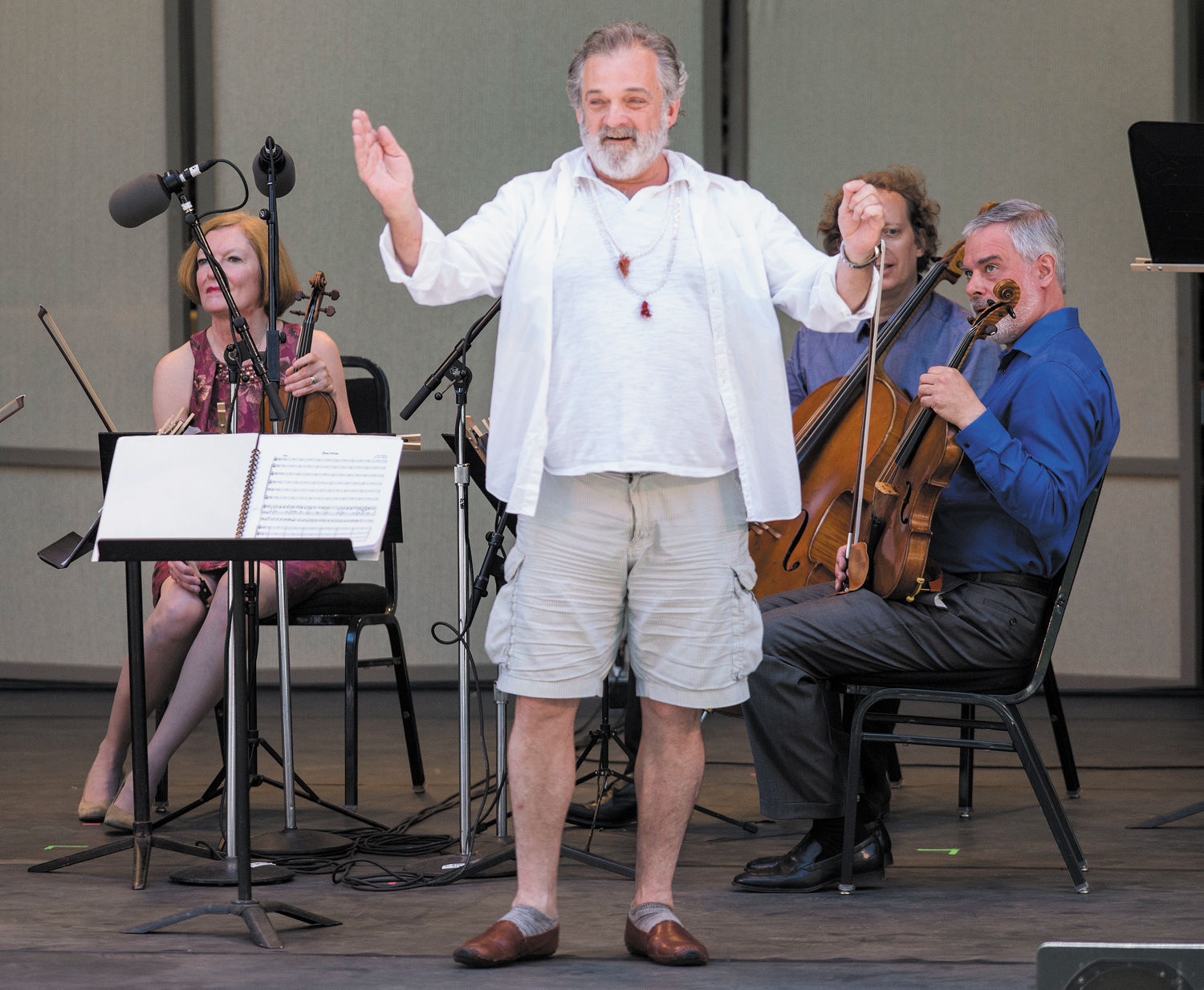
Choreographer Mark Morris is currently learning to make films remotely with his dancers. Above, he leads audience members in a sing-along at California’s Ojai Music Festival in June 2013. The image is from an article in the
Nation.

As we all try to learn new technologies to continue valued activities under social distancing, I’m noticing that some technologies turn out to be pretty hopeless while others will be a good addition to our repertoire. Figuring out why my sound system’s feedback was disrupting an ESL teacher’s online class wasn’t worth repeated failures. I contribute to the teaching other ways. But basic features of Google Classroom, WhatsApp, Skype, and FaceTime have been great. Those are keepers.

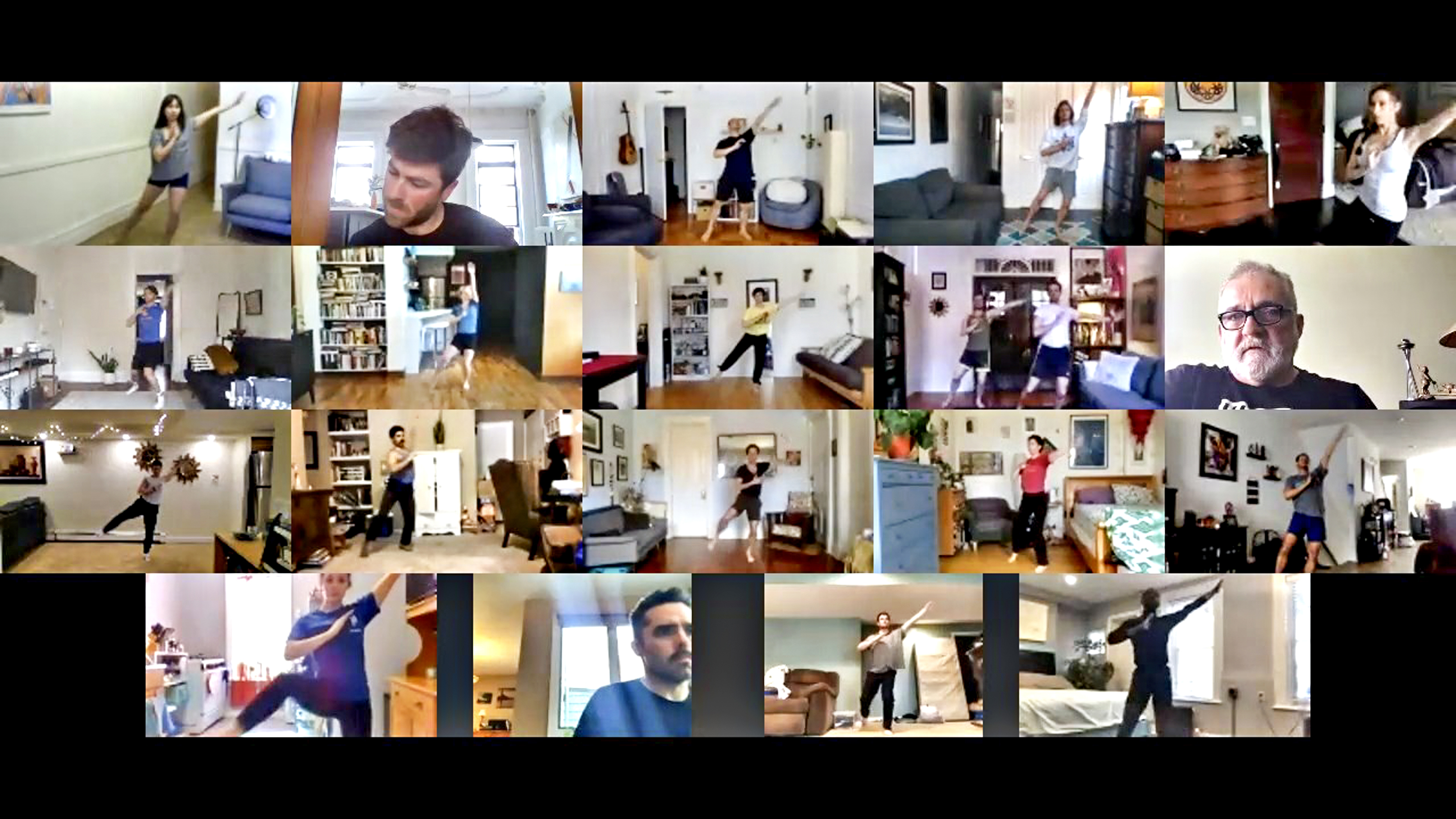
In an example from the dance world, choreographer Mark Morris is teaching himself to make films with his quarantined dancers.

Sarah L. Kaufman writes at the Washington Post, “Choreographer Mark Morris says to his dancers. ‘Go as far away as you can in your room.’

“Morris, in a black T-shirt and a string of beads, peers through his reading glasses at his computer screen. Arranged around his own image in rows of little boxes he can see who’s on this recent videoconference call: his rehearsal director, music director and three Mark Morris Dance Group performers.

“Stuck at home like everyone else in New York, the dancers jog backward, past couches, beds and bookshelves, to the rear walls of their apartments. … It’s all he and his performers have to work with.

“Choreography in the age of covid-19 is hardly a graceful undertaking. Morris, the esteemed modern-dance artist whose company has performed to acclaim for more than 40 years, suddenly finds himself out of place in a world of seclusion. His profession depends on working closely with people, getting them to move exactly as he wants. But he’s determined to keep creating. No matter that the city’s quarantine makes gathering in a rehearsal studio impossible.

‘Now, let’s dance a little bit,’ he says. ‘Foot articulation is not important ’cause I don’t see that. What’s more interesting is swooshing’ — he swirls his hand in a serpentine movement — ‘and depth changing.’ …

“The three dancers in their separate squares whirl and glide into view with a smooth, floating quality, winding side to side as if drifting on wind currents. In his chair, Morris echoes their moves with his upper body, lifting his arms as they do. He gasps, he gapes. He sucks in a breath and runs a hand over his hair. Suddenly he waves frantically at the screen.

“ ‘Stop, stop!’ He grabs his head in his hands and pitches backward in his chair. Something has bowled him over — but what? Anguish, despair? Has he been horrified into silence by what he’s seen?

“The dancers wait, breathing hard. Finally the choreographer snaps himself upright.

” ‘That was great!’ he shouts, beaming.

“He adjusts his glasses and adopts a lilting Italian accent: ‘I feel like-a Federico Fellini.’

“That captures this weird, tilted reality perfectly. There is a certain hallucinatory, Fellini-esque quality to this scene, where a giant of the dance world struggles to master the same awkward video technology that remote office workers are using to teleconference. And where top dancers are limited to a few feet of floor space and bad lighting, using bathroom doors as stage wings. …

“Morris has retooled himself as a filmmaker. He began working on this dance last fall, devising the movements in his company’s spacious Brooklyn headquarters with a pianist and 15 dancers. He was nearly finished before shuttering the building last month. …

” ‘My job is irrelevant, if not obsolete,’ Morris says in a phone interview. … ‘The truth is,’ he continues, ‘I’m not making up a dance. I’m making a film. But I’m not an auteur, I don’t understand this technology.’ …

“The dancers have been taking company class every day on Zoom, and having weekly Zoom singing sessions and happy hours. But rehearsing with Morris — even with his tendency to tease them about their unmade beds — fulfills a deep-seated need. Gazing into his virtual studio, Morris appears to be comfortably in his element, scanning each face, each body, picking up every move and gesture, editing freely. No one escapes his focus.

” ‘Can you exit stage left or stage right?’ Morris asks the group. Christina Sahaida and Laurel Lynch slip out of view through nearby doorways, then simultaneously strut back in like Ziegfeld showgirls.

“ ‘Oh, my God,’ he exclaims, delighted. He leans in, like a scientist studying specimens under glass. …

“ ‘There will be more dance products coming from me,’ Morris says later. … ‘When I’m done with this I’ll start something else. Even though it’s not my medium.’ ”

More here. (There’s a firewall at the Post, but you can get a free subscription for a short period of time.)

Photo: Mark Morris Dance Group

DANCE-MORRIS

Read Full Post »


Photo: Sara Krulwich/NYT

Everyone is beautiful in the ballet.”

The truth of that line is being demonstrated over and over again at English National Ballet — not just onstage but in classes for Parkinson’s patients.

According to the website Ballet.org, “Dance for Parkinson’s extends opportunities for people with Parkinson’s, their carers, friends and family members to engage in artistic dance activity inspired by the repertoire and within the professional environment of the dance studio.

“Regular weekly classes in London are based at our studios in Kensington. Our programme provides an insight into the way a production is put together with opportunities to meet our dancers and musicians, see rehearsals and English National Ballet performances.

The ballet did make me urgently want to move more, and move better and hinted at how this might be possible. – Participant, Dance for Parkinson’s London …

English National Ballet is proud to be part of the Mark Morris Dance Group Dance for PD membership programme and the Dance for Parkinson’s UK.” More at Ballet.org/uk.

The initiative receives significant support from the P H Holt Charitable Trust, D’Oyly Carte Foundation and Paul Hamlyn Foundation.

Read Full Post »