Feeds:
Posts
Comments

Posts Tagged ‘parkinson’s’

Photo: Senior Swans.
The cognitive challenges of dancing ballet can help people stave off dementia.

In my retirement community, there are lots of exercise classes, and they all have something in common. They meet the needs of seniors. They may include a special exercise to keep the psoas muscle healthy so seniors don’t start shuffling when they walk. They may wake up the brain with exercises like reaching with the right arm at the same time as the left leg. Other communities use ballet, a discipline thought to be especially beneficial in the fight against dementia.

Emily Goligoski, a reporter at Harper’s Bazaar who worries about the history of dementia in her family, wrote recently about taking a Balletcore class.

She wrote, “Our instructor, dancer and choreographer Angela Trimbur ,,, tells me, ‘Whether someone remembers every step is honestly less important to me than the fact that they’re building new neuron pathways and challenging familiar patterns to shift gears. … When we’re learning choreography, we’re asking the brain to do so many things at once: remember sequences, process music, coordinate movement, adapt when we make mistakes, and stay present with other people in the room. It’s a perfect puzzle for keeping the mind fresh.’

“My intention is not to improve endurance or lower-body strength. I’m returning to the discipline to stave off the dementia that runs in my family. Seeing my paternal grandfather’s decline and considering my dementia predisposition give me anxiety, sadness, and fear of future helplessness. But being in the studio brings feelings of possibility and challenge. Could going back to ballet be the ultimate offset?

“Dementia is an umbrella term for a group of chronic neurological conditions, the most common cause being Alzheimer’s disease. For people with dementia, memory, language, problem-solving, and other coordination skills deteriorate. As a partial prevention mechanism, some people pick up crossword puzzles. I have chosen to put on ballet slippers. Dance hits on a few components — replication, recall, and creation — that make it especially relevant for preventing cognitive aging. ,,,

“I find that the coaching and collective workshopping that regular barre and floorwork classes offer is exactly the scaffolding I crave. Catalina Jackson-Urueña, the director of the Dancing Through Parkinson’s program at Invertigo Dance Theatre in Los Angeles, explains that ballet technique is among the most codified in the world of dance. ‘There’s the standard positions. There’s alignment. It’s very specific. … Jackson-Urueña’s family also has a history of neurological conditions, both Parkinson’s and Alzheimer’s, which In ballet class, I know what to expect: first, pliés, then tendus — something I’ve been doing my whole life. There’s comfort there, but it’s also challenging.’ The structure of specific components of each class (barre work is followed by stretching and sequences in the center of the class, then jumps) warm up the body and mind while offering variety that keeps dancers alert.

“Trimbur adds, ‘The people who seem most vibrant as they age don’t just keep exercising. They keep learning. They keep living in surprise. That’s what I love about choreography. It’s not repetition in the traditional fitness sense. Every week, you’re being asked to create a new map.’ …

“Lisa Mosconi, director of the Women’s Brain Initiative and Alzheimer’s Prevention Program at Weill Cornell Medicine, explains this from a neuroscience perspective: ‘Novel movement is not simply exercise. It’s exercise plus learning. And that combination appears especially powerful for maintaining brain health as we age.’

“Trimbur sees the importance of novel movement too. ‘What I’ve noticed is that many of us move through life using a surprisingly small vocabulary of movement,’ she says. ‘Dance interrupts that. It asks you to cross your body differently, change direction unexpectedly, blow around like a tree in the wind, embody different characters, respond to rhythms you wouldn’t normally choose.’

“David Leventhal, one of the founding teachers of Mark Morris Dance Group’s Dance for PD [Parkinson’s Disease] program and its current director, sees benefit for professional dancers and people with neurodegenerative disease diagnoses alike. ‘Regardless of whether you’re dancing eight hours a day or one hour a week, it’s first and foremost a mindful activity. And it’s one of the best ways that we can integrate all of our sensory awareness along with a physical awareness and physical execution.’ The neural pathways that develop out of new experiences force brain adaptation — also known as neuroplasticity — that can slow down symptom progression.”

More at Harper’s, here.
Read Full Post »

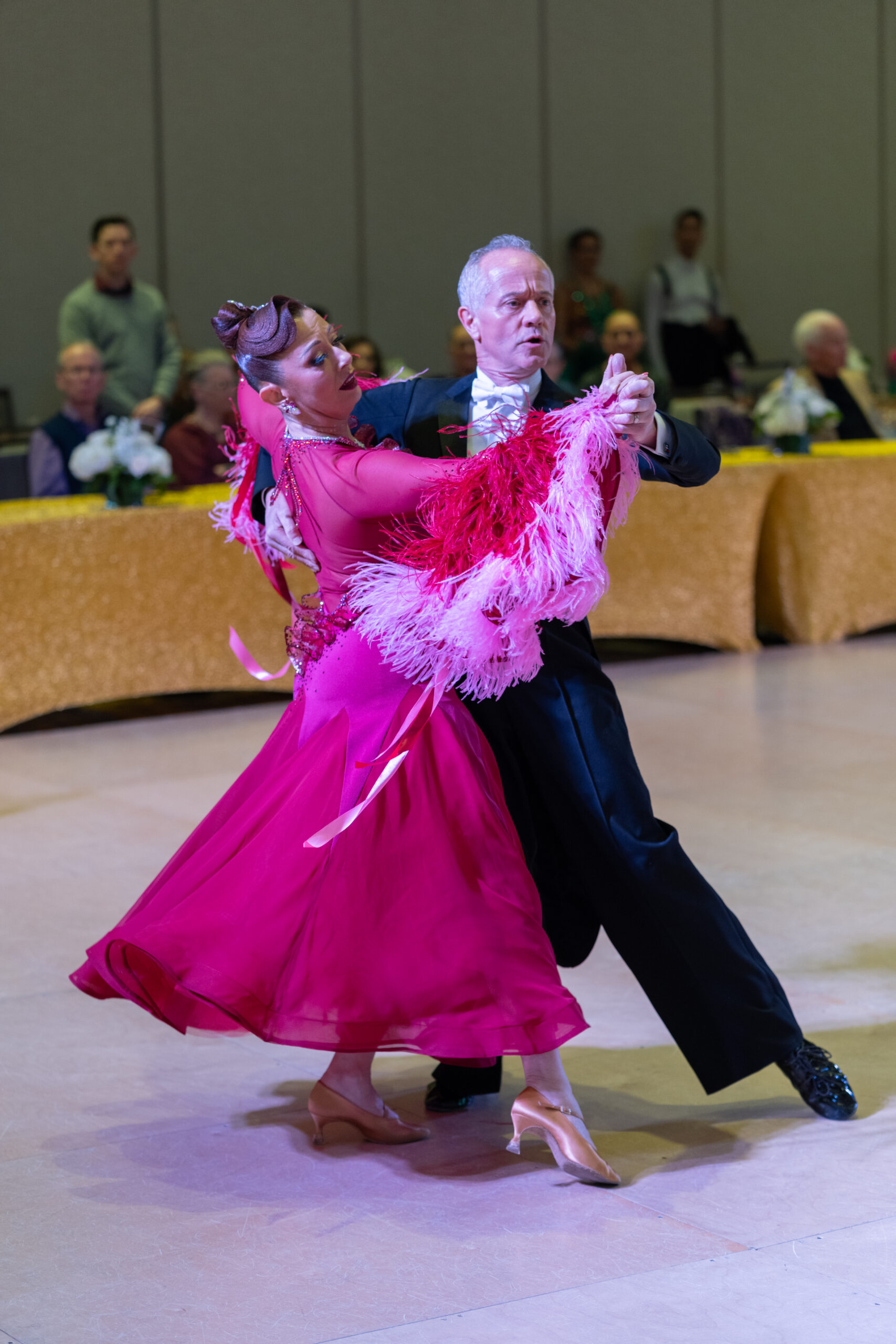
Photo: USA Dance.
A dance competition for seniors.

One of the exercise classes I like at my retirement community is called Movement for Body and Brain. It is led by a dancer who is trained in a variety of related disciplines, including exercise for Parkinson’s patients. I started attending because she has the best music of any of the classes. I stayed because it’s great exercise.

An article at the Washington Post by columnist Trisha Pasricha, MD, explains why movement like dancing is good for your health.

“This fun hobby,” the Post claims, “may reduce your risk of dementia by 76 percent.”

Dr. Pasricha writes, “Dancing combines some of the best elements known to be associated with longevity: exercise, creativity, balance and social connection. … One study found that people who danced frequently (more than once a week) had a 76 percent lower risk of dementia than those who did so rarely.

“In the early 1980s, a group of researchers at Albert Einstein College of Medicine set out to better understand the aging brain by recruiting almost 500 men and women ages 75 to 85 living in the Bronx. Each person underwent neuropsychological tests and responded to questionnaires about their health and lifestyle. Then, over the next couple of decades, the researchers tracked the people’s cognition.

“Perhaps not surprisingly, the scientists found that, for every cognitively challenging activity performed one day a week, there was an associated 7 percent reduction in dementia risk. The more often people tested their brains — such as with board games or crossword puzzles — the less likely they were to develop Alzheimer’s or vascular dementia.

“But when it came to physical activity, one hobby stood out above the others after controlling for other lifestyle and health factors: dancing.

“The researchers, who published their findings in the New England Journal of Medicine in 2003, concluded that physical activities such as swimming and walking also trended in the right direction but that their results were not as profound as those associated with dancing. …

“Physical activity, especially aerobic exercise, in general is wonderful for our brain health. And this isn’t intended to knock walking. … But combining physical activity with creativity and cognitive challenges may help protect the brain further. Dancing asks your brain to do several things at once: match a rhythm, remember steps (or quickly improvise some new ones), navigate space and perhaps even respond to a partner. …

“Dancing is simply music-based movement — ideally of a kind that makes you feel good and involves the company of others. And it can truly be for almost everyone. In my own clinic, we recommend dancing as therapy for patients with movement disorders like Parkinson’s disease. …

“Besides brain health, there are other great reasons to consider shaking a hip. A 2020 meta-analysis of 29 randomized trials among healthy older adults found that social dance-based activities were associated with a 37 percent reduced risk of falling — as well as improvements in balance and lower body strength. …

“While many community centers offer dance classes specifically for older adults (often free), I know that dance classes suited to your interests and needs are not always easily available nearby. … There are also several classes on YouTube tailored to possible physical limitations and needs. …

“Even if you’re not up for dancing, there’s still power in playing your favorite tunes: A large population study published recently found that just listening to music most days was linked to a decrease in dementia risk.

“Music can evoke memory and emotions, but certain kinds of it can also offer a distinctly enjoyable challenge to the brain. As you listen to music, your brain is constantly evaluating its predictions regarding what comes next: Will the next note and beat be the one you’re anticipating?

“A  potent driver of the urge to groove is syncopation. When music is syncopated — meaning, you expect to hear a loud beat in line with the rhythm, but instead it’s weak, or there’s a quick pulse of silence — it challenges our brain’s expectations. Think ‘Satisfaction’ by the Rolling Stones or ‘Uptown Funk’ by Bruno Mars.

“Syncopation creates an exciting sense of ‘push and pull in the music. Humans perceive songs with a healthy dose of syncopations as more pleasurable. Studies have found that those syncopations strongly compel us to bust a move, completing that gap our brain is craving to fill.

“There’s no magic bullet to prevent dementia. Cognitive changes are the result of several factors converging in our brains — our genetics, lifestyle, stress, diets and environmental exposures. Walking and other forms of physical activity can help boost your brain health, but doing so shouldn’t feel like a chore. Cognitive strength can also grow out of many activities that give us great joy — moving to music you truly love, sharing space with someone else’s company, and trying something new without worrying how you look doing it.”

More at the Post.

Read Full Post »

methode2ftimes2fprod2fweb2fbin2f7bfa7a70-aa3c-11e8-8404-0bee60a6f70d

Photo: James Glossop
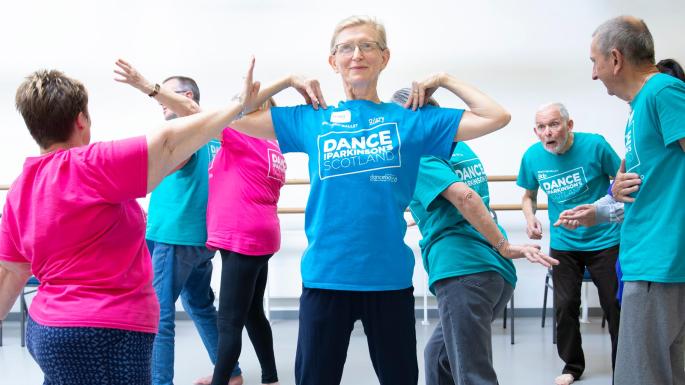
Scottish Ballet expands Dance for Parkinson’s classes to cities across the country.

The class that comes right before my Essentrics stretch class on Thursdays is for people with Parkinson’s. The participants seem to enjoy it. One man, who is said to be over 100, routinely leaves the class with a smile on his face.

Exercise classes for people with Parkinson’s are not new, but there are always new locations offering them and new techniques to help people keep moving. Consider, for example, this report from Scotland, where the Scottish Ballet has a program.

Jeremy Watson writes at the Times, “Research has shown that dance can help people with the degenerative disease physically, mentally and socially. [At the Scottish Ballet,] staff and volunteers help participants develop movement skills with particular emphasis on fluidity, balance, co-ordination and posture. The sessions include activities focused on problem solving, improvisation, vocal skills, memory and multi-tasking.”

The Scottish Ballet website adds background. “Established in 2016, the Dance for Parkinson’s Scotland programme supports those with Parkinson’s to experience the benefits of dance and creativity — improving balance, spatial awareness, confidence and fluidity in movement. Every week, around 75 participants take part in sessions delivered by Scottish Ballet in Glasgow and Dance Base in Edinburgh. …

“The warm and informal Dance for Parkinson’s Scotland classes feature elements of ballet and contemporary dance with a focus on Scottish Ballet’s repertoire. Using the themes and movement from current productions, specially trained Scottish Ballet and Dance Base Dance Artists lead participants to develop movement skills with particular focus on fluidity of movement, balance, coordination, expression, posture and rhythm.”

The Edinburgh Parkinson’s site says that the aims of the classes “are to

* wake up stiff muscles and improve flexibility,
* encourage mind-body connection,
* improve co-ordination and balance, and
* increase self-awareness and self-esteem
* in a supportive and joyful environment

“The social time at the end of each session is a chance to make connections and feel part of the dance community. … The teachers have a wonderful sense of light-heartedness and fun which they bring to the classes. Live music is an essential ingredient, and we have a talented pianist, Robert Briggs, providing the accompaniment, so the music is used flexibly to encourage movement and development of sequences. …

“The original concept, arising from collaboration between the Mark Morris Dance Group and the Brooklyn Parkinson’s Group in New York, is now increasingly practised worldwide among the Parkinson’s community.”

Patients’ partners and caregivers attend the class that I’ve looked in on, and they are welcome to participate and get some exercise, too. The musical selections are great, but unlike in Scotland, there is not a live accompaniment.

Read Full Post »


Photo: Sara Krulwich/NYT

“Everyone is beautiful in the ballet.”

The truth of that line is being demonstrated over and over again at English National Ballet — not just onstage but in classes for Parkinson’s patients.

According to the website Ballet.org, “Dance for Parkinson’s extends opportunities for people with Parkinson’s, their carers, friends and family members to engage in artistic dance activity inspired by the repertoire and within the professional environment of the dance studio.

“Regular weekly classes in London are based at our studios in Kensington. Our programme provides an insight into the way a production is put together with opportunities to meet our dancers and musicians, see rehearsals and English National Ballet performances.

The ballet did make me urgently want to move more, and move better and hinted at how this might be possible. – Participant, Dance for Parkinson’s London …

“English National Ballet is proud to be part of the Mark Morris Dance Group Dance for PD membership programme and the Dance for Parkinson’s UK.” More at Ballet.org/uk.

The initiative receives significant support from the P H Holt Charitable Trust, D’Oyly Carte Foundation and Paul Hamlyn Foundation.

Read Full Post »