Feeds:
Posts
Comments

Posts Tagged ‘Maya’

Photo: BBC.
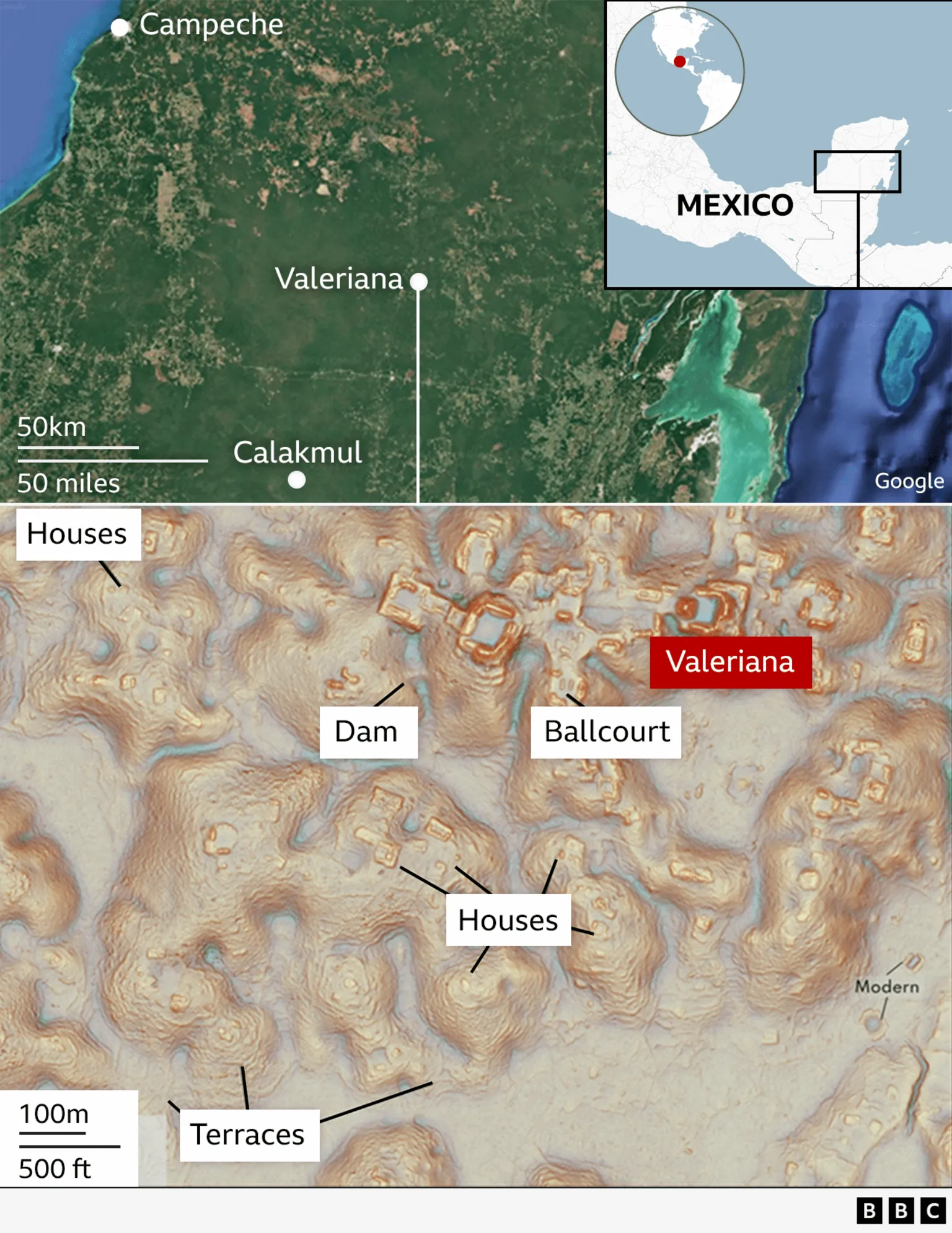
A PhD student found a lost city by accident in eastern Mexico, in Campeche.

Talk about happy accidents! I’m sure we have all experienced a few, whether in cooking or driving around. And we often hear of happy accidents in science. Today, we learn about an alert PHD student who found an ancient civilization without precisely looking for one.

Georgina Rannard writes at the BBC, ” ‘I was on something like page 16 of Google search and found a laser survey done by a Mexican organization for environmental monitoring,’ explains Luke Auld-Thomas, a PhD student at Tulane university in the US.

“It was a Lidar survey, a remote sensing technique which fires thousands of laser pulses from a plane and maps objects below using the time the signal takes to return.

“But when Mr Auld-Thomas processed the data with methods used by archaeologists, he saw what others had missed — a huge ancient city which may have been home to 30,000-50,000 people at its peak from 750 to 850 AD. … Mr Auld-Thomas and his colleagues named the city Valeriana after a nearby lagoon.

“The find helps change an idea in Western thinking that the Tropics was where ‘civilizations went to die,’ says Professor Marcello Canuto, a co-author in the research. Instead, this part of the world was home to rich and complex cultures, he explains. …

It is ‘hidden in plain sight,’ the archaeologists say, as it is just 15 minutes hike from a major road near Xpujil, where mostly Maya people now live.

“There are no known pictures of the lost city because ‘no one has ever been there,’ the researchers say, although local people may have suspected there were ruins under the mounds of earth.

“The city [had] two major centers with large buildings around 2km (1.2 miles) apart, linked by dense houses and causeways. It has two plazas with temple pyramids, where Maya people would have worshipped, hidden treasures like jade masks and buried their dead. It also had a court where people would have played an ancient ball game. There was also evidence of a reservoir, indicating that people used the landscape to support a large population. …

“Professor Elizabeth Graham from University College London, who was not involved in the research, says it supports claims that Maya lived in complex cities or towns, not in isolated villages. …

“The research suggests that when Maya civilizations collapsed from 800 AD onwards, it was partly because they were so densely populated and could not survive climate problems.

” ‘It’s suggesting that the landscape was just completely full of people at the onset of drought conditions and it didn’t have a lot of flexibility left. And so maybe the entire system basically unravelled as people moved farther away,’ says Mr Auld-Thomas.

“Warfare and the conquest of the region by Spanish invaders in the 16th century also contributed to eradication of Maya city states.

“Lidar technology has revolutionized how archaeologists survey areas covered in vegetation, like the Tropics, opening up a world of lost civilizations, explains Prof Canuto. …

” ‘I’ve got to go to Valeriana at some point. It’s so close to the road, how could you not? But I can’t say we will do a project there,’ says Mr Auld-Thomas. ‘One of the downsides of discovering lots of new Maya cities in the era of Lidar is that there are more of them than we can ever hope to study,’ he adds.

“The research is published in the academic journal Antiquity.

More at the BBC, here. Seems to me the discovery was hardly an accident. Anyone with the patience to look at page 16 of a Google search deserves a bit more credit.
Read Full Post »

Photo: Richard Hansen.
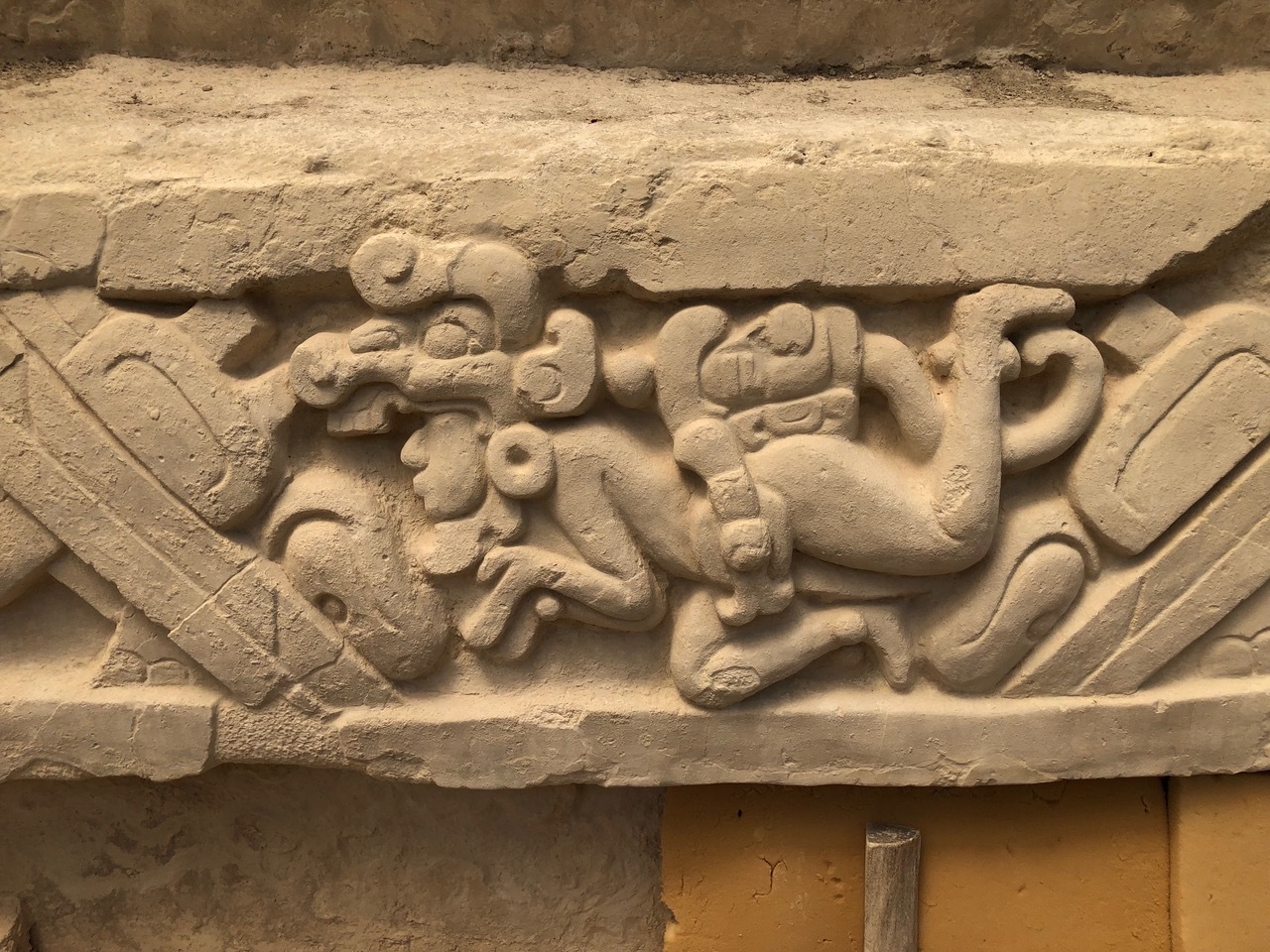
Some of the elaborate carvings researchers uncovered from the Preclassic Maya.

New tools make it possible for archaeologists to discover sites that were densely covered with vegetation. In Guatemala, as a result, almost every day leads to surprising revelations. You wouldn’t think that new insights on the Mayan culture would create controversy, but read on.

Maya Pontone reports at Hyperallergic, “Scientists have uncovered an extraordinary network of Preclassic Maya multi-tiered cities, towns, and villages that date back to 1,000 BCE in Guatemala. The findings indicate a previously unknown culturally and economically complex kingdom-state, dispelling previous beliefs of ‘sparse early human occupation in the Maya Lowlands’ and raising new anthropological questions about this ancient society, according to a research report published in the Cambridge University Press journal Ancient Mesoamerica in December.

“Using airborne light detection and ranging technology (LiDAR), the archaeologists were able to map out 964 lost settlements, which they consolidated into roughly 417 ancient towns, villages, and cities. The team also identified over 100 miles of interconnected roadway. The clusters of sites were found within the Mirador-Calakmul Karst Basin (MCKB), an area that spans northern Guatemala and southern Campeche, Mexico. Like much of the Maya Lowlands, this basin has historically been difficult for archaeologists to explore due to its dense tropical forest terrain, according to the report. New technologies such as LiDAR, however, have created more opportunities in recent years for scientists to conduct this research.

“Beginning in 2015, researchers conducted two aerial surveys using LiDAR at altitudes as high as 2,100 feet. Remote sensing technology works by bouncing pulses of light off of surfaces. The time it takes for these pulses to return to the sensor is then used to determine the distance between the receptor and the surface, allowing scientists to build a detailed map of an area’s environment.

“These analyses found ‘dense concentrations’ of sites including ceremonial and religious complexes, massive triadic constructions, at least 30 ball courts, reservoirs and terraces, defensive structures, villages, and a web of raised causeways. The labor that such constructions would have required suggest ‘a power to organize thousands of workers and specialists,’ the report reads, from lithic [stone] technicians and architects to legal enforcement and religious officials.

“One of these labor-intensive constructions identified from the LiDAR surveys includes the pyramid of Danta. Located east of the El Mirador settlement, this monumental complex stands 236 feet tall, and researchers estimate it required ‘between 6 and 10 million person-days of labor’ to erect.

“Additionally, outside of small marshes, the MCKB lacks perennial bodies of water, which forced the ancient Maya to build alternative systems for water collection and management. Researchers identified 195 artificial water reservoirs, or aguadas, as well as a series of major reservoir systems including dams and canals. 

“Richard Hansen has been researching the early Maya in northern Guatemala for over 38 years. As the director of the Mirador Basin Project, he has been recognized for uncovering major ancient sites in Central America. But in recent years, critics have accused his practices of going against the wishes of local Guatemalan communities. Last month during the Los Angeles Times Festival of Books, demonstrators disrupted a talk Hansen was giving at the University of Southern California, shouting ‘This is stolen land!’ …

“Hansen has also received backlash for his work on the Mirador-Calakmul Basin Maya Security and Conservation Partnership Act, a bipartisan-backed bill introduced to the Senate in 2019. The proposed bill aimed ‘to create a sustainable tourism model’ that would give ‘low-impact, controlled access’ to the MCKB. … While Hansen argues that this bill would provide protections for the area and support local communities, critics have claimed that the act would open up the basin to large-scale tourism.

“In response, Hansen claims that all these criticisms stem from the same source — an alleged misinformation campaign orchestrated by organized crime groups in Guatemala who ‘do not want the security and conservation of that area.’ He said his research has always supported the economic and educational development of communities by hiring and training locals.”

We will have to stay tuned to see how this all shakes out.

More at Hyperallergic, here.

Read Full Post »