Feeds:
Posts
Comments

Posts Tagged ‘Middle Ages’

Photo: mor Charpentier,
Malo Chapuy’s “Scene of Pilgrimage,” 2025, is an example of one contemporary artist’s love of the medieval.

Here’s an artist who imitates the medieval painters, adding threatening hints about our world’s destiny. Not exactly upbeat, but interesting. His paintings make me wonder if I have missed hidden messages in paintings that were actually created in the Middle Ages.

Wilson Tarbox writes at Artnews, “Medieval art continues to resurface as a foil for the art of subsequent generations. … By the mid-19th century [revivalists] looked to it for inspiration, an egress from the calcified obsequiousness of neoclassicism and the depredations of industrialization.

“The latter had torn up the old social fabric, killed hundreds of thousands during the Napoleonic wars, and displaced millions from the countryside to the cities. Yet what emerged was a radically new interaction between old forms and new ideologies. William Morris, the socialist founder of the Arts and Crafts movement, believed medieval art embodied artisanal brilliance and collaboration. By contrast, Augustus Pugin, a monarchist architect of Westminster Palace, hoped it would usher in ‘a return to the faith and the social structures of the Middle Ages.’

“Malo Chapuy is the latest avatar of medieval revivalism. Born in 1995 in northeastern France, he studied philosophy before turning to art history at the Sorbonne, and then to studio art at the École des Beaux-Arts in Paris. At art school, Chapuy resisted pressure from his advisor to ‘paint like Rothko,’ gravitating to late 13th- and early 14th-century art. He obsessed over ancient techniques, probing manuals by famous conservationists and counterfeiters. He learned how to not only paint like the Old Masters but also make his surfaces look faded and cracked. For his thesis exhibition in 2022, he produced an illuminated manuscript, several small paintings in egg tempera, and a tapestry of faux stained glass made from Covid-19 face shields.

“Today he paints religious scenes, altarpieces, and early Renaissance-style portraits that look like museum artifacts save for the proliferation of wind turbines, water towers, astronauts, and spaceships. … When we met, he had just returned from Bogota, where his gallery, Mor Charpentier, had organized a solo show of recent work.

“Chapuy isn’t his gallery’s only medieval revivalist. Sacha Cambier de Montravel, a Belgian artist also born in 1995, whose studio is located across the courtyard from Chapuy’s, contributed dark diptychs and triptychs evocative of Hieronymus Bosch to the [Lens, France] ‘Gothiques’ exhibition. … Clearly, there is a movement—a new neogothic revival — to which Chapuy belongs.

“Big tech, after all, has created a new click-based serfdom, as Yanis Varoufakis asserts in Technofeudalism, replacing capitalist markets and profit with platforms and rents. But Chapuy’s skewering of techno-feudalist fantasies shuns the digital in favor of tactile materiality, just as his 19th-century counterparts resisted industrialization. Although he denies any specific political subtext, something is happening underneath the artificially aged surfaces of his work — a new synthesis of past forms and modern ideas that says as much about ambient apocalyptic fears as it does about desires for alternative futures.

“In one of his two paintings of Saint George (2024), the monstrous dragon of legend appears as a serpentine oil pipeline. Black viscera seeps from its flank, pierced by George’s lance, as the saint raises his sword to strike the fatal finishing blow. Here, the potent beauty and storytelling of medieval religious art, used to such great disciplinary effect under feudalism, is reimagined as indistinguishable from the dream of overcoming present ecological and political crises.”

More at ArtNews, here. Strange pictures. No paywall.
Read Full Post »

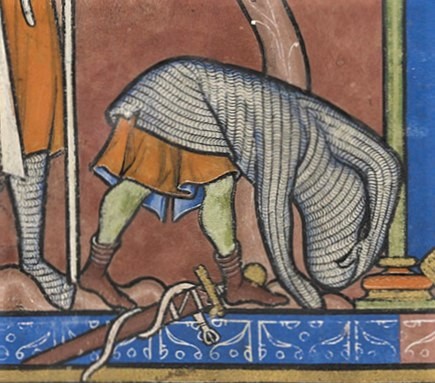
Photo: Morgan Bible, 13th century, via Wikimedia.
In this meme, @artmemescentral captions the art thus: “When I’m drunk and try to take off a turtleneck.”

There’s something entertaining happening on Instagram lately. A goofy look at the art of the Middle Ages.

At Hyperallergic, Alicia Eler writes, “Medieval imagery wasn’t meant to be funny when it was made hundreds of years ago, but all over Instagram it has been remixed, captioned, and somehow reads as peak hilarious — depending on your sense of humor.

“One evening while wasting time on the addictive social media platform, I came across a meme of a medieval battle scene; on the right, a horse was giving the sword-wielding dude some serious side-eye,” she writes.

A perfect caption made her laugh “maniacally, posting it to my Instagram story and sending it to all my close friends. How could this seemingly arcane medieval imagery, previously confined to an art museum or, perhaps, a European crypt, feel so meme-able? …

“ ‘It’s funny for the same reason that Black American Vernacular English is so sticky — because it references a level of servitude that we don’t want to admit,’ said artist Kenya (Robinson), whose work often explores privilege, consumerism, and perceptions of gender, race, and ability. She noted that the text is written in Black American Vernacular English, also known as the language of social media. …

“That’s the text. But what about the image and the side-eye horse? It actually portrays the ‘Captivity of Jeholachin King of Israel, which isn’t particularly funny. Babylonians destroy the Temple of Jerusalem, then lead the Jews into captivity. (As a Jewish person, this makes the meme feel very unfunny, and more like a story my grandma, or bubbe as we say, might have told over a holiday dinner.) … 

“But the fact that the image suddenly appears hilarious in this remixed context struck me. …

“ ‘There’s something about the surprise of the medieval,’ said Sonja Drimmer, a scholar of medieval European art, and associate professor at the University of Massachusetts Amherst. ‘One of the conceptions about the European Middle Ages has to do with blind piety, prudishness, but when people see imagery that defies that, the disjunction leads to laughter.’ …

“ ‘I think there is something about Western medieval art that seems like a safe target … some of the memes — like the side-eye horse, if it were sub-Saharan Africa — you could imagine meme-ifying it, and then imagine it becoming deeply problematic very quickly,’ said Erik Inglis, professor of Medieval art history at Oberlin College. ‘I think with the very white faces of Western medieval art, it seems innocent. We are pretty willing to condescend to the Middle Ages, [which is] not fraught as it is to condescend to other ages.’

“Most of the medieval art history memes come from broader art meme accounts, such as @artmemescentral or @classical_art_memes_official, though there are some discontinued accounts that focus only on medieval imagery. …

“ ‘Medieval imagery is so phone-friendly,’ explained Cem A., an artist and curator who runs the popular art meme page @freeze_magazine (no association with Frieze magazine), and curatorial assistant at Documenta 15.

” ‘For me, its style is more simplified, representational, and cartoonish than our classical understanding of painting. Figures in these images usually have exaggerated (and therefore easier to grasp) relationships onto which you can build a meme. Its aesthetics works better on the compact screens of smartphones.’

“At the same time, medieval imagery isn’t all just easy fodder for funny memes. It can ‘be racist and quite terrible, and ground zero for white supremacy, said Drimmer. 

“The mob that stormed the United States Capitol Building on January 6, 2021, carried … symbols associated with the Crusades. The far Right’s use of medieval iconography gained steam after the September 11 attacks, with white supremacists picturing themselves as ‘modern Christian warriors fighting to preserve the idea of America as a white, Christian nation,’ according to a report in Teen Vogue. 

“This is an even more troubling connection for academics and those who study the era, but also speaks to the layers upon layers of racialized remix culture that make up the ever-pervasive American visual pop culture that keeps on spreading. There’s also an impulse to turn almost anything into a meme these days.

“ ‘The funny thing about retroactively searching through history to identify memes is that you start to see memes where they might never have existed before,’ noted Daniel Shinbaum, a Berlin-based cultural critic and memes researcher. ‘Almost anything can start to look like a meme.’ ”

More at Hyperallergic, here. No firewall.

Read Full Post »