Feeds:
Posts
Comments

Posts Tagged ‘mister rogers’

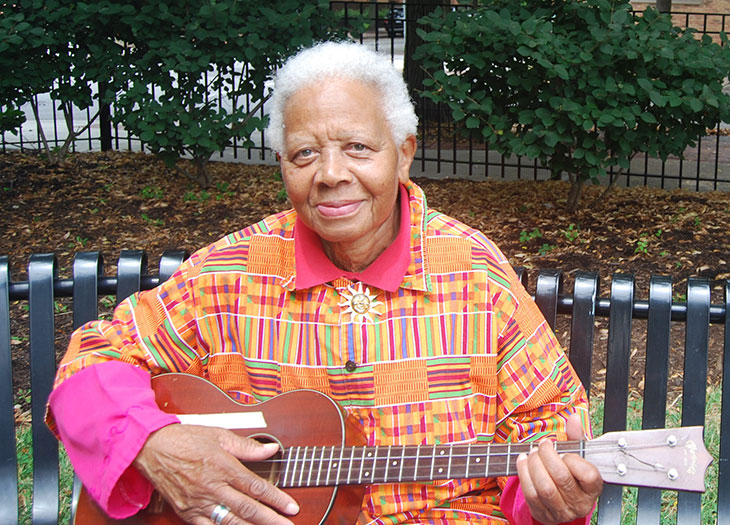
Photo: EllaJenkins.com.
Ella Jenkins is the best selling individual artist in the history of Smithsonian Folkways Recordings. She introduced children to music from around the world and never talked down to them.

Today we learn about a folksinger whose unorthodox approach revolutionized music for children. Her name is Ella Jenkins.

Laurel Graeber writes at the New York Times, “When Ella Jenkins began recording young people’s music in the 1950s and ’60s, her albums featured tracks that many of that era’s parents and teachers would probably never have dreamed of playing for children: a love chant from North Africa. A Mexican hand-clapping song. A Maori Indian battle chant. And even ‘Another Man Done Gone,’ an American chain-gang lament whose lyrics she changed [into] a freedom cry.

“ ‘She found this way of introducing children to sometimes very difficult topics and material, but with a kind of gentleness,’ said Gayle Wald, a professor of American studies at George Washington University and the author of a forthcoming biography of Jenkins. ‘She never lied to them. She certainly never talked down to them.’

“Jenkins’s unorthodox approach became a huge success: … A champion of diversity long before the term became popular, Jenkins helped revolutionize music for the young, purposefully encouraging Black children. In addition to introducing global material, which she often recorded with children’s choruses, she wrote original, interactive compositions like ‘You’ll Sing a Song and I’ll Sing a Song,’ now part of the Library of Congress’s National Recording Registry. …

“You might think that Jenkins, [100], would now want to relax. … What she would really like to do — although her fragile health prevents it — is to perform again herself. ‘I want to get well and get back on the job, where I’m working with other people, working with children,’ she said. ‘I work with them, and they work with me. I enjoy work.’

“Jenkins’s efforts, which comprise more than 40 recordings, began on Chicago’s South Side, where she grew up. Although never formally trained as a musician, she learned harmonica from her Uncle Flood and absorbed a variety of musical traditions through neighborhood moves and jobs as a camp counselor. After graduating from what was then known as San Francisco State College, she directed teen programs at the Chicago Y.W.C.A., which helped cement her love for children. Her street performances led to an offer to do young people’s music segments on local television, a debut that would be followed years later by appearances on shows like Sesame Street and Mister Rogers’ Neighborhood.

“ ‘Her curiosity is so insatiable,’ said Tim Ferrin, a Chicago filmmaker who is completing a documentary, Ella Jenkins: We’ll Sing a Song Together. He added, ‘I think she saw herself as a conduit, as somebody who could then share that enthusiasm, share that understanding.’

“Often called ‘the first lady of children’s music,’ Jenkins captivated her listeners because she presented music not as lessons but as play. A charismatic performer whose accompaniment often consisted of only a baritone ukulele and some percussion, she encouraged her young audiences not to sit still but to get up and move. Using a signature call-and-response technique that she adapted from African tradition and artists like Cab Calloway, she engaged her listeners in a musical conversation, even if they didn’t understand what they were singing.

“ ‘She made it very immediate and not exotic,’ said Tony Seeger, an ethnomusicologist and the founding director of Smithsonian Folkways. … At a Chicago convention of the National Association for the Education of Young Children in the 1990s, he recalled, so many members tried to crowd into a Jenkins concert that the organizers shut the doors. Those excluded responded with frenzied knocking.

“ ‘It was astounding, her popularity, and also the insistence with which these preschool teachers were pounding on the door,’ Seeger said, chuckling in a video interview. ‘I mean, you don’t think that they would do that sort of thing. But they did.’ ”

More at the Times, here.
Read Full Post »

ma-bb21-2018-beat-billboard-1548

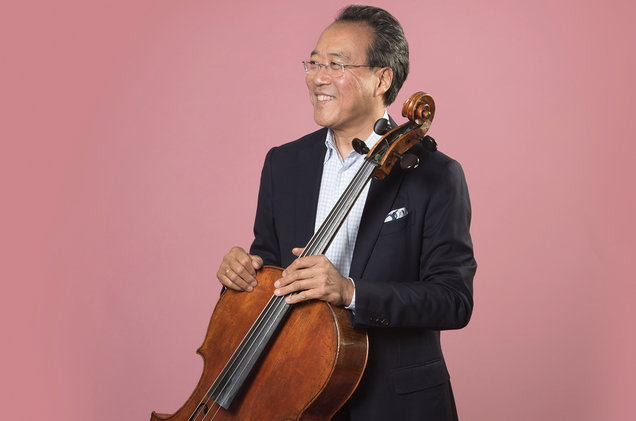
Photo: Judith Jockel/laif/Redux
Cellist Yo-Yo Ma is a musician who knows the power of music to be a force for good. Concerned about our fractured society, he asked himself, “What can I do?”

Recently, my husband and I watched the lovely documentary Won’t You Be My Neighbor? — about children’s television visionary Fred Rogers.

Mister Rogers had a gift for speaking directly to the individual child through a mass medium, unlikely as that sounds, looking into the child’s eyes and letting the child know that she was seen.

Cellist Yo-Yo Ma, who ultimately became a friend of Mister Rogers, is seen in the documentary making his first appearance on the show. He tells the documentarian, who happens to be his son Nicholas, that he was scared to death when Mister Rogers put his face very close and looked into his eyes, until he realized that’s what children do.

It made me a bit sad and more conscious of the lack of eye contact today’s children get as we imagine we’re interacting if we talk to them while looking at our phones. No wonder they get stressed. Generally speaking, it’s through the eyes that children learn they are really seen. Mister Rogers understood their needs. He was a great healer.

Yo-Yo Ma is also a healer, but although he has appeared often on television like Mister Rogers, it is music that is his medium. Rebecca Milzof reports at Billboard about Ma’s current project to use his musical gift to help heal the fractured world.

“On Sept. 2, cellist Yo-Yo Ma played all six of Bach’s cello suites at the Nikolaikirche in Leipzig, Germany. It wasn’t out of the ordinary for the world’s most famous classical musician, who was playing at the church where the composer premiered many of his works. But the setting had a deeper meaning: In 1989, it’s where peaceful rebellions against communist rule — which led to the fall of the Berlin Wall — began.

“ ‘This is the very [place] where these [political] changes happen,’ says Ma, 62, over the phone from Leipzig. Today, he notes, Syrian refugees are coming to the city and facing demonstrations of a different sort — from right-wing nationalists. ‘It’s the right moment to explore the idea of home. What is home? It’s where you go to be sustained in difficult times. For me, Bach is home.’

“Over the next two years, Ma will visit 36 sites worldwide as part of his Bach Project, playing the cello suites in places like the Nikolaikirche — settings with sociopolitical meaning. It coincides with the recent release of his third and final recording of the suites, Six Evolutions.

“ ‘We live in more and more of a fractured society,’ the 18-time Grammy winner says. ‘As a cellist, I was thinking, “What can I do to help?” I’ve been toying with the idea of “citizen musicians” for a while.’ …

“So far, that has meant engaging with the Mexican-American community around Denver after playing Red Rocks in August and meeting community organizers spurring industrial revitalization outside Cleveland.

“ ‘One of the things culture does best is to make the “other” into “us,” ‘ he says. He’ll test that idea on six continents.” More at Billboard, here.

By the way, Nell Minnow has a really nice interview with the younger Ma about Won’t You Be My Neighbor? on Medium, here. He talks about performing with his dad as a child on Mister Rogers’ Neighborhood, and he still sounds amazed that Fred Rogers could get him to do that.

Read Full Post »

Before I had children, I didn’t quite “get” Mister Rogers. I thought the slow, gentle way he talked was odd.

But then I saw how John at the age of three reacted to him, and the penny dropped. I hadn’t been able to figure out Mister Rogers because he wasn’t talking to me! He was talking to three-year-olds.

Mister Rogers did know how to talk to grown-ups when needed.

Recently, during the national discussion about possible funding cuts for the arts and Public Broadcasting, someone posted on Facebook a 1969 video of Mister Rogers testifying before US Senator John O. Pastore of Rhode Island. At the time, Sen. Pastore was chairman of US Senate Subcommittee on Communications.

It’s a great, great speech. It’s even recognized as such on the American Rhetoric website. The testimony won PBS $20 million in funding from the originally skeptical Sen. Pastore.

But what strikes me most strongly is that its power comes from the speaker’s clearly communicated belief in the essential goodness of his listener. It is communicated through Mister Rogers’s tone of voice and body language.

Faith in the listener is what came across to three-year-old John, too. “You are special. I like you just the way you are.”

See what you think.

Read Full Post »

In Slate magazine, Katie Roiphe wonders whether good children’s book writers need to be childlike themselves.

“Is it possible that the most inspired children’s book writers never grow up? By that I don’t mean that they understand or have special affection or affinity toward children, but that they don’t understand adulthood, and I mean that in the best possible sense. It may be that they haven’t moved responsibly out of childhood the way most of us have, into busy, functional, settled adult life.” Read more.

Roiphe may be right about certain children’s writers, but I think she misses an important aspect of Margaret Wise Brown and Goodnight Moon. The book is based on research conducted at the Bank Street School in New York. Educators there observed that very young children like to hear about common things that they see around them and know about. And they like repetition. Watching toddlers react to Goodnight Moon is proof of the theory.

Some people known for their children’s books were indeed Peter Pans who never grew up. Hans Christian Anderson comes to mind. Roiphe mentions Lewis Carroll. But surely the most important thing, whether you are a childlike children’s author or an adultlike children’s author, is to see things the way children do. Ed Emberley, the subject of my March 24 post, is an example. Mister Rogers, too, for that matter. I became an instant convert to Mister Rogers when I saw how my 3-year-old responded to him.

Would love to hear your take on this.

Read Full Post »