Feeds:
Posts
Comments

Posts Tagged ‘model’

Photo: BBC.
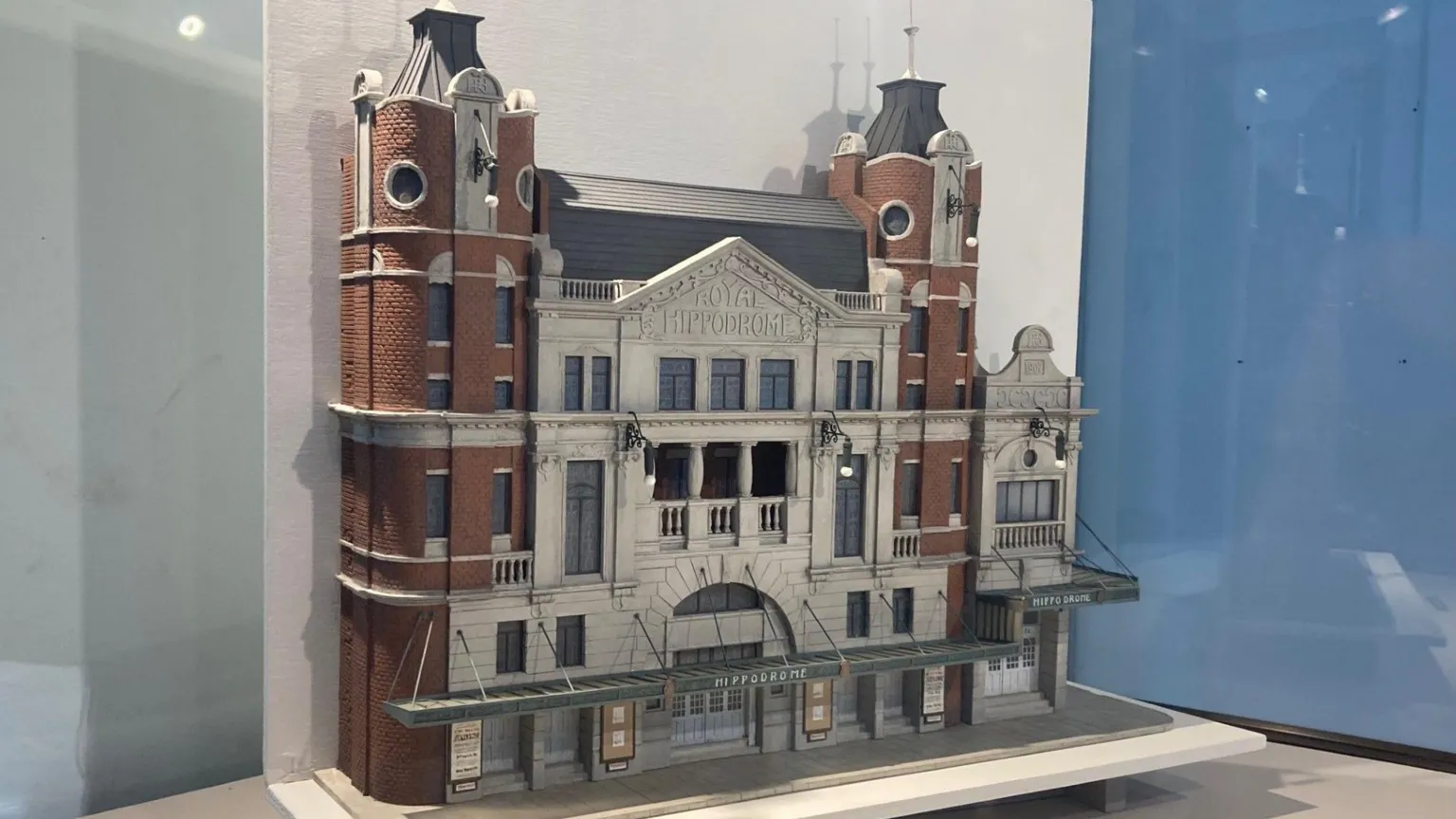
During lockdown, set designer Stuart Marshall started making models of Belfast’s lost theatrical world. Above is his model of the Hippodrome.

No one wants to go back to the pandemic’s lockdown, but enough time has passed for people to feel a little nostalgia for the creative projects some folks undertook during that dark time. I remember a guy in Boston who encouraged artists to send him miniatures of their work, which he would then display on his popular website. Refresh your memory of that here.

Jake Wood at the BBC reported in March on an exhibit in Northern Ireland that had its beginnings when a set designer was stuck at home.

“Miniature models of Belfast’s lost theatres created by set designer Stuart Marshall are bringing the city’s vibrant theatre history back into the the limelight. They are part of an exhibition at Ulster University for the Children’s Festival.

“Mr Marshall told BBC News NI that … ‘Children appreciate the miniature dolls house type model making, adults appreciate the skill that goes into making them, and older people who may remember when some of these places still stood. …

” ‘I started working on a model of the Grand Opera House as part of the heritage exhibition and through doing that got interested in looking at all the other theatres that aren’t about anymore. …

” ‘The Hippodrome was the most complicated and detailed one I’ve made; it took me around six weeks to make.’

“He said he mostly works from old photographs, but it can be hard to get enough accurate detail because ‘with a black and white photograph that you can’t move around, it’s basically static.’

“When photographs of the old theatres are not available or poor quality, Mr Marshall refers to old newspaper articles which sometimes have written descriptions of what materials the theatre was built from and how it appeared.

“Opening in the early 1870s, the Alhambra was Belfast’s first music hall and was a ‘real spit on the floor type joint,’ according to Mr Marshall. ‘In the early days, the Alhambra was more of a variety house, and I’ve heard that it wasn’t the most enticing establishment, quite a rowdy place.’ …

“A typical bill from the early days of the Alhambra shows performances which ‘would nowadays be contentious’ included events such as a minstrel show and a Japanese troupe. …

“To adapt to the evolution of mass entertainment, the Alhambra converted to a full-time cinema house in 1936. Between the late 1800s and its closure in 1959, the Alhambra suffered four separate fires.

“The Theatre Royal was Belfast’s original high-end theatre, opening in the late 1700s with a capacity of just over 1,000. The building was demolished and rebuilt a number of times.

” ‘As these places go, they kept getting burnt down or demolished and rebuilt again – there’s always a renewal aspect to them.’

“The Theatre Royal was to be Belfast’s ‘higher class establishment,’ which in the end became ‘a mixed-use building of shops and place called the “boom boom room,” which was like a dance hall upstairs. …

” ‘Now, there’s a little Starbucks in the corner where the building stood,’ he added.

“Not to be mistaken for the pub and music hall on Botanic Avenue, the Empire Theatre was situated on Victoria Square and opened to the public in 1894. …

“While it did adapt to the growing popularity of cinema, the Empire ‘stayed true to theatre for all of its life,’ Mr Marshall said.

“The Hippodrome was ‘more fiddly.’ … There aren’t too many quality photographs of the Hippodrome, so he ‘had to use his judgment’ when designing the model in terms of color scheme and scale.

“Coming quite late, the ‘Hippodrome was was built in 1907 originally with a cinema in mind’ as to take full advantage of the advent of modern cinema and growing popularity of picture shows.

” ‘And then there was the Ritz,’ which opened in 1938. The Ritz was, according to Mr Marshall, ‘a giant cinema more or less, but it called itself the Ritz Theatre.’ However, it did produce shows as part of the night’s entertainment.

” ‘They would have a brass band, dancers or a ballet, and then a film at the end. It also did huge concerts, people like the Stones, The Beatles and Billy Connolly all performed at the Ritz during their time,’ he added. …

“The Ritz was damaged by bombs hidden in the seats and the theatre’s interior and roof was destroyed in 1977.” More at the BBC Northern Ireland, here.

Did you do a particularly creative project during lockdown? Of, course, many of us kept on blogging away, but we would have done that anyway.

Read Full Post »

Photo:  Michael Willian.
“I’m a natural person and I’ve never had any surgery,” says Brazilian model Rosa Saito, 73.

In today’s story from the Guardian, Brazilian model Rose Saito looks pretty glam in her 70s, but that is not the point. The point is she never gave up on something she wanted to do. And it wasn’t until she was 69 that the movers and shakers in the fashion world realized they were plum out of beautiful older models. Suddenly she was in demand.

Ammar Kalia writes, “For her 68th birthday in 2019, Rosa Saito decided to give herself an unusual present. Over the past year, she had been approached by photographers and casting agents three times on the streets of her home town in São Paulo, Brazil, each telling her she should consider becoming a model. Initially, she brushed off the flattering advances, but after deliberating for several months, she changed her mind.

“ ‘No one had commented on my appearance until I reached 67, when people suddenly started to notice me,’ she says. ‘It was very strange, but being spotted made me realize I could still achieve something for myself at this stage of my life. I had raised three children and now I wanted to see what I could do alone. If not now, then I never would.’

“Contacting one of the agencies that had previously approached her, she was immediately added to their roster and sent out to castings. ‘At my first casting they asked me to act like I was just getting home from a nightclub, but I have never done that before,’ she laughs. ‘I didn’t get the job, but I started to see how modeling is about inhabiting a character and performing. It was a challenge that began to excite me.’

“It would be another year until Saito booked her first job. Arriving at dozens of castings and routinely turned away with little explanation or feedback, she was determined to see these experiences as an opportunity to practice her posing and walking in front of other professionals. ‘The rejections only made me want to book a job more,’ she says.

‘I was used to facing difficulties in my life and so these were small setbacks compared with everything else I had been through. I was prepared to keep going.’

“Saito learned resilience from an early age after becoming the sole carer, at 22, for her mother, who had a stroke. After the death of her husband, to whom she was married for 20 years, in 2000, she raised her three children alone. She has always been passionate about natural remedies and plant medicine. ‘I think that is the most important thing that has helped me look the way I do today,’ she says. …

“In 2020, at 69 years old, Saito’s persistence paid off and she finally booked her first modeling job for a Brazilian cosmetics brand. … ‘As soon as we began, my experience from all the castings kicked in and I relaxed. The production team asked me where I had been hiding, since they said they had been looking for older women like me for years.’ …

“Saito also found herself unwittingly becoming a role model for the younger women on the shoot. ‘I got so many compliments from the other models and it made me realize that my presence was showing them that you can grow older without fear,’ she says. …

“Now 73, Saito has modeled for clothing brands, cosmetics and magazine editorials, while her highlight has been making her debut at São Paulo fashion week in 2022 as one of the oldest models on the catwalk. … ‘It’s a gift to be doing this in my 70s,’ she says. ‘I love modeling because each job is a unique challenge and it pushes me to give the best I can. It has made me a more confident person in all parts of my life.’ ” More at the Guardian, here.

Say, did you notice that at São Paulo fashion week, she was only one of the older models on the catwalk!?

Read Full Post »

One day last week, I was writing a letter to Brandeis admissions to help Shagufa get a bit more support for grad school, and I used a thumbnail description of this blog to explain how I met her. I said it was tied to my daughter’s jewelry company, which I always say, but then I added something I’d just thought of: “my goal is to share inspiring stories.”

Is that right, Dear Reader? These stories are not always inspiring, but I didn’t think the university would care that they were merely topics some stranger calling herself Suzanne’s Mom finds interesting. I’d be grateful for your own thumbnail description of SuzannesMomsBlog.

Today’s story is in the interesting department. (I wonder if everything interesting is by its nature also inspiring.)

Sarah Cascone writes at Artnet, “We may never fully solve all the mysteries of Stonehenge, the monumental prehistoric circle of stones built on the Salisbury Plain in Wiltshire, England. But a new study suggests that it may have been designed to amplify sound in very specific ways.

“To recreate the acoustic properties of the stone circle as it was originally built around 2,500 BC, acoustics engineers at the University of Salford in Manchester constructed a 1:12 scale model they called ‘Minihenge.’ The results of their research have been published in the Journal of Archaeological Science.

“ ‘Constructing and testing the model was very time consuming, a labor of love, but it has given the most accurate insight into the prehistoric acoustics to date,’ Trevor Cox, the project’s lead researcher, said in a statement. ‘With so many stones missing or displaced, the modern acoustic of Stonehenge is very different to that in prehistory.’

“Thanks to laser scans of the site conducted by the governmental research group Historic England, Cox and his team were able to replicate the exact dimensions and precise topography of the monoliths using a computer-aided model and a 3-D printer. Missing stones were replaced where they were believed to have originally stood — 157 in all, based on the latest archaeological research.

The simulated stones were treated to replicate the acoustic properties of the site’s actual materials, allowing for more accurate results than in past models. … Researchers then tested the model, placing speakers and microphones in and around it while working at the university’s Acoustics Research Centre, which boasts a specialist acoustic chamber. (To account for the difference in scale, all sounds were 12 times their normal frequency, in the ultrasonic range.)

“The study found that people who spoke or played music inside the monument would have heard clear reverberations against the massive standing stones. Testing on the model also suggests that the stones increased the volume on interior sound, kept exterior sound out, and made it hard for anyone outside the structure to hear what was going on inside. …

“The placement of the stones was capable of amplifying the human voice by more than four decibels, but produced no echoes. Music and other sounds would have been enhanced such that someone standing within the outer circle of stones would have heard conversations from the center with perfect clarity, even as the sound was obscured to those outside. …

“While sound appears to have been an important consideration for the ancient builders, researchers still believe that astrological alignment was the primary factor in the placement of the stones. And mysteries about Stonehenge’s musical properties still abound.

“ ‘Stonehenge hums when the wind blows hard,’ musicologist Rupert Till of the University of Huddersfield in England, who has previously conducted acoustic research on the site, told ScienceNews.

“There is also speculation that some of the smaller stones used in the ancient site’s construction may have been chosen for their musical qualities. Making a sound much like a metallic gong when struck, they could have been used as percussion instruments, Cox suggested in the Guardian in 2014.

“That theory was tested in a 2013 study conducted by researchers from the Royal College of Art in London, who were able to ‘play’ Stonehenge’s ringing stones like a giant xylophone in a unique form of ‘rock’ music. According to their findings, published in Time & Mind: The Journal of Archaeology, Consciousness, and Culture, the stones’ musical properties were likely even more pronounced in antiquity, before they were set in reinforced concrete.”

More at Artnet, here.

Read Full Post »

Amtrak-trains-Boston

I love Amtrak, and I love writing, but I don’t think I am ever going to do an Amtrak Artist Residency, so I am passing along the info so you can apply. It sounds like fun. Just glimpsing the exposed backs of houses along the tracks with their hints of the private lives lived in them is inspiration for a ream of stories.

William Grimes writes for the NY Times blog ArtBeat, “The wheels have begun moving on Amtrak’s plan to offer writers a rolling residency aboard their trains. … Up to 24 writers, chosen from a pool of applicants, will be given a round-trip ticket on a long-distance train, including a private sleeper-car room with a bed, a desk, and electrical outlets. …

“The idea was born in December when the novelist Alexander Chee, in an interview with the magazine PEN America, casually mentioned his love for writing on trains, and added, jokingly, ‘I wish Amtrak had residencies for writers.’

“When Jessica Gross, a writer in New York, echoed the sentiment on Twitter, Amtrak arranged for her to do a trial residency on the Lake Shore Limited from New York to Chicago. She agreed.

“Her account of the trip, ‘Writing the Lake Shore Limited,’ published by The Paris Review in February, grabbed the attention of The Wire, The New Yorker and The Huffington Post. Soon after, Amtrak decided to turn the trial run into a full-fledged program.” More on when and how to apply.

Even before that series of events, there was the Whistlestop Arts Train, you know. I blogged about the rolling public art project by Doug Aitken last July, here.

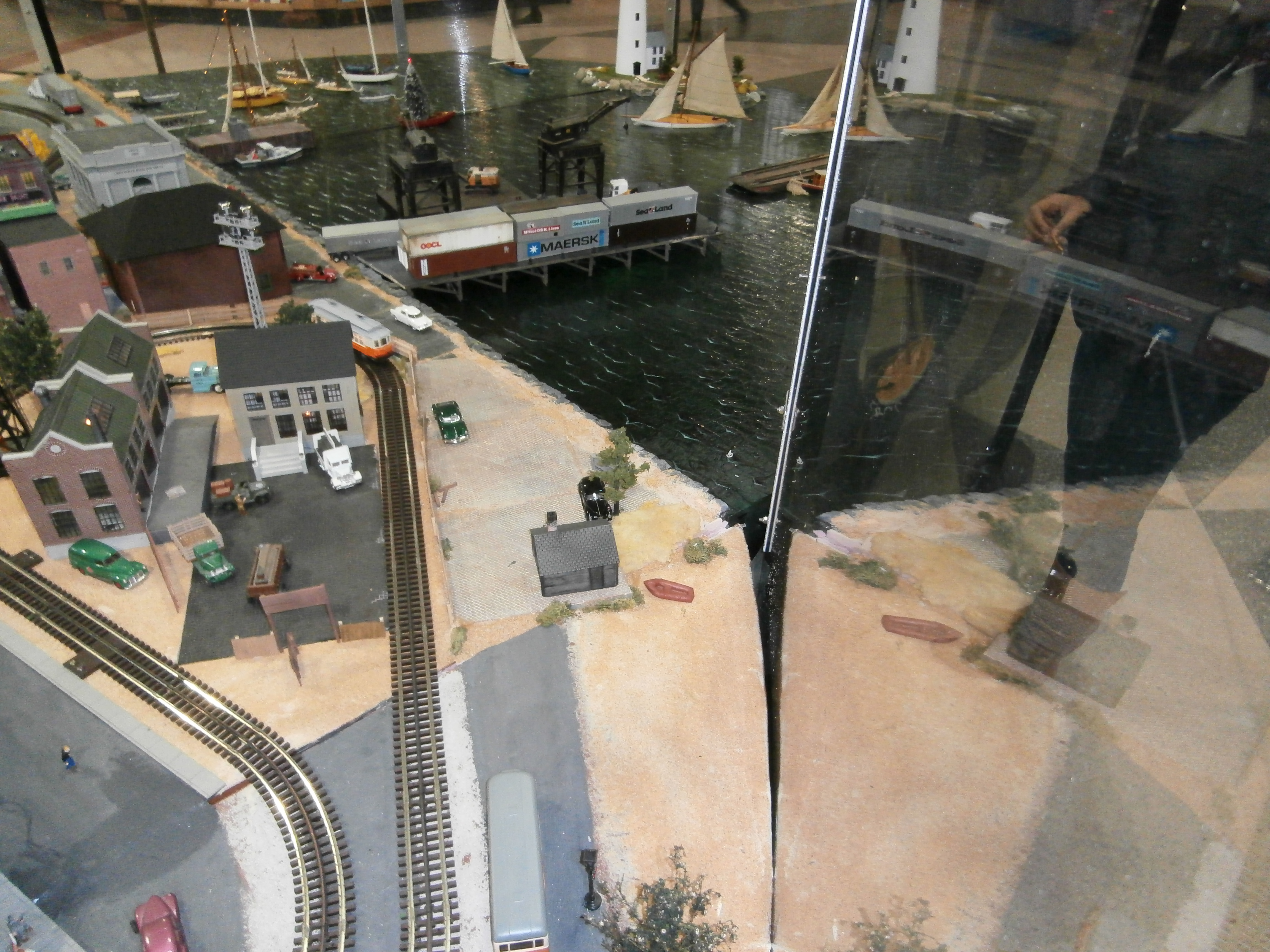
Trains for dreaming. Holiday model train layout at Amtrak’s South Station, Boston.

model-trains-Amtrak-S-Station

Read Full Post »

Matadero was an old abandoned slaughterhouse in Madrid. Lately it has been “evolving into a cultural laboratory, where a new arts financing strategy is being tested.” So says Doreen Carvajal in the NY Times.

“Companies and institutions are providing financial support to supplement dwindling government arts subsidies, but with a twist: they don’t just send checks, they move in.

“Within the walled 59,000-square-foot center, there are public theaters and exhibition spaces that last year drew more than 500,000 visitors for music and art events and avant-garde plays. But five new residents are private institutions, including a designers’ association, a publishing house’s foundation and offices of Red Bull, the Austrian energy drink maker.

“They are in the compound rent-free for now, but have invested millions in the remodeling of pavilions there, as well as in programming, from art exhibitions to music festivals.

“These new partnerships are forged, out of necessity, here in Spain, where government support for culture has plunged by almost 50 percent over the last four years, a result of a lingering economic crisis that hit late in 2008.”

Some observers worry about the downsides of corporations having a big influence on what art gets shown, but haven’t the arts always had to have some help from patrons or companies?

Probably it pays just to be wary, to recognize when there is undue influence, and to push back. Certainly smaller, more experimental projects are unlikely to find a home under a Red Bull banner.

Read more at the Times, here.

Photo: Carlos Luján for The International Herald Tribune
Inside Matadero Madrid: A closer look at the arts complex.

Read Full Post »