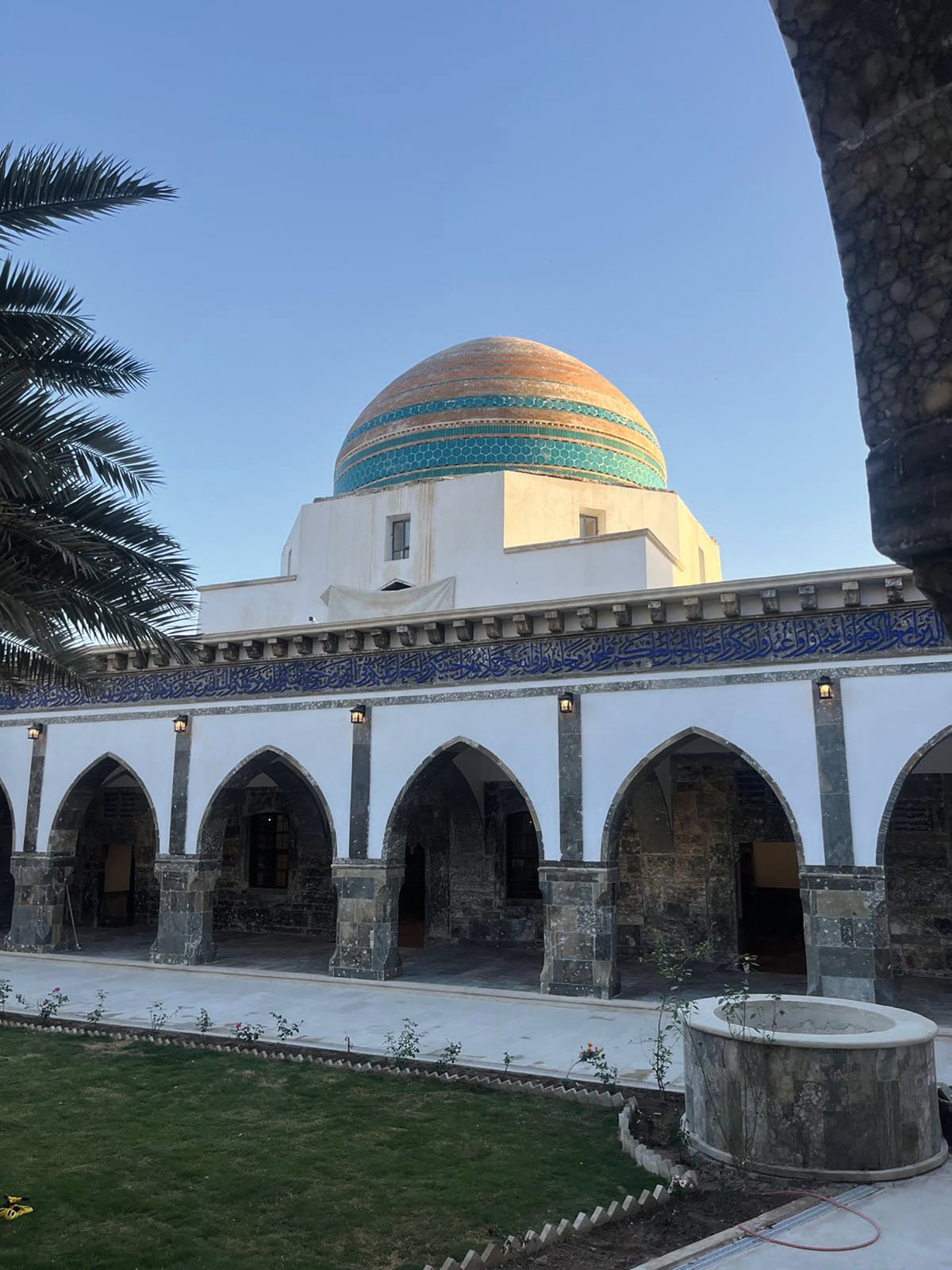
Photo: Valéry Freland/International Alliance for the Protection of Heritage (ALIPH).
The Al-Raabiya Mosque — severely damaged during the battle to liberate Mosul from Isis in 2017 — was one of several restored buildings revealed in October 2025.
Let’s think about how humans rebuild places after the unspeakable. Mosul, in Iraq, is one such place. A goal to nurture a diversity of faith traditions there has been dubbed the Mosul Mosaic.
Hadani Ditmars writes at the Art Newspaper that 2025 was “a banner year for the restoration of heritage in Mosul, a city rising from the ashes of war and still recovering from three years of occupation by Islamic State (Isis). When it was liberated in 2017, the northern Iraqi city lay in ruins at a level of destruction Unesco described as unequalled since the Second World War.
“A multitude of reconstruction projects began in 2018 after landmines and debris were cleared. Dozens of these were completed in the past year, among them, Unesco’s program to restore Ottoman houses in the old city. The Isis-ravaged Mosul Central Library opened on 1 January. The Al-Nouri Mosque, Al-Tahera Church, and Al-Saa’a Convent are among the sites to have been restored under Unesco’s $115m Revive the Spirit of Mosul program. In October, two more churches and a mosque restored by the Geneva-based NGO Aliph (International Alliance for the Protection of Heritage) were inaugurated.
“It remains to be seen whether rebuilding churches and mosques will encourage social cohesion and religious peace in a still-fractured society. There are fewer than 70 Christian families living in Mosul, down from a pre-2014 population of 50,000. …
“David Sassine, the project manager of Mosul Mosaic, an initiative launched by Aliph in 2018, tells the Art Newspaper that the NGO’s primary reason for restoring churches and mosques is their heritage value. But it is also, he says, ‘a message that the international community is supporting the presence of all communities in Mosul.’ Displaced communities can be encouraged to return by building schools and restoring monuments, he says. …
“In addition to preserving the cultural heritage of Mosul in its religious diversity (including documentation of the historic Jewish community), Mosul Mosaic also provides on-the-job training in heritage restoration and employment to locals. …
“[In 2024] Aliph reopened the historic Tutunji House—an Ottoman home used by Isis as an explosives factory that is now a cultural centre. This year, it completed the rebuilding of the House of Prayer at the Al-Saa’a Church and the Al-Masfi Mosque, one of Mosul’s oldest, likewise damaged during occupation by Isis, was also inaugurated. …
“At the first public mass at the exquisitely restored Al Tahera Church in May, most of the Christians in attendance no longer lived in Mosul. After the service, attended by perhaps three dozen worshippers, everyone left quickly. Few were inclined to speak to the Art Newspaper, including the priest. ‘I don’t feel comfortable,’ he said.
“One young man said he had moved back to Mosul to take a job as the church verger, and because his old family home was still standing in the old city. The rent in Erbil … where he and his family had fled in 2014, was unaffordable, he said.
“A Muslim construction worker outside the church, said he … fondly remembered his old Christian classmates at the Catholic school he attended in his youth. ‘I haven’t seen them in many years,’ he said.
“But Shams Majid, who returned to Mosul a few years ago to rebuild his family home, was optimistic. He recently transformed his traditional [house] with several stories that overlook the al-Nuri Mosque in the old city into the Mosul Heritage Art House, open to visitors.
“ ‘Everything in Mosul is great now,’ he said. ‘They are rebuilding all the monuments, the tourists are coming back, and the economy is improving.’ …
“Aliph’s next big restoration project—the Mosul Museum—combines ancient and modern heritage preservation. Looted after the 2003 Iraq War and ravaged by Isis in 2015, it is scheduled to open in autumn 2026. The $15.8m project was initiated in 2018 in partnership with the Musée du Louvre, the Smithsonian Institution and the World Monuments Fund.”
Learn about other restored buildings at the Art Newspaper, here.

 Suzanne's Mom's Blog