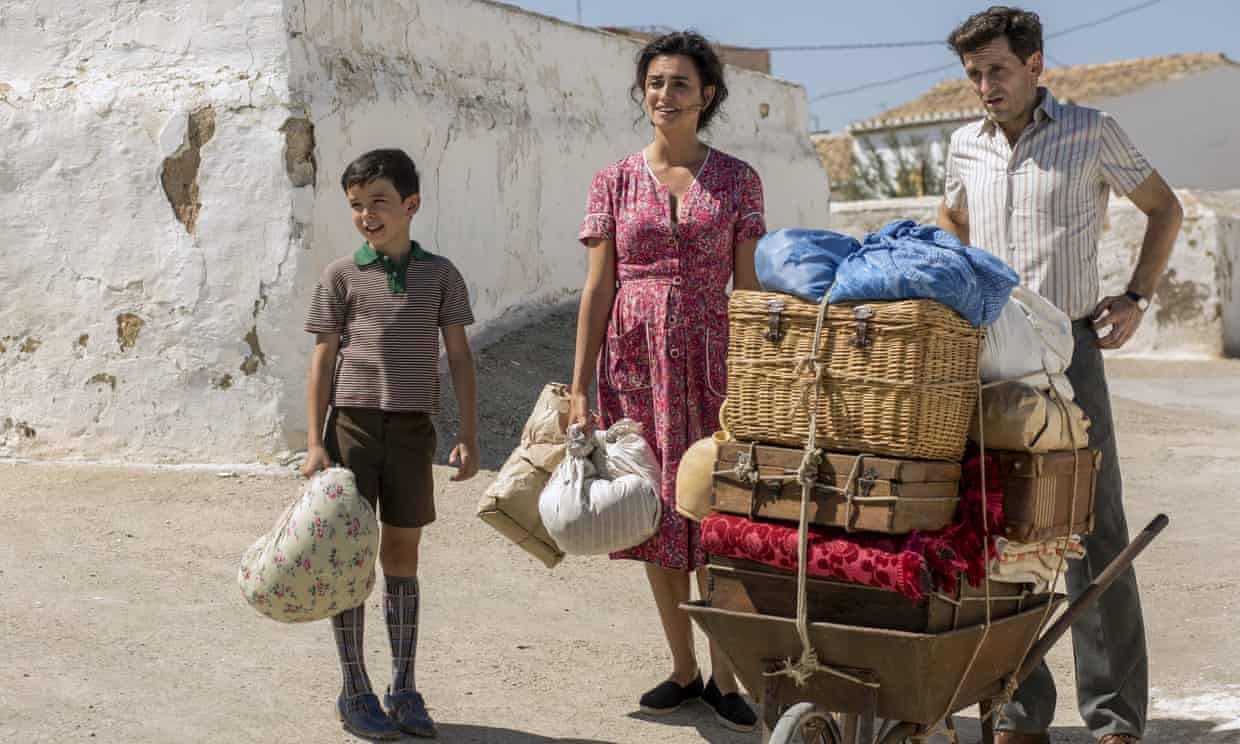
Photo: Sony Pictures Classics/Manolo Pavon/Allstar.
From left: Asier Flores, Penélope Cruz, and Raúl Arévalo in a scene from Pain and Glory (2019), a film by Pedro Almodovar.
Today’s story is about how Spanish film director Pedro Almodóvar wrote a collection of short stories as a kind of memoir. And it zeroes in on his mother’s influence on his life’s work.
Sam Jones writes at the Guardian, “One day when he was nine years old and living in a small Extremaduran town of makeshift adobe houses, steep slate streets and dusty, meagre horizons, Pedro Almodóvar caught his mother out in a lie.
“The family had recently moved south from La Mancha and Francisca Caballero was making ends meet by reading and writing letters for her illiterate neighbors. As he read over his mother’s shoulder, Almodóvar realized the words on the page did not correspond to the words on her lips.
“ ‘She was improvising and saying things that weren’t in the letters,’ he says. ‘My mum knew all the neighbors – she knew the grandmother and the granddaughter and how they got along. And so she made stuff up. For example, if she noticed that no one had asked after the grandmother, she’d say, “I hope Granny is very well and knows that I think about her a lot.” That wasn’t in the letter.’
“When they got home, he asked why she had made up the reference to the grandmother. His mother looked at him and replied: ‘Did you see how happy it made her?’
“At the time, Almodóvar was most struck by the fact of the lie. But, as the years passed and he began writing stories on the Olivetti typewriter his mother gave him when he was 10, he came to understand the meaning of her actions. ‘I realized just what a huge lesson she’d taught me: that life needs fiction to make it bearable. We need fiction so that we can live a bit better.’
“The truth his mother imparted that day lies at the heart of El último sueño, the short-story collection-cum-memoir now published in English as The Last Dream. Almodóvar, 74, has travelled an almost unfathomable distance from the house in Orellana La Vieja whose bare earth floors would turn to mud under his mother’s mop. The smart central Madrid offices of his production company, which sit near a yoga studio and a short walk from the neo-Moorish splendor of the city’s Las Ventas bullring, are lined with film posters – Tie Me Up! Tie Me Down!, High Heels, Live Flesh, All About My Mother, Volver – that describe a singular director now in the sixth decade of his career.
“Just as those films have become time capsules of his life and his era, so the dozen stories that make up The Last Dream, which has been translated by Frank Wynne, are snapshots of his development as a person, a writer and a filmmaker. … There are fictional tales of misfits, outsiders, actors and the odd supernatural entity.
“One tells of a writer whose life is lived backwards, beginning with his burial … another of a wounded soul out for revenge on the priest who abused them as a child; another of a world-weary vampire seeking solace in a monastery. There is a cult film director in the throes of a crisis … and, at the book’s conclusion, a melancholic sense of the director’s retreat from the hedonism and delightful chaos of the 1970s, 80s and early 90s, as chronicled in his early films. …
“A mix of fiction, observation and autobiography, the collection exists largely thanks to the care and efficiency of Almodóvar’s long-serving assistant Lola García, who assiduously grabbed and filed the pieces over the decades, preserving them from house move to house move. Some were written in his late teens and early 20s, others during his first years in Madrid, and some as recently as last year. …
“As the collection progresses, you can almost see the artist develop: the kitsch, riotous and transgressive early work giving way to something calmer, sadder and increasingly self-reflective. Over the course of 211 pages, the exuberant, coal-haired enfant terrible of Spanish cinema becomes the salt-and-pepper-haired auteur of the late 90s and then, finally, the thoughtful, white-haired sage who sits on the other side of the desk on a merciless Madrid summer afternoon and explains, over bottled water, why the 12 tales tell a more honest story than would a straightforward memoir.
“ ‘There’s a biographical line that runs through them, even though some of them are pure fiction,’ he says. ‘It’s a way of looking back at something I found interesting, because I recognized myself in all those stories: even if some were written when I was 17 or 18, I’m still the same person. Yes, things change, time passes and biology changes – there’s nothing you can do about that – but I’m exactly the same person now as I was when I came to Madrid forty something years ago.’ …
“Although Almodóvar is modest about his literary abilities, writing was his initial vocation and one that he has pursued from the early days of tapping away on his Olivetti ‘under a grapevine with a skinned rabbit hanging from a string, like one of those revolting flycatchers,’ to the scripts he wrote on the sly while working for Telefónica in Madrid.
“ ‘I’ve wanted to write from the very beginning, and I thought about devoting myself to literature, but from the time I was about 18 or 19 – when I’d bought a Super 8 camera – I immediately turned all those literary ideas into images,’ he says. ‘I also discovered that I was better at telling stories with images than with words. Very often, I’d start writing a story but it would end up as a film script.’
“Cinema had long been an escape from the claustrophobic confines of his provincial upbringing. ‘I’d already learned from living in small communities that I was different,’ he says. ‘People made me see that I was different. Life there horrified me. I started going to the cinema when we lived in Orellana and I continued going when we moved to a nearby village. From the moment I discovered cinema, I discovered a parallel reality that interested me far more than daily reality.’ …
“ ‘My references still come from outside – from a book I read, or a conversation I overhear, or something I see on TV – but over the past few years, I’ve been resorting much more to myself as inspiration,’ he says. ‘Well, perhaps not for inspiration, but as a document store.’ …
“That autumnal, autobiographical approach is most apparent in the collection’s titular story, which sees Almodóvar seeking to make sense of his mother’s life, death, and the epiphany contained in her embellished letter readings. The Last Dream is also a letter of love, gratitude and a belated effort to settle an old debt.
“ ‘My mother always used to get very worked up when people talked about Pedro Almodóvar or just Almodóvar,’ he remembers. ‘She used to say, “You’re Pedro Almodóvar Caballero because I’m the one who gave birth to you!” She wanted me to use my full name in my films.’ …
“Better late than never – the six pages that make up ‘The Last Dream’ are signed: Pedro Almodóvar Caballero.”
More at the Guardian, here.




 Suzanne's Mom's Blog