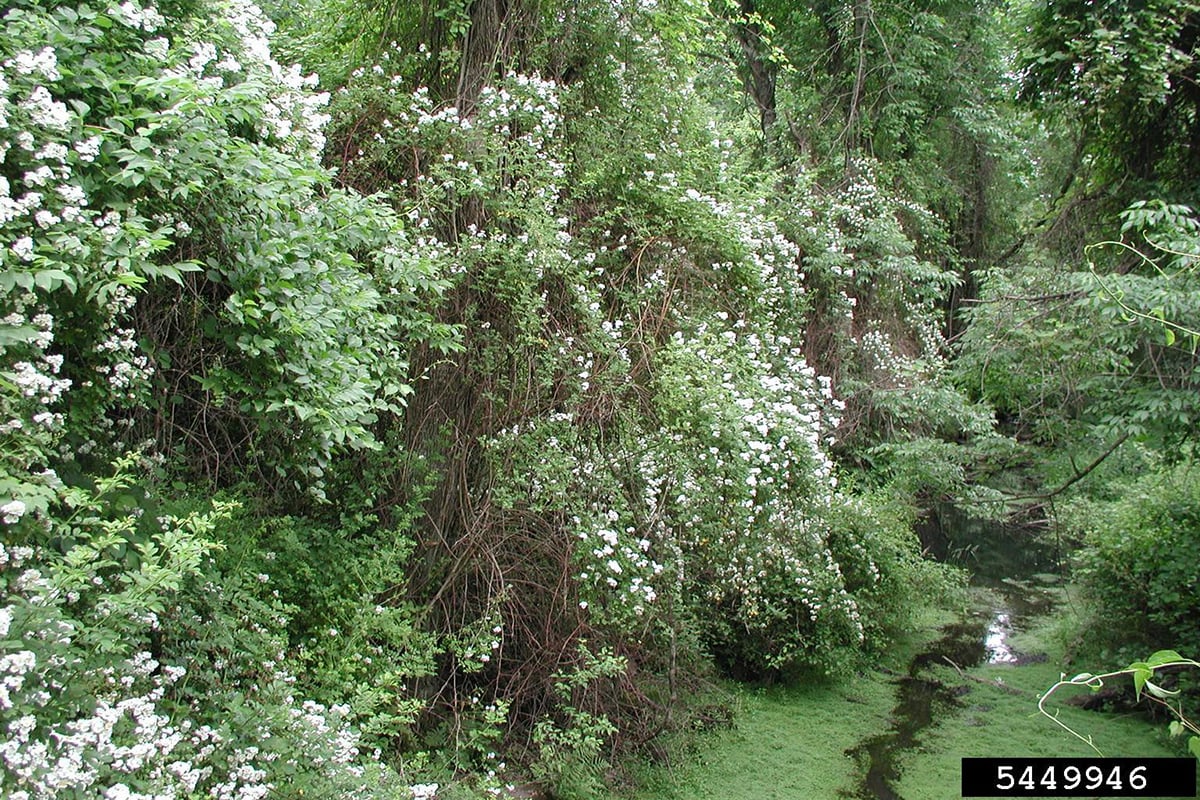
Photo: MassAudubon.
The invasive multiflora rose forms dense thickets in fields and field edges, crowding out other species.
The problem with invasive species that aren’t native to a region is that they crowd out the local species, and that has a snowball effect. We colonists crowded out indigenous people, which among other things, undermined wisdom about protecting nature. In the plant world, local pollinators don’t get what they need to pollinate. The list goes on.
Frank Carini reports at ecoRINews on how invaders hurt both the environment and the economy: “Invasive Asian shore crabs are outcompeting young lobsters. Invasive snake worms and hammerhead worms are burying themselves deeper into southern New England, where the former consumes the top layer of soil and dead leaves where the seeds of plants germinate, and the latter is toxic and transmits harmful parasites to humans and animals.
“Invasive multiflora rose and oriental bittersweet have long been embedded in the region, crowding out native vegetation and strangling trees. …
“Last summer, the Intergovernmental Science-Policy Platform on Biodiversity and Ecosystem Services (IPBES) for the United Nations issued a global assessment providing clear evidence of this growing threat.
“In a paper recently published in the journal Nature Ecology & Evolution, the authors of last year’s assessment — 88 experts representing 101 organizations from 47 countries — outline the main findings from that report and echo the need for urgent action.
“Laura Meyerson, a University of Rhode Island professor of invasion science and habitat restoration ecology and editor-in-chief of the journal Biological Invasions, is a contributing lead author on the IPBES assessment and a lead author on the recent paper. …
“She said, ‘Our research produced overwhelming and unequivocal evidence that the negative impacts of biological invasions far outweigh any benefits and that those who depend most on nature suffer the worst consequences.’
“The researchers documented some 37,000 invasive species that had been introduced by people to areas around the world. Of those, about 3,500 species were considered harmful invaders that negatively affect nature and people’s quality of life.
“The number of invasive species — major drivers of global biodiversity loss, according to Meyerson — are expected to continue to grow. Some 200 new species are expected to be added annually by human activities in regions that have not recorded such invaders before, according to the June 3 paper. And established invasives will continue to expand their ranges, spreading into new countries and choking out native species.
“The paper also noted that simple extrapolations from current impacts from invasive species are likely to underestimate the level of future impacts, and drivers of biodiversity loss, such as the climate crisis, are acting in concert and those interactions are increasing biological invasions. …
“ ‘It’s critically important that we all do our part to reverse current trends,’ Meyerson said. ‘The public can make sure that the plants they are buying for their gardens are native species. Pet owners should not release animals, like rabbits or Burmese pythons, that are no longer wanted into the wild.’
“For example, red-eared sliders — native to the Southeast, the south-central United States, and northern Mexico — are the most popular pet turtle in the United States and available at pet shops around the world. But this turtle species lives for about 30 years, so they are often released where they don’t belong after pet owners tire of them. As a result, they are considered one of the world’s 100 most invasive species.
“Meyerson is also the senior author on a global study that explored the extent of biological invasions on lands owned or managed by Indigenous people. The study was published in Nature Sustainability in late May.
“The spread of animal and plant species into new regions by humans is increasing rapidly worldwide, with thousands of species now present in regions outside their native range. The research team, which included scientists from Australia, Austria, Germany, Hungary, and the United States, investigated the spread of invasive species to lands managed by Indigenous people and found significantly fewer invaders in those areas compared with other natural areas.
“ ‘This was a really important finding because even after controlling for the remoteness and accessibility of Indigenous peoples’ lands and how land is used, in general, the numbers of invasive species are lower, as is biodiversity loss,’ Meyerson said. …
“Researchers analyzed millions of available data points from around the globe on the distribution of non-native plant and animal species. On average, there were 30% fewer non-native species on Indigenous lands. The study suggested the enormous difference is primarily due to sustainable land use, a higher proportion of forests, and lower accessibility to humans.
“Indigenous people represent ethnic groups that settled in regions long before the arrival of Europeans, such as Native Americans, the Aborigines of Australia, and the Sami in Scandinavia. About 28% of the land surface around the globe is inhabited by Indigenous people. Most of these areas are in remote regions and many have enormous importance for conservation of biodiversity such as the Amazon basin and wilderness areas in the Arctic.”
More at ecoRI News, here. No firewall. Donations solicited.

 Suzanne's Mom's Blog