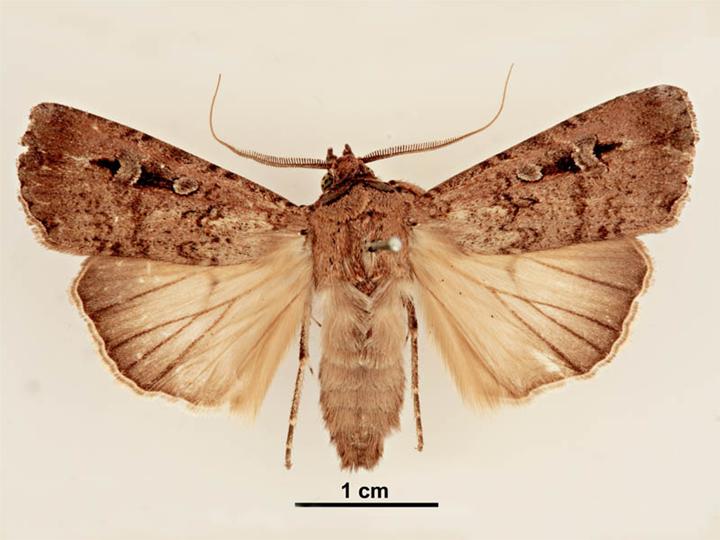
Photo: Lucinda Gibson and Ken Walker/Museum Victoria.
The endangered bogong moth can travel great distances to a place it has never been to before. It uses the stars to navigate.
Some of the least prepossessing critters in nature often have interesting attributes that could teach us a lot if we pay attention.
Ari Daniel reports at National Public Radio (NPR), “The Bogong moths of Australia aren’t much to look at, says Andrea Adden, a neurobiologist at the Francis Crick Institute. ‘They’re small brown moths with arrow-like markings on the wings. They’re pretty nondescript.’
“But these insects undertake an epic migration twice in their lifetime, traveling hundreds of miles in each direction.
“Researchers have shown that the Earth’s magnetic field helps the moths orient, but that alone wasn’t sufficient. ‘They needed something visual to go with it,’ says Adden.
“She wanted to know what that cue might be over such a vast landscape — especially at night when there’s little light.
“In a paper published in the journal Nature, Adden and her colleagues show that the cue comes from the heavens. That is, the starry sky allows the Bogong moths to both orient and navigate.
“Bogong moths follow an annual rhythm. They hatch in their breeding grounds in the spring in southeast Australia where it gets really hot in the summertime. ‘So if they were to reproduce immediately, their larvae would starve because there is not enough food,’ says Adden.
“Instead, the moths migrate over multiple nights more than 600 miles south to the Australian Alps where they settle in cooler caves, entering into a dormant phase called estivation (like hibernation but in the summer), by the millions. …
“In the fall, they return to their breeding grounds, mate, lay their eggs, and die.
” ‘Then the next year, the new moths hatch,’ says Adden. ‘And they’ve never been to the mountains. They have no parents who can tell them how to get there.’ And yet they make it.
“She suspected the stars might offer just the cue they need. To test her theory, Adden, who was doing her Ph.D. at Lund University in Sweden at the time, and her colleagues caught moths in the Australian Alps and ran them through one of two experiments in the dead of night.
“The first was a behavioral test. It involved placing a moth inside what was basically a mini-planetarium that contained a projection of the night sky and no magnetic field. … The result surprised the researchers.
” ‘They didn’t just circle and do twists and turns, but they actually chose a fairly stable direction,’ she said. ‘Not only that, it was their migratory direction.’ In other words, the moths were using the starry sky as a compass cue to orient and navigate.
“Adden’s next question involved what was happening in the moth’s brain. She recorded the electrical activity of individual neurons while rotating a projection of the Milky Way.
“When she looked in the brain regions that process visual information, the majority of neurons were active when the moth was facing south. This specific direction suggests that the moths’ brains encode direction by processing visual cues of the Milky Way. …
“The moths’ ability to use both visual and magnetic information to navigate can be essential for survival — in case it’s cloudy, say, or the magnetic field is unreliable. ‘If one fails, they have a backup system,’ says [biologist Pauline Fleischmann at the University of Oldenburg].
“The Bogong moths are endangered. Adden says her findings could help conserve these insects — and everything that relies on them for food.”
More at NPR, here.


 Suzanne's Mom's Blog