Feeds:
Posts
Comments

Posts Tagged ‘nepal’

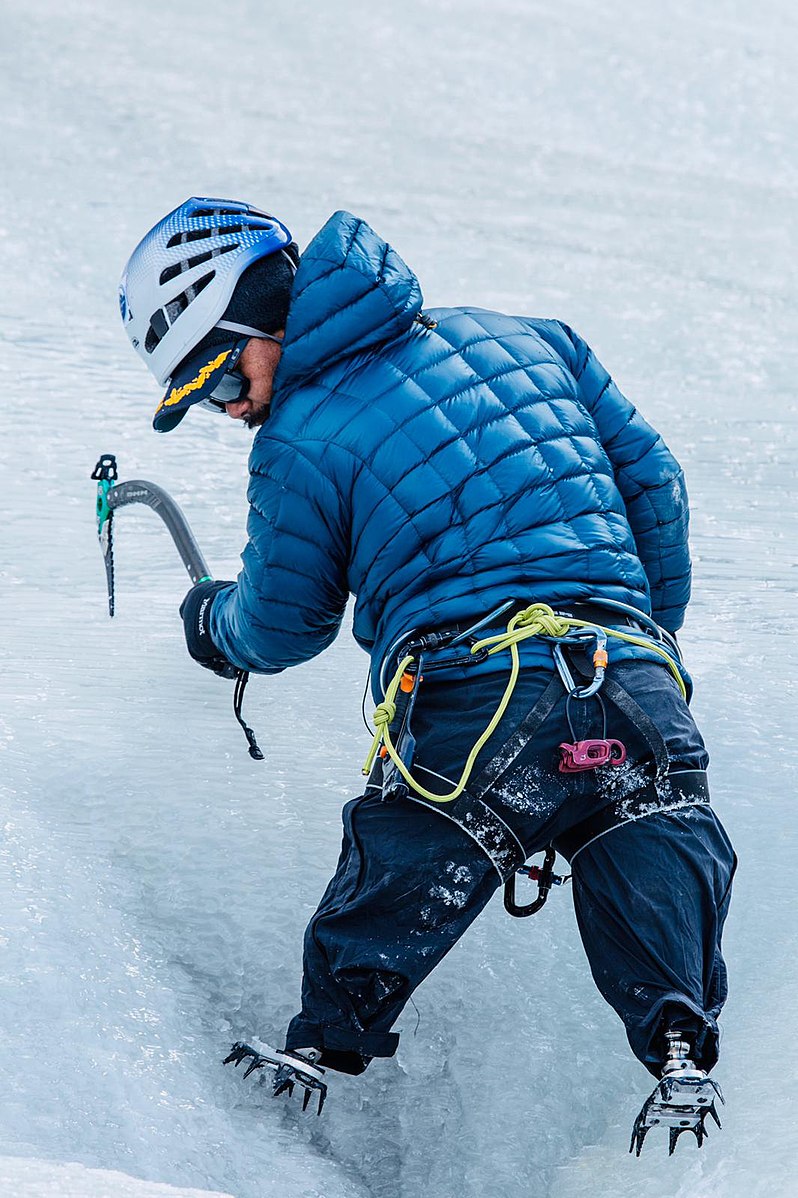
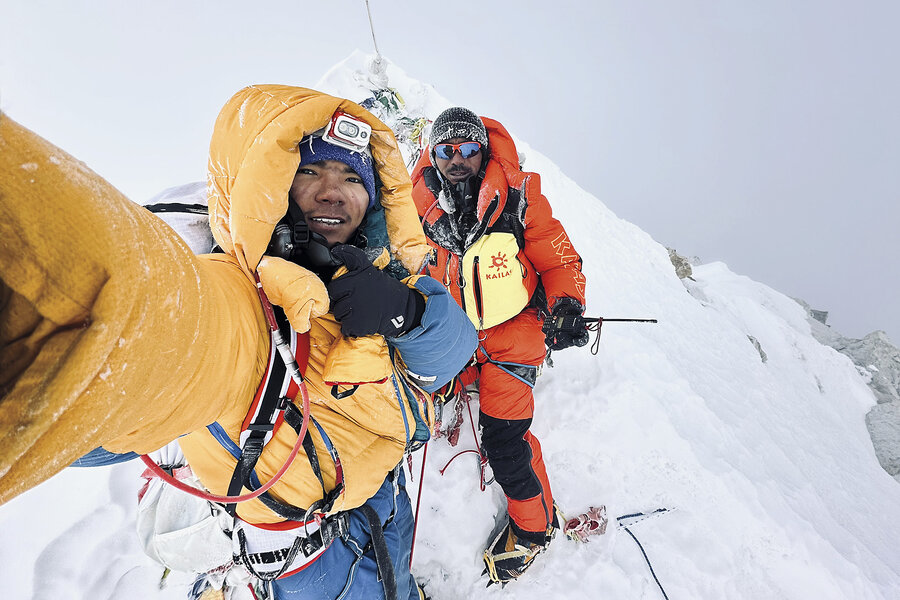
Photo: Nima Rinji Sherpa.
This sherpa “aims to inspire more young people to break away from the Sherpa tradition of serving only as helpers on expeditions,” says the
Monitor.

It reassures me about the world when I see young people deciding on new paths and leading the way. In today’s story, we learn about a young Nepalese sherpa who wants to help young people like him to start climbing on their own terms.

Reporting from Kathmandu, the Christian Science Monitor‘s Aakash Hassan, writes, “On a bright afternoon, Nima Rinji Sherpa’s stroll down a crowded Kathmandu street is frequently interrupted by people coming to greet him. Some give him a warm pat on the back. As he joins friends for lunch at a pizzeria, its owner rushes to embrace him, gushing, ‘You are making us proud, Nima.’ …

“In October 2024, at age 18, he became the youngest person to summit the world’s 14 mountains higher than 8,000 meters (26,247 feet). Apart from Nepal, these mountains are in Pakistan, China, and India. 

“Mr. Rinji hails from a family of Sherpas, an ethnic Tibetan tribe living in Nepal whose people are pioneers in mountaineering. For generations, they have been highly sought-after guides and porters for international clients making the world’s most difficult climbs. …

“He is seen as a trailblazer who is pursuing climbing as a professional mountaineering athlete and who aims to inspire more young people to break away from the Sherpa tradition of serving only as helpers on expeditions. …

“Mr. Rinji’s father, Tashi Lakpa Sherpa, has summited Mount Everest nine times; at age 19, he became the youngest person to summit Everest without additional oxygen. …

“Mr. Rinji nevertheless showed no interest in climbing in his early teenage days. But in 2020, during the lockdown imposed for the COVID-19 pandemic, he developed an interest in photography and eventually followed his father up mountains with the hope of capturing scenic photos and videos. 

“On the first trek, Mr. Rinji says, he surprised his father by matching his pace and kept following him in the coming weeks on more trails, awestruck by the ‘beautiful and overwhelming’ mountains. Soon, Mr. Rinji was part of his father’s training sessions for professional climbers and was determined to summit the Himalayas. 

“In September 2022, a few months after Mr. Rinji turned 16 – Nepal’s legal age for climbing – he was part of an expedition to Mount Manaslu, the world’s eighth-highest mountain at 8,163 meters. There Mr. Rinji had firsthand experience of the challenges climbers face and of how tirelessly Sherpas work for their clients.

“Out of 500 people who were at the base camp preparing to summit that season, he says, only about 100 achieved the feat. Twenty people were caught in avalanches and had to be rescued. …

“ ‘I think I was one of the last people to summit. Then it clicked,’ he says with a smile and some pride showing on his face. 

“After that, he kept summiting one after another ‘eight-thousanders.’ …

“It was during his 14-peaks expedition spread over the span of two years that Mr. Rinji realized the extraordinary, underrecognized work of Sherpas. …

” ‘It’s our duty to vocalize ourselves, to take credit for who we are.’ 

“Making his own case as an example, he says he didn’t receive support from any major sponsors for his 14-peaks expedition and had to rely on the resources of his family. …

“Mr. Rinji has been meeting with young Sherpas who work as guides – or aspire to be guides – to motivate them to see themselves as athletes. He visits schools, addresses public events, and posts on social media about the need for young Nepalese to be ‘leaders’ in climbing. 

“With the help of his father’s expedition company, he provides free courses, or charges a nominal fee, to train young people who want to become athletes. …

“Mr. Lakpa is proud of his son not only for what he has achieved but also because ‘he is working for himself.’ 

“Lakpa Temba, a Sherpa who works for an expedition company in Kathmandu, says Mr. Rinji is broadening the employment horizons for Sherpas. ‘Nima is showing us a middle path,’ he says, ‘where you are climbing mountains for yourself, on your own terms.’ 

“Veteran Sherpas also believe that having more people from Nepal become athletes in climbing will bring new attention and opportunities for Sherpas. And it could attract more people to Nepal, a poor country that relies on tourism.”

More at the Monitor, here.
Read Full Post »

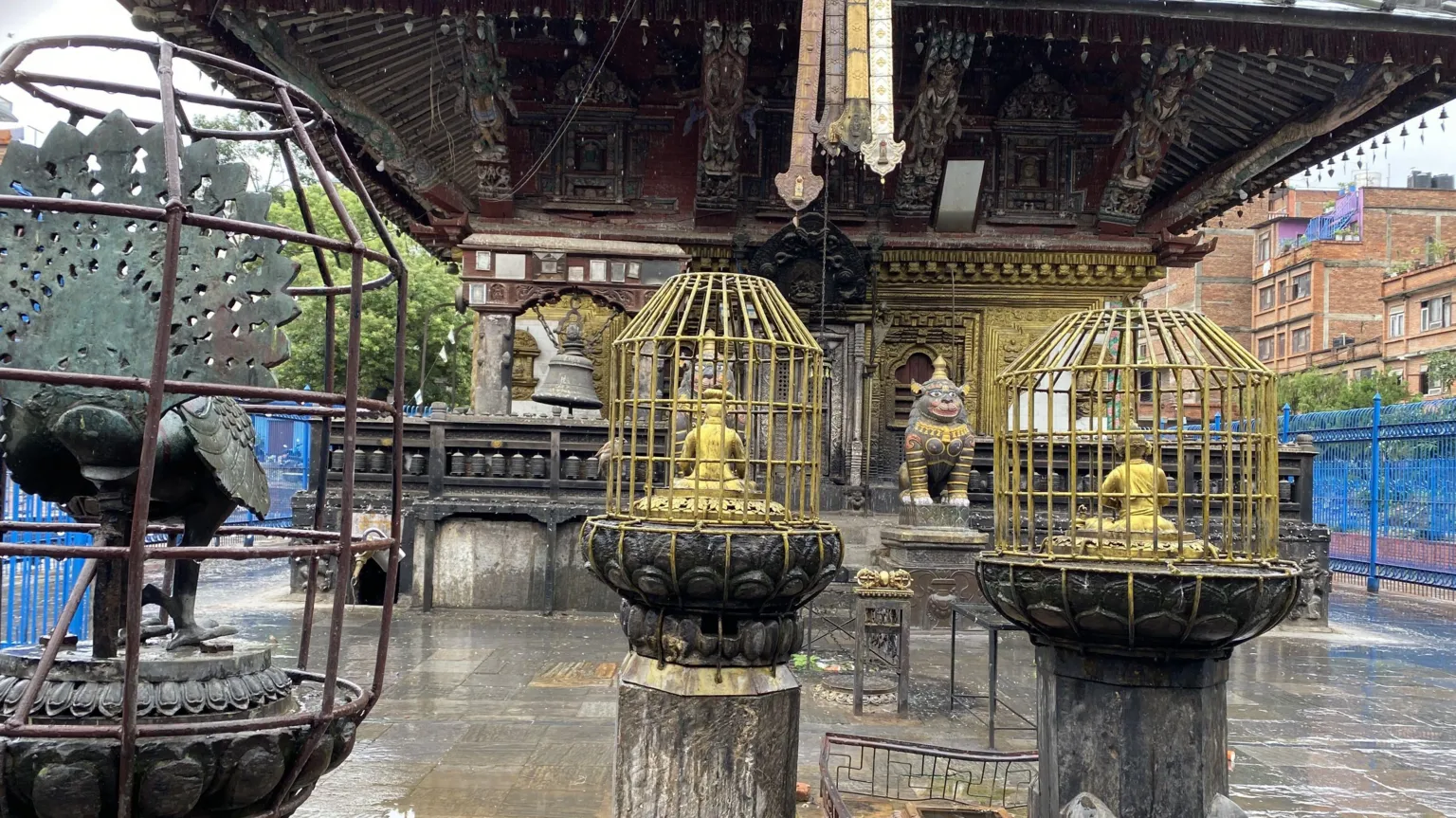
Photo: Sanjaya Dhakal/BBC Nepali.
In Nepal, some communities have put their recovered idols in iron cages for security.

Who does art belong to? For centuries, looters have justified their thefts by asserting that they aim to protect the stolen art for posterity. That no longer holds up, and now art is getting returned to the plundered countries.

And if you play nice and return Nepali idols, you may be given an accurate replica.

Sanjaya Dhakal writes at The Guardian, “Along a small street in Nepal’s Bhaktapur city stands an unassuming building with a strange name — the Museum of Stolen Art. Inside it are rooms filled with statues of Nepal’s sacred gods and goddesses.

“Among them is the Saraswati sculpture. Sitting atop a lotus, the Hindu goddess of wisdom holds a book, prayer beads and a classical instrument called a veena in her four hands.

“But like all the other sculptures in the room, the statue is a fake. The Saraswati is one of 45 replicas in the museum, which will have an official site in Panauti, set to open to the public in 2026.

“The museum is the brainchild of Nepalese conservationist Rabindra Puri, who is spearheading a mission to secure the return of dozens of Nepal’s stolen artifacts, many of which are scattered across museums, auction houses or private collections in countries like the US, UK and France.

“In the past five years, he has hired half a dozen craftsmen to create replicas of these statues, each taking between three months and a year to finish. The museum has not received any government funding. His mission is to secure the return of these stolen artifacts – in exchange for the replicas he has created.

“In Nepal, such statues reside in temples all across the country and are regarded as part of the country’s ‘living culture,’ rather than mere showpieces, says Sanjay Adhikari, the secretary of the Nepal Heritage Recovery Campaign. Many are worshipped by locals every day, with some followers offering food and flowers to the gods. …

“It is also common for followers to touch these statues for blessings — meaning they are also rarely guarded — leaving them wide open for thieves.

“Nepal has categorized more than 400 artifacts missing from temples and monasteries across the country, but the number is highly likely to be an underestimate, says Saubhagya Pradhananga, who heads the official Department of Archaeology.

“From the 1960s to the 1980s, hundreds of artifacts were looted from Nepal as the isolated country was opening up to the outside world. Many of the country’s most powerful administrators back then were believed to have been behind some of these thefts — responsible for smuggling them abroad to art collectors and pocketing the proceeds.

“For decades, Nepalis were largely unaware about their missing art and where it had gone, but that has been changing, especially since the founding of the National Heritage Recovery Campaign in 2021 – a movement led by citizen activists to reclaim lost treasures. …

“There are many hurdles. The Taleju Necklace, dating back to the 17th century, is a case in point. …

“It’s still unclear how it might have been stolen and many in Nepal had no idea where it might have gone until three years ago, when it was seen in an unlikely place – the Art Institute of Chicago.

“It was spotted by Dr Sweta Gyanu Baniya, a Nepali academic based in the US who said she fell to her knees and started to cry when she saw the necklace.

“According to the Art Institute of Chicago, the necklace is a gift from the Alsdorf Foundation — a private US foundation. The museum told the BBC it has communicated with the Nepali government and is awaiting additional information.

“It’s not just a necklace, it’s a part of our goddess who we worship. I felt like it shouldn’t be here. It’s sacred,” she told the US university Virginia Tech. …

“But [Saubhagya Pradhananga, who heads the official Department of Archaeology] said Nepal’s Department of Archaeology had provided enough evidence, including archival records. On top of that, an inscription on the necklace says it was specifically made for the Goddess of Taleju by King Pratap Malla.

“It’s these ‘tactics of delay’ that often ‘wear down campaigners,’ says one activist, Kanak Mani Dixit. ‘They like to use the word “provenance” whereby they ask for evidence from us. The onus is put on us to prove that it belongs to Nepal, rather than on themselves on how they got hold of them.’ …

“Many worshippers are now a lot more paranoid — putting these idols in iron cages to protect them from going missing.

“Mr Puri however hopes his museum will eventually have its shelves wiped bare.”

More at the BBC, here. No paywall.

Read Full Post »

Photo: Shanta Nepali.
He lost his legs in Afghanistan, went on to summit Everest.

Today’s story reminds me that people can overcome almost anything if it’s important to them — and if they believe they can.

Bryan Pietsch has the story at the Washington Post.

“Hari Budha Magar was born in the foothills of the Himalayas. Growing up in Nepal, surrounded by the mountains and seeing Mount Everest constantly in textbooks and local media, he thought about climbing it someday.

“But school kept him busy, and then at 19, he left his country to join a Gurkha unit in the British army. He saw and skied through mountain ranges around the world on his missions and travels, but he was still ‘thinking about Everest all the time,’ he said in an interview.

“Those bucket-list plans to climb the world’s tallest peak were complicated by an explosion in Afghanistan in 2010 that left Budha Magar with above-the-knee amputations on both of his legs. But after years of preparation — and delays due to the coronavirus pandemic and a rule that sought to keep people with certain physical disabilities off the mountain — Budha Magar made history [in May] by becoming the first above-the-knee double amputee to summit the 29,000-foot peak. …

“Budha Magar was part of a 12-person team led by Krishna Thapa, another Gurkha veteran. The pair served together in the army for three years and were reunited in 2016 as Thapa was planning an Everest expedition.

“ ‘What do you think? I’ve got no legs,’ Thapa recalled Budha Magar asking him. ‘Do you think it is possible I could climb Everest?’

“ ‘We can only try,’ Thapa replied.

“After acclimating to the elevation and the snowy, windy environment at base camp, the team intended to start the journey to the summit on April 17 — exactly 13 years after the explosion in Afghanistan that took Budha Magar’s legs — but poor weather delayed them for weeks. This year’s conditions were especially difficult, Thapa said. …

“Unpredictable wind — despite access to three separate weather forecasting tools — and conditions such as slushy snow [proved] challenging. ‘The snow was soft,’ Budha Magar said, ‘and I didn’t have knees to lift up.’

“Budha Magar said there were times when he wanted to give up, and Thapa said there were a couple of moments when he thought they wouldn’t be able to move forward. But they persisted.

“ ‘Hari kept surprising me,’ Thapa said.

“They summited about 3:10 p.m. [May 19], spending only a few minutes at the peak due to harsh conditions. At the summit, Budha Magar said his tears — happy ones — froze on his cheek. Some on the team had to fetch more oxygen on the descent, and Budha Magar was so exhausted that he slid down on his rear end for part of it. …

“Budha Magar, who lives in Canterbury, England, said his 10-year-old son was especially worried about him attempting the climb. ‘I promised myself, “I’ll come back for you. I’m not going to go die up there,” ‘ he said. …

“Many Nepalese believe that people with disabilities were sinners in their past lives, Budha Magar said.

“ ‘I wanted to show that disabled people can have a happy, successful and meaningful life,’ he said. ‘Our disability might be our weakness, but we can do many other things.’ ”

More at the Post, here.

Read Full Post »

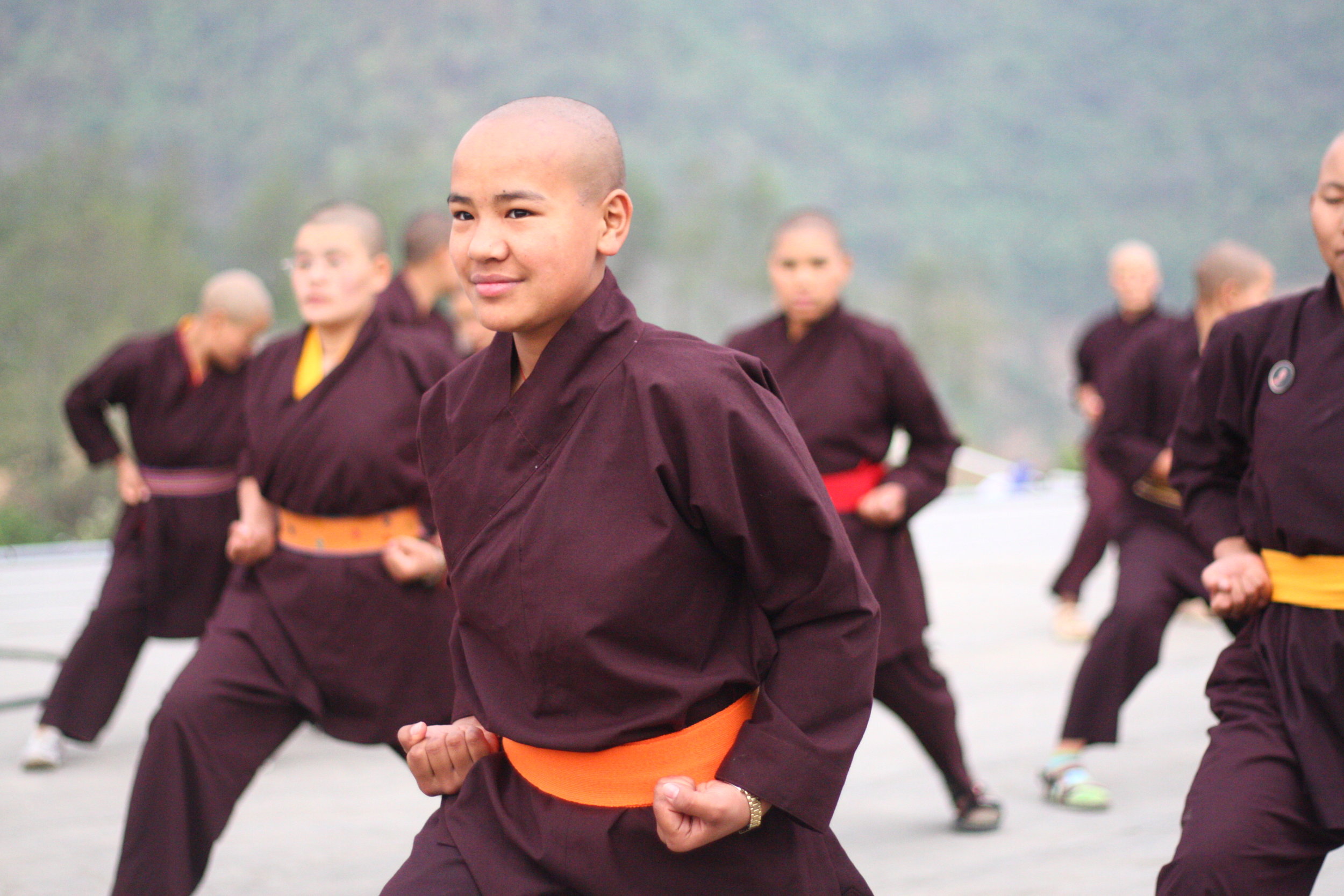
Photo: Kung Fu Nuns.

The roles of women around the world keep evolving. Today we learn that the traditionally quiet Buddhist nuns of Nepal are branching out — through their practice of kung fu and through good works in the community.

Sameer Yasir reports at the New York Times, “As the first rays of sun pierced through the clouds covering snowcapped Himalayan peaks, Jigme Rabsal Lhamo, a Buddhist nun, drew a sword from behind her back and thrust it toward her opponent, toppling her to the ground. …

“Ms. Lhamo and the other members of her religious order are known as the Kung Fu nuns, part of an 800-year-old Buddhist sect called Drukpa, the Tibetan word for dragon. Across the Himalayan region, and the wider world, its followers now mix meditation with martial arts.

“Every day, the nuns swap their maroon robes for an umber brown uniform to practice Kung Fu, the ancient Chinese martial art. It’s part of their spiritual mission to achieve gender equality and physical fitness; their Buddhist beliefs also call on them to lead an environmentally friendly life.

“Mornings inside the [Druk Amitabha] nunnery are filled with the thuds of heavy footsteps and the clanking of swords as the nuns train under Ms. Lhamo’s tutelage. …

“ ‘Kung Fu helps us to break gender barriers and develop inner confidence,’ said Ms. Lhamo, 34, who arrived at the nunnery a dozen years ago from Ladakh, in northern India. ‘It also helps to take care of others during crises.’

“For as long as scholars of Buddhism remember, women in the Himalayas who sought to practice as spiritual equals with male monks were stigmatized, both by religious leaders and broader social customs. Barred from engaging in the intense philosophic debates encouraged among monks, women were confined to chores like cooking and cleaning inside monasteries and temples. They were forbidden from activities involving physical exertion or from leading prayers or even from singing.

“In recent decades, those restrictions have become the heart of a raging battle waged by thousands of nuns across many sects of Himalayan Buddhism.

“Leading the charge for change are the Kung Fu nuns, whose Drukpa sect began a reformist movement 30 years ago under the leadership of Jigme Pema Wangchen, who is also known as the 12th Gyalwang Drukpa. He was willing to disrupt centuries of tradition and wanted nuns who would carry the sect’s religious message outside monastery walls.

‘We are changing rules of the game,’ said Konchok Lhamo, 29, a Kung Fu nun. ‘It is not enough to meditate on a cushion inside a monastery.’

“Every year for the past 20, except for a hiatus during the pandemic, the nuns have cycled about 1,250 miles from Kathmandu to Ladakh, high in the Himalayas, to promote green transportation. Along the way, they stop to educate people in rural parts of both Nepal and India about gender equality and the importance of girls.

“The sect’s nuns were first introduced to martial arts in 2008 by followers from Vietnam, who had come to the nunnery to learn scriptures and how to play the instruments used during prayers. Since then, about 800 nuns have been trained in martial arts basics, with around 90 going through intense lessons to become trainers.

“The 12th Gyalwang Drukpa has also been training the nuns to become chant masters, a position once reserved only for men. He has also given them the highest level of teaching, called Mahamudra, a Sanskrit word for ‘great seal,’ an advanced system of meditation. …

“But the changes for the sect have not come without intense backlash, and conservative Buddhists have threatened to burn Drukpa temples. During their trips down the steep slopes from the nunnery to the local market, the nuns have been verbally abused by monks from other sects. But that doesn’t deter them, they say. When they travel, heads shaved, on trips in their open vans, they can look like soldiers ready to be deployed on the front line and capable of confronting any bias.

“The sect’s vast campus is home to 350 nuns, who live with ducks, turkeys, swans, goats, 20 dogs, a horse and a cow, all rescued either from the knife of butchers or from the streets. The women work as painters, artists, plumbers, gardeners, electricians and masons, and also manage a library and medical clinic for laypeople.

“ ‘When people come to the monastery and see us working, they start thinking being a nun is not being “useless,” ‘ said Zekit Lhamo, 28, referring to an insult sometimes hurled at the nuns. ‘We are not only taking care of our religion but the society, too.’ ”

More at the Times, here. The pictures are wonderful, but you do need a subscription.

Read Full Post »

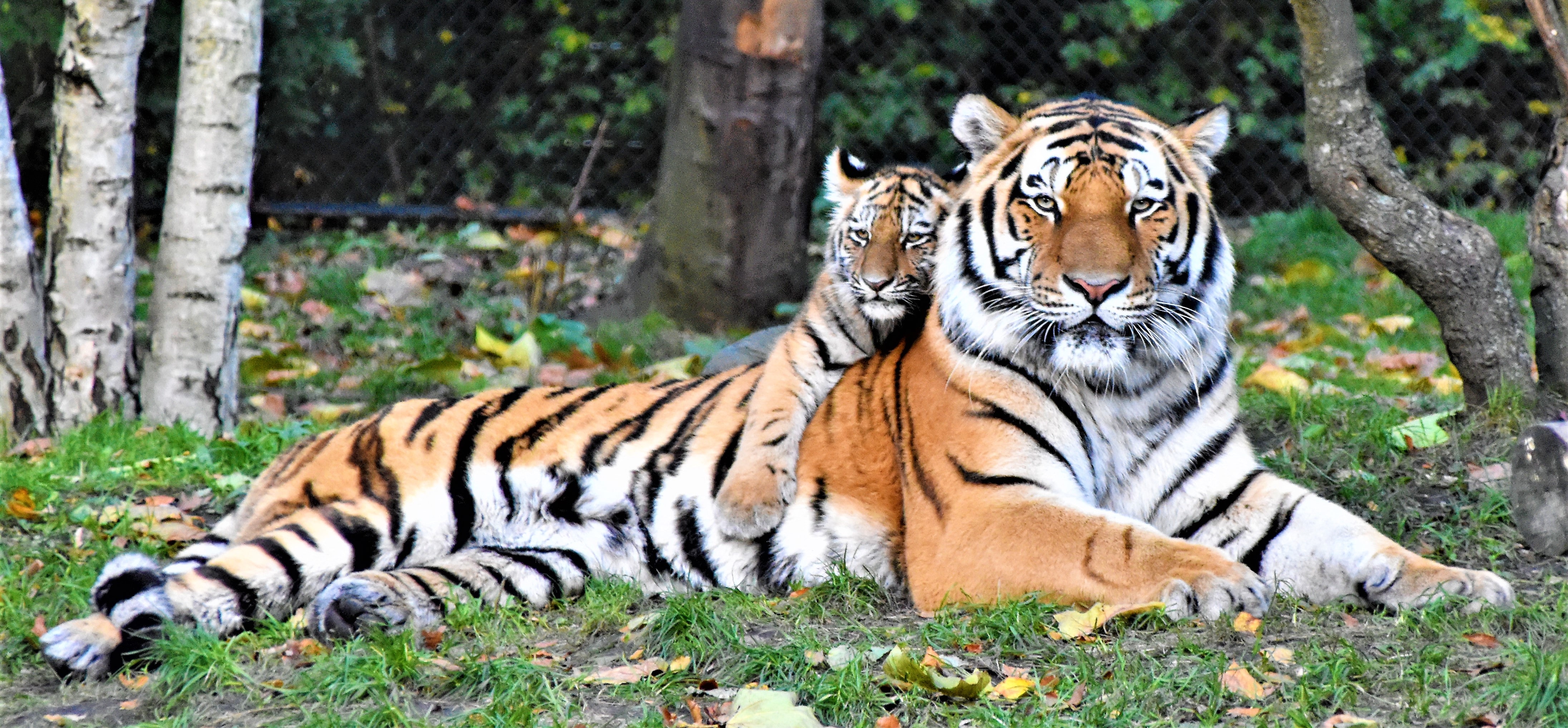
Photo: Waldemar Brandt/Unsplash.
Though still endangered, tigers are doing better this year than last year.

We hear so much about species on the verge of extinction that we have to blink twice get it through our heads that anything is coming back. That’s why I like today’s story.

Dino Grandoni reports at the Washington Post that “tigers are having a good year. Nepalese officials announced [in July] that the top predator’s numbers within the country’s borders have more than doubled in a bit more than a decade. Across Asia, there are as many as 5,500 tigers prowling jungles and swamps, a leading wildlife group said last week, a 40 percent jump from its 2015 assessment.

“The slow but steady rise in the big cat’s estimated population comes as biologists get better at tracking the animal and marks a high point amid a deepening extinction crisis that may see as many as a million plants and animal species disappear worldwide because of habitat loss and climate change.

“Tiger researchers, while optimistic, warn that the fierce hunter remains under threat from both poaching and encroachment into its remaining habitat. …

“ ‘It’s a fragile success,’ said Dale Miquelle, tiger program coordinator for the Wildlife Conservation Society. ‘There are still many pressures on tiger populations, and they are disappearing from some areas.’

“There are between 3,726 and 5,578 tigers in the wild today, according to the International Union for Conservation of Nature (IUCN), which tracks the status of plants and animals facing extinction. Tens of thousands of tigers once roamed Asia.

“One big reason behind the recent jump in tiger estimates: Scientists have simply gotten better at counting the cats, placing motion-sensing cameras in more spots to identify their territory. …

“But a combination of expanding protected areas and targeting poachers who sell tiger parts for use in traditional medicine has allowed tigers to stabilize or recover in China, India and Thailand.

“ ‘In all of those countries, tiger conservation has been a priority at the highest levels of government,’ said Ginette Hemley, senior vice president of wildlife conservation at World Wildlife Fund.

“Asia’s most iconic predator is perhaps doing best of all in Nepal, where the estimated population has soared from 121 to 355 since 2009, its government said Friday, after the small Himalayan country committed to restoring habitat and dispatched military units to patrol for poachers.

“The grassy lowlands between Nepal and India near the Himalayan foothills — known as the Terai — teem with grazing animals, making it among the most productive potential habitats for the carnivore. …

“Tigers once roamed from Turkey in the west to the eastern coast of Russia and from frigid forests of Siberia in the north to tropical islands of Indonesia in the south. But a century of hunting both tigers and their prey has restricted their range and decimated their numbers.

“By the 1940s, wild tigers vanished from Singapore and Bali. By the 1960s, they were gone for good in Hong Kong and Java. In recent decades, they disappeared from Cambodia, Laos and Vietnam. And today, they continue to die out in Malaysia. …

“Both revered and feared across the globe, the tiger is a classic ‘charismatic megafauna’ — a big, regal animal that receives outsize attention and money in the conservation movement. But by protecting tigers, Miquelle said, conservationists end up protecting entire ecosystems on which other animals and people depend.

“ ‘When we talk about protecting tigers, you’re really talking about protecting the environment that people also need to survive and live a better life,’ he said.

“Yet, as tigers rebound, conflicts arise. In India, home to two-thirds of the world’s wild tigers, the big cats killed 383 people between 2010 and 2019, testing the tolerance of locals for living among them. A protest erupted in a Nepalese village this June after tiger and leopard attacks.

“In a bid to bolster incomes and provide economic incentive for tiger conservation, groups such as the WWF are encouraging residents to open their homes to ecotourists hoping to see the animals.

“Further complicating conservation efforts is Russia’s war in Ukraine, which has made it more difficult for researchers to collaborate with Russian counterparts and to attend a major tiger forum in the port city of Vladivostok scheduled for September.

“And rising seas fueled by global warming threaten to inundate tiger-filled mangroves in Bangladesh, though climate change may end up expanding the cat’s range in Russia.

“Despite the gains, tigers are still officially classified as endangered in the IUCN’s Red List of Threatened Species. And countries still are failing to double their numbers.

“ ‘We haven’t succeeded in that process,’ Miquelle said. ‘But we do feel that there are more tigers today than there were 12 years ago — that progress is being made.’ ”

More at the Post, here.

Read Full Post »

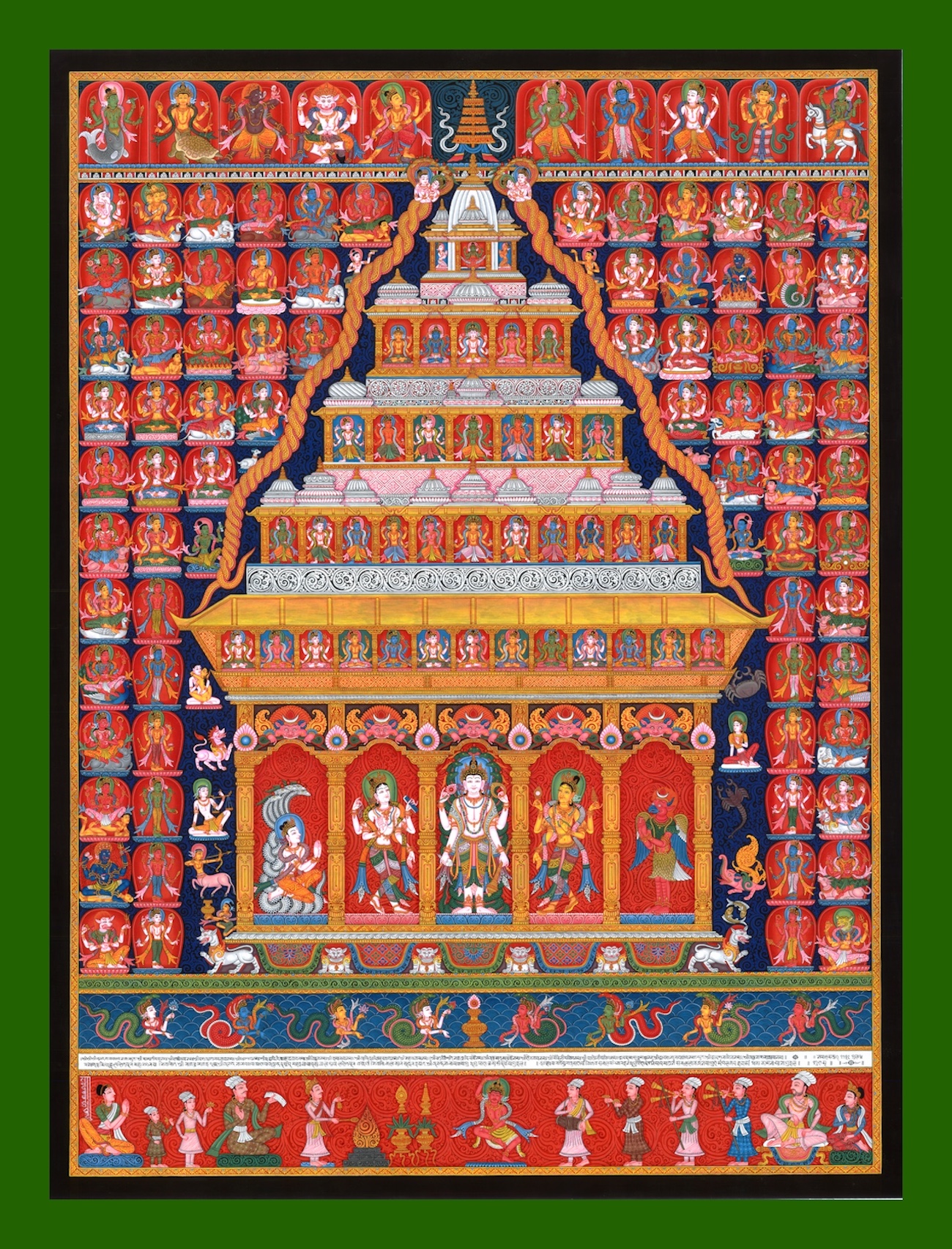
Photo: Erin L. Thompson/ Hyperallergic.
Paubhā painting of Vishnu surrounded by other major Hindu deities, based on various historical paintings from the Malla era.

Around the world, artists are finding unique ways to blend ancient and contemporary, taking the most meaningful aspects of tradition and interpreting it for new generations.

Erin L. Thompson has a story about Nepal artists at Hyperallergic.

“The Vietnamese monks said they wanted a river. So Lok Chitrakar, one of Nepal’s most prominent painters, wrote ‘need river’ amid the folds of a landscape on a preparatory sketch for the gateways of a Buddhist monastery in Vietnam.

“These drawings stretched across the wall of a room in Chitrakar’s studio when I visited Nepal late last year. I was there to see the reinstallation of a 10th-century sculpture of a deity into the shrine it had been stolen from in 1984 … but I couldn’t help being drawn into Nepal’s vibrant contemporary art scene. …

“The Chitrakars have long followed their name’s Sanskrit meaning: ‘image maker.’ But Chitrakar’s father tried to persuade him to follow a different career path, believing that it had become impossible to make a living creating paubhā, the devotional paintings used in Newar Buddhism. …

“But Chitrakar, born in 1961, persevered. His paubhās, painted following the exacting dictates of traditional form and subject matter in hand-ground mineral pigments bound with buffalo-hide glue, are now in collections and Buddhist sites across the globe. Chitrakar also receives commissions, like the one from the Vietnamese monastery. …

“Chitrakar correctly anticipated that the lull during his youth was temporary. Now, the streets around the major Buddhist pilgrimage sites in the Kathmandu Valley are lined with artists’ shops selling deities in paint, limestone, wood, and copper. Ordinary tourists take some home, but the most magnificent examples are commissioned by Tibetan Buddhists eager to establish new sanctuaries outside their homeland.         

“The Valley’s sought-after artists used the pandemic to catch up on these orders, often placed years ahead of time. Chitrakar also finished an enormous painting of the elephant-headed deity Ganesha, who is worshipped in both of Nepal’s major religions, Newar Buddhism and Hinduism. The artist had to climb a ladder to unveil the painting to me. Its intricate details took him 20 years to complete. Ganesha, worshipped as a remover of obstacles, is usually shown as a peaceful deity sampling a bowl of sweets. Chitrakar’s magnum opus depicts his wrathful side. Holding a skull cup and flourishing a variety of weapons, Ganesha dances, symbolizing the strength necessary to protect his devotees.

“Chitrakar was easy to find, but it took me much longer to track down another artist I wanted to meet. … I especially admired a mural with saddhus — Hindu ascetic sages — meditating on heaps of coals, intertwined with bouncy figures wielding spray-paint cans, wittily squirting out the traditional scroll-shaped depictions of clouds.

“I finally spoke to Sadhu X, who created the mural in collaboration with the illustrator Nica Harrison. Today, Sadhu X’s works blend traditional iconography and modern influences into his own distinct style. But when he was growing up, the only street art in Nepal was made by visiting foreign artists. In 2010, as he was completing his undergraduate degree, a teacher suggested he use the stencils he was creating on walls outside those of his art school. He followed the advice, soon met others interested in creating street art, and helped found the art space and community Kaalo.101.

“Helena Aryal, who also joined the video call, is another of Kaalo.101’s founders. She expressed her frustration at the perception, both inside and outside Nepal, that street art is a Western phenomenon. Aryal insisted that although the medium might be foreign, the form is deeply rooted in Nepal’s history. The hand-painted paper illustrations of snakes (nagas), pasted on many homes and buildings in the Valley during the annual rainy season festival, confirm that paste-ups are nothing new in Nepal. And the concept of creating art by modifying the public landscape also fits in well with the interactive, multisensory nature of devotion in Nepal, where worshippers in open street-corner shrines leave fingerprint marks in vermillion powder on deities’ foreheads and offer them marigolds, perfumes, food, and even music, by ringing bells. Some shrines are covered in names written in marker — not casual graffiti, but reminders to the gods about who has prayed for what.

Sadhu X told me that he’s never seen a rigid distinction between the style of traditional paubhās and the work of street artists he admires from other parts of the world. …

“Sometimes he thinks that his work is helping traditional Nepali art to evolve, but more often he’s just mixing together his influences and inspirations because he wants to tell stories using a visual language that he hopes his audience will understand. …

“I also had long discussions about this question with Birat Raj Bajracharya, a scholar of Newar Buddhism and part owner of a gallery selling the works of artists intent on both preserving and transforming paubhā painting. …

“Like Sadhu X, Bajracharya does not see a fundamental distinction between traditional Newar style and classical European models. For example, he pointed out to me that the texts describe paintings as portraying deities with emotionally expressive faces. But such expressions are difficult to render in the linear style of traditional paubhās. Bajracharya thus believes that the more complex shadings of emotion captured by artists who use European Renaissance techniques and the full range of colors of modern pigments may better approximate the ancient texts than the older paubhās. …

“Bajracharya advises the artists associated with his gallery about details like the color, attributes, and hand positions of deities in their paintings, making sure they follow the standards passed down in Buddhist and Hindu texts. He wants art to transform without ‘letting go of its core sense.’ “

More at Hyperallergic, here. No firewall.

Read Full Post »

The People Making a Difference series of the Christian Science Monitor is a reliable source of worthy stories that don’t make the US headlines. I thought this one — about women in Nepal holding things together as their husbands pursue jobs in India — was worth sharing.

Zoe Tabary, of the Thomson Reuters Foundation writes, “Ratna Chaudhary delicately lifts the hem of her pink and green dress with one hand, while using the other to scoop up a batch of cabbages in her garden in the village of Phulbari, a dozen kilometers from the Nepal-India border.

“She calls three women to help, who join the dance-like movement, bending and swaying as they pick up vegetables and lay them in a basket.

” ‘Since my husband works in India now, I’m responsible for harvesting all our crops,’ said Chaudhary, holding two cabbages to her face before throwing the yellower one to the ground.

“Her husband, Chatkauna, is one of at least 2.2 million Nepalis – nearly 10 percent of the population – who work abroad, according to the Nepal Institute of Development Studies.

“For the past three years, Chatkauna has taken on seasonal work for most of the year as a miner in the Indian city of Haldwani. It pays more than the daily jobs he used to do in his hometown, and he returns to Phulbari every four months to see his family and hand over his earnings. …

“The outflow of male workers – in particular from rural areas faced with worsening climate conditions – has major implications for the country’s agricultural sector, believes Madan Pariyar, project director at International Development Enterprises (iDE), a non-profit group that helps poor farmers with work and income opportunities. …

“Chaudhary used to work on a sugarcane farm in India herself. ‘We just couldn’t earn enough in our village,’ she said.

“For the past six months, however, she has cultivated her own patch of land and leases the remainder of it – 1,700 square meters (18,299 square feet) – to other poor, low-caste farmers from the ‘tharu’ ethnic minority group, one of Nepal’s largest.

“In 2015, iDE helped Chaudhary set up a village vegetable co-operative, which she chairs, to boost local farmers’ incomes. The project is part of the Building Resilience and Adaptation to Climate Extremes and Disasters (BRACED) program, funded by the British government. …

“With iDE’s help, 25 subsistence farmers – 18 women and five men – grow vegetables on 68 square-meter plots of land, which they rent from Chaudhary, paying her in cash or in kind. They bring their spare produce to a collection center, which transports the vegetables and other crops to large markets or sells them to regular buyers.

“The co-operative also gives farmers better access to cheaper seeds, fertilizers and finance such as private investment and micro-credit. While the project is still in its early days, it is already yielding results. ‘Farmers now earn 50 rupees ($0.50) more a day than they did previously,’ said Pariyar.”

More here.

Photo: Zoe Tabary
Women farmers pick vegetable crops in the village of Phulbari, Nepal, May 18, 2016.


Read Full Post »

Kimberley Mok reports at Treehugger about how a prize-winning architect plans to repurpose the rubble from the recent earthquake to rebuild Nepal in an adaptable style based on traditional Nepalese architecture.

“Japanese architect and recent Pritzker Prize winner Shigeru Ban announced back in May that he would be part of the humanitarian effort in rebuilding post-earthquake Nepal. In addition to employing his signature cardboard tube architecture, Ban has announced that he intends to re-use brick rubble from the disaster, in order to speed up the rebuilding process.

“According to Designboom, Ban’s design for relief housing will consist of a modular wooden framework measuring 3 feet by 7 feet. Immediate occupation will be made possible by tossing temporary tarps over the structure, which will allow residents and builders to rebuild at their pace, u sing rubble or other materials for the infill. Walls could be then mortared with whatever is locally available. …

“Ban studied traditional Nepalese methods of building, and used this research in the design of the operable window frames. … For the long-term, there are plans to implement some sort of prefabricated housing, which the architect has done before in the Philippines.”

More here.

Photo: Shigeru Ban

Read Full Post »

Maybe I could be a clown. One of my brothers has clowned for years, mostly at his church in Wisconsin. He really enjoys it.

This story by Elianna Bar-El story at Good magazine makes me want to know the same satisfaction medical clowns get from helping sick children. But clearly, it takes lots of training.

“On a recent visit to Wolfson Medical Center on the outskirts of Tel Aviv, Israel, Yolana Zimmerman is met with audible sighs of relief.

“ ‘Great! You’re here! We need you,’ says a nurse.

“Zimmerman is not a medical doctor. In fact, she casts quite a contrast to the typical image of a doctor with her pink leggings, cupcake apron, and eyelet bloomers — not to mention the underwear on her head and the stuffed monkey in her hands.

“Yolana ‘Yoyo’ Zimmerman is part of a team of medical clowns called Dream Doctors. The pioneering organization started in 2002 with three medical clowns at one hospital and today facilitates the work of more than 110 clowns across 28 hospitals in a country increasingly recognized as the vanguard of medical clowning. After this past April’s devastating earthquake in Nepal, for instance, the Israeli government sent an envoy from Dream Doctors to Kathmandu to work with affected children. As you might expect, the medical community is taking notice of the tiny nation’s zany medical practitioners. …

“ ‘Medical clowning has developed in Israel in a different way than anywhere else in the world,’ says Professor Ati Citron, creator and director of University of Haifa’s Medical Clowning program. ‘Medical clowns were absorbed into the medical system as part of the staff.’ …

“Walking into [a] hospital room, without missing a beat, Yoyo directs her attention to a religious man sitting beside his daughter who is sleeping in a hospital bed. He is obviously reading from the Bible. ‘Is that a good book?’ Yoyo asks. ‘I think I’ve heard something about it. … Who wrote it again?’ The father looks up at her, grinning in surprise. In the same moment Yoyo doubles over with genuine laughter, igniting a cacophony of noises from a squeezable rooster in her apron. …

“In Israel, medical clowns are involved in over 40 medical procedures, including accompanying patients to CT scans, X-rays, MRIs, chemotherapy, radiation treatment, physiotherapy, and rehabilitation. Clowns in Israel also work solo to initiate a more interactive, one-on-one relationship with patients. … Dream Doctors, which works closely with Israel’s Ministry of Health and the University of Haifa … also hosts monthly workshops for the clowns where medical staff provide them with a range of medical knowledge and training on hygiene, vaccinations, before-and-after procedures for entering a room, role-playing, case studies, and more.”

Read all the details at Good.

Photo: Ziv Sade

Read Full Post »

Photo: Geoff Childs
Cleaning harvested yartsa gunbu prior to sale. 

Thanks so much to the folks who recently signed up to follow this blog. If you joined hoping that I would blog often about the topic that drew you here, you will soon find that the posts are rather eclectic. A couple years back, Suzanne thought it would be nice to have a blog tied to Luna & Stella, and she said I could write about anything that interested me. I thought, Wow! What an opportunity!

Today’s story is from the radio show Living on Earth. It’s about Tibetans in Nepal who have managed to avoid overharvesting a fungus that’s wildly popular in China.

“Anthropologist Geoff Childs of Washington University tells host Steve Curwood how one [area] is managing to harvest the resource sustainably. …

“Nubri is a valley in Gurkha district in the country of Nepal. The residents are ethnically Tibetan. They’ve been living there for about 700 or 800 years, so it’s an indigenous population of Nepal. What they have done in contrast to other areas is they’ve limited the number of collectors to only residents of the villages, and so that keeps the number of collectors way down. …

“CHILDS: What they’ve arrived at in Nubri is a combination of what they call ‘yultim,’ which we could translate as village regulations, secular regulations, and ‘chutim,’ which are religious regulations. … What they will do is, they will decree certain areas off-limits to human exploitation, and usually that’s a sacred grove of trees, a certain slope of a mountain that a deity inhabits or something like that. … In terms of the sustainability of Yartsa Gunbu, that’s going to be important because those are areas where annually nobody will harvest it. So it can come to fruition. It can spore. It can live out its normal life cycle.

In terms of the village regulations the first one that I just mentioned is the exclusion of all outsiders. The second one is they’ve got a designated starting date, and they arrive at that by looking at the snow melt, looking at the conditions in the alpine pasture and figuring out what’s going to be the likely time when it’s best to gather it.

“And so for a couple weeks prior to the official starting date, every adult in the village has to check in four times daily to the village meetinghouse to prove that you’re not collecting early. A third thing that they do is they tax it. For the first member of your household, the tax is very low; it’s 100 rupees or approximately $1 dollar … they gather that tax and use it for communal purposes.

“CURWOOD: So this consensus process, everybody agrees, everybody trusts, but they also verify. … looking at this from a broader resource management perspective, what are some lessons that we can take away from what’s happening in Nubri?

“CHILDS: Trust indigenous people. Don’t immediately assume that as outsiders with more education we can come in and devise a system that will work for them. I think, first of all, study what’s in place. Study with an open mind and move from there.”

Photo: Geoff Childs 
Mt. Manaslu (26,759ft.) in Nubri is the 8th highest mountain in the world.

Read Full Post »