Feeds:
Posts
Comments

Posts Tagged ‘nevada’

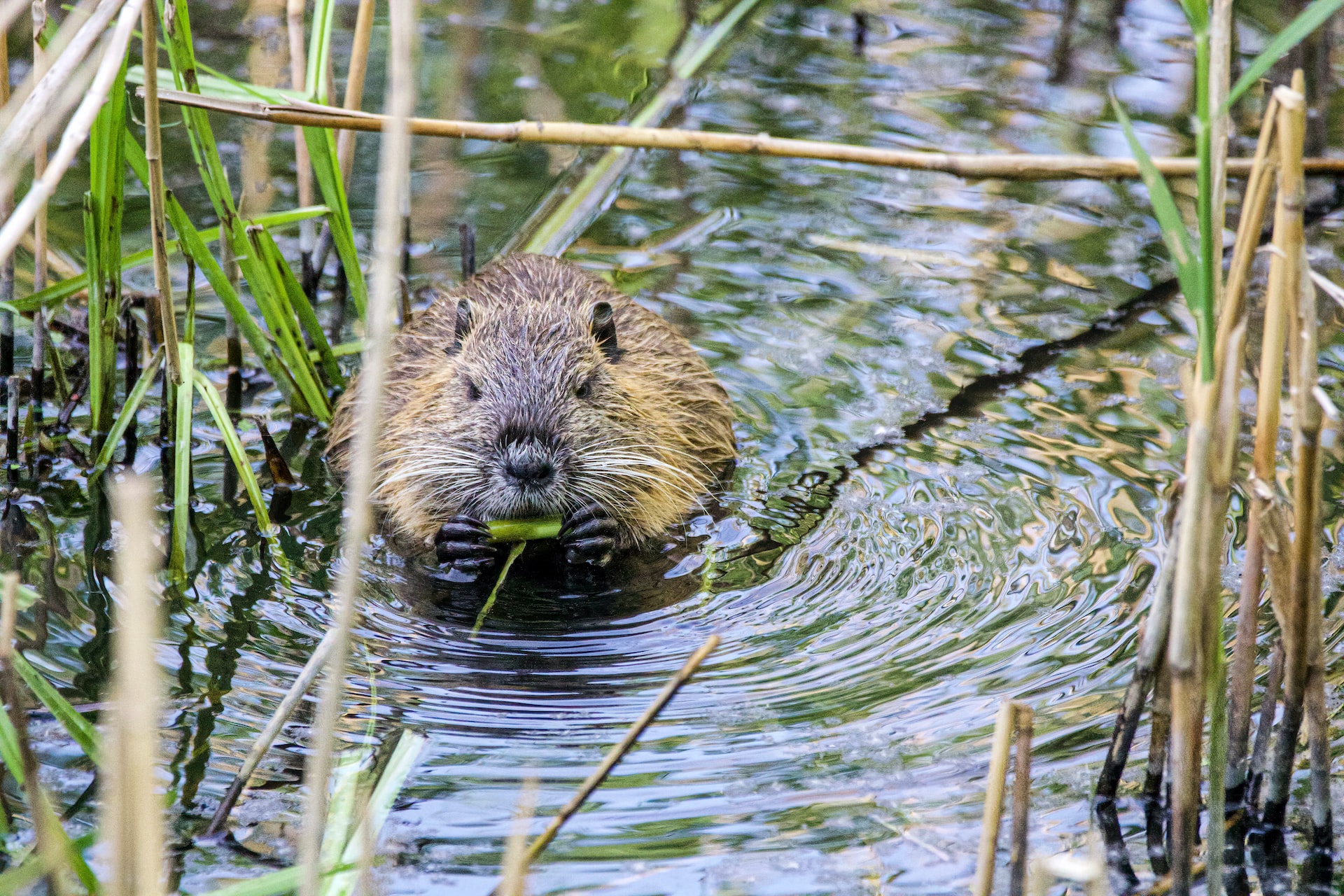
Photo: Svetozar Cenisev/ Unsplash.
When vegetation that beavers flood is dying, neighbors object to the smell. But often they like the lake that comes later.

There was a woman in my town who was up in arms about beavers flooding part of her property to build a dam. That is, she was angry until the odor of dying grasses dissipated and a beautiful lake appeared.

According to Catrin Einhorn at the New York Times, farmers out West are finding other reasons to appreciate the work of beavers.

She reports, “Horace Smith blew up a lot of beaver dams in his life. A rancher here in northeastern Nevada, he waged war against the animals, frequently with dynamite. Not from meanness or cruelty; it was a struggle over water. Mr. Smith blamed beavers for flooding some parts of his property, Cottonwood Ranch, and drying out others.

“But his son Agee, who eventually took over the ranch, is making peace. And he says welcoming beavers to work on the land is one of the best things he’s done.

“ ‘They’re very controversial still,’ said Mr. Smith, whose father died in 2014. ‘But it’s getting better. People are starting to wake up.’

“As global warming intensifies droughts, floods and wildfires, Mr. Smith has become one of a growing number of ranchers, scientists and other ‘beaver believers’ who see the creatures not only as helpers, but as furry weapons of climate resilience.

Last year, when Nevada suffered one of the worst droughts on record, beaver pools kept his cattle with enough water.

“When rains came strangely hard and fast, the vast network of dams slowed a torrent of water raging down the mountain, protecting his hay crop. And with the beavers’ help, creeks have widened into wetlands that run through the sagebrush desert, cleaning water, birthing new meadows and creating a buffer against wildfires.

“True, beavers can be complicated partners. They’re wild, swimming rodents the size of basset hounds with an obsession for building dams. When conflicts arise, and they probably will, you can’t talk it out.

“Beavers flood roads, fields, timber forests and other areas that people want dry. They fell trees without a thought as to whether humans would prefer them standing. In response to complaints, the federal government killed almost 25,000 beavers last year.

“But beavers also store lots of water for free, which is increasingly crucial in the parched West. And they don’t just help with drought. Their engineering subdues torrential floods from heavy rains or snowmelt by slowing water. It reduces erosion and recharges groundwater. And the wetlands beavers create may have the extra benefit of stashing carbon out of the atmosphere.

“In addition to all that, the rodents do environmental double duty, because they also tackle another crisis unleashed by humans: rampant biodiversity loss. Their wetlands are increasingly recognized for creating habitat for myriad species, from salmon to sage grouse.

“Beavers, you might say, are having a moment. In Colorado, Idaho, Montana, Nevada, Oregon, Utah and Wyoming, the Bureau of Land Management is working with partners to build beaver-like dams that they hope real beavers will claim and expand. In California, the new state budget designates about $1.5 million a year to restoring the animals for climate resiliency and biodiversity benefits.

“ ‘We need to get beavers back to work,’ Wade Crowfoot, California’s secretary of natural resources, said in a webinar this year. ‘Full employment for beavers.’ (Beaver believers like to note that the animals work for free.) …

“Instead of killing beavers, the federal government should be embracing them as an important component of federal climate adaptation, according to two scientists who study beavers and hydrology, Chris Jordan of National Oceanic and Atmospheric Administration Fisheries, and Emily Fairfax of California State University Channel Islands.

“ ‘It may seem trite to say that beavers are a key part of a national climate action plan, but the reality is that they are a force of 15-40 million highly skilled environmental engineers,’ Dr. Jordan and Dr. Fairfax wrote this year in a perspective article in the research journal WIREs Water. …

“When human-beaver conflicts arise, they can be addressed without killing the animals, experts say. Paint and fencing can protect trees from gnawing. Systems like the Beaver Deceiver secretly undo their handiwork with pipes that drain water from beaver settlements even when the animals keep building. Such measures are actually a more effective solution than removing the animals, according to advocates, because new beavers tend to move into empty habitat.

“If coexistence is impossible, a growing number of groups and private businesses are seeking to relocate, rather than kill, nuisance beavers.

“ ‘We put the nuisance in air quotes,’ said Molly Alves, a wildlife biologist with the Tulalip Tribes, a federally recognized tribal organization just north of Seattle that moves unwanted beavers to land managed by the United States Forest Service.

“The group’s impetus was a desire to expand the extraordinary habitat that beavers offer salmon, a culturally and economically important species. When they started in 2014, the Tulalip Tribes had to invoke their sovereign treaty rights to relocate beavers because doing so was illegal in their area under Washington State law. After a lobbying push, beaver relocation is now legal statewide and the tribes are advising state officials on a program to train others in best practices.”

More at the Times, here. Hat tip: John.

Read Full Post »

Photo: Central Sierra Snow Lab.
This is how the three-story Central Sierra Snow Lab on Donner Summit looked in 2011. The lab contains one of the longest sets of manually collected data on snow in the world.

As my neck of the woods gets back to normal (some family members got over two feet of snow last weekend), I’m thinking about places with traditionally high snowfall and wondering what might be happening under climate change. Step one: keeping good records.

Julie Brown reported at SFGate in November 2021, “At the top of Donner Summit, an old cabin rests in a thicket of tall trees. The structure is three stories tall, including the basement. Still, in the heaviest of winters, the snow drifts are deep enough to bury the front door, so the only way into the building is through a window on the top floor.

“The cabin is the home of an obscure laboratory, called the Central Sierra Snow Lab, that holds records of snowfall on Donner Summit dating back to 1878. That makes the laboratory’s measurements one of the longest sets of data on snowfall in the world — and many of those records were written by hand, in long-form cursive penned on dated entries in small red notebooks.

“The lab is just five minutes off an exit on Interstate 80. But there are no signs to mark the way to the cabin, which stands at the end of a dirt road and a steep hill. Even among UC Berkeley researchers and the biggest snow nerds in Tahoe, the laboratory has remained hidden, quietly collecting data for decades without much fanfare. 

“Then, two years ago, the laboratory and its valuable collection of data were almost lost amid the pandemic, university budget cuts and a hiring freeze. To save the laboratory, a small group of researchers banded together to prove the value of the work being done there, find funding and hire new blood to take the lab into the future. … A new station manager, who is an atmospheric scientist, moved in, and Google Maps even knows the lab’s location now.

“ ‘It was mind-blowing to me,’ said Robert Rhew, about the first time he visited the snow lab five years ago. Rhew is a faculty member in the department of geography at UC Berkeley and the director of the Central Sierra Field Stations, which includes the snow lab and Sagehen Field Station in Truckee. 

‘There’s this research gem just hanging out in the forest near Donner Pass, collecting all sorts of important data for California’s snowpack and for the future of water in California,’ Rhew said. …

“The Central Sierra Snow Lab is unlike those with stark white walls and spotless counters. Inside the old cabin, closets are stuffed full of winter boots and outdoor gear. Signs are posted to advise occupants to leave the doors open; the cabin is so old its walls tend to sway beneath the weight of the snowpack, making the doors stick shut in their frames. …

“ ‘You just continually find things,’ said Andrew Schwartz, the lab’s new researcher and station manager. Since he moved in, he’s spent a lot of time cleaning and organizing. ‘You find all kinds of weird stuff, peek through cabinets and look at what’s in them. And then you take a closer look and oh, there’s some $15,000 instrument in there.’ …

“The earliest records of snowfall stored at the laboratory come from the transcontinental railroad. The Central Sierra Snow Lab was built in 1946 by the Army Corps of Engineers and the Weather Bureau. … Since 1946, researchers at the laboratory have measured every inch of snowfall, stomping out into the snow with a ruler and a scale at 8 a.m. sharp. 

“Because of the Central Sierra Snow Lab, we know that the winter of 1982-1983 was the biggest winter since 1970, which is how far back the digitized records go. That winter, 671 inches of snow fell at the lab. That’s more than 55 feet. 

“Today, the Forest Service owns the building and the land, but UC Berkeley oversees the laboratory and the research. In 1996, Berkeley hired a snow researcher named Randall Osterhuber, who would become the lab’s longtime steward and sole employee. …

“During the tenure of Osterhuber, the snow lab hosted many research projects, including testing new technologies to measure how much water is in the snow, called the snow-water equivalent. This is an essential reading for California because it helps researchers understand how much water is stored in the snowpack, and subsequently, how much water will melt come spring and flow down the watershed into the lower elevation reservoirs and valleys. More than 60% of California’s water supply comes from the Sierra Nevada, according to the Sierra Nevada Conservancy.

“The data that Osterhuber presided over is also invaluable for determining trends in climate. The lab’s contributions were mostly for public knowledge, used by numerous government agencies. …

“The University of California was in a period of budget austerity, Rhew said, and the pandemic put even more pressure on already limited funding. The snow lab was at risk of being zeroed out in the budget. … Rhew convened a meeting for anyone in the landscape of research institutions and government agencies who had a vested interest in the snow lab to garner support to keep the lab’s work going. 

“ ‘It was very clear to everybody that we need to continue,’ Rhew said. …

“For Schwartz, who just finished a Ph.D. in atmospheric sciences in Australia, the job was a great fit. … When he arrived, though, the laboratory was abandoned save for the spiders and the mice. The internet was too slow to even send an email, and a lot of things needed to be fixed. 

“Behind the cabin, scientific equipment stands atop rickety scaffolding that could easily topple over. So Schwartz is building a new platform with a sturdy foundation to hold all that scientific equipment safely.

“He is also liberating the data, taking all those handwritten records in the red notebooks that are collecting dust on a shelf and putting them online so they’ll be available to anyone who wants to use them. He built a new website. He started posting snow measurements from recent storms and historical observations on a Twitter account he set up for the lab.

“ ‘A large portion of the knowledge that we have on snow hydrology now, on meteorology and climate in the region, is directly due to this lab,’ Schwartz said.”

At SFGate, here, there are more pictures, and you can read about research on atmospheric rivers the lab is undertaking. No firewall.

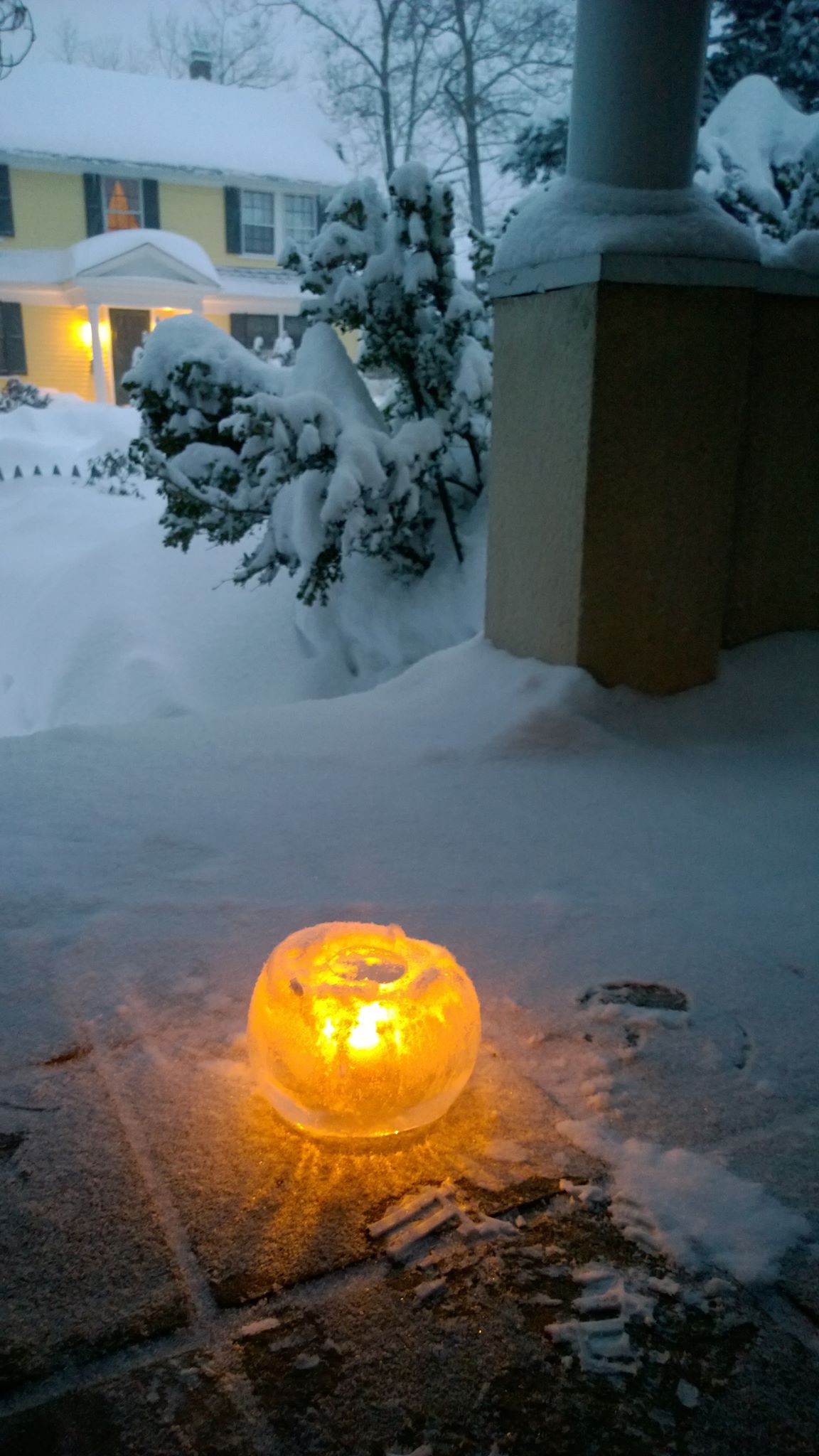
Our big snowfall last weekend reminded me of past snowfalls. Who remembers 2015, when I made ice globes?

Read Full Post »

Photo: Richard Lane/Basque Library, University of Nevada, Reno
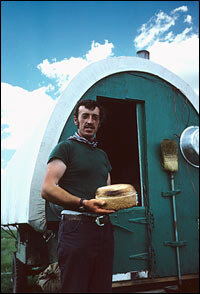
A herder holds freshly baked bread. His sheep wagon was a camp on wheels with beds, a table, and a wood stove. In the early days, a team of horses pulled the wagons.

I was driving to Providence and listening to the radio when I heard a story about Basque men who emigrated to the American West years ago because they needed jobs and because Idaho, Nevada, and other states needed shepherds.

Although the Basques actually knew nothing about being shepherds, they persisted, and today significant Basque communities remain.

Kimberlee Kruesi writes at the Associated Press, “Idaho is home to one of the biggest concentrations of Basques in the United States. … Basques began settling in southwestern Idaho as early as the late 1800s, with many coming from the Basque region on the border of Spain and France to work as sheepherders in Idaho. Nearly 8,000 residents of the Gem State identify as Basque today. …

“The Basque Museum and Cultural Center is packed with exhibits that explore the lives of the first Basque sheepherders, including a sheep wagon and full-size sheepherder’s tent. …

“The Basque Market … has become famous for preparing large portions of paella, served with homemade baked bread every Wednesday and Friday right on the patio. …

At National Public Radio, the Kitchen Sisters reported on the life of Basques in Nevada.

“Francisco and Joaquin Lasarte came to America in 1964 from Basque country in northern Spain. Francisco Franco, the Spanish dictator who repressively ruled the country for nearly 40 years, made life miserable for the Basque people, suppressing their language, culture and possibilities.

“The result was a massive exodus, and the only way to come to the United States for many Basque was to contract as sheepherders. There was a shortage of shepherds in the American West. …

“Neither Lasarte brother had any sheepherding experience when they arrived in America.

” ‘You lonely, you by yourself,’ Francisco Lasarte said. ‘My God, you with 2,000 sheep and two dogs and you don’t know what to do, where to go.’

“The brothers were contracted for five years to this life. It was a sentence.

“Each brother had his own flock, and they rarely saw each other or anyone else for months on end. Mostly they ate lamb and bread cooked in a Dutch oven in a hole they dug in the ground. You can still find these holes up in the mountains of Idaho, Montana, Nevada and California.

” ‘You say Basque to a Westerner and you think sheepherder,’ said Mark Kurlansky, author of The Basque History of the World. “In Basque country very few people were shepherds.’ …

“William Douglass, former director of the Center for Basque Studies at the University of Nevada, Reno, describes this solitary life.

” ‘Teenagers were ripped up out of their communities back home, brought to a foreign land, with a foreign language, put up on top of a mountain … crying themselves to sleep at night during the first year on the range.’

“The Basques have a family-oriented, communal culture, gathering around big tables to eat, drink and sing. This solitary life in remote mountains ran against the grain.” More at NPR, here.

Photo: Kimberlee Kruesi/The Associated Press
The Basque Center displays both the United States flag and Basque flag in Boise, Idaho.

Read Full Post »