Feeds:
Posts
Comments

Posts Tagged ‘nile’

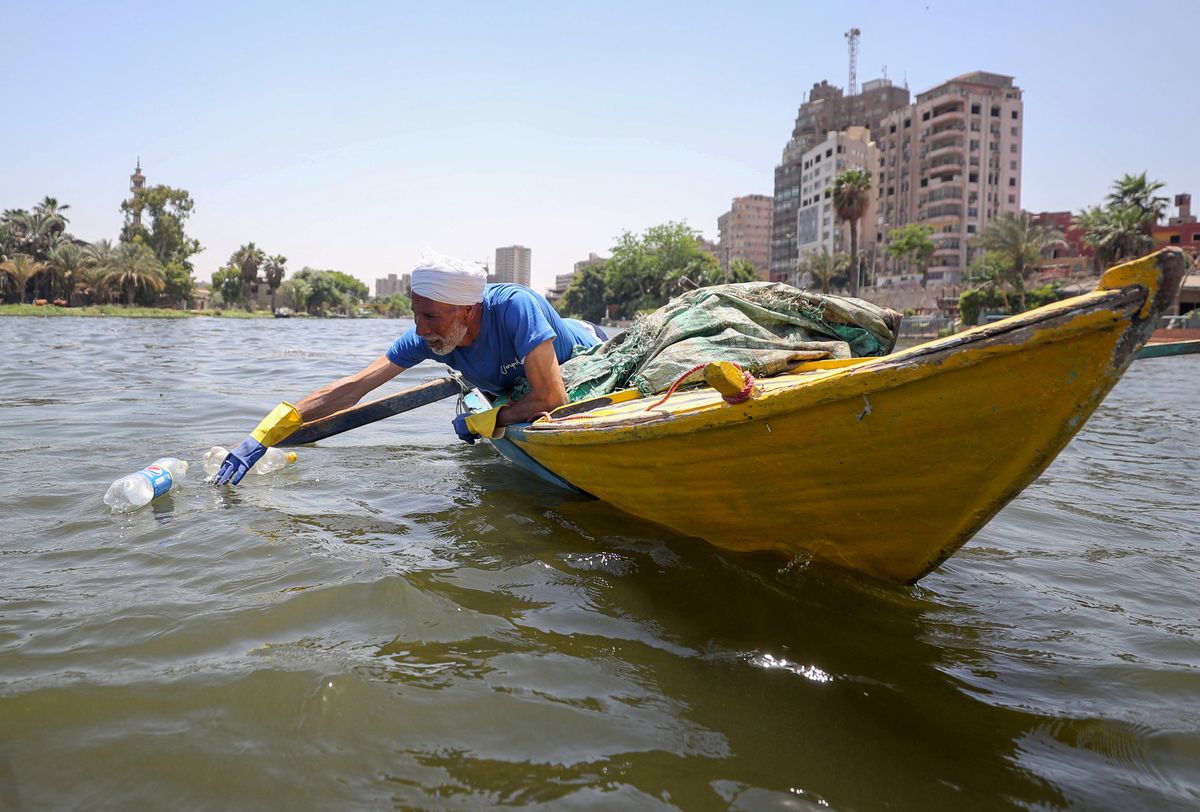
Photo: Reuters.
An Egyptian nonprofit has enlisted fishermen from Al-Qursaya, an island near central Cairo, to collect plastics that have been reducing the catch.

At the Center for Biological Diversity, I recently learned about the enormity of the plastics problem in waters where people fish. The website states: “Plastic accumulating in our oceans and on our beaches has become a global crisis. Billions of pounds of plastic can be found in swirling convergences that make up about 40 percent of the world’s ocean surfaces. At current rates, plastic is expected to outweigh all the fish in the sea by 2050.” Yikes!

New efforts large and small are needed to reverse what’s happening. On Twitter, the World Economic Forum is promoting one of the small efforts, which is how I learned about it.

Reuters reports, “For 17 years, Mohamed Nasar has supported his family of five by fishing in the Nile River near the banks of the tiny island of Al-Qursaya close to central Cairo.

“But the 58-year-old says fishermen like himself catch fewer fish every year as the Nile has become clogged with plastic bottles, bags and other waste.

‘The fish get caught in the bottles, and they die,’ said Nasar.

“A local environmental group named ‘VeryNile‘ has asked the island’s fishermen to use their boats to collect plastic bottles from the river. VeryNile says it buys the bottles at a higher price than the general market price on offer from traders or recycling plants.

“The initiative provides a sustainable solution for helping to clean up the Nile, while providing an additional source of income for fisherman like Nasar.

” ‘This job helped us a bit. We come and collect about 10 to 15 kilos (of plastic bottles), we get about 12 Egyptian pounds ($0.7682) for each,’ Nasar said as he sat in his boat collecting bottles. …

“Another fisherman, Saeed Hassanein, said cleaner Nile water would mean more fish.

” ‘On the one hand, the Nile is cleaner, and on the other hand the fisherman now has more than one source of income,’ he said.

“With the help of more than 40 fishermen, VeryNile has over the past year collected around 18 tons of plastic bottles, most of which were sold to recyclers.” More at Reuters, here.

The World Economic Forum, which defines itself as the “international organization for public-private cooperation,” is increasingly focused on addressing the consequences of global warming, and I hope it is serious about that. It’s easy to feel cynical about the forum’s annual conference for the world’s rich and powerful — called Davos because it takes place in Davos, Switzerland — but I have to believe it’s helping to make both the problems and the possible solutions more widely accepted. Besides, I know there are many altruistic people on the staff, like my friend Kai, who was one of them several years ago.

In a recent podcast, Radio Davos discusses initiatives tackling climate change, calling the current decade “the decade of ocean science, and one in which we must get on track for net-zero by 2050.”

So there’s that. Meanwhile, in Egypt, impoverished fishermen are pulling out plastic that corporations, cruise ships, and too many individuals keep dumping.

Read Full Post »

There is still so much to be discovered about the cosmos, medicine,  psychology, nature … and human history.

Claire Voon’s story at Hyperallergic about a “new” 2,800-year-old painted sarcophagus is a case in point. The colorful hieroglyphs promise to add to our knowledge.

Voon reports, “Archaeologists in Luxor have found an exquisitely decorated, millennia-old sarcophagus near the pharaonic temple of Thutmose III that still contains the remains of its ancient owner. The discovery is the most recent to emerge from the Spanish Thutmosis III Temple Project excavation, which since 2008 has explored the 18th Dynasty pharaoh’s funerary complex, situated along the west bank of the Nile. …

“Archaeologists are now starting to piece together the history of the coffin’s permanent resident. Although termites had eaten away at parts of the slim, wooden container, as the team’s head, Myriam Seco Alvarez, told El Mundo, the surface still retains a rich array of hieroglyphs that offer clues. Sarcophagi are much more than simple containers for the departed, and the pictorial script on this one records that it belonged to a man named Amenrenef, who once served as a royal court advisor.

“The images, whose bright pigments have been preserved after all this time, also depict religious figures such as the ancient goddesses Isis and Nephtys and the four sons of Horus.

“The archeologists have since removed the sarcophagus from its tomb and brought it to a lab, where it will undergo restoration. The team also plans to carry out X-ray examinations to determine the exact state of the remains inside.” More here.

Photo: Thutmosis III Temple Project
A decorated sarcophagus recently found by Spanish archaeologists near Luxor.

Read Full Post »

This story was a reminder to me that every country has kind-hearted people. Too much of the news about Sudan focuses on its leader, his treatment of minorities, and his troubles with the international court. But this story is about Sudanese youth reviving a tradition of service.

Isma’il Kushkush reported the story for the NY Times.

“Their temporary headquarters are a beehive of young volunteers buzzing in and out of rooms, up and down stairs, carrying bags of donated food, medicine and large packets of plastic sheets. …

“They are the members of Nafeer, a volunteer, youth-led initiative that responded swiftly to the humanitarian crisis caused by heavy rains and flash floods that struck Sudan [in August]. …

“The area around Khartoum, the capital, suffered the hardest blow. …

“ ‘We saw that the heavy rains and floods were going to impact the lives of many, and we felt we had a social responsibility to help people,’ said Muhammad Hamd, 28, a Nafeer spokesman. ‘The idea came out of a discussion on Facebook among friends.’

“A ‘nafeer’ is a Sudanese social tradition that comes from an Arabic word meaning ‘a call to mobilize.’ The group’s formation was all the more important because the Sudanese government was slow to respond, some critics say.

“ ‘It was a weak response,’ said Khalid Eltigani, the executive editor of Ilaf, a weekly newspaper. ‘The Nafeer youth broke the silence on the flood situation.’ ” More here.

I love that the latest manifestation of this Sudanese tradition got organized on Facebook.

Photo: Reuters
Men built a barrier to protect houses from rising water in Khartoum, Sudan, the last week of August. More than 300,000 people were directly affected by the flooding.

Read Full Post »