Feeds:
Posts
Comments

Posts Tagged ‘noise’

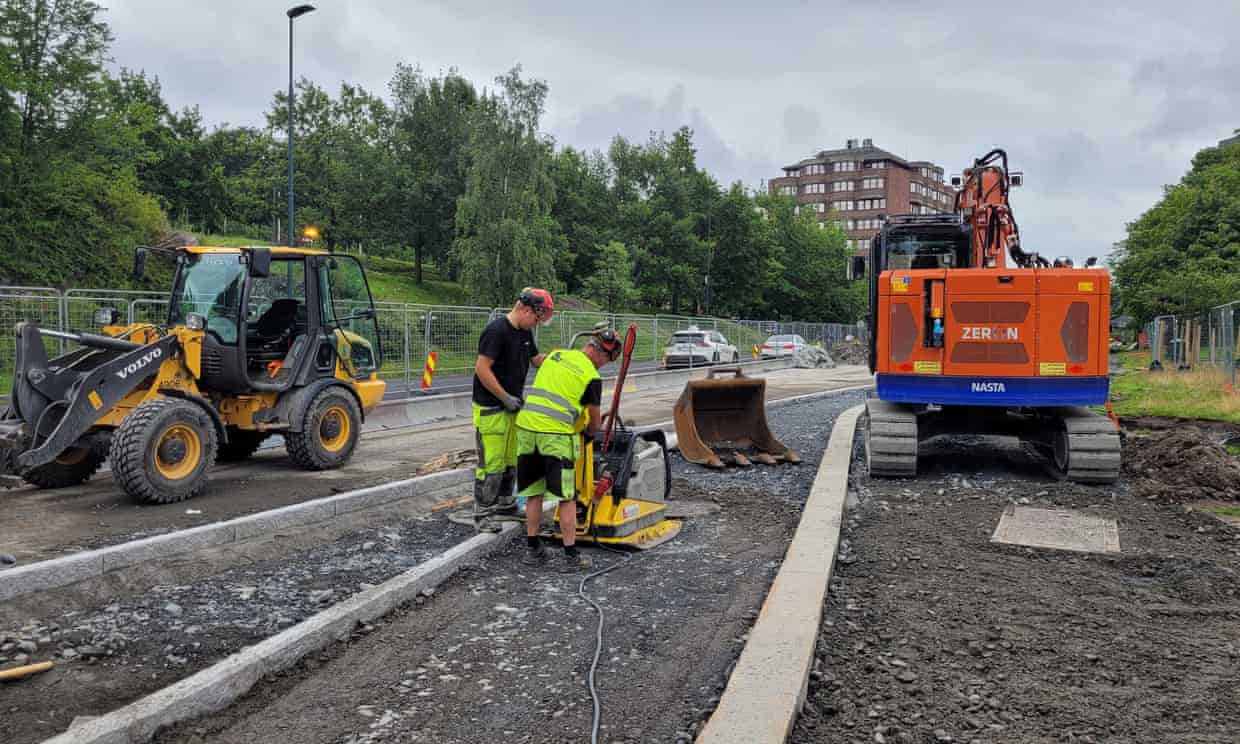
Photo: Ajit Niranjan/The Guardian.
The electric machinery at an emissions-free building site in Oslo, Norway, makes for quieter construction.

Whether we realize it or not, our noisy world is making us a little more jittery than we need to be. It’s not just the clangor and clash of big cities but near airports, hospitals with medivac helicopters, and construction sites.

Despite Norway’s reputation as one of the biggest oil producers, it is leading the way with electric vehicles, even at construction sites.

Ajit Niranjan has the story at the Guardian.

“Tafseer Ali felt no need to raise his voice as the pair of diggers lumbered past him, their treads weighing heavy on the rock and asphalt. Quiet electric machines like these make it easy to work in the city center, the construction manager said – and keep the neighbors happy. …

“The peaceful streets of Oslo are growing even calmer as the city drives noisy machines off municipal building sites. For locals and builders, the drop in decibels is a welcome side-effect of a goal to keep city-managed construction projects free from toxic emissions. The mandate, which is the first of its kind in the world, came into effect on 1 January.

“ ‘I don’t think we’re going to get to 100%, because not all [electric] machines are available on the market,’ said Ingrid Kiær Salmi, an engineer from Oslo’s urban environment agency, speaking to the Guardian at a building site in the city center last year. ‘But I think we’re going to get pretty close.’

“Construction is one of the biggest sources of urban air pollution, but even forward-thinking cities such as Oslo have struggled to clean it up. The Norwegian capital has led the way in replacing the petrol and diesel that powers its construction equipment with biofuels, which do little to heat the planet but still foul the local air. It is now moving to battery-powered machines.

“The latest data shows Oslo’s municipal building sites were 98% free from fossil fuels in 2023; three-quarters were powered by biofuels and less than one-quarter by electricity. For projects run by the urban environment agency, which has more recent data through to October 2024, two-thirds of machine hours were powered by electricity and one-third by biodiesel.

“The proportion of its projects powered by electricity has more than doubled in the past two years as new machines have come on to the market. …

“Electric vehicles are nothing new to Norwegians, who are more likely to drive a car with a big battery than one with a combustion engine, but the market for clean diggers [excavators] and wheel loaders still has a way to go. The building industry has pushed back on Oslo’s pioneering plans for moving too fast. …

“The requirement that all machinery on building sites must be emission-free is ‘at this point, neither effective nor cost-efficient,’ said Stine Marie Haugen, from the Norwegian construction and civil engineering contractors’ association.

“ ‘Currently, very few countries in Europe have a strong focus on emission-free machinery, which means that access to such equipment is somewhat limited,’ she said. ‘Only a few countries bear the development costs of bringing these machines to market.’

“But by taking on these costs, Norway and a handful of other countries are making clean machines cheaper and more attractive for cities around the world. Manufacturers say the early demand from procurement policies like Oslo’s has encouraged them to develop new electric machinery and make existing ones better.

“As the volume of vehicles increases, costs will come down – but ‘like with all new technology, there is a green premium,’ said Tora Leifland, the head of public affairs at Volvo Construction Equipment. A battery-powered machine can cost twice as much as a diesel one, she said, though it will save money on fuel and do little to inflate the overall costs of a construction project.

“There are also benefits that are harder to capture, such as quieter working conditions on-site and reduced disruptions to local communities and businesses.”

More details at the Guardian, here. No firewall. Contributions to support the Guardian‘s reliable journalism are solicited.
Read Full Post »

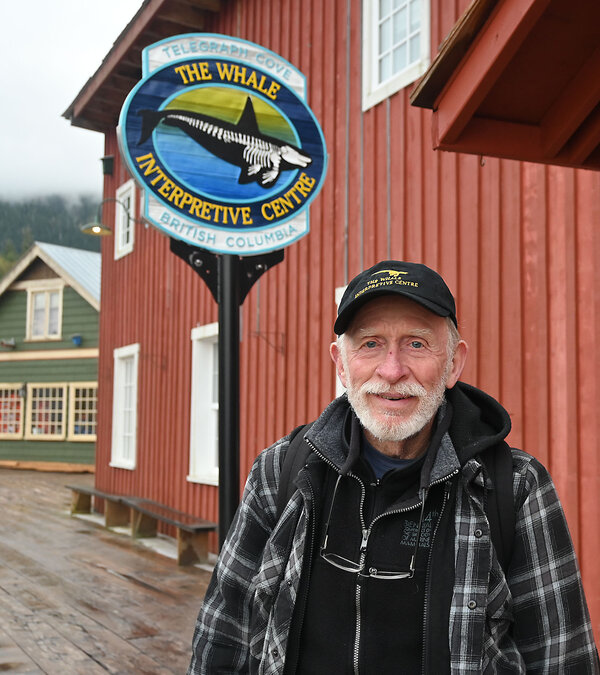
Photo: Jules Struck.
Jim Borrowman was part of a successful lobby to create an ecological reserve in western Canada’s Johnstone Strait in the 1980s.

Today’s story is about a few people whose determination helped to reverse the decline of a group of Orca whales — people who just don’t give up.

At the Christian Science Monitor, Jules Struck wrote recently about their work.

“Jim Borrowman cut the engine of the Nisku in the gray water of the Johnstone Strait, relinquishing his boat to an eastbound tide. He unraveled the line of a hydrophone – a cylindrical, underwater microphone – and dropped it portside.

“On the other end of the cord a pint-size Honeytone speaker in the cabin broadcast a conversation from the deep: the ethereal, two-toned call of an orca whale to her clan.

“ ‘I think they’re what we call “A1s,” ‘ said Mr. Borrowman, browsing a database of local orcas on his phone.

“Mr. Borrowman has been watching, and watching over, these whales for decades. He was one in a band of Vancouver Islanders who successfully lobbied in the early 1980s to set aside a protected area for Northern resident orcas, which lost a third of their population to hunting and capture in the 1950s and ’60s.

“This early act of ocean preservation laid a foundation from which decades of important research – and a deep local allegiance to the whales – have flourished. Galvanized by this data, environmentalists and First Nations just won a battle to evict commercial open-net fish farms from the area, which compete with the orcas’ food supply.

“With early signs of abundant salmon, and a small but decades-long uptick in Northern resident population numbers, it feels to some like nature rallying.

“ ‘You can see the whales coming back,’ says Alexandra Morton, an author and marine biologist who has studied salmon in the Johnstone Strait since the 1980s. She was part of a group that occupied a Vancouver Island fish farm in 2017 in protest of the industry.

“The A1s spotted by Mr. Borrowman from the bow of the Nisku are one pod of one type of orca, called Northern resident killer whales, which number some 400 and live along the coast of British Columbia.

“They’re doing particularly well, and have been growing by a handful of members each year since the ’70s. Northern residents are the most reliable visitors to the Robson Bight (Michael Bigg) Ecological Reserve, where Mr. Borrowman has served as a warden and run a whale-watching tour business with his wife, Mary, for decades until recently retiring.

“ ‘This is a beautiful, sensitive estuary at the terminus of a 100,000-acre watershed, the last untouched one on the east coast of Vancouver Island at the time,’ he says.

“It’s unique for another reason. At two known beaches at the mouth of the Tsitika River, Northern resident orcas rub gracefully along the seafloor pebbles in what scientists have dubbed a unique ‘cultural behavior.’

“It was this behavior, first captured in underwater footage by Robin Morton, Alexandra Morton’s late husband, that convinced the public, the press, and finally the federal government to set aside about 3,000 acres of water plus shore buffer as a protected area closed to boat traffic.

“Today, volunteer wardens with the Cetus Research & Conservation Society Straitwatch program monitor the reserve and gather population data on the whales and their pods. …

“Today, the whales’ major issues are food scarcity, noise, and chemicals in the water. But if the threats to orcas have become more complex, the responses have grown increasingly well-informed by a bedrock of research, much of which has come out of the ecological reserve and its orbit. …

“Decades of research have since shown that major pathogens and lice leak from [salmon] farms’ huge, suspended net pens straight into the paths of migrating salmon, ravaging their thin-skinned young and immobilizing the adults.

“Pacific salmon are also an important food source and cultural pillar for First Nations. They are intricately linked to the ecosystem, and scientists have even tracked nutrients from decomposed salmon high into the mountains.

“Ms. Morton campaigned for decades to close the fish farms. Nothing changed until she and Hereditary Chief Ernest Alexander Alfred, with a group of other First Nations people, peacefully occupied a Vancouver Island salmon farm owned by Marine Harvest.

“That protest led to a 2018 agreement with the British Columbia government requiring the consent of three First Nations – ‘Namgis, Kwikwasut’inuxw Haxwa’mis, and Mamalilikulla – for fish farms to operate around Vancouver Island.

“First Nations closed more than a dozen salmon farms in and near the strait. Then, the federal government announced it would ban all open-net farms in British Columbia by 2029.

“The decision is not universally supported by First Nations along the coast: 17 have agreements with salmon farming companies, which collectively employ around 270 Indigenous people, according to the Coalition of First Nations for Finfish Stewardship. Overall, open-net salmon farming accounts for 4,690 jobs and $447 million in gross domestic product across Canada, according to the BC Salmon Farmers Association.

“But for many, it was a turning point. Coho and especially Chinook salmon stocks spiked this year in Vancouver Island and its inlets, according to the Pacific Salmon Foundation, after years of downturn.”

Read more at the Monitor, here.

Read Full Post »

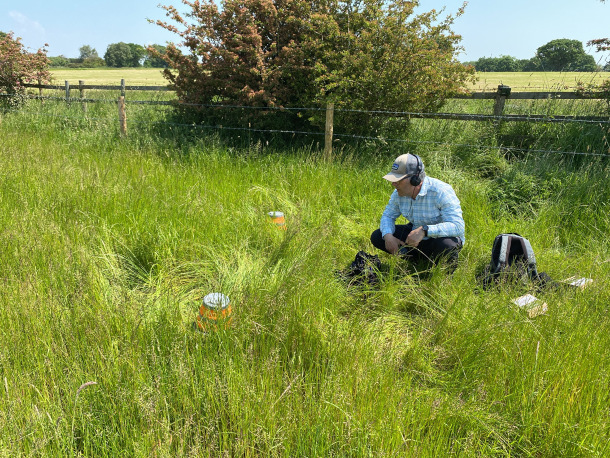
Photo: Baker Consultants Ltd. via Living on Earth.
Listening to sounds in the soil is a minimally invasive way to measure biodiversity underground.

Remember when you were a kid and thought millipedes and bugs in general were icky?

It turns out, those tiny critters in the soil help to make the planet healthy. Just listen to them.

From Luca Ittimani at the Guardian: “Ever wondered what the Earth sounds like? New research suggests healthy soil has a distinctive soundtrack of its own – the crackles, pops and clicks of ants and worms bustling around underground.

“Scientists from Australia’s Flinders University listened to microphones planted in the ground to see if invertebrate instrumentals are a good indicator of biodiversity and soil health. Land filled with plants and tiny animals carried diverse underground sounds, while cleared land only had bland white noise, they found.

“ ‘It’s a bit like going to the doctor,’ the ecologist Dr Jake Robinson said. ‘They put a stethoscope on your chest, take a health check, listen to your beating heart … we’re doing something similar in the soil.’ He said the effectiveness of the microphone method could make it easier for researchers, conservationists and farmers to find and fix soil degradation. …

“Insects and other invertebrates build up soils, improve their nutrient content and prevent erosion, so their presence is a good indication of soil health.

Soil full of worms carries low bubbly sounds, while lighter, six-legged ants make frequent higher-pitched clicks, Robinson said.

“ ‘A millipede has lots of tiny legs and they make little tapping sounds, whereas the snail has a more slimy glide sound,’ he said.

“Because the noises cannot be heard by the human ear, scientists set up microphones that pick up vibrations from contact with the dirt – then amplify the recording by 20 decibels. …

“Robinson and his colleagues reviewed hundreds of hours of recordings from 240 locations around Mount Bold in South Australia, near Adelaide, adding to previous research in the UK. … The new study confirmed the acoustic method worked just as well as traditional methods of checking soil health, which include expensive DNA testing or destructive methods such as digging up the soil or laying traps for invertebrates. …

“Audio tech may even be able to improve soil health. Robinson’s forthcoming research found playing certain sound frequencies can speed up growth of fungi and bacteria that fend off plant diseases.”

At the Guardian, here, you can listen to healthy soil. Similarly, at Living on Earth, here, or at The World, here.

Read Full Post »

Ian Burrell has a funny story at the Independent about the Times of London deciding to create the old-tyme newsroom ambiance by piping in the sound of typewriters clacking. Goodness knows if the young people can concentrate, but it must make the guys with the green shades feel they’re in the right place.

“Almost as if the digital revolution never happened,” writes Burrell, “the newsroom of The Times once again resounds to the clatter of the old-fashioned typewriter.

“Nearly three decades after Rupert Murdoch’s UK newspaper publisher revolutionised the industry by moving to Wapping and ending the ‘hot metal’ era, his flagship title has reintroduced the distinctive sound of old Fleet Street.

“To the surprise of Times journalists, a tall speaker on a stand has been erected in the newsroom to pump out typewriter sounds, to increase energy levels and help reporters to hit deadlines. The audio begins with the gentle patter of a single typewriter and slowly builds to a crescendo, with the keys of ranks of machines hammering down as the paper’s print edition is due to go to press.

“The development, which was described as a ‘trial’ [in August] by publisher News UK, has caused some bemusement among journalists, one of whom tried unsuccessfully to turn the sound off. …

“The Times’s initiative coincides with a revival of interest in the typewriter, a trend which the newspaper reflected on Page 3 today, with a report on how the actor Tom Hanks has developed the Hanx Writer app, which simulates the sound of an old-fashioned typewriter and has gone to the top of the iTunes app store in the US. Hanks, it noted, can tell the difference between the sounds of an Olivetti, a Remington and a Royal typewriter model. …

“Michael Williams, who began his newspaper career at The Times’s old offices in London’s Gray’s Inn Road in 1973, and is now a senior lecturer in journalism at the University of Central Lancashire, saw merit in the idea.

“ ‘People feel to some extent disengaged from the thrill of producing a newspaper, which is galvanising,’ he said, referring to the relative quiet of modern newsrooms.”

More here.

Photo found at Gizmodo 

Read Full Post »