Feeds:
Posts
Comments

Posts Tagged ‘north carolina’

Photo: Erin Brethauer.
Marquee hosted more than 300 artists and small business owners in Asheville, North Carolina, before Hurricane Helene, a devastating storm in 2024.

When Hurricane Helene washed through Asheville, North Carolina, last year, my childhood friend Ursula was one of the many who lost out. Her basement washed out, not only forcing her to stay at a neighbor’s but damaging many of her father’s artworks and the materials for her own weaving. At the same time, Asheville lost its whole arts district.

Now Ursula is rebuilding, and so is Asheville.

Jonathan Abrams writes at the new York Times, “Jeffrey Burroughs strolled among crooked trees and clumsily leaning chain-link fences on a recent Thursday afternoon in Asheville’s lower River Arts District. Nearby, heaps of flood-damaged antiques dotted the ground outside gaptoothed buildings that had previously housed hundreds of working artists.

“ ‘It’s nice that at least it’s green,’ Burroughs, president of the River Arts District Artists, said of the bent trees. ‘It was really depressing through the winter and the fall.’

“Burroughs, who uses they/them pronouns, is not joking when they say they have taken just two days off in the more than 10 months since Hurricane Helene, the deadliest hurricane to strike the mainland United States since Katrina in 2005, ravaged wide swaths of the Southeast, leaving at least 250 people dead.

“The storm overwhelmed Asheville’s French Broad River, submerging much of the once robust River Arts District in as much of 24 feet of water, caking it in layers of mud and destroying the life’s work and financial pipeline of hundreds of artists. …

“ ‘People were prepared because this area has flooded’ in the past, Burroughs said. ‘They moved everything up. Nobody anticipated second floors would flood. That’s not something you even conceive.

‘All of a sudden, it was like a lake opened in the middle of our town.’ …

“Over the past few decades, the River Arts District blossomed into that sprawling artistic epicenter as antiquated buildings transformed into bustling studios, classrooms, galleries and showrooms. The district’s recovery is seen as a crucial step in regaining a steadiness of income and the sense of normalcy for the many who lost so much in the storm.

“ ‘The business owners in the River Arts District have been working their tails off to rebuild since Hurricane Helene struck and I am making sure the state works with that same urgency to support their recovery,’ said Gov. Josh [Stein] who recently toured the district on a bike.

“The River Arts District housed nearly 750 artists before the hurricane. ‘You’re just immersed in art,’ said Davis Perrott, a woodworker who recalled waking up from the storm to a sound like someone forcefully slamming themselves against his window. ‘I’m sure there are other areas like it, but I haven’t seen it.’

“The upper portion of the district, which houses Burroughs’s jewelry store, returned fully in January. A few spaces have reopened in the lower portion of the district, which is closer to the river and suffered the most flooding.

“About 350 of the displaced artists are working again in the district. Some are actively involved in the continuing recovery process, waiting to return to the home that welcomed them.

“Others have decided not to return. For them, the risk of another storm outweighed anything else.

“Riverview Station was a major hub in the district, once hosting hundreds of artists, including the 14,000-square-foot ceramics space, the Village Potters Clay Center. That was before ’26 feet of water went through and wiped us out,’ said Sarah Wells Rolland, its founder. …

“The center was home to studios, showrooms, a gallery and classrooms where workshops were held. Wells Rolland said that $500,000 worth of equipment was lost in the flooding.

“ ‘I never even entertained going back,’ she said. … ‘I believe it’ll all wash away again.’

“Instead, Wells Rolland opened a new center near the arts district. While her business has returned, she is still searching for her creative spark.

“ ‘I’ve lost a lot of people. … Just numb is what I felt. I didn’t have any ideas. Still, almost a year out, I’m a highly creative person, but I still don’t feel like I have that creative energy yet.’

“As the district returns in fits and bursts, it could provide a blueprint for how other communities ravaged by increasingly destructive natural disasters can recuperate their livelihoods. Those affected have been depending much more on smaller networks of supporters and volunteers than on any government channels. …

“Marquee, an art gallery that hosted more than 300 artists, [anticipated] a September reopening, with other businesses in the lower district.

“ ‘We’re able to tweak the things that we wished we’d have done the first time before we opened and now we’re getting to get it all right,’ said Robert Nicholas, the building’s owner.

“Despite the devastation it caused, the storm reinforced what had drawn many to the district in the first place, heightening their sense of community.” More at the Times, here.

Read Full Post »

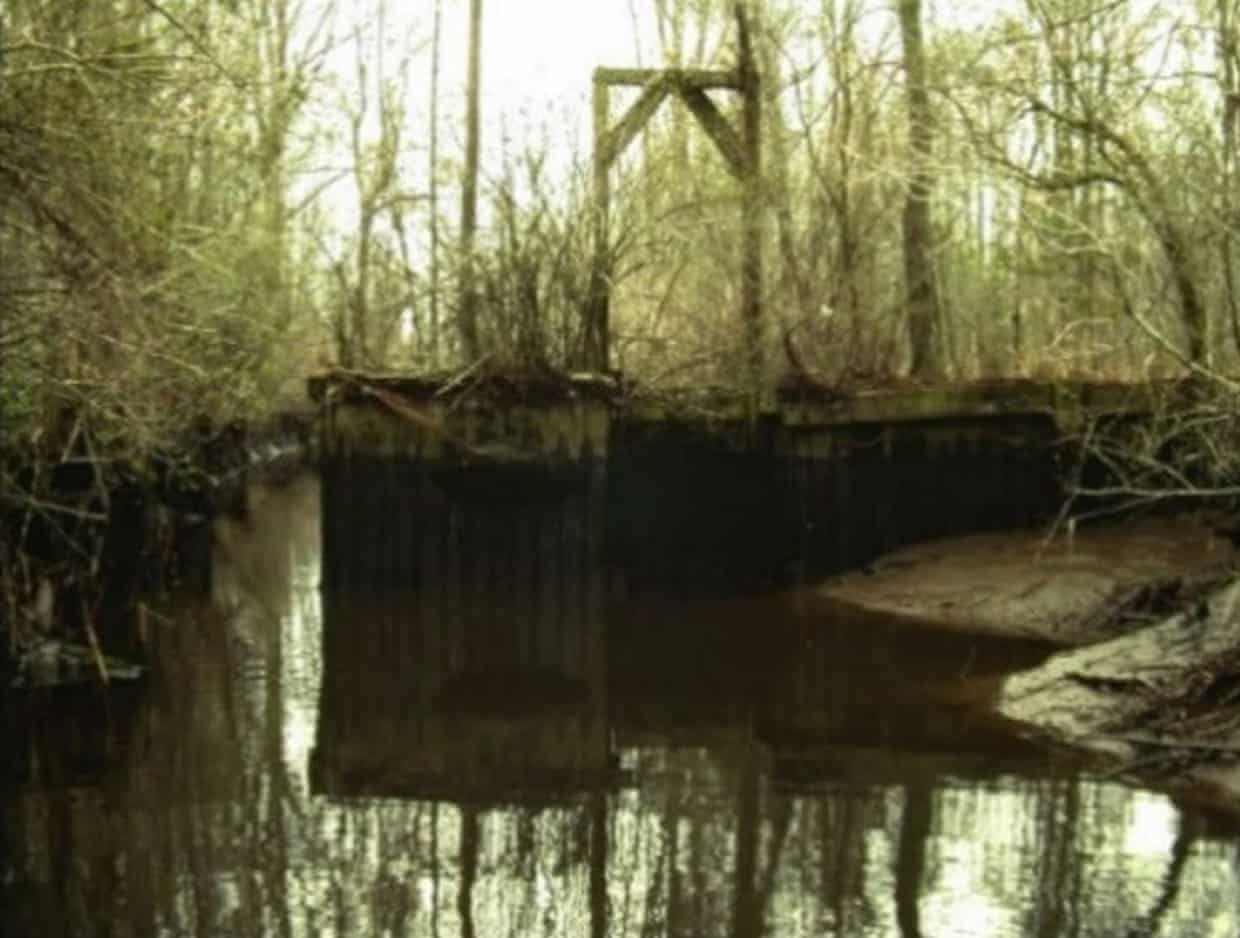
Photo: North Carolina office of state archaeology.
A rice gate, seen here in 1986. At Eagles Island, North Carolina, in the late 1700s, the enslaved Gullah Geechee people began creating ingenious rice fields. 

If the people described in this archaeological report used brilliant rice-growing techniques while enslaved, imagine what they might have done if they had been free! But, alas, slavery destroys lives of the enslaved and their descendants for generations, as Pat Conroy documented in The Water is Wide, his memoir about teaching.

In an in-depth article at the Guardian, Adria R Walker writes about recent archaeological discoveries concerning the Gullah Geechee people of the American South.

“As a former deputy state underwater archaeologist, Mark Wilde-Ramsing can’t help but look down. While rowing around North Carolina’s Eagles Island, at the tip of the Gullah Geechee corridor, he noticed signs of human-made structures, visible at low tide. Though he’d retired, he was still active in the field and knew his former agency hadn’t recorded the structures – which meant he had come across something previously undocumented. …

“Wilde-Ramsing knew the area had once been full of rice fields. His neighbor, Joni ‘Osku’ Backstrom, was an assistant professor in the department of environmental sciences at the University of North Carolina-Wilmington whose specialty was shallow-water sonar, and he had the skills and technology to explore the area. Using a sonar device, the duo detected 45 wooden structures in the river, and the remote sensing tool allowed Backstrom and Wilde-Ramsing to acoustically map the canal beds. …

“Spanning 2,000 acres (809 hectares) of the northern end of Eagles Island, the 45 irrigation devices were developed by enslaved people, who would later come to be known as the Gullah Geechee. The devices were used to control water flow for the rice fields in conjunction with earthen dams and levees, Wilde-Ramsing said.

Their existence provides further evidence of the engineering and technological skills that Gullah Geechee people used for rice cultivation, beginning in the late 1700s at the latest.

“Backstrom and Wilde-Ramsing documented their findings in a study published earlier [in 2024]. ‘The use of the island for this endeavor prior to the Civil War, in large part rested on the shoulders of transplanted and enslaved Africans and their descendant Gullah Geechee tradition,’ the study reads.

“The team’s discoveries, which came after two years of research in and around Eagles Island, have helped further shed light on the ingenious, skilled work of the Gullah Geechee people. Though Gullah Geechee people have been studied for centuries, Backstrom and Wilde-Ramsing’s research is the first to focus on their irrigation systems. The research couldn’t come soon enough: Eagles Island is environmentally vulnerable, both because of climate change and ongoing development. The duo registered their sites with the state, making development more difficult as a means to ensure the protection of cultural artifacts.

“ ‘The whole area was originally swamp. It was cleared mostly in the post-colonial, early 1800s period for tidal rice cultivation because that area was freshwater,’ Wilde-Ramsing said. ‘They were able to actually use, regulate, introduce the water and drain it with the tides.’ …

“The work the Gullah Geechee people did would have been exhaustive. Wilde-Ramsing says it required removing the cypress forests, then building dams and levees. Growing rice necessitated the use of water, so they created long wooden boxes, or ‘trunks,’ with gates on either side, that allowed them to let the water in by opening the gates. …

“The enslaved populations throughout the Gullah Geechee corridor – which spans the coasts of North Carolina to upper Florida – were isolated in such a way that they developed and maintained a culture different from that of most plantations.

“ ‘[They were] from coastal regions of west Africa, an area that had similar environs to those along the southern Atlantic seaboard centering on Georgia and the Carolinas, where rice agriculture was a mainstay of the economy,’ the study reads. …

” ‘I didn’t quite realize the role that rice played. It rivaled cotton during the 1840s and 50s,’ Backstrom said. ‘It was all over Europe and the US and it was all run by African Americans. A lot of it was developed based on their skills. I’m just happy that it’s coming to light and they’re getting their – I won’t say new – but recognition that this was an amazing thing, amazing work.’

“Even though Wilde-Ramsing and Backstrom’s discovery likely won’t permanently stop either development or climate change, not least because the island is owned by multiple private entities, the existence of historic, cultural artifacts can ensure that the Gullah Geechee structures are at least documented instead of simply being razed and forgotten.

“The researchers have been in communication with East Carolina University’s maritime program, and the school plans to send a contingent to the site to study some of the characteristic types. People from the school will be able to work on noting the various structures, trying to figure out how they operated and taking samples. Backstrom said that they’ve also been in contact with researchers at George Mason University in Fairfax county, Virginia, including a professor who had ancestors [from the area].

“In terms of further discovery, a mix of approaches best suits the complicated terrain. ‘We’re thinking about using drone imagery,’ Backstrom said. ‘We have some preliminary drone footage, which gives us access to these areas at dead low tide, areas that we had a lot of difficulty with, even with a very small vessel.’ The area is remote, full of tight nooks and crannies. It’s ‘particularly challenging because of the tides and the timing,’ he said. The different combinations of drone imagery and sonar mean the researchers aren’t limited by turbidity in the water.

“Backstrom hopes to go to west Africa, specifically to Senegal or the Senegambia region, where many Gullah Geechee people were from, to learn about the history of rice farming, including the roles women and children played. Children, for instance, tasted the water to ensure too much saltwater wasn’t being let in, and women helped in the actual cultivation of the rice, using skills from their home countries that were passed down throughout generations.”

More at the Guardian, here. No firewall. Donations help save reliable news.
Read Full Post »

Photo: Kyle Mellott via Heather Divoky.
Catastrophic flooding swallowed up buildings of Asheville’s River Arts District. Despite ongoing floods and fires in the US, government disaster relief is facing big cuts.

My childhood friend Ursula, an artist in Asheville, North Carolina, lost much of her own and her late father’s artwork to Hurricane Helene last year. As I consider the Hyperallergic article below, I can’t help thinking that in addition to individuals who helped victims (like blogger Deb), government disaster relief (like FEMA, now on the chopping block), was indispensable.

Rhea Nayyar wrote, “Southeastern states are reeling from catastrophic loss and damages after Hurricane Helene tore a deadly path of devastation from Florida’s Big Bend region up through inland Georgia, the Carolinas, and Tennessee. In the mountains of western North Carolina, the city of Asheville was particularly hard hit by flooding … obliterating the cherished River Arts District (RAD) — a creative hub home to studios, galleries, community spaces, and other artist-run small businesses.

“ ‘Two-thirds of the district has been destroyed,’ said Jeffrey Burroughs, president of the River Arts District Artists Association, in an interview with Hyperallergic. Hosting over 350 local artists and craftspeople, the RAD complex comprises 27 buildings that span just over a mile of the eastern riverside. The southernmost string of buildings along Foundy Street, including the enormous Marquee warehouse which was once a bustling marketplace for artisans and antique dealers, are ‘gone,’ according to Burroughs. …

“ ‘Marquee is rubble, the nearby winery has washed away … It’s completely apocalyptic,’ Burroughs said. He recalled overseeing artwork, art supplies, and cans of beer being carried off by the [water] itself, saying that it was like ‘watching the spirit of Asheville being washed away.’

“A little further north at Pink Dog Creative on Depot Street, Asheville artist Heather Divoky, a marketing co-chair for RAD, told Hyperallergic … ‘This will absolutely reshape RAD — we’re going to be forever changed,’ Divoky said. ‘We’re all in complete shock right now. I don’t know how many of us can come back.’

“Down the street, Trackside Studios reported that flood waters reached the ceiling of the first floor where about 40 of the 60 studio artists maintain their practice. Co-owners Julie Bell and Michael Campbell were out of state during the storm, and have since become a communications switchboard as they have reliable internet access and power. Bell noted to Hyperallergic that Trackside Studios had recently completed a months-long renovation prior to the storm to restore the building’s historic appearance. …

“ ‘It’s so dangerous to clean up after these types of disasters because the mud is full of debris, mold spores, sharp objects, and dead fish. It’s neither safe nor sanitary,’ she said. …

“Miles east of RAD, artist, tax expert, and Hyperallergic contributor Hannah Cole reported that her studio along the Swannanoa River tributary had been entirely upheaved by floodwaters.

“ ‘The building is totaled,’ Cole told Hyperallergic, noting that 20 years worth of artwork and supplies were ‘effectively put in a blender for hours’ in a mixture of water, mud, heavy furniture and tools, and other debris carried in by the river.

“ ‘Some level of flooding is normal during big storms, but this has never happened before,’ Cole continued, adding that when she paid a risky visit to the studios after Helene, the water lines were up to the ceiling.

“Ruby Lopez Harper, executive director of the Craft Emergency Relief Fund (CERF+), which imparts safeguarding advice for natural disasters and offers emergency relief and preparedness grants to artists across the United States, told Hyperallergic that ‘recovery is going to take years.’

“ ‘We tell artists to store their things in waterproof bins and other such protective measures … None of that is going to help when your home is underwater,’ she said, explaining that no one had predicted this. …

“But on the ground, both Burroughs and Cole expressed that it’s impossible to even think so far ahead while they and their loved ones are still focused on securing potable water. However, Burroughs and the other RAD board members are conceptualizing an action plan to get stipends for artist relief, recovery funds for RAD, and a clean-up effort to remove the dangers and debris onsite.

“ ‘My husband and I moved here in 2020 after I was suffering from long COVID,’ Burroughs said. ‘There is nothing like this area, this community, anywhere else in the country. We will come back stronger.’ ”

More at Hyperallergic, here.

Read Full Post »

Photo: Ken Ruinard/USA Today.
Asheville, North Carolina, after Hurricane Helene.

Asheville, NC. “I’m safe, but my house is structurally damaged and I’ve just dealt with FEMA and they’re very good and my insurance is being a pain in the neck so … ugh. Anyway, I don’t have power or water and I’m living in a neighbor’s house right now. Thank you for thinking of me. I’m safe and a little stranded feeling. I’ll try and reach out when I’ve got more definite news.”

I got that voicemail on October 7. Hurricane Helene struck my childhood friend’s home September 24. She didn’t answer email. I didn’t have her mobile phone number. But when the US mail delivered my letter to her, we connected.

Patrik Jonsson goes in depth at the Monitor about hurricane-tossed North Carolinians pulling together to help one another.

“Eric Gillespie put his sandals on, walked outside his house, and stood in awe at the sight of Clear Creek – usually a gurgling rivulet – rushing like a dark torrent.

“Then he heard the screams for help. Down a steep bank lay a row of cookie-cutter houses, now up to their eaves in muddy water. Friends and neighbors – some infirm – remained in their homes as nearly 30 feet of water rushed down the French Broad River system, rising in a matter of minutes, trapping a dozen neighbors unable to scramble to higher ground.

“ ‘That’s when things got crazy,’ says the owner of the Wakey Monkey coffee shop in nearby Saluda. ‘There was no way to prepare for what happened.’

“In a rescue scene replicated over 6,000 times across Appalachia as remnants of Hurricane Helene crashed into the steep terrain, neighbors and first responders rushed to action, using everything from sofa cushions and paddleboards to mules and Chinook helicopters in order to ferry friends and strangers to safety. Over 230 people died in the storm, the bulk of them in Appalachia. The toll includes 11 members of one family in the Asheville suburbs.

“ ‘There was both beauty and tragedy in the response,’ says Nathan Smith, a pilot from Charlotte, North Carolina, who surveyed the damage as he flew his 1979 Cessna 180 Skywagon on multiple missions into hard-hit county airports. …

“There were slip-ups and mistakes. But to many on the front lines here, the very worst that nature could conjure was met by the very best America had to give. …

“What promises to be a long recovery is now top of mind for residents of Greater Appalachia, many of them exhausted and still in shock at the discombobulation not only of their lives, but also of the geography of their valleys. …

“In Saluda, North Carolina, a railroad stop that became an adventure destination, the tone of the first meeting of the local business association after the storm was subdued at best.

“The Green River, a world-renowned kayaking destination, could remain impassable for months, if not years, some association members said. With major roads blocked and tourist towns like Bat Cave and Chimney Rock leveled, would anyone show up for leaf-peeping season?

“ ‘What happened was scary,’ says Emily Lamar, co-owner of The Purple Onion restaurant in Saluda. ‘What happens next is scary, too.’

“Access issues for rescue crews tell that story. There is little way to get from South Carolina to Tennessee as parts of Interstate 40 are washed out. The famous Blue Ridge Parkway is undrivable, covered with trees and washouts. Large parts of Asheville’s quirky River Arts District are smashed. {See photo.] Much of what was the iconic village of Chimney Rock is now wreckage situated downstream in Lake Lure. …

“One analogue is the city of New Orleans, which lost more than a quarter of its population [after Hurricane Katrina] 2005 and 2011. But just as New Orleans used that experience to strengthen its levees, many here hope these Carolina communities can build back stronger. Hard-hit Asheville, for one, has long debated better flood controls for its vulnerable River Arts District.

“ ‘This recovery, it’s going to be weeks, months, years, decades, if it’s ever complete,’ says Aaron Clark-Ginsberg, professor of policy analysis at the Pardee Rand Graduate School in Santa Monica, California. ‘Some of this trauma is going to be incorporated into the structure of the community.’ “

More at the Monitor, here. No paywall. Excellent pictures.

Read Full Post »

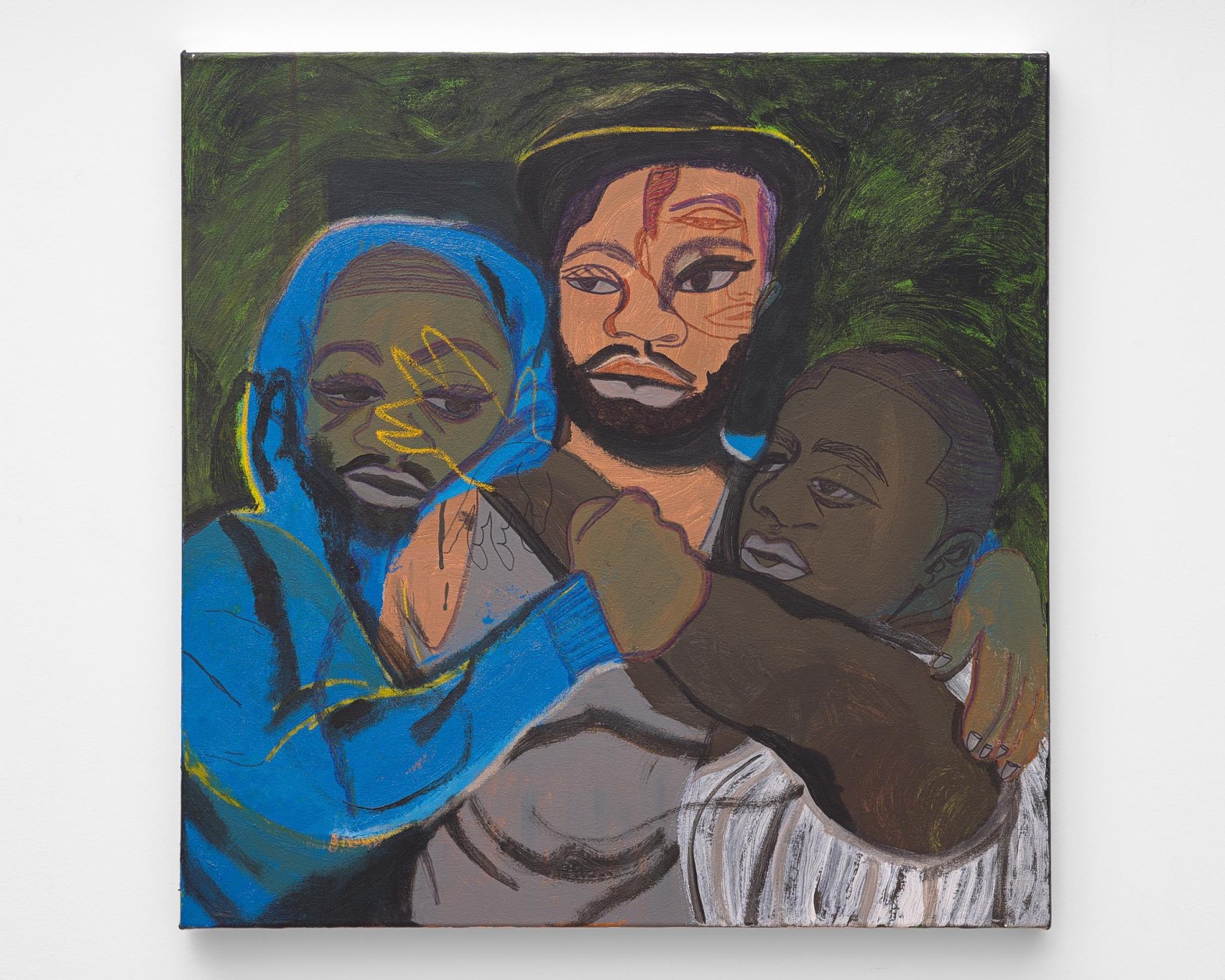
Art: Jonathan Lyndon Chase.
“Calm Touches” (2021), acrylic paint, oil stick, and marker on canvas, 20 x 20 inches. One of the pieces that students chose for the art collection at Wake Forest University.

I’ve been reading Just Kids, Patti Smith’s memoir about her life with artist Robert Mapplethorpe, and I’ve been thinking about how young artists carve out new ways, how they realize they have a different vision and develop the confidence to stick with it.

So it was with interest that I read at Hyperallergic about a university tapping youthful insights about art to form a very special collection.

John Yau reports from Winston-Salem, North Carolina, “Wake Forest University is one of the few American institutions of higher education to establish a collection of student-acquired art.

“Once every four years, a small group of students, along with faculty advisors, travels to New York City to buy art for the Mark H. Reece Collection of Student-Acquired Contemporary Art. This collection was started in 1963, at the beginning of a convulsive era in American history.

“Mark Reece, the dean of students and college union advisor, decided the school should establish a collection of contemporary art chosen by an acquisitions committee composed solely of students. In June of that year, Reece, Dean Ed Wilson, Professor J. Allen Easeley, and two students, David Forsyth and Theodore Meredith, drove to New York to visit contemporary art galleries. Working within a budget that Reece had cobbled together from unused funds, Forsyth and Meredith chose 18 works by 17 artists. 

“Earlier this year, Wake Forest University celebrated the 60th year of this program — and the 16 trips that have taken place since the program’s inception — with a selection of works obtained by previous generations of students. The exhibition, Of the Times: Sixty Years of Student-Acquired Art at Wake Forest University at the Charlotte & Phillip Hanes Art Gallery, was curated by Jennifer Finkel, who also contributed to the catalog, along with Leigh Ann Hallberg and J. D. Wilson. 

“The collection comprises more than 130 works, including, paintings, sculptures, drawings, photographs, and prints. Unsurprisingly, given that the acquisitions committee changes every four years, no style, movement, or material dominates. The one constant holding the collection together, though in no obvious way, is the mandate that Reece gave the first two students, which has been followed ever since: the art they buy must be ‘a reflection of the times.’ 

“During my time on campus, I was invited to sit on Professor John J. Curley’s class, titled Slow Looking. The small group of students, seated in a semicircle, faced Ida Applebroog’s ‘Promise I Won’t Die?’ (1987), a work on paper combining lithography, linocut, and watercolor that the acquisition group elected to buy in 1993. …

“By asking students to research an artist and carefully scrutinize a particular work of art, Curley encouraged them to go down a rabbit hole, where they can consider what they are looking at and how it communicates with them. This level of engagement is hard to achieve without being in the presence of a physical artwork. That it was chosen by a group of students 30 years ago underscores this collection’s ongoing vitality and relevance. 

“On campus, I also met some of the students who participated in the most recent New York buying trip. All were genuinely excited. They talked about how they prepared for the trip, beginning with Reece’s original mandate. They began compiling the initial list of 300 artists once they had been accepted into Contemporary Arts and Criticism. Throughout the semester the list expanded and contracted until it was down to 20 names. The students met in and outside of class. Each week, they presented a short list to their two professors, Finkel and Curley. 

“The students discussed what they thought art reflecting the times would look like, and who might make it, resulting in a racially diverse group. Before the trip, they made appointments with the artists’ galleries. Some dealers, I learned, were arrogant to them, treating them as if they didn’t know what they were doing. Others were warm and welcoming. At least one gallerist kept looking to the professors who accompanied them, convinced it was they who would make the final decision. …

“This immersive art-buying experience … mirrors this country’s changing demographics. For the first decades, the artists on the list were all or nearly all White. In 1989, the students bought Robert Colescott’s painting ‘Famous Last Words: The Death of a Poet’ (1988). … Four years later, the students bought ‘Untitled (Four Etchings)’ (1992) by Glenn Ligon and ‘Untitled (from the Empty Clothing series)’ (1991) by Whitfield Lovell. In 2001, they added South Korean artist Do-Ho Suh and Pakistani-American artist Shahzia Sikander to the collection. They confronted controversial subjects, such as Congolese child soldiers, photographed by Richard Mosse, and Pakistani artist Salman Toor’s paintings of queer Brown men. 

“This year, the eight students chose the work of eight artists: Tunji Adeniyi-Jones, Jonathan Lydon Chase, Melissa Cody, Adebunmi Gbadebo, Emilie Gossiaux, Melvin L. Nesbitt Jr., Willa Wasserman, and Zhang Xiaoli.

“My only criticism,” Yau writes, “is that the university has no building dedicated to this collection, and it really should. Yet the diversity of artists, mediums, and practices is to be applauded. Taking their cues from Reece’s mandate, Wake Forest’s students have assembled an impressive gathering of art.”

I love how the university recognizes that young people have different sensibilities and how it honors that. More at Hyperallergic, here. No paywall. Subscriptions encouraged.

Read Full Post »

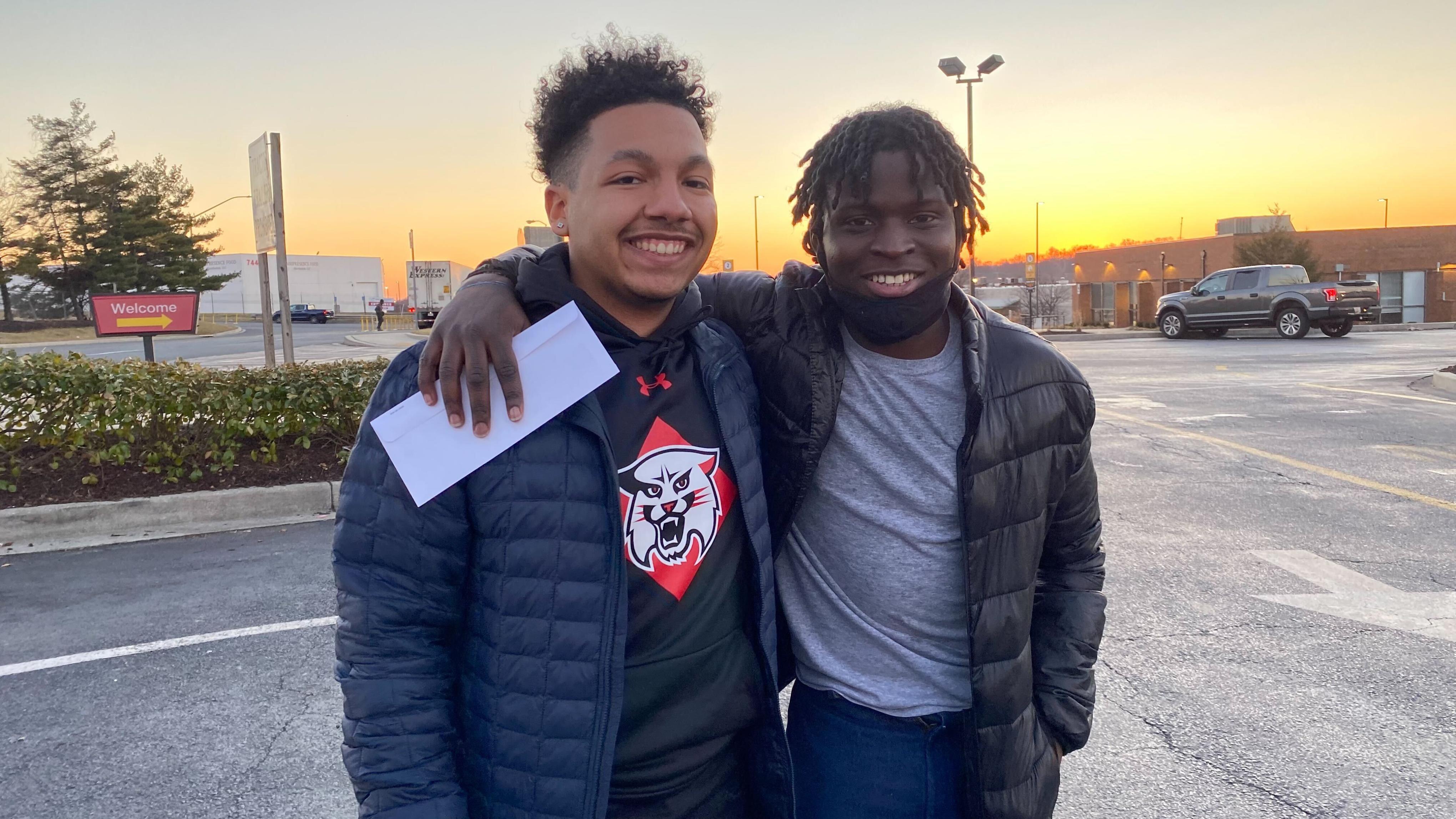
Photo: Brandon Harris.
Brandon Harris (left) and Sura Sohna after Sohna’s release from the Patuxent Institute Feb. 8. Harris’s work on a Davidson College project figured into the court’s decision to release Sohna more than a decade before the end of his 14-year sentence.

Your childhood friends may know you better than anyone else. In today’s story, Brandon Harris knew that a disadvantaged friend who had gotten in trouble with the law was a good person at heart and deserved a second chance. Getting him out of jail took a college research project and people willing to listen.

Sydney Page reports at the Washington Post, “Brandon Harris sat anxiously in an Annapolis courtroom, his head buried in his hands. He took an audible breath as the judge prepared to read the ruling.

“The 22-year-old college student didn’t fear his own fate. He was concerned for Sura Sohna, his childhood friend, whose 15-year prison sentence for first-degree burglary was being reconsidered that morning.

“ ‘Being in that moment was completely surreal,’ said Harris, a senior at Davidson College in North Carolina. It was his independent-study project that was part of what compelled the court to reassess the case [of] Sohna, 23, who had been in the Patuxent Institution, a correctional facility in Jessup, Md., since he was 20. …

“Sohna’s friendship with Harris began at Hillsmere Elementary School in Annapolis, when they were in the same fourth-grade class.

“ ‘We had a lot of great times,’ Sohna recalled. ‘We were close as kids.’ … They remained close as they moved on to Annapolis Middle School.

“ ‘But towards the end of that, we started drifting apart,’ Harris said.

“As teenagers, they were on opposite paths. While Harris got an academic scholarship to a prestigious private high school, Indian Creek School, Sohna was living in an affordable-housing community, witnessing acts of violence with little guidance or stability in his life.

“ ‘We had bad circumstances,’ Sohna said, explaining that he felt responsible for looking after his mother and brother. ‘I felt like I had to be the one to support us, and I went into criminal activity because of that.’ He broke into several houses when people weren’t there and stole property. He would then sell the items for money.

“Sohna got caught and was first incarcerated at age 17 after being charged as an adult with 25 counts, including burglary, theft and multiple gun-related offenses. Many of the charges were dropped in a plea deal, but he still ended up behind bars. When he was released, he continued committing crimes and was again arrested. On Jan. 14, 2020, he was sentenced to 15 years in prison for one count of first-degree burglary, which he had committed while on probation.

“ ‘The judge gave him a really hefty sentence,’ said Keith Showstack, Sohna’s lawyer, who thinks the tough sentence was due to ‘a track record of Sura committing a lot of burglaries, and the judge thought enough was enough.’

“At that time, Harris and Sohna had lost touch. Harris remembers seeing Sohna’s mug shot in the local news more than once over the years. ‘I was very scared for him,’ Harris said. ‘That hurt.’

“Harris knew his friend was a good person at his core and believed he had committed those crimes as a response to poverty and desperation. ‘The thought that went through my head was that if our life circumstances were flipped, I might also be behind bars,’ Harris said.

“While they weren’t in contact, Sohna stayed on Harris’s mind, particularly during his college classes that covered social justice. ‘It just made me think a lot about him,’ Harris said.

“But it wasn’t until June 2020, when Harris read about how the coronavirus pandemic was worsening already poor prison conditions, that he decided to write a letter to his childhood friend to check in. Sohna was stunned to receive it.

“ ‘It was so shocking to me,’ he said. ‘I saw it said, “Brandon Harris,” and that made me feel warm inside.’ [He added] that when you’re in prison, ‘you don’t have people on your side.’

“Harris’s letter was mostly filled with life updates, as well as motivational messages. … Before long, their childhood bond was restored.

“Sohna shared with Harris what life was like in prison. ‘It was miserable. It was shameful. It was angering,’ Sohna explained. ‘I felt like that place was going to define me and make the worst of me.’ When Harris resurfaced in his life, he added, it was ‘at a time when I really needed it.’

“Corresponding with Sohna was meaningful for Harris, too. … He was inspired to start an independent-study project through the school’s Communication Studies department. … Sohna was enthusiastically onboard. It offered him a sense of purpose, and for the first time in a while, allowed him to see himself as more than an inmate.

“As part of the semesterlong assignment that started last January, Harris conducted interviews with Sohna, as well as some of the victims of Sohna’s crimes, prosecutors, law enforcement officers and Sohna’s family.

“Harris learned that Sohna’s father was mostly uninvolved in his upbringing, and that his family struggled with homelessness at one point. He also came to understand the violence that Sohna had seen while living in Robinwood, an affordable-housing community in Annapolis, where even this week, two youths were shota boy, 15, and a girl, 11.

‘He had to be willing to listen to good things about Sura but also things that were not all that flattering in order for him to actually have the full story, which is not always easy,’ said Ike Bailey, a journalist and professor at Davidson College, who mentored Harris through the project. …

“Harris contacted Maryland Gov. Larry Hogan (R), who gave permission for Sohna to participate in a public interview from prison, which the facility initially had prohibited. It turned into a live Zoom conversation that was publicly broadcast.

“Sohna’s lawyer, Showstack, participated in the discussion — which was promoted by the school and featured in local media — along with hundreds of members of the Davidson community and others. Sohna could feel the support, he said.

“His lawyer said the Zoom was helpful, as it ‘opened his eyes to the realization that there are a lot of good people who are willing to help,’ Showstack said. … In December, Showstack decided to try to get Sohna’s sentence reevaluated. … The judge granted the request. …

“By the end of the month, Sohna was granted a hearing. While Showstack was optimistic, Sohna was less confident. ‘I just had really no hope,’ he said.

“At the Feb. 8 hearing, though, he poured out his heart to the judge, owning his actions and explaining why he was worthy of being back in society. He said he wanted to contribute to his community rather than take from it.

“ ‘It was an amazing speech. I was proud,’ Harris said. … Harris also took the stand, outlining the findings from his project, including Sohna’s unstable situation at home and his family’s financial struggles. He reinforced that Sohna’s behavior was a series of bad choices he made rather than who he was as a person — or who he would be in the future.

“ ‘I talked about the progress I’ve witnessed since working with him’ [and added] that Sohna’s father is back in his life, he speaks regularly with a therapist and, because of the project, he has many prospective mentors in the Annapolis community and beyond.

“At one point, Maryland Circuit Court Judge William Mulford II — the same judge who sentenced Sohna in 2020 — asked everyone in the gallery to raise their hand if they had come to support Sohna that morning, and everyone did.

“Then, in a moment Harris and Sohna described as dreamlike, the judge said: ‘You’re going home today.’ “

More at the Post, here.

Read Full Post »

3894533f-02e4-45fb-98b4-9f06e777c4e7_360x203

Gavin Hardy is good at both the bass and basketball. For a bigger image, watch the video at WFMY.

Our niece teaches orchestra at a middle school in North Carolina. Teaching orchestra is a job she loves, and she has often said she thinks she was born to do it. Sometimes she gets notes from long ago students telling her things like, “I always looked forward to your class. It was the time I felt best in school.”

She encourages students of every ability, and when she sees exceptional talent, she likes to spread the word. Here’s a story about a young bass player.

Maddie Gardner at television station WFMY in Clemmons has the report.

“You might say basketball is like music. The ball hitting the court: resonance. A shoe squeaking against the hardwood: pitch. The perfect shot: crescendo. And then there’s the discipline.

” ‘I think both go hand in hand. You have to be very disciplined to be a musician – same thing with an athlete. You have to practice it. You have to do it when nobody is looking. You have to be able to work hard when nobody is watching you do it.’

“Coach Tommy Witt says 8th grader Gavin Hardy brings a certain harmony to the Clemmons Middle School gym.

” ‘I hope to play at a division one school. My dream is to play in the NBA, but I know it’s going to take a lot of hard work, but I’m willing to put in the work,’ Gavin said. …

” ‘Just keeping the tunnel vision, staying focused, you gotta block out all of the distractions that get in your mind, know what you want and attack it. Strive to be the best,’ he said. …

“For 10 years Gavin’s been on the court. … But playing the National Anthem on his bass was something he’d never done before.

” ‘It’s funny – we want to get people to play the national anthem and I went to [his orchestra teacher] Barbara and said, “Do you think he can play the national anthem in his uniform?” ‘ Witt said.

‘It was just a no brainier; he can do anything,’ Gavin’s orchestra teacher, Barbara Bell said. ‘Whatever he puts his mind to he can do.’ …

” ‘I’ve been listening to classical music ever since I was four. I just like the string family and I like the dark tone of the bass,’ Gavin said.

Gavin says he usually listens to string music to get pumped up for a game but before the team played Winston-Salem Prep he decided he’d be the string music before tip off. …

” ‘He’s always interested in more. He keeps working harder to get to the next level,’ [said Bell]. …

” ‘When your best player is also your hardest worker you have a chance to be really good and that’s what Gavin has done for us,’ [Coach] Witt said.” More here.

Barbara tells me that her student learned the National Anthem on the bass in two days and that the publicity brought him wider attention.

“The National Bass Society has contacted Gavin,” she said in a text. “They want him and they’re offering a playing opportunity. The assistant principal bassist from the Philadelphia Orchestra contacted him. He teaches at Juilliard and he is very interested in helping him. I am beyond excited for him. I was screaming and jumping up and down when he told me.

“The Philadelphia Orchestra bassist loved his playing and was especially excited about his work ethic and attitude. I told Gavin he had to give me tickets to wherever he lands.”

Gavin’s teacher with her twins. All three are string musicians.

032519-Bell-string-players

Read Full Post »

ws_edits_11_of_15

Photo: Victoria Bouloubasis/The World
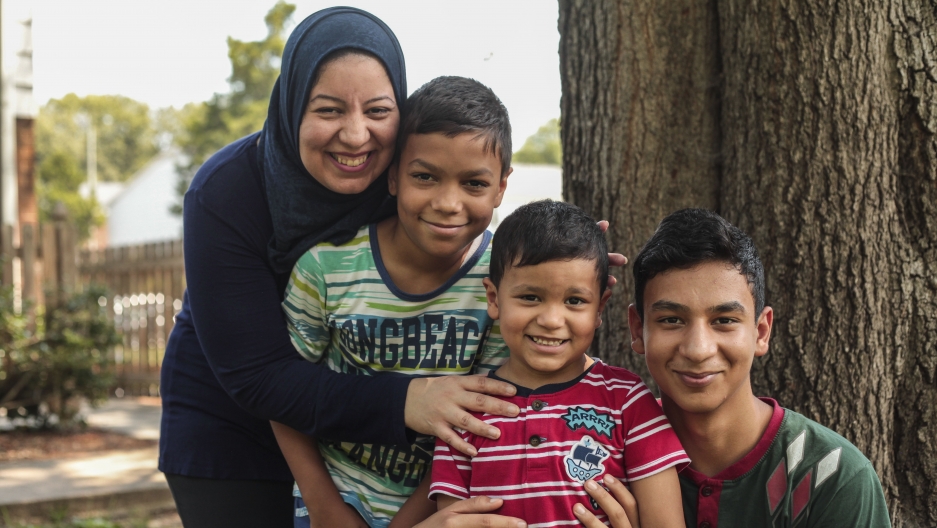
The Al-Khasrachi family lived on the Guilford College campus in North Carolina for months after arriving in the US as refugees. The father had received threats while working for a US military contractor in Iraq.

I know from my own experience as a volunteer in a refugee resettlement agency that there are few refugees coming through today although the need is greater than ever. Some agencies, like the amazing Alight (formerly the American Refugee Committee) have chosen to “do the doable” at refugee camps abroad. Other agencies and individuals give extra love to the few families still arriving — at the same time reaching out to other immigrants who live here. Today I have a story about people who welcome others with open hearts.

Victoria Bouloubasis reports for The World at at Public Radio International [PRI], “Growing up in Burundi, Blaise Pascal was fascinated with R&B music from the United States. … According to Pascal, studying those lyrics helped him become fluent in English with no formal training.

“Pascal, 31, never forgot this teen pastime. When he arrived in Greensboro, North Carolina, in February 2019, music helped him ease into his new life. It also helped that he was part of the Every Campus a Refuge (ECAR) program, an organization that provides housing and utilities for refugee families and individuals like Pascal. The organization was founded in 2015 at Guilford College and later spread to six other college campuses across the country. …

“Pascal also took advantage of the resources at his disposal at Guilford College, like the music room and soccer field. He met fellow musical minds, professors and students with whom he hosts regular jam sessions. He would also send videos of himself singing and playing guitar with his new friends to his older sister in Burundi over WhatsApp. …

“His sister raised him after their Congolese parents died when Pascal was still a young child. The siblings survived the civil war that their parents did not. Both have applied for refugee status; Pascal was resettled to the US while his sister waits. … Pascal [says] without his sister, it has left a ‘big, big darkness before me.’ …

“ ‘To go to zero is an enormous blow to the refugee resettlement program,’ says Diya Abdo, the English professor at Guilford College who created ECAR. …

“It’s also forcing resettlement agencies and supporting organizations like ECAR to rethink the future. Further cuts would be devastating to these organization, but there would be opportunities too, says Abdo — to re-focus efforts on refugee communities already in the US and finding ways to support them. …

“On a global level, the number of people seeking refuge and asylum is at 70.8 million — an all-time high — according to the UN Refugee Agency. But a mere 7% of those seeking refuge have been resettled. …

“ ‘This is about supporting human beings who are seeking security,’ [Abdo] says. ‘This should be framed always as hospitality and empathy, and it’s a way to diversify and enrich our communities.’ …

“In 2015, she asked Guilford’s president Jane Fernandes for permission to use a house on campus, framing the project against the backdrop of the college’s Quaker history.

The campus historically served much like a parish in supporting one another and the college was a site of refuge during the Underground Railroad. …

“Marwa Al-Khasrachi, her husband Ali and their three boys arrived in Greensboro from Baghdad on March 8, 2017. … The Al-Khasrachis were placed in the Guilford College house and given more than the allotted three months, since no one else was arriving. …

“The kids found immediate playmates within the community (which includes nearby housing for students who are also parents) that helped ease them into life in the US. …

“Marwa Al-Khasrachi and Abdo developed a friendship that has now withstood almost two years, one ECAR house and two apartments. Sharing an Arab heritage and rambunctious children close to the same age — Marwa is mom to three and Abdo to two — the mothers quickly became friends. … Marwa says she didn’t have continuity in friendships in Iraq, and they felt more circumstantial than cultivated.

” ‘I didn’t believe in friendship, but now I do,’ says Marwa, with Abdo translating for her. …

“The relationships built and shared experiences with Abdo give the Al-Khasrachis a sense of normalcy as they overcome the hurdle of survival and learning to flourish in a new place. Both Church World Service [CWS} Greensboro and ECAR will continue their work despite what the government may decide — by focusing on supporting communities already here.

“ ‘We have so many community members who support our work,’ says [Megan Shepard, director of Church World Service Greensboro]. ‘It couldn’t seem further than what that rhetoric is on a national level.’ ”

More at PRI, here.

Read Full Post »

Photo: Michael Falero
Seventh graders Daelyn Brown and Elaina Grady with their teacher, Justin Parmenter, at Waddell Language Academy in Charlotte, NC. After a traumatizing shooting at a nearby school, Parmenter launched an activity called Undercover Agents of Kindness. The results speak for themselves.

Like you and me, the folks of WNYC radio have noticed a certain lack of emphasis on kindness in the public sphere. Recognizing that there are always people reaching out to others somewhere, they decided to track down those obscure acts of kindness and feature them on the air. The station’s series taps the knowledge of listeners, who provide leads.

From WNYC: “We expect schools to prepare students by teaching them math and science and reading and writing. But what about teaching kindness?

“Justin Parmenter, who teaches Language Arts to seventh graders at Waddell Language Academy in Charlotte, North Carolina, decided to try. After a deadly school shooting at a nearby high school rocked the campus, he launched Undercover Agents of Kindness, an activity designed to gets his students out of their social bubbles and doing good deeds for each other.”

He writes at his blog: “I’d already been thinking a lot about the decline in positive interactions in our society and how we might more effectively teach character in our schools. … An adult simply talking about character or modelling positive behavior does not often lead to the changes we want to see in our children. There had to be a more impactful approach. …

“To increase interaction between students who did not normally talk to each other, I had students draw a random classmate’s name from a bowl.  After they drew names, I was shocked to hear some of them had no idea who the other person was –- even after being in class together for two months and in many cases attending the same school for years. Students had two weeks to perform an unexpected act of kindness for the other person and complete a written ‘mission report’ detailing what they did and how it went.

“Soon I began to see encouraging sticky notes on lockers in the hallway. Batches of homemade cupcakes and bags of leftover Halloween candy made their way onto desks in my classroom, as did origami, inspirational quotes, and hand-drawn portraits.  I heard compliments exchanged about all kinds of things. Students I’d never seen together started offering to carry each other’s books and musical instruments to the next class.  As the mission reports started trickling in, I read accounts of children studying together, inviting others to sit together at lunch, helping others put football equipment on at practice.

“However, it was my students’ reflections on the kindness activity that revealed its impact most.

Again and again they acknowledged that it was difficult and felt awkward to approach someone they didn’t know well and do something for them.  But almost every time they added that they were proud of themselves for doing it anyway and felt the power in brightening someone else’s day.”

WNYC interviewed the teacher with two of those students.

” ‘I always thought that people would just reject me if I ever started talking to them, but the truth is if you branch out, you’d be surprised at how nice people can be,’ Waddell student Daelyn Brown, 12, says of the kindness activity.

” ‘When someone does something kind for you or you do something kind for a person, it’s just like wow, I can do this so much and I can make so many friends and everybody would be so happy,’ adds fellow classmate Elaina Grady, 13.”

Listen to the radio report here. And please treat yourself to the wonderful student notes at the teacher’s blog, here.

Read Full Post »

091720nc20boats

Photo: Patrik Jonsson/Christian Science Monitor
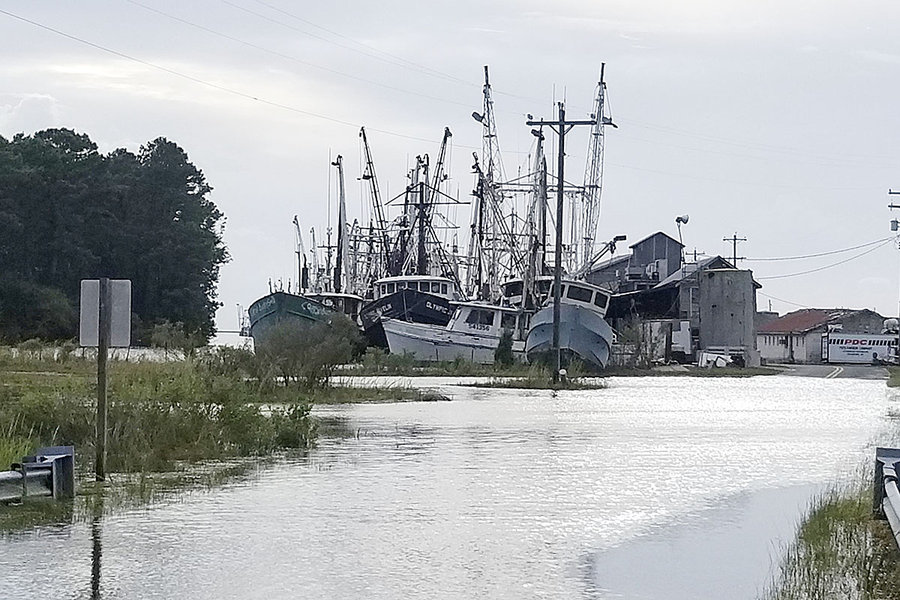
At Swan Quarter, North Carolina, shrimp boats cluster on the shore ahead of hurricane Florence in September. The town’s protective dike represents cooperation among practical people, who put aside politics to solve a serious problem.

Even when people believe global warming is only a cyclical blip, they can find common cause with others to solve a problem that affects everyone. Residents of a small town in North Carolina did just that after years of dangerous floods.

From the Christian Science Monitor: “As staff writer Patrik Jonsson began traveling the Carolinas after hurricane Florence, he came across a town that put aside its differences over politics and global warming to find a solution to chronic flooding. …

“Neighbors J.W. Raburn and Henry Williams are political polar opposites. … But the two lifelong friends – along with about 300 or so other North Carolinians who call Swan Quarter home – stood united [in September] against hurricane Florence.

“Nearby Oriental, New Bern, and large parts of central North Carolina were devastated when up to 40 inches of rain fell. … Tens of thousands of residents were displaced, and at least 23 people died.

” ‘There is no doubt that dike has saved us. It gives us a little bit of hope,’ says Raburn. His friend nods.

“The dike, completed in 2010, is a piece of political pragmatism that has gained stature as it held up well against during hurricanes Irene and Matthew, superstorm Sandy. …

“There is also growing evidence that mounting property losses, declines in property values, and threatened historical landmarks are wearing away resistance to preparedness. That common purpose might sometimes be hard to see on the national stage. But locally, people are putting aside politics in favor of practical solutions.

” ‘Working in Swan Quarter, flooding is not an ideological issue there. It is a way of life. Same with sea level rise. People have watched it happen within that lived environment. If you watch forests turn to marshland and the roads flood, the politics fade away,’ says Jason Evans, an environmentalist from Stetson University in DeLand, Fla., who worked on the dike project.

“Raburn and Williams, former bandmates, show the human side of the debate. Raburn believes that finding solutions to manmade climate change is vital. Williams, a farmer and volunteer firefighter, does not believe that humans are altering the temperature of the planet, calling it ‘a phase we are going through.’ But he is the one who cares for and maintains the dike – a job he takes very seriously. …

“In Swan Quarter, local taxes are likely to go up. The county needs to purchase pumps to help clear water that seeps through the dike. Across the sound on Ocracoke Island, county leaders are working on bolstering dunes. …

“At the same time, the dike played a role in the county investing millions in a new courthouse and fire station. The state credit union has felt confident enough in the dike to build a new branch. A critical ferry service runs from the docks to the Ocracoke Island. Inside the local gas station, a line drawn at head level shows the height of Isabel’s surge. Thus far, Florence has left no mark at all.

“The size of the town and the lean budgets mean, ‘the kind of interventions that can be done there and how we think about it is much different than thinking about New York City or Miami,’ says Evans. ‘Hyde County is a hardscrabble place trying to build a dike. Nothing solves anything forever. … But it clearly has helped with certain floods. I wouldn’t want to be in Swan Quarter during a big hurricane event without that dike being there. …

‘Whatever legislators want to do, whatever presidents want to do, it’s in the end not relevant in terms of trying to work through the facts. We have scientific understanding that can apply to all these places,’ says Evans. ‘But I have also seen over and over again – whether in the Florida Keys or in Swan Quarter – that within areas facing substantial problems, all the political stuff that we all get drawn into fades away.’ ”

Speaking of political stuff fading away, I want to do a post sometime on the fact that the divisions among us may make lively and urgent headlines but aren’t always replicated on the ground. Don’t we all interact regularly with people whose politics we know differ from ours? Would love to hear your examples to add to my own.

More at the Christian Science Monitor, here.

Read Full Post »

Photo: North Carolina Arboretum
Plant physiologist Joe-Ann McCoy extracts seeds from black cohosh collected in western North Carolina.

A plant physiologist, worried about the future effects of global warming on biodiversity in Appalachia, is not only preserving seeds but working to attract preservation-based economic development. It would be almost like getting a sponsor for one of the plants there, a plant whose roots are used in popular herbal remedies.

At Yale Environment 360, Nancy Averett writes, “When she can spare the time — away from the grant applications, journal articles, and economic reports strewn across her desk — plant physiologist Joe-Ann McCoy laces up her hiking boots and heads to the Pisgah National Forest in western North Carolina.

“Dodging copperheads and black bears, she winds her way deep into the forest, her eyes scanning the lush understory for black cohosh, a native plant whose roots have been used in herbal remedies for centuries, primarily to treat symptoms related to menopause. When she spots her quarry, McCoy gently pulls the plant’s seed pods — tiny brown orbs that rattle when shaken — off the stem and slips them into a paper envelope.

“The seeds inside those pods — which will be cleaned, vacuum-packed, and then stored in a freezer at -20 degrees Fahrenheit — give McCoy hope. As the director of the North Carolina Arboretum’s Germplasm Repository, her job is to preserve native seeds in this highly biodiverse area in southern Appalachia before climate change makes it impossible for some native vegetation to survive there.

“But the black cohosh holds another promise, as well. The plant’s roots are used in top-selling herbal remedies, and, if someone could succeed in growing black cohosh as a crop and manufacturing supplements here [it] could help drive economic development in this job-scarce region. …

“North Carolina [is] special in terms of biodiversity. Studies have documented more than 4,000 species of plants, 2,000 species of fungi, and 500 species of mosses and lichens in the region. Unlike much of the U.S. East Coast, during the last three ice ages the ground in this region did not freeze, which means the plants here have a much longer genetic history and more diversity than in other areas.

‘If I had to pick one place in the entire U.S. for this project,’ McCoy says, ‘it would be here. This is the ultimate spot.’ …

“When she first came to the arboretum, she focused on black cohosh and creating a robust seed collection from the plant’s entire geographic range — she has 22 different strains — and then growing plants from each strain so she would have enough seeds to back up her collection in three different repositories. These include two federal storage sites — in Ames, Iowa and Fort Collins, Colo. — plus the Svalbard Global Seed Vault in Norway.”

After cataloging the seeds, McCoy turns her attention to the economic possibilities. Read here about her work with investors. The Yale article also describes her ginseng efforts and her assistance to Cherokees who value plants used in traditional medicine.

Read Full Post »

To me it’s tragic that languages are disappearing and, with them, unique cultures.

Small, determined efforts can bring attention to the problem, as I noted this morning when the filmmaker behind Marie’s Dictionary retweeted this from North Carolina’s Pilot Mountain Elementary School (@pilotMtnElem).

Third grade students are learning about Marie’s Dictionary and endangered languages. @goproject #scsed #pmespirates @UNESCO

Excellent. Third graders are sure to spread the word.

Recently, I came across an article on another threatened language, Hawaii Sign Language.

“In 2013, at a conference on endangered languages, a retired teacher named Linda Lambrecht announced the extraordinary discovery of a previously unknown language. Lambrecht – who is Chinese-Hawaiian, 71 years old, warm but no-nonsense – called it Hawaii Sign Language, or HSL.

“In front of a room full of linguists, she demonstrated that its core vocabulary – words such as ‘mother,’ ‘pig’ and ‘small’ – was distinct from that of other sign languages. …

“The last-minute arrival of recognition and support for HSL was a powerful, almost surreal vindication for Lambrecht, whose first language is HSL. For decades, it was stigmatised or ignored; now the language has acquired an agreed-upon name, an official ‘language code’ from the International Organization for Standardization, the attention of linguists around the world, and a three-year grant from the Endangered Languages Documentation Programme at the School of Oriental and African Studies in London. …

“An initial estimate of up to 280 surviving HSL signers was soon revised down to 40, then down to just 10 or so old-timers still likely to be competent in HSL. ASL had made deep inroads even among these signers, but there was evidence, especially from Lambrecht’s signs, that HSL was distinct, and lay close enough to the surface to be recovered. Spoken languages such as Basque, Welsh, and Hawaiian have come back from the brink of extinction – could HSL be the first sign language to do it?”

The article is from the Guardian by way of the blog Arts Journal. Read it here.

Photo: Eugene Tanner Photography, LLC
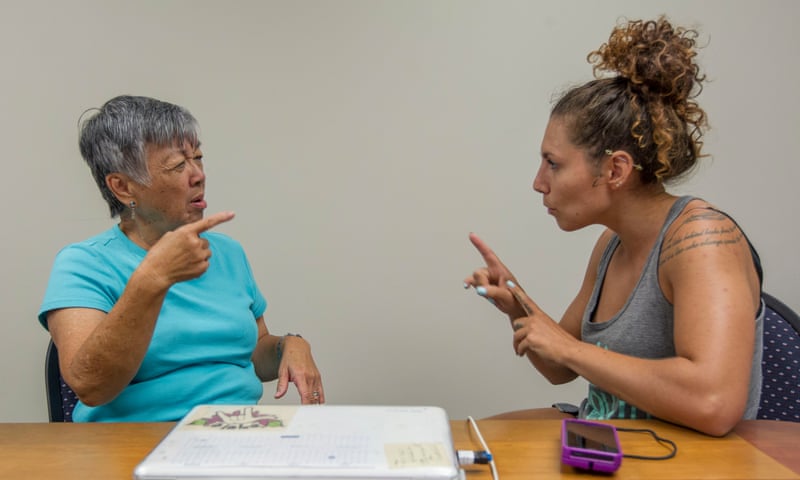
Linda Lambrecht, left, teaches Hawaii Sign Language.


Read Full Post »

121115-ICA


Until January 24, you can see at the ICA in Boston an exhibition on the artistic legacy of one of the most interesting colleges ever. It couldn’t last, but while it did, it burned with a bright flame.

Let me drop a few names of people who worked and studied there: Robert Rauschenberg, Josef Albers, Robert Motherwell, Cy Twombly, Jacob Lawrence, Willem de Koonig (painters); Buckminster Fuller (architect); Merce Cunningham (choreographer); John Cage (music); and Robert Creeley (poetry). I am leaving out too many, including the women, whose names are not as well known.

I went on my lunch hour and so swept through the exhibition too fast. I confess I am not crazy about much of the art from this period. My favorites here are Motherwell, Lawrence, Cunningham, and Creeley. But how amazing that they all gathered North Carolina’s Blue Ridge Mountains, energizing one another across disciplines and making the school their life for a while, even pitching in with the chores.

Surprisingly, the things I took away with me were two ideas I’d like to apply to art with grandchildren.

I’ve done photographic paper before (you put objects like leaves or shells on the paper, leave it in the sun a few minutes, then run in the house and rinse it in water), but someone in the show did a full body. I might try a hand or a face. I also loved the textures of one piece of art I saw. Not quite a collage, it used string and bumpy surfaces in imaginative ways that reminded me of a project I watched Earl Gordon do when I was a child. He sliced the seed pod of a flower and used it as a stamp. Got to try more of that.

You can read about the school and the exhibit here.

Photo: Craig F. Walker/Globe
I liked “Female Figure” on sun-exposed photographic paper, by Susan Weil and Robert Rauschenberg, left.

Read Full Post »

On Sunday, I got to the Peabody Essex Museum early and decided to walk around Salem before going in to see the Thomas Hart Bentons. I thought I might take a look at the hotel where I stayed when DeAnna and Mairtin got married.

I hadn’t gone very far when what should I spy but some very strange constructions made of sticks. Turns out the sculptures, by Patrick Dougherty, were also a PEM exhibition: “Stickwork.”

From Dougherty’s website: “Born in Oklahoma in 1945, Dougherty was raised in North Carolina. He earned a B.A. in English from the University of North Carolina in 1967 and an M.A. in Hospital and Health Administration from the University of Iowa in 1969. Later, he returned to the University of North Carolina to study art history and sculpture.

“Combining his carpentry skills with his love of nature, Patrick began to learn more about primitive techniques of building and to experiment with tree saplings as construction material. In 1982 his first work, Maple Body Wrap, was included in the North Carolina Biennial Artists’ Exhibition, sponsored by the North Carolina Museum of Art. In the following year, he had his first one-person show entitled, ‘Waitin’ It Out,’ in Maple at the Southeastern Center for Contemporary Art in Winston-Salem, North Carolina.

“His work quickly evolved from single pieces on conventional pedestals to monumental scale environmental works, which required saplings by the truckloads. Over the last thirty years, he has built over 250 of these works, and become internationally acclaimed. His sculpture has been seen worldwide—from Scotland to Japan to Brussels, and all over the United States.” More at http://www.stickwork.net.

Aren’t artists something? They just follow where it leads. Nobody gets them into windowless rooms to discuss strategy, goals, subgoals, benchmarks, measures, or evaluation.

Although, I suppose, if Dougherty started out in hospital management, he was subjected to lots of that sort of thing.

071215-Dougherty-Sticks-Salem

071215-lilies-and-sticks

071215-more-Stickwork

071215-thru-the-sticks-darkly


071215-Pat-Dougherty-Stickwork-Salem

Read Full Post »

Older Posts »