Feeds:
Posts
Comments

Posts Tagged ‘northwest’

Photo: Riley Robinson/Monitor Staff.
Kawehnokwiiosthe teaches the Mohawk language to students from both sides of the US-Canada border at the Akwesasne Freedom School, St. Regis Mohawk Reservation, northern New York.

Today many languages are in danger of dying out as the elders who speak them die off and young people don’t learn them.

Fortunately, in some places there are efforts to educate new speakers. Consider this Mohawk language school at a reservation in upstate New York.

Sara Miller Llana writes at the Christian Science Monitor, “Students and teachers, as well as some parents, sit on two wooden benches running the length of the hallway of their school, organized not by age or grade but by their clans.

“They take turns reading from the Ohén:ton Karihwatéhkwen, which translates from the Mohawk language to ‘Words before all else.’ These words, which recognize all life forces in creation, mark the day’s start at the Akwesasne Freedom School.

“But the 60-odd students here wouldn’t understand these lessons if it weren’t for this little schoolhouse at the United States-Canada border that for decades has been fighting to preserve Mohawk language and culture. ‘This makes us who we are, and if we don’t have this, who are we going to be?’ asks teacher Kawehnokwiiosthe, whose name in English means ‘She makes the island beautiful.’ …

“Kawehnokwiiosthe turns to her young pupils, who introduce themselves by their clans – Wolf, Bear, and Eel – and state that they are wisk, or age 5. Every class in K-8 that students take is full language immersion.

When a child asks a question in English, Kawehnokwiiosthe responds in Mohawk.

“Most parents pay tuition with a quilt sold at an annual auction in August. The school is run as a co-op, where parents do the cleaning (along with the students) and the maintenance work. Students come from American and Canadian sides of the border, but the school has never accepted funds from either government, says Alvera Sargent, who heads the nonprofit Friends of the Akwesasne Freedom School and is one of the last first-language speakers of Mohawk.

“That makes her precious, says Waylon Cook, former teacher and now project manager of the school’s nonprofit arm. ‘We treasure our first-language speakers,’ he says. … ‘If you lose [Mohawk], you can’t go to France like you could to learn French. There is nowhere else to do it but here.’ More at the Monitor, here.

Meanwhile, in the state of Washington, there’s an effort to bring Native language teaching into public school, too.

Lauren Gallup wrote at Northwest Public Broadcasting, “A number of Washington state public schools are partnering with tribes to bring Indigenous languages into classrooms in an effort to rectify the marred history of Native American boarding schools.

“Rachael Barger is a teacher on special assignment with Bethel School District, one of the districts partnering with the Nisqually Tribe to bring its Southern Lushootseed language into the classroom for a small subset of students. 

“5% of Bethel’s student population identifies as American Indian, Alaskan Native, two or more races or Hispanic and Native. Barger serves over 200 Title VI Indian Education Program students for the district. Title VI is a federal program that aims to meet the specific needs of Native American students. 

“The tribe and district have partnered, so far, to bring the language classes to two elementary schools for students who qualify for Title VI. Bethel School District had 461 qualifying students this last school year, which is around 2% of its student population.  Barger said those students were excited to learn the language because it felt unique to them. …

“The tribe’s partnership with the Bethel schools is part of the Nisqually Language Resource Center which started two years ago.

“ ‘It makes  it chokes me up,’ said Catalina Sanchez, research coordinator for the center. ‘It’s just something new that we’ve always needed in our community. So I’m proud of us for finally getting our own program in our schools and in our community.’

“The language work being undertaken by the tribe is part of broader efforts to expand and uplift culture and identity for the tribe. 

“ ‘You’re starting to see everything kind of awakening right now here in Nisqually,’ said Willie Frank III, chairman of the Nisqually Tribe. …

“Frank said he thinks it’s a perfect time to focus again on the tribe’s cultural traditions. ‘What I was taught was to tell our story, and, you know, keep building our people up,’ Frank said, ‘and that’s what we’re doing with all this great work in here. I think about the art, the culture and the language; that’s going to be something that sustains us.’ ” 

More at Northwest Public Broadcasting, here. No paywall for either article.
Read Full Post »

Photo: Dave Herasimtschuk, US Fish & Wildlife Service/Wikimedia.
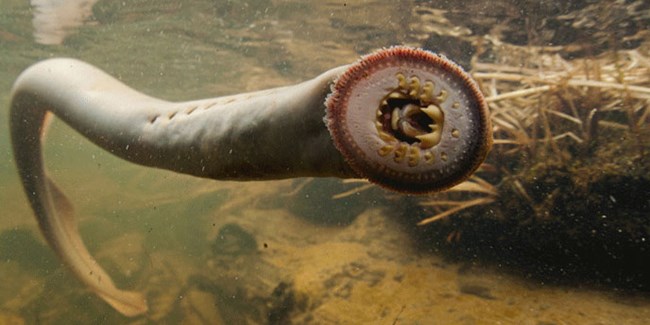
In Washington State, the Yakama Nation Fisheries crew routinely teams up to catch lamprey at an “eeling” hole that’s fed tribal members for generations. Lamprey use the suction of their oral discs to climb rocks at the eeling hole.

I like to explore social media and recently added Mastodon to the places I visit. At Mastodon, you have to join a group (what they call an instance), and I chose the Climate Justice instance. Being with Climate Justice has exposed me to people I haven’t followed before on social media. You won’t be surprised to learn that a topic like climate justice has attracted quite a few indigenous people. They are from all over the world: Sámi from the Nordic countries, Aborigine people from Australia, among others.

B. “Toastie” Oaster is one, a citizen of the Choctaw Nation in Oklahoma. From Toastie, I learned about a publication called High Country News and an article on the Pacific lamprey, an ugly fish with a long, important history.

“Lamprey have lived on Earth for 450 million years. To them, dinosaurs were a passing fad, and the North American continent is a fairly recent development. Lamprey swim out to sea as juveniles, looking for hosts like salmon to parasitize until they are mature enough to swim up some other river to spawn. Adult lamprey are calorie-dense and slow, protecting their hosts and cousins, the salmon, by acting as a predation buffer in another gesture of reciprocal care. 

“Though lamprey play a key role in Pacific watershed ecosystems, they remain understudied outside of tribal fisheries. They’re the target of misplaced disdain, in part because they’re easily confused with sea lamprey, an Atlantic species that caused ecological havoc in the Great Lakes after a 19th century shipping canal allowed them to invade. Pacific lamprey are a different species, in a different ecosystem; they belong here, just like the people they sustain.

“As far back as the memory archive reaches, people have fished for eels in this watershed. Lamprey climb wet rocks with their sucker mouths, so waterfalls are good places to catch them. Celilo Falls was a dangerous place for eeling, so people went to places like Willamette Falls, Celilo’s younger cousin. In its heyday, it was an international destination for summer eeling. Elders remember elders who remember trails that connected the falls to central Oregon. Camps lined both sides of the Willamette and the Clackamas River, which branches off below the falls. 

“Wewa [an elder and tribal councilman of the Confederated Tribes of Warm Springs] and other elders are clear that their ancestors were not nomads. Families returned to permanent homes, making seasonal trips to where food thrived. This non-European approach to agriculture ensures that both people and ecosystems flourish. In its healthy state, the Willamette Valley was a food-producing white oak savanna, bright blue in springtime with flowering carpets of delicious camas roots. That’s where it got its name: ‘Willamette’ is a French corruption of lámt, the Ichishkíin word for blue, Wewa said. ‘They ruined it.’

“For the millions of lamprey that returned from the ocean to spawn in the Willamette Valley, the first obstacle they faced was Willamette Falls. In the late 1800s, settler accounts described the 1,500-foot-long, four-story-high falls as ‘completely covered‘ in eels during the summer runs — three layers deep, in some places. Historical photos give an idea of how the rocks looked blanketed in eels, some latched onto each other’s backs, rendering the boulders as shaggy as mastodons. In the 1940s, European settlers commercially harvested as many as 500,000 lamprey a year, but tribal harvests until that point had kept the population in careful balance. …

“Since industrialization, lamprey numbers have dropped by 90%, largely because of dams. According to some Natives, public antipathy toward the species hasn’t helped. Willamette Falls is one of the last places where there are still enough lamprey to harvest. There, the Confederated Tribes of the Umatilla Indian Reservation, the Confederated Tribes of Warm Springs, the Confederated Tribes and Bands of the Yakama Nation and the Nez Perce Tribe — all of whom retain treaty fishing rights at Willamette Falls — boat upriver between industrial structures to harvest lamprey at the falls. These four tribes comprise the Columbia River Inter-Tribal Fish Commission (CRITFC), an organization that enforces treaty rights and promotes conservation of the basin’s aquatic life. Every year, CRITFC coordinates eeling trips with tribes.

“Eeling teams consist of at least two people: one to hold the net, the other to catch the eels. Plucking them off the rocks is easy enough with cotton work gloves, which provide the best traction against eels’ dolphin-smooth skin. …

“To work a waterfall, crews start at the bottom; eels will spook and stampede if they sense danger or smell blood in the current. Sometimes, eelers use this to their advantage, sticking a net or a trap at the downspout of a rockpool and scaring the eels into it from behind. When a dipnet is full, the crew transfer the catch eel by eel into burlap bags, then carry the pulsing, writhing sacks over the boulders to the boat. …

“While any tribal member can organize eeling trips, the fisheries department conducts its own trips to get eels for elders, those in need and ceremonial uses. The boat’s driver, a teddy-bear-faced man in his mid-50s with a bandanna tied over a loose knot of gray hair, lit a cigarette, apparently the only person unfazed by the cold or the early hour.

“ ‘All this is pretty tame to me,’ he laughed. He said he used to work ’30-hour days’ running a commercial salmon fishing operation at Lake Celilo, where Celilo Falls used to be. He reminisced about his glory days at Willamette Falls in the late ’80s and early ’90s, claiming, with a sly smile, that he caught so many eels, he’s probably the reason they’re in decline. Five thousand pounds in a day, he said. ‘I’ve been there, done that, 30 years ago, 40 years ago.’

“The boat driver is Evans Lewis Jr., a veteran fisherman now serving as the assistant manager of the Yakama Nation Fisheries’ sturgeon hatchery. … Lewis said he knows the best eeling holes from previous generations, where lamprey still gather by the thousands. He pointed out the best route along the boulders: Don’t hug the ridge, he said. Swing out in a wide arc, closer to the water line. He described techniques no one uses anymore: Drilling drainage holes in a metal trash can is easier, he said, than hauling gunny sacks of eels back across the rocks. ‘Nobody fishes like I do,’ Lewis told me and grinned.’ “

Toastie’s long, fascinating article is at High Country, here. You may read four High Country articles for free each month.

Read Full Post »