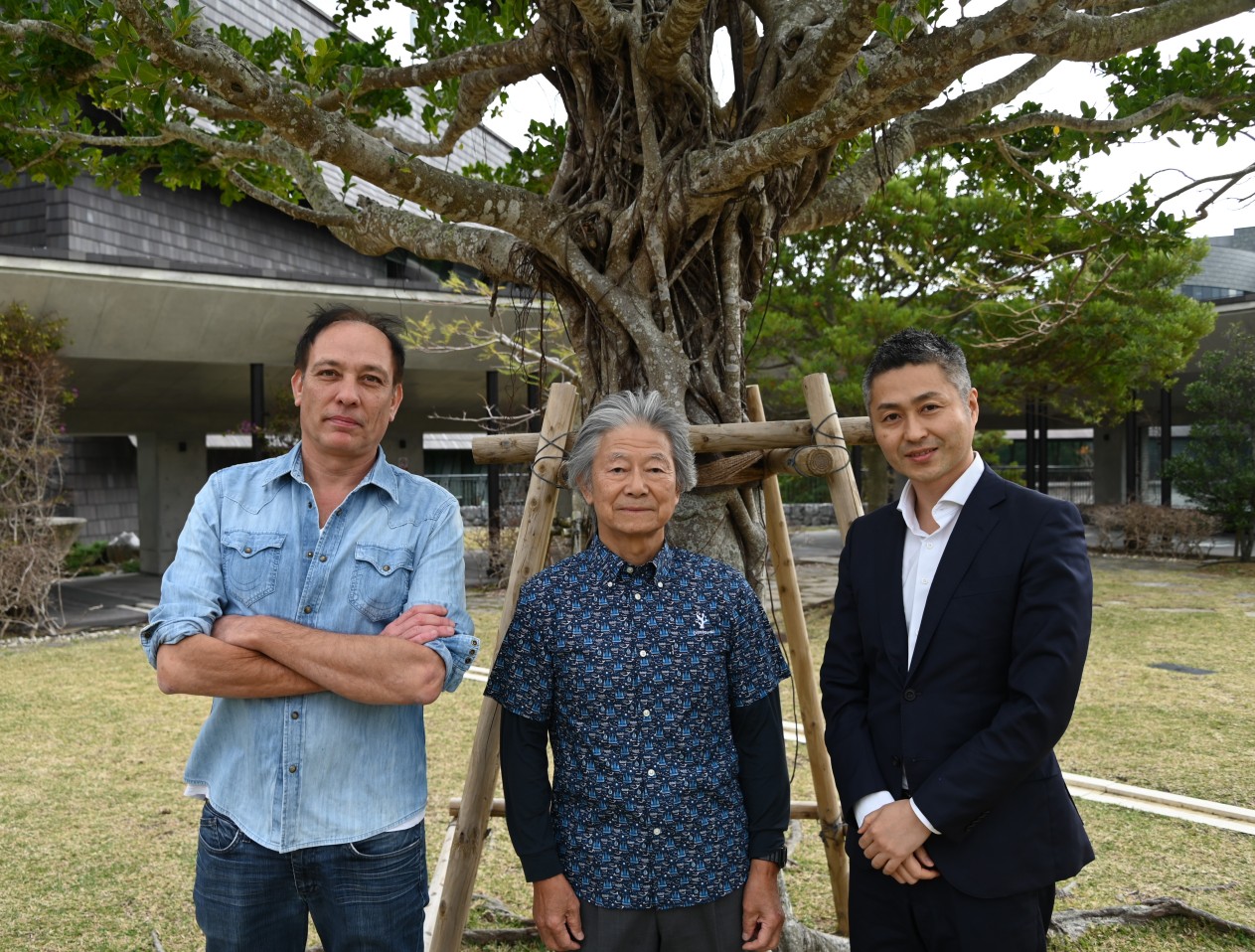
Photo: Okinawa Institute of Science and Technology.
Prof. Timothy Ravasi, Prof. Noriyuki Satoh, and Shimon Sato (L-R) lead the Coral Project at OIST, a nonprofit initiative helping conserve coral biodiversity in Okinawa.
It is now generally known that corals are important for ocean biodiversity but are in danger from climate change. If you search on “coral” at this blog, you will find a variety of stories about what people are trying to do to help.
Today we look at an organization in Japan that merges the work of local people to that of scientists.
The website of the Okinawa Institute of Science and Technology (OIST) says, “Unlike many global reef locations requiring a boat ride, Okinawa’s reefs are accessible directly from the beach — a simple walk to a nearby beach, a quick dip into the crystal-clear waters, and within moments, you are immersed in a lively ocean community.
“Yet elders in Okinawa remember a time when coral-filled waters were more abundant, a contrast to the significant coral decline observed in recent years, especially near shorelines. Worldwide, human activities have resulted in an alarming decrease in coral populations in the last decade. Consequently, efforts to plant corals are gaining momentum.
“The OIST Coral Project, an initiative focused on studying and preserving coral biodiversity in Okinawa, was launched in July 2023 at the Okinawa Institute of Science and Technology (OIST). To date, the project has successfully enlisted the support of 20 companies in Okinawa and mainland Japan. …
“In January 2023, Prof. Noriyuki Satoh, head of OIST’s Marine Genomics Unit, sat down with Shimon Sato, an experienced fundraiser and Advancement Officer at OIST. They came up with an ambitious idea: to use knowledge of genomics and eDNA in a new project to plant and conserve coral in Okinawa. This was the start of an innovative effort to protect local marine life by connecting with locals and companies in Okinawa and Tokyo to establish potential collaborations.
“Prof. Satoh and his team at the Marine Genomics Unit achieved groundbreaking milestones by decoding the genomes of corals in 2011, zooxanthellae (symbiotic organisms that coexist with corals) in 2013, and the crown-of-thorns starfish (known for devouring corals) in 2017. …
“Using this knowledge, Prof. Satoh identified the best types of coral that can be planted at specific sites in Okinawa. … Permission was granted by Okinawa Prefecture and planting is done by professional vendors, following Japan’s strict coral planting regulations.
Each planting site is overseen by a different fishermen’s organization, each with its own unique team and structure.
“Before planting, Prof. Satoh engages in negotiations with the fishermen’s organizations, explaining the project’s objectives and benefits. These fishermen, who have a deep understanding and respect for the sea, are important allies. …
“Yet this project is not just about planting corals — scientists also conduct eDNA monitoring of corals and study the fish that arrive after the planting, observing which species are on the rise or decline. …
“Cause-related marketing is one of the unique aspects of this project. This is an approach where businesses associate themselves with societal issues or values by working with non-profit organizations to promote a specific cause. …
“ ‘We began with 8 companies, including Japan’s largest mobile company NTT Docomo in Tokyo and several others in Okinawa.’ … Supporting companies can use the project’s [logo]. Ryukyu Cement Co., Ltd., the largest cement company in Okinawa, displays the logo on their cement bags and donates a portion of their cement sales to the project. Another notable supporter is Majun, the leading Kariyushi wear company in Japan. Majun has created an original 100% cotton Kariyushi t-shirt embroidered with the Coral Project logo. …
“In 2018 Onna Village, where OIST is located, was declared a ‘coral village’ or ‘sango no mura’ in Japanese, and in 2019 the Government of Japan declared the village a ‘Sustainable Development Goals Future City.’ Impressively, the practice of coral planting in Onna Village began two decades ago. In 2004, a local organization, Team Churasango, was established by community members with participation from both local and mainland companies. On average, they plant 1,000 corals annually, in response to the observed decline in coral numbers. …
“The project team has recently welcomed a third person – Prof. Timothy Ravasi, leader of the Marine Climate Change Unit at OIST. Prof. Ravasi’s unit uses the latest methods in genomics to study how marine organisms adjust to warmer and more acidic oceans. …
“Shimon attributes the success of the project to two main factors. First, Prof. Satoh’s expert knowledge of corals and excellent people skills. Second, the project has secured the support of numerous stakeholders. … ‘Okinawan people value coral, and they want to return the coral reefs to their previous beautiful and healthy state. We want to support those hopes using the power of science,’ he said.”
More at the Okinawa Institute of Science and Technology, here. And you can click here to read about how OIST got the Isawa Award for this work.

 Suzanne's Mom's Blog