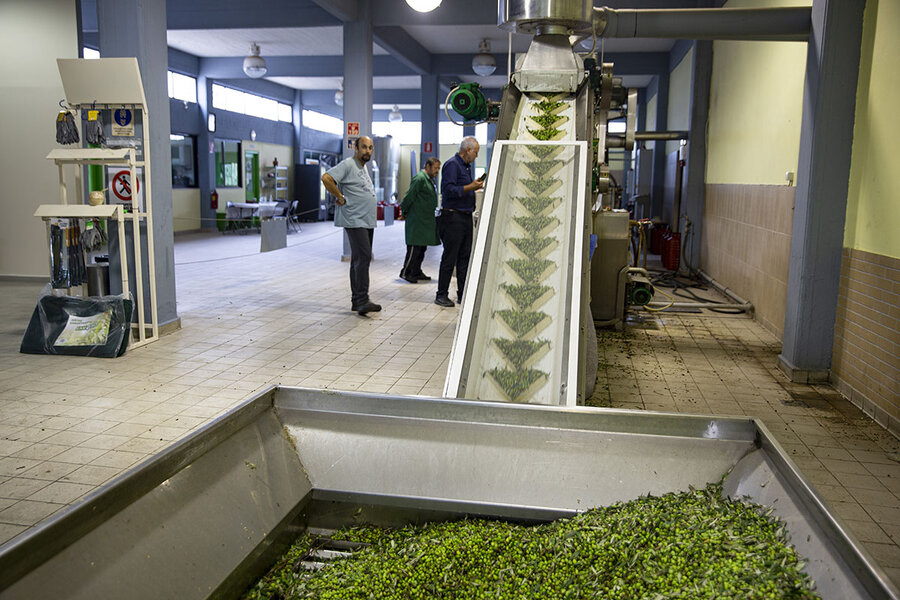
Photo: Dominique Soguel.
Michael Antonopoulos, president of the Agricultural Cooperative of Kalamata, tells the Christian Science Monitor, “We want to adjust as soon as possible to the environment and be pioneers. Our place has to be fully ecological.”
In Greece, where farmers have grown olives for millennia, global warming has imposed a new normal. Nevertheless, writes Dominique Soguel at the Christian Science Monitor, “the result is not resignation. Rather, it’s fresh thinking and approaches.”
Soguel continues, “Olives and olive oil have become synonymous with Greece, and are credited, in part, with fueling the rise of Greek civilization. But despite a history spanning thousands of years, these culinary pillars of Greek identity are under threat. Small farmers expect this year’s harvest season, which got underway in November, to be one of the worst years on record, thanks to climate change and the irregular seasonal shifts it has wrought upon the flowering process and fruit development.
“ ‘We are collecting olives much earlier than ever before. Our producers do not recall any year like this,’ says Michael Antonopoulos, president of the Agricultural Cooperative of Kalamata. …
“He is not alone in expecting southern Europe to look like northern Africa in the span of 50 to 100 years. But Mr. Antonopoulos, a geologist and geotechnical environmentalist by training, is optimistic. He points to a series of steps that the community is taking to adapt to unseasonal temperature variations.
‘You can’t change the climate, but you can adjust.’
“[He] notes that traditional olive groves have an important role to play in combating climate change. They are carbon sinks and could easily be integrated into carbon-offsetting projects, increasingly popular but also controversial methods used to reduce the carbon footprint of a company or country. Kalamata is among six Greek cities participating in the European Union mission for 100 climate-neutral and smart cities by 2030.
“ ‘We want to adjust as soon as possible to the environment and be pioneers,’ he says. ‘Our place has to be fully ecological. We don’t care about higher productivity. We care about sustainability. We know people in the future will appreciate that more than anything.’
“One November day in Kalamata, as the mill that serves a community of roughly 300 olive oil producers operates at full throttle, the rain outside turns to hail. … It’s been that kind of year for Kalamata’s olive crop. In 2023, it endured winter conditions during the spring and, unlike much of Greece, experienced relatively low summer temperatures. That unusual weather, coupled with low rainfall, resulted in fewer and smaller olives. …
“ ‘If you don’t have certain weather conditions at a certain time,’ explains Mr. Antonopoulos, ‘you can’t have olive oil.’
“But the mill is also representative of how Greek olive farmers are adapting to the new environment. It is designed to run as sustainably as possible. Waste compost from the mill enriches the soil of the surrounding groves. It is the first mill in the region to rely on solar panel energy, and it recently secured a deal to sell electricity to the Greek government. Further, its farmers have adjusted their pruning tactics to optimize water use. And geothermal energy heats the olive oil extraction plants. …
“ ‘It’s all about feeding the soil,’ says George Kokkinos, head of the Nileas olive oil producers cooperative in the broader Messenia region, which encompasses Kalamata. ‘Soil health is top priority.’ …
“ ‘The philosophy was to look at how olive tree cultivation adapts to climate change,’ adds Mr. Kokkinos. ‘It was the first time that we heard of the expression “climate change.” … The consequences only start to be seen and felt here in 2016.’
“One of the most visible of these consequences, he says, are warmer, humid winters. This led to the spread of fungal diseases. Another change … summer now starts in July and lasts longer. All that confuses the olive tree, which decides in February whether to flower and delivers olives in April. …
“ ‘The normal, maximum temperature for this place this time of year would have been 16-18 C [60-66 F]. Typically, we would start the harvest wearing heavy clothes. Now we harvest in our T-shirts.’
“The mitigation measures are working, he says, even though recent summer heat waves dried up thesoil. He sees evidence of that in a 30% loss of productivity this year on his grove, compared with much higher losses among those who took no measures. The techniques they tested in the project now form part of the EU sustainable agricultural policy. But he worries that the Greek government is not prioritizing action and the spread of know-how to other farmers.
“ ‘The farmer stands in the middle and does not connect the dots,’ he says. ‘The average farmer in Greece is 60 years old. It’s a hard time. That’s true. But there are opportunities. The key is to adjust.’ ”
More at the Monitor, here. No paywall.

 Suzanne's Mom's Blog