Feeds:
Posts
Comments

Posts Tagged ‘orphan’

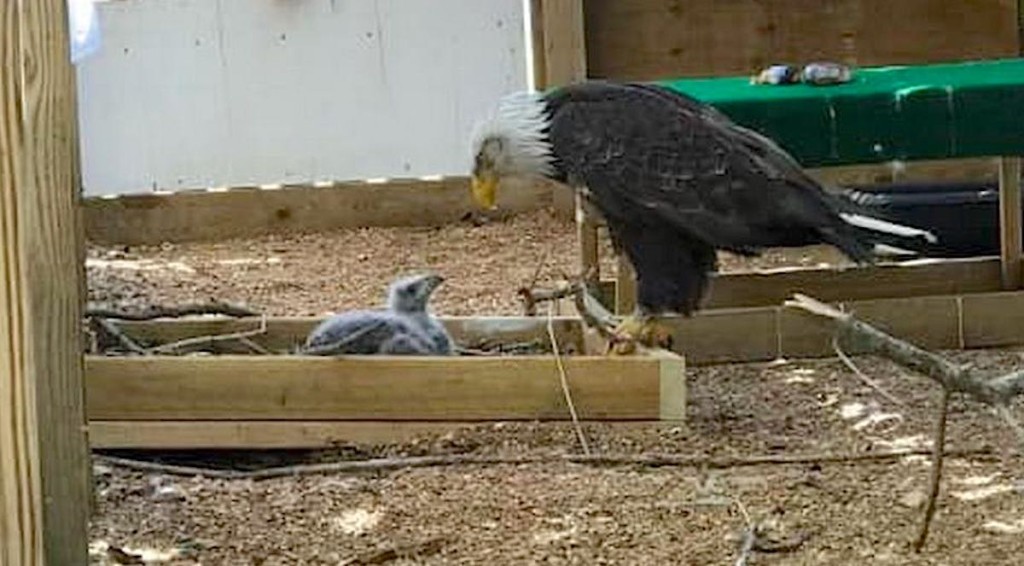
Photo: World Bird Sanctuary on Facebook.
Murphy the bald eagle really want to be a dad and tried hatching a rock. Friends helped him adopt an orphaned eaglet.

Sometimes humans actually do the right thing by critters. For example, in today’s story, they gave a hand to a bald eagle who wanted so much to be a parent that he tried hatching a rock.

Praveena Somasundaram reports the story at the Washington Post.

“Visitors to the World Bird Sanctuary in Valley Park, Mo., started to worry about Murphy [in March]. They saw the 31-year-old bald eagle sitting in one spot in the aviary, barely moving, and worried that he was sick or injured. As the month went by, so many visitors brought their concerns to the keepers that the sanctuary posted a sign near the enclosure explaining why the eagle sat so still underneath his perch and atop a makeshift nest.

“ ‘Murphy is not hurt, sick, or otherwise in distress,’ the sign read. ‘He has built a nest on the ground, and is very carefully incubating a rock. We wish him the best of luck!’

“A tweet about Murphy’s mission quickly went viral, leading thousands to follow along as he tried to hatch the rock, though they knew it was impossible. Then, in a twist, Murphy’s new fans got to see the eagle become a father after all when, in early April, he began to bond with an eaglet the sanctuary received.

” ‘He was sitting on a rock and everybody told him, “It’s a rock, it’s not going to hatch,” ‘ said Dawn Griffard, CEO of World Bird Sanctuary. ‘And all of a sudden, in his mind, it hatched and he has a chick.’

“Murphy first arrived at the sanctuary, which tries to release the birds it receives back into the wild, about 30 years ago. He was transported from Oklahoma with a broken leg that was treated at World Bird Sanctuary before he was released. But he soon returned with a broken wing.

“Staff determined he had suffered permanent damage that made him unable to fly or survive in the wild, where most eagles live 20 to 30 years, and he has lived at the sanctuary ever since.

“Murphy was in the center’s bald eagle aviary with four others in early March when staff first noticed that he’d taken to one of the rocks in the enclosure.

“Over several weeks, Murphy had become so protective of his rock that he wouldn’t allow the other four eagles near his side of the enclosure, Griffard said. If they tried to come anywhere close, he screamed or charged at them.

“While Murphy had not incubated like that before, Griffard said it’s not uncommon for birds during the spring breeding season when their hormones run high. …

“A few days after Murphy had started to protect his ‘rock baby’ too aggressively, on April 4, the sanctuary staff moved him to a separate, private enclosure, she said. … That same week, rescuers brought a baby eaglet to the sanctuary from Ste. Genevieve, Mo., following a windstorm that had blown its nest down. The other eaglet it had shared the nest with died in the fall, Griffard said.

“After the eaglet was checked for injuries, the sanctuary staff’s next task was to figure out which eagle to bond it with. … Murphy was ‘the best choice.’ …

“But Murphy only had experience caring for a rock. So sanctuary staff decided to place the eaglet in a small cage they then put inside Murphy’s nest. They monitored the bonding process carefully through a camera in the enclosure. The eaglet was released from its cage on April 13, after about a week in the nest with Murphy. …

“That morning, Murphy was given a full fish, and the eaglet had small chunks placed in the nest to eat. When keepers checked to make sure both had eaten, Murphy’s fish had been torn apart, but the eaglet’s pile of fish was untouched.

“However, the eaglet’s crop, an area under its chin where food is stored, was full — meaning Murphy had fed his chick. …

“Soon, staff will begin training the eaglet to fly and to hunt, preparing the chick to be released back into the wild this summer. But, Griffard said, people shouldn’t worry too much about Murphy being sad or lonely when that happens.

“ ‘There is a point where eagle parents know that it’s time for the chick to leave,’ she said. ‘And they almost kick the chick out of the nest. So, he’ll know.’ ”

More at the Post, here.

Meanwhile, if you wake up early, you can watch an osprey (“fish eagle”) feed its baby in real time, here. Today feeding started at 6:09 a.m. Eastern Daylight Savings.

Read Full Post »


080616-vision-of-hope-zambia-apron

The first booth I encountered at the Art and Artisan fair Saturday was promoting a charity called Vision of Hope Zambia.

Co-founder Meg O’Brien had been a student at Berklee College of Music when a missionary friend in Zambia asked her to lend her musical talent to uplifting girls who lived on the streets.

When she visited Africa, Meg must have been shocked by what she saw: young girls, often orphaned, often HIV positive, who had no place to get a meal or even take a shower. She flew into action, co-founding Vision of Hope Zambia with Chitalu Chishimba.

Meg’s mother and aunt also flew into action, creating a craft initiative that donates 100 percent of proceeds to the cause.

The two artisans not only sew with skill — baby bibs, changing blankets, aprons and the like — they also are good at selling, promoting Meg’s charity while highlighting various features of their products.

Meg’s aunt saw me talking to my grandchildren and immediately pointed out the colorful array of child-size aprons. In the end, though, I bought an adult-sized apron for myself.

From humble beginnings in 2009 (“weekly meetings in the backyard of the Girl Scouts building underneath a tree”), the organization is now able to provide housing and education for many girls as it continues to grow.

Photo: Vision of Hope Zambia
Girls at Vision of Hope proudly show off their hard work in rug making.


Read Full Post »

When I think of Russia and the words “big brother” together, I don’t ordinarily picture the charitable organization that partners adults with kids who need role models. Roman Sklotskiy has altered my mental model.

Last month, Diana Kultchitskaya interviewed Sklotskiy for the Christian Science Monitor.

“Roman Sklotskiy, a former businessman and a graduate of the Moscow State Institute of International Relations, didn’t dream of having a career in charity. In the early 2000s he was a pioneer in the telecommunications industry, testing applications for mobile networks.

“But then he was invited by a friend to be the administrator of a theater for deaf actors – a charity project launched by a group of professional actors and directors. He was so inspired by the experience that he decided to pursue charitable work.

“In 2007 he learned of a nonprofit group trying to bring a United States-based mentoring program to Russia. Big Brothers Big Sisters International is a volunteer program that helps orphans and children from troubled families find mentors who provide them with a role model and help them build a healthy relationship with an adult.

“In Russia this kind of volunteering was a new idea. Mr. Sklotskiy decided to join the Big Brothers Big Sisters of Russia team and became its director, spending six years developing it. …

“The selection process for people who would like to participate in Russia’s Big Brothers Big Sisters program is strict. … Those who are selected receive training. Psychologists work with them and explain the unique demands of communicating with an orphan. …

“Alexandr Gezalov, an expert on child adoption and orphanages, says that the project is very successful.

“ ‘I’ve never seen a more effective format for communicating with an orphaned child,’ Mr. Gezalov says. The success of Big Brothers Big Sisters should be shared with other organizations, he says.

“Today Sklotskiy serves as director of charitable programs at the RVVZ Foundation. But he’s stayed involved in Big Brothers Big Sisters as chairman of the board. And he thinks it still has great potential to grow and help even more children. Currently Big Brothers Big Sisters is operating in Moscow and St. Petersburg.”

More here.

Photo: Svetlana Balashova for the Christian Science Monitor
Roman Sklotskiy longed to do charitable work, and he found his calling in developing Big Brothers Big Sisters of Russia.

Read Full Post »

Lately, it seems that lot of young people want to make the world a better place and are starting nonprofits to do so.

Marian Daniells writes in the Boston Globe about one young activist, who attends Northeastern University.

“Mike Behan spends six months out of the year in Njabini, Kenya. But it’s no safari vacation. Behan, 21, is the cofounder and CEO of Njabini Apparel, a nonprofit company selling handcrafted accessories made by landless and handicapped mothers in the Kenyan settlement.

“A rising senior at Northeastern University, Behan first visited Njabini in June 2010 as a volunteer with Flying Kites, a nonprofit group that supports orphaned children in Kenya. With Flying Kites’ help, Behan then started Njabini Apparel with Tom Mwangi and marketing director Erin O’Malley (both volunteers with Flying Kites) in August of that year. By October, they were selling hats and scarves. Most of Njabini Apparel’s sales are done online, or by volunteers for Njabini Apparel and Flying Kites. …

“Participating mothers are able to immediately earn four times the average national income (equivalent to $780), which is then driven back into the local economy.” Read more. It will make you feel good.

Lucy Wanjiku at Njabini Apparel, a nonprofit cofounded by Mike Behan that sells handcrafted goods made by landless and handicapped mothers in the Kenyan settlement. Photograph: John Deputy

Read Full Post »