Feeds:
Posts
Comments

Posts Tagged ‘Ozymandias’

Photo: Taylor Luck.
“The Fardous Bookstore, once under restrictions imposed by the former Assad regime,” says Taylor Luck of the Christian Science Monitor, “now sells previously banned books to eager readers.”

Books are stronger than tyrants. We hold onto that thought. We know from both history and the belief of poets that the time of tyrants has an end. I think Shelley says it best.

“My name is Ozymandias, King of Kings;
“Look on my Works, ye Mighty, and despair!
“Nothing beside remains.”

If you don’t see the downfall of the pedestal in your own country at the moment, look toward Syria. Syrians have reason to believe that new tyrants won’t be replacing the hated Assad anytime soon.

After all, books are not being banned by the revolutionary government.

“Post-revolution Syria is becoming a page-turner’s paradise,” wrote Taylor Luck at the Christian Science Monitor recently.

“After years of being banned by the former regime, dozens of long sought-after books are flooding stores across Syria, literally spilling onto the streets. An epicenter of this new literary freedom is the so-called ‘bookshop alley’ in the Halbouni neighborhood of Damascus, a leafy street lined by two dozen bookshops and printers, big and small.

“It is here that Radwan Sharqawi runs the Fardous Bookstore, a small corner shop that his family has owned since 1920. The contrast between today’s Syria and the long period of Assad family rule is like night and day, he says.

“ ‘Before, we had daily interrogations by the security services,’ Mr. Sharqawi says. ‘Now everything is permitted, nothing is banned. Now is a golden era for books!’

For decades, any book written by an intellectual or an artist who had expressed opposition to the Assad regime – or who simply did not vocally toe the official line – was banned.

“So, too, were books that touched on Syrian history from any perspective other than the ruling Baath Party’s revisionist version. Titles on the history of the Israeli-Arab conflict, or anything on the 2011 Arab Spring uprisings, were contraband.

“Islamic thinkers such as Ibn Taymiyya, the influential medieval Sunni jurist and scholar, were banned. So, too, were books by Brotherhood-aligned clerics. … Even a book as basic as a tafsīr, an annotated Quran with explanations and context, was banned, for fear it might contradict the Assad government’s tightly controlled Islamic authorities.

“ ‘These are texts about religion and God, not politics,’ says Abdulkader al-Sarooji, owner of the Ibn Al Qayem bookshop, as a customer browses shelves of leather-bound Islamic books, their titles engraved in decorative golden calligraphy. …

“As soon as the regime fell, Mr. Sarooji began importing books from Turkey and northern Syria to Damascus. Syrians are rushing to snatch up banned titles. …

“ ‘There is demand for banned books because people feel there is a gap in their knowledge, even in their religious knowledge,’ says Mr. Sarooji.

“The most dangerous texts during the Assad era – and the books in highest demand now – are works of literary fiction, titles that draw on the real experiences of Syrians who spent time in jail and suffered abuse at the hands of the regime. The most fiercely banned book was Bayt Khalti, by Ahmed al-Amri, which details the horrors faced by women in the notorious Sednaya prison.

“Now Bayt Khalti is prominently displayed on bookshelves and vendors’ roadside stands across Damascus – in both legitimate editions and blurry knockoffs that feed the high demand.

“ ‘This book was the most dangerous one,’ street-side book vendor Hussein Mohammed says as he waves a copy of Bayt Khalti. ‘If they caught you with this, you were a goner.’

“Another popular banned text, Al Qoqaa, or The Cochlea, details a Christian Syrian’s time in Mr. Assad’s prisons.

“Eyad, a young Damascene, purchased a book of fiction from Mr. Mohammed after spending an hour browsing in the bookshop alley. ‘There are a lot of books that I have wanted to read for years,’ he says.”

More at the Monitor, here.
Read Full Post »

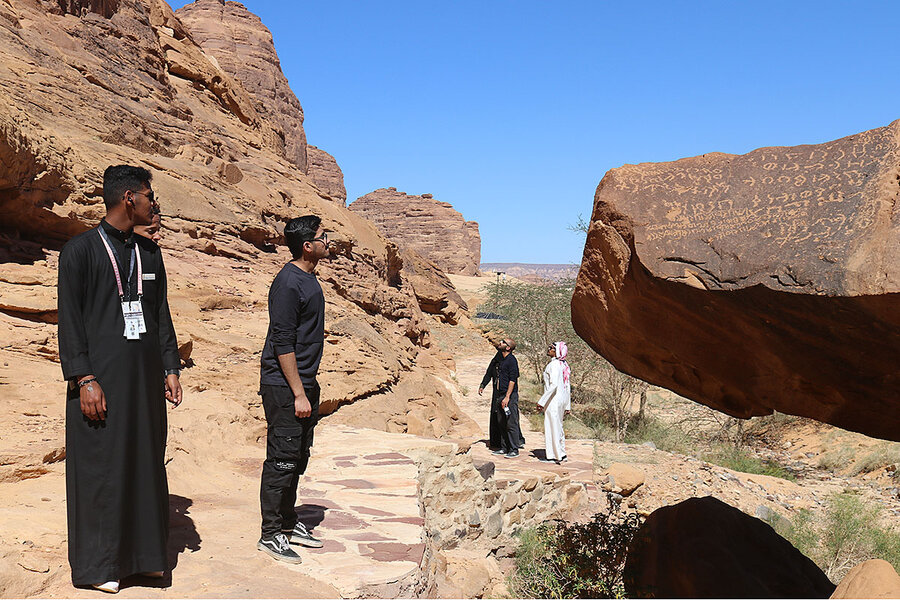
Photo: Taylor Luck.
Saudi university graduates tour the rock inscription at Jabal Ikma, one of several sites dated to the ancient Arab kingdoms of Dadan and Lihyan that are spread out across Al Ula, northwest Saudi Arabia, March 7, 2020.

Residents of Saudi Arabia have been learning recently about two previously unknown, ancient civilizations on their peninsula — making them proud to be recognized for something beyond oil.

Taylor Luck reported at the Christian Science Monitor, “Tarek never knew his daily commute was in the footsteps of ancient Arab kings. The 30-year-old Al Ula resident runs his hands over the exposed brick and rock inscriptions he has known since a child as ‘the ruins,’ listening as a tour guide lists the achievements of the tribes that built a kingdom on these sands 3,000 years ago.

“Squinting at the rock-carved tombs in front of him, he sees something greater than a civilization: a connection.

‘They prayed, they grew dates, they performed pilgrimages and welcomed visitors to the oasis like we do today,’ Tarek says as he stops to pose for a selfie in front of a rock engraving. ‘They lived just like us.’

“Today Saudi authorities and archaeologists are unearthing and promoting Dadan and Lihyan, two Arab kingdoms whose traces have lain under sand and obscurity for centuries. Cited in the Old Testament and ancient Greek texts, the ancient kingdoms once ruled vital trade routes.

“Saudi citizens are pointing to the kingdoms as proof not only that this arid region was home to civilizations centuries before the modern oil boom, but that the people of Saudi Arabia are the latest in a proud lineage stretching back millennia – that there is more to being a Saudi than oil and religion. …

“While most of the Middle East and Mediterranean were rich in legendary city-states, the vast Arabian deserts were, for generations of archeologists and academics, flyover country of little note or historical value. A blank spot on the map of the ancient world. If they were so great, where are the monuments? Where are the cities?

“The cities, it turns out, are still being unearthed. And what has already been uncovered of Dadan and Lihyan in the deserts of northwest Saudi Arabia has turned conventional wisdom on its head.

“Here in Al Ula, the remnants of these sprawling desert kingdoms from the first millennium B.C. are woven into the landscape: Temple columns, 1-meter-thick brick walls, rock-carved tombs, detailed statues, and inscription-scrawled boulders poke out among date farms, houses, and newly-established eco-resorts.

“Most of what scholars know today of these kingdoms is from the hundreds of rock inscriptions scrawled across the area in the Dadanite language, a Semitic offshoot, telling of kings and pilgrims, migrant communities, and daily life and death. And taxes. …

“ ‘This is their library, a collection of their civilization and stories carefully carved into stone,’ says [tour guide] Thuraya, who was trained to interpret rock art. ‘Lihyanites and the Dadanites … were advanced kingdoms that you could put in the same sentence as ancient Egypt or Mesopotamia.’

“The Dadanites controlled the lucrative trade of incense – namely frankincense – which was cultivated in Yemen and carried on camel caravans through Dadan en route to temples in Pharaonic Egypt, Mesopotamia, and the Levant, where this fragrant tree resin played an important role in religious ceremonies. …

“ ‘Incense was the petrol of the times, this is why Dadan flourished,’ says Abdulrahman Alsuhaibani, an associate professor at King Saud University in Riyadh who has been leading excavations at Dadan for the past decade.

“What has been excavated speaks to their advancements: one temple features perfectly square tombs and intricate lion statues carved into the rockface. At another, wells and an 8-foot-tall stone basin believed to have been used for ablution by pilgrims coming to give tribute to a pantheon of gods suggest an advanced water management system.

“In the fifth century B.C., another tribe built upon Dadan to create Lihyan, an empire extending west into the Gulf of Aqaba and Sinai and north toward the Levant. What has been uncovered speaks to the Lihyanites’ influence: two imposing larger-than-life statues of Lihyan kings, standing like half-robed pharaohs, were recovered at a Lihyanite temple. … Local residents say they have seen ‘dozens’ of statues and human-shaped stone idols over the years while picnicking in the valleys. 

“This is likely because Lihyan’s economic juggernaut was built not only on incense trade, but on tribute paid at its temples. It also was a hub for dried dates, which have grown in abundance here for nearly 3,000 years and travel well on weekslong desert treks.

“Today, this same oasis accounts for one-third of Saudi Arabia’s date production and is renowned across the country. … Such was Lihyan’s fame, ancient Greek cartographers and Pliny the Elder referred to the Gulf of Aqaba as the Gulf of Lihyan, a name that was in use for three centuries.

“But then, shortly before the first century B.C., the rival Nabataeans from southern Jordan inhabited Lihyan and transformed it into the town of Al Hajr, or Hegra, the second city of their empire. Within years, all mention of Lihyan suddenly stopped.”

Imagine! Three hundred years of fame and then nothing.

Hard to read about archaeology without thinking of Shelley’s poem:

“And on the pedestal, these words appear:
My name is Ozymandias, King of Kings;
Look on my Works, ye Mighty, and despair!
Nothing beside remains.” 

More at the Monitor, here.

Read Full Post »