Feeds:
Posts
Comments

Posts Tagged ‘paint’

Photo: Álvarez-Alonso et al.
The archaeologists excavating on the outskirts of Segovia, Spain, noticed there was something odd about this stone.

Today we ask ourselves the timeless question, “Did Neanderthals ever just horse around?”

Sam Jones has a scenario at the Guardian, “One day around 43,000 years ago, a Neanderthal man in what is now central Spain came across a large granite pebble whose pleasing contours and indentations snagged his eye.

“Something in the shape of that quartz-rich stone – perhaps its odd resemblance to an elongated face – may have compelled him to pick it up, study it and, eventually, to dip one of his fingers in red pigment and press it against the pebble’s edge, exactly where the nose on that face would have been.

“In doing so, he left behind what is thought to be the world’s oldest complete human fingerprint, on what would appear to be the oldest piece of European portable art.

The discovery, which could enrich our understanding of how Neanderthals saw and interpreted the world, has come to light after almost three years of research by a team of Spanish archaeologists, geologists and police forensic experts.

“The dig team noticed there was something odd about the stone – which is just over 20cm [~8 inches] in length – as soon as they found it while excavating the San Lázaro rock shelter on the outskirts of Segovia in July 2022. It did not look like something that had been used as a hammer or an anvil; it didn’t look like a tool at all.

“ ‘The stone was oddly shaped and had a red ochre dot, which really caught our eye,’ said David Álvarez Alonso, an archaeologist at Complutense University in Madrid. … We were all thinking, ‘This looks like a face.’ But obviously that wasn’t enough.

” ‘As we carried on our research, we knew we needed information to be able to advance the hypothesis that there was some purposefulness here, this was a symbolic object and that one possible explanation – although we’ll never know for sure – is that this was the symbolization of a face.’ …

“The team enlisted the help of other experts. Further investigations confirmed that the pigment, which contained iron oxides and clay minerals, was not found elsewhere in or around the cave.

“ ‘We then got in touch with the scientific police to determine whether we were right that the dot had been applied using a fingertip,’ said Álvarez Alonso. ‘They confirmed that it had.’ The print, they concluded, was human and could be that of an adult male. …

“Álvarez Alonso argues that the dot’s existence raises questions that all point in the same direction.

“ ‘It couldn’t have been a coincidence that the dot is where it is – and there are no markings to indicate any other use,’ he said. ‘So why did they bring this pebble from the river to the inside of the cave? And, what’s more, there’s no ochre inside the cave or outside it. So they must have had to bring pigment from elsewhere.’

“The team’s findings, reported in the journal Archaeological and Anthropological Sciences, reinforce the idea that Neanderthals – who died out some 40,000 years ago – were capable of acts of artistic and symbolic creation, meaning modern humans were not the first to use art as a means of expression.

“ ‘The fact that the pebble was selected because of its appearance and then marked with ochre shows that there was a human mind capable of symbolizing, imagining, idealizing and projecting his or her thoughts on an object,’ the authors write.

“ ‘Furthermore, in this case, we can propose that three fundamental cognitive processes are involved in creating art: the mental conception of an image, deliberate communication, and the attribution of meaning. These are the basic elements characterizing symbolism and, also prehistoric – non-figurative – art. Furthermore, this pebble could thus represent one of the oldest known abstractions of a human face in the prehistoric record.’ …

“ ‘We’ve set out our interpretation in the article, but the debate goes on,’ he said. ‘And anything to do with Neanderthals always prompts a massive debate. If we had a pebble with a red dot on it that was done 5,000 years ago by Homo sapiens, no one would hesitate to call it portable art. But associating Neanderthals with art generates a lot of debate.’ I think there’s sometimes an unintentional prejudice.’ “

More at the Guardian, here.

Read Full Post »

Photo: Gabriela Contreras González.
Saint Catherine of Alexandria, patroness of students, teachers, librarians, and lawyers.

Today’s post is about art restoration, a field that always seems brave to me. Imagine charging into some time-honored work and presuming to “fix” it! I guess a good restorer becomes the artist, too — perhaps in the way that a skilled translator of a literary work becomes a coauthor.

This month, with trepidation, my husband and I put a lovely Inuit watercolor into the hands of a conservator. Would she be able to remove all the mildew from life in a damp summer cottage? The results were nothing short of miraculous.

At Artnet, Min Chen writes about a larger work of conservation in Mexico.

“For decades, the interior of the Temple of Our Lady of the Assumption, a church in the town of Santa María Huiramangaro in Mexico, stood stark white, with blue accents. But the parish was not always so bare. A new restoration has revealed a host of resplendent 16th-century religious paintings that once spanned the ceiling of the historic church.

“The project, undertaken by participants including the Ministry of Culture of the Government of Mexico and the National Institute of Anthropology and History (INAH), dispatched a team of professionals to conserve the roof of the church. What they discovered instead were ancient images of saints and martyrs — hagiographic works rarely found in the Michoacán region — which had been painted over during the 1940s.

“The work, said Laura Elena Lelo de Larrea López, expert restorer at the INAH Michoacán Center, in a statement, ‘allowed us to recover an extraordinary work on the horizontal roof of the main altar, and to discover the rich artistic, technical and iconographic evolution that has marked this religious site.’

“The Temple of Our Lady of the Assumption was constructed in the early 16th century, when Santa María Huiramangaro was designated a district head, overseeing the communities of San Juan Tumbio, Zirahuén, and Ajuno. The building reflected the architectural styles of Mudéjar, which featured ornate motifs believed to have been originated by Muslim craftspeople in the 13th century, and Plateresque, a late-Gothic and early Renaissance aesthetic imported by the Franciscans.

“During restoration work, three pictorial layers of religious iconography were uncovered on the church’s ceiling. The oldest, from the 16th century, saw the use of tempera paint, which was applied in thin glazes to depict various characters corresponding to Saints Paul, Peter, Agatha of Cantania, and Catherine of Alexandria, as well as baby Jesus in Franciscan habit. The works were retouched with oil paints in the following century, adding volume and colors to the depicted figures’ clothing.

“When water ran dry in the region in the 17th century, the church fell largely into disrepair, as Santa María Huiramangaro lost its capital status. ‘The misfortune was a blessing in disguise, in terms of conservation,’ said Lelo de Larrea López, ‘since, not having the resources to renew its religious furnishings, the parish priests of the Temple of Santa María preserved its Plateresque ornaments. …

“Still, experts uncovered evidence of a restoration effort in the 20th century. Acrylic paints were deployed to touch up the faces of the saints. …

“During remodeling work in the 1940s, the iconography on the church’s roof was painted over in white, with blue designs. The repainting, noted Lelo de Larrea López, ’caused an alteration in the appearance of the place.’

“The latest conservation removed the repainted layer and restored missing portions of the paintings. Additionally, the ceiling was cleaned of dust and animal droppings, reinforced with joints and wood grafts, and fumigated to deter wood-eating insects. Other roof elements, such as corbels, partitions, and Franciscan cord carvings, were also given a refresh.

“The work marks the latest phase in a major restoration of the Temple of Our Lady of the Assumption, which began a decade ago with a focus on its main altarpiece. Despite a dismantling (undertaken to tackle a collapse in the church’s rear wall), conservators found the artifact in a well-preserved state. Over 2022 and 2023, they addressed damage to its cornices and carvings, and undid a repainting job to reveal its original gold leaf and polychrome.”

I admire the commitment it takes to work on projects of ten years or more like this. Have you ever had a piece of art restored?

More at Artnet, here.

Read Full Post »

Photo: Lakshmi Rivera Amin/Hyperallergic.
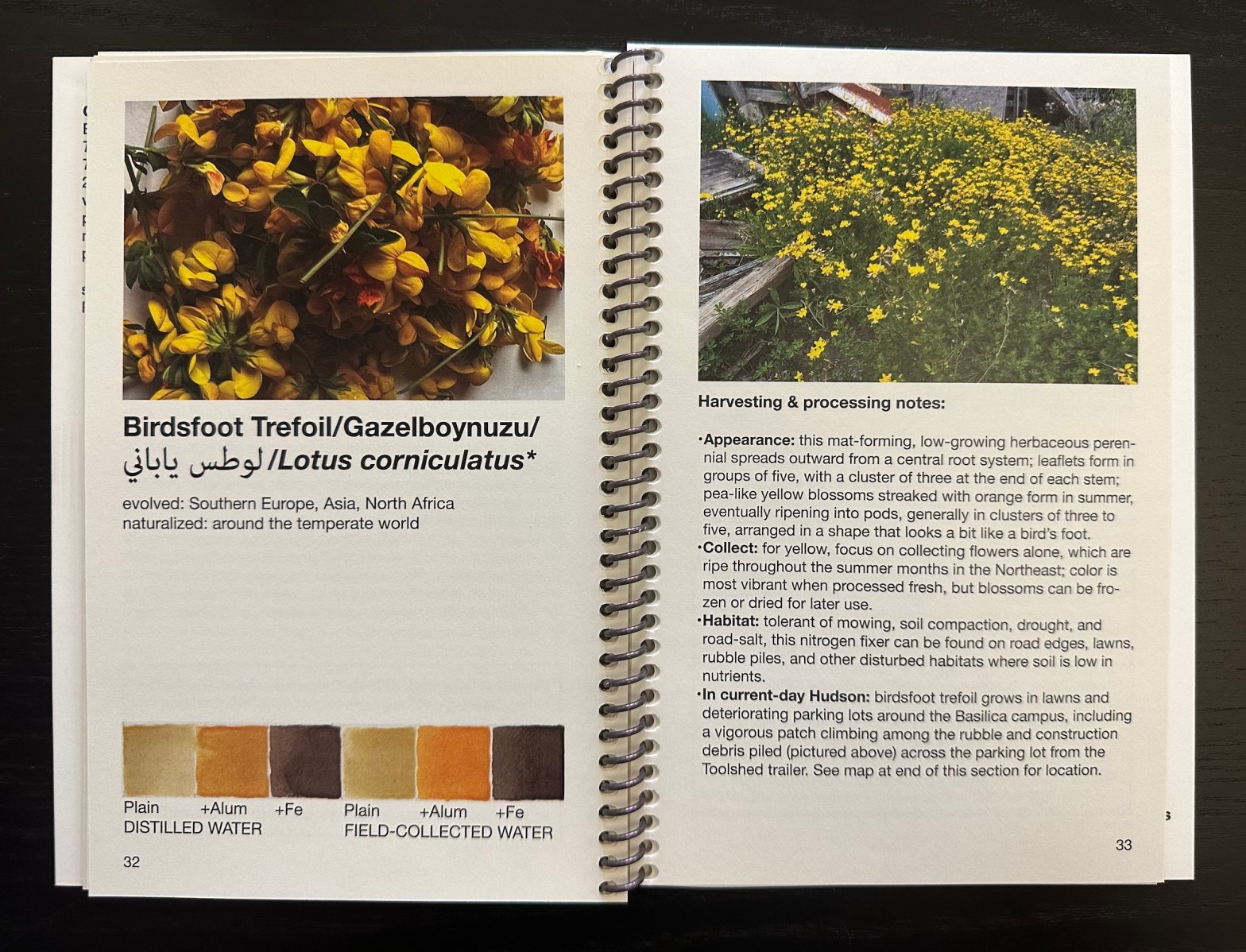
Page spread from Feral Hues, a book by Ellie Irons on making your own paints.

Artistic types are going back to nature for pigments these days. My friend Ann grows special weeds and flowers to make dyes for her beautiful textiles. In today’s Hyperallergic interview by Lakshmi Rivera Amin, we learn about an artist making her own paints.

“Taking the concept of a ‘green thumb’ several steps further, artist Ellie Irons approaches plants as a literal source of color: She creates her watery paintings with pigments tinted by organic hues found in the natural world. These works … record, honor, and reorient our relationship to the vegetation around us, specifically in current-day New York State’s Hudson area.

“I picked Irons’s brain about the process of creating her own paints through harvesting on the occasion of her recent book, Feral Hues: A guide to painting with weeds (Publication Studio Hudson). This interview has been lightly edited for clarity.

Hyperallergic: What is the most joyful part of making your own pigments?
Ellie Irons: There are many joys, which is why I’ve been entranced by the process for so many years: an ever-deepening and shifting connection to urban ecosystems and the land that supports them that emerges through careful, considered harvesting practices; the smells, colors, and textures that reveal themselves when plant parts are processed by hand in the studio; the joy of sharing the process with other humans who also become entranced by the relatively simple act of lovingly harvesting often overlooked weedy plants and creating paint with them; the process of attuning to the cycles of vegetal life sprouting, growing, blossoming, fruiting, [dying] across the seasons and years — there is always something to delight in and harvest, in any habitat, even in deep winter. …

H: How has your practice evolved over the past several years?
“Irons: I would say recently, since maybe 2019, my work has become more locally rooted and grounded. In the decade before that, I found myself investigating plants across urban habitats in a global sense — comparing pokeweed and honeysuckle growing in a parking lot in Taipei with the same species sprouting from a concrete river in current-day Los Angeles, for example.

“I’m still fascinated by those global connections, and find them resonant and relevant, but in recent years my focus and my daily practice have shifted to be more bioregional — I take the Mahicanituck/Hudson River Watershed as a salient range in which to work, connecting with human and plant populations up and down the river from New York City to the Adirondacks. …

“This shifting focus is based on a range of factors, from my increasing discomfort with energy-intensive travel to my new(ish) status as a mother to my day job with a community science and art organization that focuses on hyper-local environmental justice issues, to of course, the ongoing impacts of the pandemic. There are other ways it has changed, of course — writing has become increasingly important to me, as has enduring land-based work (a result of living in a shrinking upstate city where access to soil and open earth is simpler than in New York City, where I started working with plants more than a decade ago).

H: What are your favorite plants to work and be in relation with, and why?
Irons: Perhaps unsurprisingly, I have many favorites, and feel fortunate regularly meet plants who are new to me — my loves change by the season, and across contexts. Right now, in early August, each morning I’m greeted by innumerable, intensely blue Asiatic dayflower … blossoms lining the border of my neighbors’ chainlink fence where it meets the sidewalk.

“The blossoms only last until noon or so, depending on the weather and the intensity of the sun. I take 20 to 30 blossoms most mornings, and store them in a small cup in the freezer, accumulating them until I’m ready to process them into a range of shades of blue.

“I love dayflowers for the way they become unmissable once they catch your eye, and draw you in. They have an unassuming stature, foliage that’s easy to overlook, but when they burst into flower for several hours each morning, the proliferation of electric blue petals — almost sparkling if you look closely — can feel like tiny jewels sprinkled along the sidewalk. …

“Having migrated to the American continent, they live well in cities, where they are sometimes appreciated as a ‘wildflower,’ and are gaining notoriety as a super weed in round-up ready soybean fields, where they’ve demonstrated resistance to the herbicide glyphosate. And in their native China they are being studied as a hyperaccumulator due to their ability to thrive on the polluted soils of old copper mines, absorbing large amounts of heavy metals. …

H: What do you hope anyone interested in approaching plants as material sources for art will first consider and reflect upon?
Irons: I hope people will keep in mind processes of gratitude and respect — of mutual exchange, rather than of taking to satisfy a material need. This can look many ways. Maybe even just asking yourself a few questions before harvesting: Who else might be in relation with this plant, human or more-than-human? What is the plant doing here and why? How long has this plant been here, will they be here tomorrow, or in 100 years?” 

More at Hyperallergic, here. No paywall, but subscriptions are encouraged.

Photo: Ermell/Wikimedia Commons.
Asiatic Dayflower, or Commelina communis.

Read Full Post »

o8haafk

Photo: Imgur
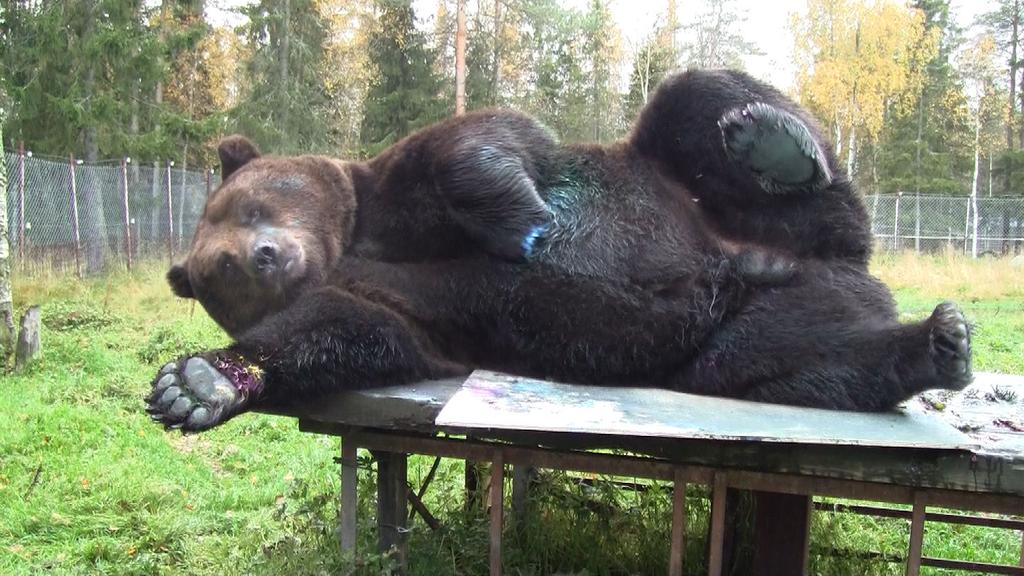
Juuso makes art by rolling in paint. Sales of his paintings help animals who, like him, have been orphaned.

This orphaned brown bear is helping to raise money for the Finnish center that rescued him. And he’s not riding a unicycle like a circus bear. He’s doing something he apparently really likes: Art.

Jussi Rosendahl and Attila Cser report at Reuters, “The artist behind the exhibition entitled ‘Strong and soft touches’ is a 423-kilogram (930 pound) brown bear named Juuso who uses his body, especially his paws, as paintbrushes.

” ‘We just leave paint for him, some plywood and paper … If we ask him to do it, he doesn’t do anything. He does all the work in his own time, when he’s alone, sitting and moving his legs on the paper,’ said Pasi Jantti, one of his keepers.

“Juuso, who is 17 years old, favors blue and red, the keeper said, adding that the paints used posed no health risk to the bear.

“His keepers discovered Juuso’s artistic bent one day while painting some facilities at Kuusamo animal center in northern Finland where he has been living since being orphaned as a cub.

” ‘Juuso got some paint in his paws and started to make marks with them. We noticed that he liked it,’ Jantti said.”

Read more at Reuters, here.

I have to hand it to keepers who noticed what the bear enjoyed, let him do it, and thought up a way it could help other animals in their care.

Photo: The Independent
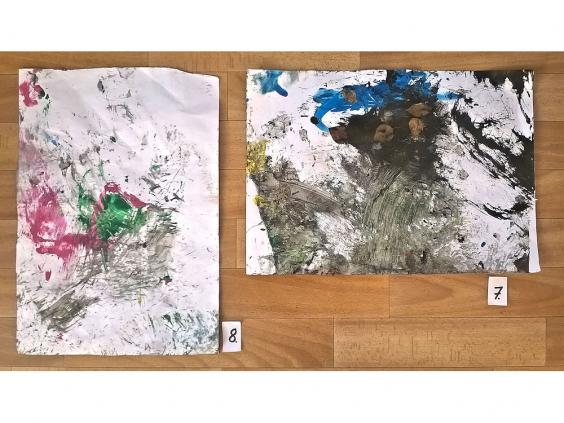
Two Juuso originals that have already sold.

Read Full Post »

One of Studio 360‘s regular hosts spoke recently with a woman who believes good design can and should be used to enhance the most mundane and cheerless places.

The radio show’s website says, “Going to the DMV, doing the dishes, commuting to work: what would you change if you could? Kurt talked with designer Ingrid Fetell about how better design can make all the difference.

“Fetell wants to ‘create principles that are informed by what the cognitive sciences are showing us about the way that objects, surfaces, colors, textures, patterns make us feel, and use those as principles for designing things that really make us feel good,’ she tells Kurt Andersen. Her curiosity stems from noticing that certain things seem to universally make people feel a sense of joy — like confetti, balloons, and bubbles. ‘It was really born out of a curiosity to understand why certain things make even babies smile.’

“She points to Edi Rama as a real-life example of putting these ideas into practice. Rama, who is now Prime Minister of Albania, was named the World Mayor in 2004 after painting much of Tirana in bright colors. The results were remarkable. ‘He found that people actually started paying their taxes after the painting,’ she tells Kurt. ‘People stopped littering as much and the shopkeepers started taking the metal grates off their windows and opening glass window fronts back out to the street.’ ” More here.

I like the idea of trying to understand what makes a baby smile. Or laugh. There are so many wonderful YouTube videos of babies laughing hysterically when someone tears paper or when a dog eats popcorn. Why is that hilarious? Because it’s startling?

By the way, Studio 360 is collaborating with Fetell and IDEO “to redesign a thing, place, or experience that is unnecessarily joyless.” Send your ideas on Twitter or Instagram, and tag #bringjoy. I sent “homeless shelter.”

Paint job: Edi Rama, who became prime minister of Albania

Read Full Post »