Feeds:
Posts
Comments

Posts Tagged ‘pandemic’

Photo: eBay
Vintage Singer sewing machine. More people are turning to sewing — or returning to sewing — during the pandemic.

Did you have home ec in high school? Did you ever finish your sewing project? I’m afraid I never did. My project was a puffy cotton skirt in a beautiful shade of blue. I still have the thread on its wooden spool.

I wonder if my wooden spool collection will ever be valuable. After all, as Jura Koncius reports at the Washington Post, sewing and other such homely skills are back in style. Maybe wooden spools, too.

“When the pandemic shut down businesses in mid-March,” says Koncius, “people who ran sewing stores, sold sewing machines and did workshops were in a panic about how they would stay afloat.

‘Then the mask thing happened,’ says Heather Grant, executive director of the Strategic Sewing & Quilting Summit.

“ ‘The mask thing’ began in early April after the Centers for Disease Control and Prevention recommended that people wear face coverings when going out in public to slow the spread of the novel coronavirus. They were not suggesting the hospital-grade variety (which were in short supply and were needed for health-care workers) but basic cloth masks that could be sewn at home.

“ ‘People dragged machines out of their closets or went online to buy new ones,’ Grant says, and stores started selling out of sewing machines, dark fabrics and elastic.

“Bryan Morris, co-owner of the four Washington-area Brothers Sew & Vac stores, says each of his stores was getting 10 or 20 calls a day from people looking to buy or repair sewing machines.

” ‘I was also getting calls from some medical facilities looking for people to sew masks,’ he says. Even now, he says, demand hasn’t slowed down.

“As the stay-at-home weeks wore on, novice and expert sewers alike found themselves with more time to work on projects. ‘People were finishing quilts they had in a drawer for years,’ Grant says.

“Mathew Boudreaux, who lives outside of Portland, Ore., (instagram.com/ misterdomestic) designs fabrics and gives classes all over the country. He has started finishing projects, such as crocheting afghans, that he had never had time to get to.

“ ‘It was a way not to have to think,’ he says. …

“Singer, which sells 56 models of sewing machines ranging from $99 to $400, saw an immediate spike. ‘Our business grew quickly during the pandemic, resulting in almost every model being out of stock in early April,’ says Dean Brindle, chief marketing officer of SVP Worldwide, Singer’s parent company. …

“The company has attracted younger customers and more male customers since the pandemic began, including boys who have taken up sewing to make masks. ‘Roughly 20 percent of our consumers have been men,’ Brindle says. …

“At Bernina, the entry-level Bernette machine (about $199) sold out in a few weeks, says Paul Ashworth, chief executive and president of Bernina of America. …

‘By the end of April, you really could not find a single sewing machine below $500 in the United States,’ he says. …

“Joe Cunningham of San Francisco, who has been quilting for 40 years, lost all of his teaching gigs and seminars for the rest of the year. … He did a lecture and studio tour on Zoom, and then he hosted his first online class. He was skeptical as to how many people would pay $35 for it, but he was thrilled that 268 people signed up for the webinar. ..

” ‘This pandemic could sure change my business,’ he says. ‘This forced me to learn online teaching, and now I actually have more time to quilt.’ …

“Latifah Saafir, 44, who has been sewing since she was 10, designs fabrics and patterns for children. ‘There’s not too much out there in product lines for kids, so parents are happy to find these,’ says Saafir, who is co-founder of the Modern Quilt Guild.

“She says stores have increased their orders of her designs, hearing from parents that they needed ways to keep kids occupied. ‘I have one customer who ordered three patterns directly from me so she could teach sewing to her grandkids on Zoom,’ she says. …

“Industry executives are betting people are not going to pack away their machines anytime soon. ‘People are not returning to life as normal for a while,’ Brindle says. ‘We are already in month four, and a lot of people who did come back to sewing will continue.’ ” More at the Washington Post, here.

I got my lovely mask from a talented woman I know on Etsy, here.
Read Full Post »

Photo: ergey Ponomarev for the New York Times.

This was completely new to me: Many Russian restaurants provide disposable gloves for things like burgers that you eat with your hands. Although I know I’m much more likely to get Covid-19 from breathing droplets, I think I could get used to the glove concept.

As Anton Troianovski reports at the New York Times, “When you enter a home in Moscow, you take off your shoes. When you go to a play, you have to check your coat. When you eat a burger, you often wear gloves.

“Across hygiene-conscious Eastern Europe, many people consider it uncouth and unsanitary to eat a burger with their bare hands. The answer used to be a knife and fork. But the pandemic has accelerated a years-old trend: order a burger from Kyiv to Kamchatka — or in Brighton Beach, Brooklyn — and there is a fair chance it will come with a side of disposable gloves.

“Most often, the gloves are made of a synthetic, latex-free rubber called nitrile. At Black Star Burger, which launched the phenomenon in Moscow in 2016, the gloves on offer are black, individually wrapped in plastic packets. At Star Burger in Kyiv, Ukraine, they are green (or pink on Valentine’s Day). At Butterbro, a gastro pub in Minsk, Belarus, they come wrapped discreetly inside a napkin next to a serving dish made of the trunk of an ash tree.

‘Gloves, I think, are an unspoken, required attribute of any burger restaurant,’ said Butterbro’s manager, Alina Volkolovskaya. ‘I’m surprised that establishments in every country don’t offer them.’

“To visiting Americans, the practice always seemed odd, bordering on blasphemous. But when Moscow’s lockdown ended this month and I went out to celebrate, nervously, with a cheeseburger to go, it suddenly kind of made sense. …

“I called George Motz, a New York hamburger specialist, and he insisted that gloves negate the ‘very tactile experience’ of eating a burger. ‘Take the gloves off and get closer to your burger!’ Mr. Motz said. ..

“Several American restaurant safety experts, however, were intrigued, having never heard of establishments providing diners with disposable gloves. They doubted the practice would take off in the United States — the coronavirus, after all, is not even known to spread through food — but some said that gloves used properly could help protect people who don’t wash their hands from a variety of germs. …

“Vanity, not health concerns, first propelled Eastern Europe’s gloves-and-burgers fad. Mr. Levitas of Black Star Burger recruited Timati, a Russian rap star close to the Kremlin, to lend a celebrity cachet to his new burger chain, which now has 67 locations across the former Soviet Union and one in Los Angeles. …

“The gloves help Black Star’s customers feel special, Mr. Levitas said, like the sparklers that go off when waiters bring out the $11 ‘V.I.P.’ burger.

“The gloves proved impervious to politics. A Kyiv restaurateur, Gennady Medvedev, says he had the idea to serve gloves with burgers independently of Black Star Burger in the years after he opened his Star Burger chain in the Ukrainian capital in early 2014 — during his country’s anti-Putin revolution. …

“The trend took off behind the former Iron Curtain as fancy burger places popped up in a region unfamiliar with the dish before McDonald’s arrived in the 1990s. Alexander Monaenkov, a Moscow-born burger-bar owner in Prague, says he handed out gloves to evoke the refinement of white-gloved waiters in Michelin-star restaurants. Corina Enciu, a Moldovan-born restaurateur in Krakow, Poland, said she introduced gloves because her burger joint lacked a place for people to wash their hands. …

“Gera Wise, a Kyiv-born cafe and nightclub owner in the Russian-speaking Brooklyn neighborhood of Brighton Beach, said his customers started asking for gloves after Timati started modeling them. …

“Isaac Correa, a Puerto Rico-born chef who lived in Moscow for two decades, thinks the gloves-and-burgers concept could have a global future. Mr. Correa worked with Mr. Medvedev in Kyiv to start the Star Burger chain. … Now Mr. Correa runs a restaurant in Sarasota, Fla., and his diners hesitate to touch menus or to come inside to collect takeout orders.

“ ‘I could see some of my customers in a casual restaurant say, “Hey, look, I’m going to try this,” ‘ Mr. Correa said.”

I’m thinking of adding gloves to my other nutty pandemic practices, including throwing out the takeout container immediately and reheating all the food in the oven. Now, if only I could find a place that sells disposable gloves.

More at the New York Times, here.

Read Full Post »

APTOPIX Virus Outbreak Germany

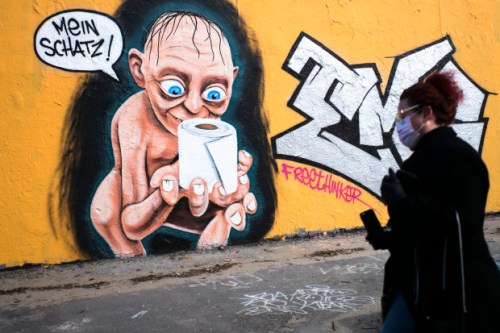
Art: Street artist FreeThinker via the Mercury News
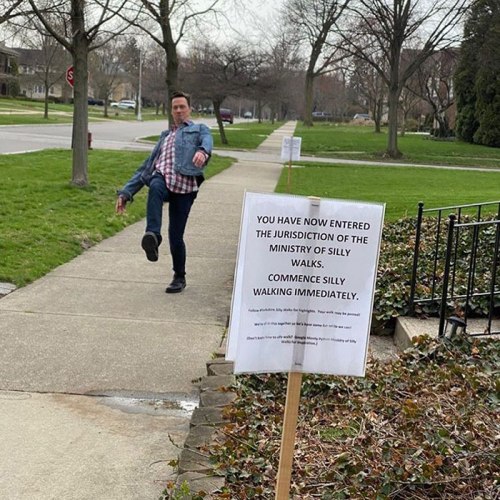
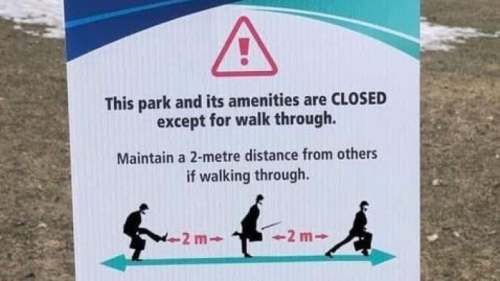
Artists are reflecting our pandemic experience in whatever media they use. Some of the work ends up in the Covid Art Museum, some can be found on the street.

The Covid Art Museum (@covidartmuseum on Instagram) has provided some laughs for me lately. It’s one of the many new links I’ve added to my social media during the pandemic. I first learned about it at a site called OZY.

Dan Peleschuk reported, “With entire populations around the world locked inside, museums everywhere have closed their doors until the deadly coronavirus pandemic passes.

“Not this one. Which actually opened. …

“Three Barcelona-based advertising professionals came up with a bright idea: the Covid Art Museum (CAM), an Instagram account collecting the best COVID-19-related work out there.

“Launched in mid-March, just as Spain was careening into the health crisis, this volunteer effort showcases the creative fruits of mostly European artists who have something to say about how society’s changing before our eyes. …

“After all, ‘we are now in a period of very important reflection on everything,’ says CAM co-founder Irene Llorca, creative art director at marketing agency Honest Barcelona.

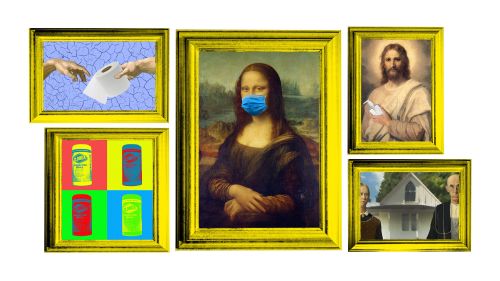
“Popular themes include creative pleas for consumers to stay home, as well as playful takes on the newly ubiquitous face masks. And, perhaps unsurprisingly, toilet paper features prominently too. Virtually every art form — photographs, illustrations, installations and much more — makes an appearance in the museum’s quickly growing archive. …

“London-based art director Thomas Ollivier, also known as Tom le French, has turned his attention to a series of photographic manipulations that comment, among other things, on what face masks might tell us about our future. Even after the crisis ends, he says, the objects might find their way into our normal routine. ‘Surely it will start to become like a handbag or an accessory, and obviously brands will step in and create their own version of it,’ he says. …

“For creators, it’s a free platform for their art. For everyone else, Llorca adds, ‘it’s a space that can give them strength and help them realize that they are not alone in this.

‘Maybe they’ll see that artwork by a Spanish person in Bilbao speaks directly about their current situation. It’s a way to connect people virtually.’

“Just like with every other aspect of life these days, it feels pointless to talk about future plans. But at the very least, Llorca says, a digital book might be in the works — plus a physical exhibition, for when it’s all over.” More.

In Angie Kordic’s Widewalls interview with the museum’s founders, Irene Llorca explains more: “From the artworks that we receive through our questionnaire, so far we have counted more than 50 different nationalities. We have also created the hashtag #CovidArtMuseum and many artists are using it. They send the artworks to us and we also look for them.

“The three of us are passionate about art and we follow many artists and art galleries; this has helped us find very interesting works.

“The main filter when choosing the pieces is that they are related to the current moment: the crisis of Covid19. That’s why we don’t close ourselves to any technique, we collect all kinds of art whether it’s illustrations, photographs, paintings, drawings, animations, video, etc. From all the works received or found, a selection is made to publish those that best reflect the current moment.” More.

If you are on Instagram, it’s definitely worth following @covidartmuseum.

Photo: Bored Panda

yorkshire-silly-walks-1-5ea299cbc7ddf__700

Photo: CBC

altered-city-of-ottawa-sign

Image: Ozy

shutterstock1101396713-3

Read Full Post »

« Newer Posts