Feeds:
Posts
Comments

Posts Tagged ‘paper’

Photo: Library of Congress.

I have often thought about what we’ve lost in the digital age, when we can no longer scrutinize the thought process of a novelist from seeing her many revisions. Nor can we learn much about the significant people in her life, given that so many of her emails and texts will have been erased.

What will biographers do? How will today’s archivists deal with the challenge?

Michael Waters writes at the Atlantic (via MSN), “It was long the case that archives were full of physical ephemera. Think of Oscar Wilde’s love letters to Lord Alfred Douglas; … Sylvia Plath’s shopping list; Malcolm X’s lost poem; and other scraps of paper buried in boxes. Today, text messages and disappearing voice notes have replaced letters between close friends, Instagram Stories vanish by default, and encrypted platforms such as Signal, where social movements flourish, let users automatically erase messages. Many people write to-do lists in notes apps and then delete them, line by line, when each task is complete.

“The problem for [historians]: On the one hand, celebrities, artists, executives, and social-movement leaders are generating more personal records than ever, meaning a lucky researcher might have access to a public figure’s entire hard drive but struggle to interpret its contents. On the other hand, historians might lose access to the kind of intimate material that reveals the most. …

“The work of history starts with a negotiation. A public figure or their descendant — or, say, an activist group or a college club — works with an institution, such as a university library, to decide which of the figure’s papers, correspondence, photos, and other materials to donate. Archivists then organize these records for researchers, who, over subsequent years, physically flip through them. These tidbits are deeply valuable. They reveal crucial details about our most famous figures and important historical events. …

“Over the past two decades, the volume of these donations has increased dramatically. When Donald Mennerich, a digital archivist at NYU, first started working in the field, 15 years ago, writers or activists or public figures would hand over boxes of letters, notes, photos, meeting minutes, and maybe a floppy disk or a ‘small computer that had a gigabyte hard drive,’ he told me. Now, Mennerich said, ‘everyone has a terabyte of data on their laptop and a 4-terabyte hard drive’ … plus an email inbox with 10,000 messages or more. …

“Now many libraries possess emails that they don’t have the bandwidth to make accessible to researchers. … Even when an email archive is made public … it’s easy to get lost in the chaos. Jacquelyn Ardam, a writer and a literary scholar, was one of the first people to visit Susan Sontag’s archive, which she told me was filled with digital clutter: Sephora marketing emails, files with unlabeled collections of words (rubberyineluctable), and lots and lots of lists — of movies she’d liked, drinks she’d enjoyed. …

“Among that mess of information, however, Ardam found emails confirming Sontag’s relationship with the photographer Annie Leibovitz, which Sontag had denied. All Ardam had to do to locate them was ‘search her computer for the word Annie,’ she said. …

“In the past, even a writer of Sontag’s stature would typically have a small-enough correspondence collection that they could plausibly review the letters they were planning to donate to an archive—and perhaps wouldn’t have included missives from a secret lover. But the scope of our digital lives can make it much harder to account for everything (imagine giving up your whole social-media history to a researcher) and much easier for a historian to locate the tantalizing parts with a single search.

“Of course, that’s if historians are lucky enough to access records at all. Many people delete their old texts to save storage space. … Mennerich said he’s been locked out of the email accounts of several deceased public figures because they never shared their passwords. …

“Archivists might be able to sidestep some of these problems by rethinking how they present collections of digital records. Today, after archivists do their initial review of a collection, visitors can typically get a complete box of someone’s letters with no questions asked. With emails, conducting that whole initial review up front would be so much more time intensive that blanket access might no longer be realistic. …

“The archivists I spoke with told me they’re all bracing themselves for the moment when, inevitably, a public figure donates their smartphone. It is in some ways the most personal kind of donation someone can make, offering access to text and WhatsApp histories, photos, Tinder messages, saved recipes, TikTok likes. Such a donation seems both likely to reveal more than a person’s emails ever could and even harder to sort through and interpret.”

More at the Atlantic, here.
Read Full Post »

Photo: Claudia Wolff/Unsplash.
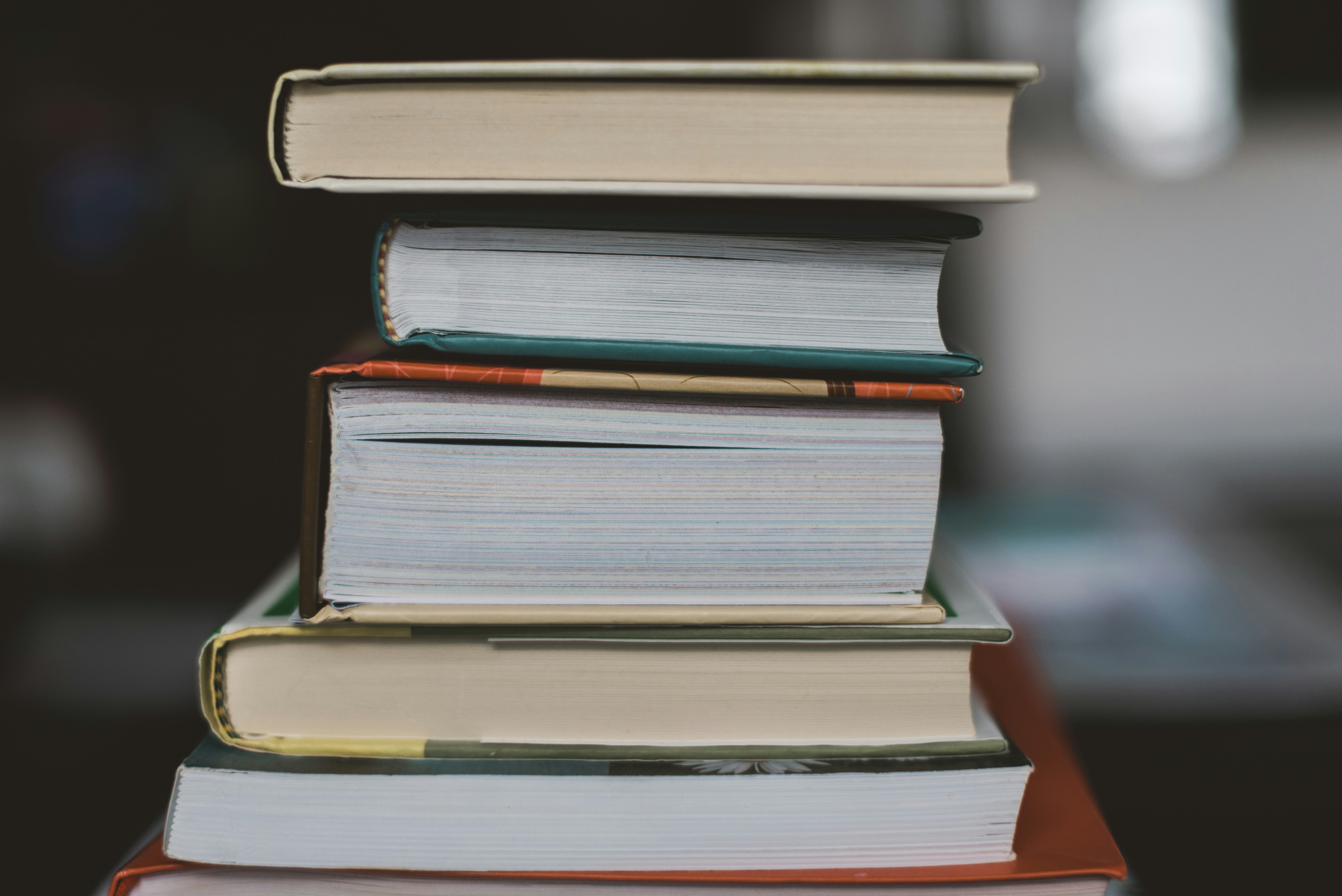
Do books use too much paper?

Those of us who still prefer a solid book to a pale, digital imitation may sometimes wonder whether we are encouraging the use of too much paper, especially since overstocks can end up in landfills.

Curiously, at least one publisher is thinking along the same lines.

Elizabeth Segran writes at Fast Company, “Over the past three years, HarperCollins’s designers have put their skills toward a new mission: saving paper. In an effort to reduce the carbon footprint of each book, they’re tweaking fonts, layout, and even the ink used. The goal is to pack more into each page, while ensuring that the pages are as readable as ever. And so far, these subtle, imperceptible tweaks have saved 245.6 million pages, equivalent to 5,618 trees.

“HarperCollins’s Christian publishing division, Zondervan Bibles, first came up with the idea of using design to save paper. Bibles have historically used upwards of 2,500 pages. In 2015, Zondervan’s designers determined that if they used different fonts and adjusted the page layout, they could reduce the number of sheets used. It would also cut HarperCollins’s printing costs. They developed a new compact typeface called the NIV Comfort Print. Ultimately, it saved more than 350 pages per bible, resulting in a total savings of 100 million pages in 2017. Stacked up, that would be the equivalent to four times the height of the Empire State Building.

“Tracey Menzies, the VP of creative operations and production at HarperCollins, wanted to see if the company could apply these learnings to other kinds of books. … The team got to work. They tested their theories with a large book in their catalog — more than 600 pages — by creating 50 versions of it using different fonts. HarperCollins uses a wide range of off-the-shelf fonts in its books, rather than custom ones. As the team ran the experiments, they observed that some fonts were more compact, resulting in fewer total pages, while remaining easy to read. So they curated a list of 15 fonts they determined are the most eco-friendly, which will be the preferred fonts from now on.

“In the end, the designers found that clever font selection, coupled with a thoughtful layout design that reduced white space, resulted in more words per page. For instance, in one example, the same text set to Garamond Pro resulted in many more words on the page compared to Bembo. Both fonts are fairly similar, with a classic serif look. And when you place them side by side, the differences are imperceptible. ‘The goal is to make these changes without the reader even seeing the difference,’ says Menzies.

“But there were also many complexities in the process. For instance, they had to consider the heaviness of the font. One font they used frequently is Bodoni, which was first created in 1798, and appears frequently in HarperCollins books. As a very heavy font, they realized they could fit more words on a page, while keeping it readable. But they also found that with very large letters, like subheadings, the ink would bleed through the paper, making it hard to read the words on the next page.

“ ‘The designer is always balancing out not just a single page, but also what’s on the page before and the page after,’ says [Leah Carlson-Stanisic, associate director of design at HarperCollins]. ‘Ultimately, this ended up with finding fonts that used less ink, in addition to less paper, which is also better for the planet.’

“Still, there is complex math involved with cutting pages from books. Printers produce very large sheets, which are then cut and folded into what ultimately becomes segments of 16 pages. When trying to cut pages from the book, designers need to be able to remove multiples of 16 pages. For the book So Fetch, for instance, using a more eco-friendly font saved nearly a million pages in total over the entirety of its print run. ‘We want to make sure our big titles, by prominent authors, are using these eco-fonts,’ says Carlson-Stanisic. ‘It adds up a little bit at a time, saving more and more trees.’ …

” ‘When we experimented with these fonts, we realized they weren’t a limitation at all,’ Menzies says. ‘It was simply a different approach that didn’t sacrifice aesthetics. Now, our designers are constantly questioning how we do things and thinking about ways to make things more sustainable.’

More at Fast Company, here.

Read Full Post »

Photo: Calvin Nicholls
Wilson’s Bird of Paradise rendered in paper.

Some people seem to make a beeline straight from childhood to the work that will define them. People like Mozart, for example. Others have a long, circuitous route to greatness. Malvolio weighs in on the puzzle in Shakespeare’s Twelfth Night: “some are born great, some achieve greatness, and some have greatness thrust upon them.”

Pat Leonard writes at Living Bird that Calvin Nicholls came to his amazingly great art a bit by accident.

“The daily commute to his attic studio is short and steep. The road to success for Canadian artist Calvin Nicholls has been much longer. He’s spent the last 30 years perfecting an unusual art form that is all about light, shadow, shape—and illusion. Nicholls is a paper sculptor who creates fantastically detailed birds and other animals that seem to leap, lean, or flutter straight out of their frames. His career evolved from drawing, model-making, sculpting, photography, and periodic doses of serendipity.

“ ‘It’s so clear in my mind—it was 1983,’ says Nicholls. ‘I had my own graphic design studio in Toronto. I met a fellow who was manipulating paper to produce areas of highlight and shadow to create the feeling of depth in two dimensions. We worked on a restaurant menu concept together and I could see the potential in this technique. I got playing with paper sculpture myself and it was just so much fun.’

“At first, Nicholls created his sculptures as a method for creating his final product, a photograph that could surprise viewers by seeming three dimensional. The technique turned out to be a hit when Nicholls introduced it to some of his clients. He showed photographic prints of his work in an art show in Ontario in 1990, but he also wound up selling sculptures of a Snowy Owl and Mallard as well.

“ ‘I was focused on the prints and trying to make two dimensions look like three,’ Nicholls says. ‘Then clients would say, so where’s the artwork? And I thought, yikes—I never even thought about displaying the artwork! I still marvel that I didn’t know then that the original artwork could be as interesting as the illusion created in the prints with sophisticated studio lighting.’

“Switching focus to the original artwork meant reducing the depth of his sculptures so they could be framed and so the jumble of foam core supports and toothpicks underneath didn’t show when the piece was viewed from an angle. It took a lot of time and experimentation. But the end result is an uncanny illusion of depth from layers of paper that are only about an inch thick. …

‘What makes the sculptures work is thinking about anatomy and how [feathers] flow a certain way on the musculoskeletal structure,’ says Nicholls. ‘I have to get a sense of the skeleton and the muscles and what they do in certain gestures.’ ”

Read more and see the great pictures at Living Bird, here.

Read Full Post »

An early stage in the creation of a Hari & Deepti light box

Do you ever click on the links to the right, in my blog roll? My Dad’s Records, for example, has old blues recordings you’d be hard-pressed to find anywhere else.

And This Is Colossal is a constant wonder. Today the art and visual-culture site posted illuminated paper light boxes that have to be seen to be believed.

Says Colossal: “Deepti Nair and Harikrishnan Panicker (known collectively as Hari & Deepti) are an artist couple [originally from India] who create paper cut light boxes. Each diorama is made from layers of cut watercolor paper placed inside a shadow box and is lit from behind with flexible LED light strips. The small visual narratives depicted in each work often play off aspects of light including stars, flames, fireflies, and planets. The couple shares about their work …

‘What amazes us about the paper cut light boxes is the dichotomy of the piece in its lit and unlit state, the contrast is so stark that it has this mystical effect on the viewers.’ ”

More.

Read Full Post »

A new $100 bill is in the works. For security, it will have half a million tiny lenses in a special strip, and the lenses will create a particular optical effect as you tip the bill this way and that.  Kind of like a hologram, is my understanding. There will be even more tiny lenses on the Liberty Bell and the numeral 100, and as you tip the bill, the one will turn into the other, thanks to the lenses.

This rather surprising information I learned from a speaker today — Doug Crane, vice president of the family company that has been making America’s currency and some other nations’ currencies since 1801. He makes paper only from cotton (80%) and linen (20%).

There are a lot of interesting old documents about the history of Crane & Co. — and how it overlapped with key events and players in American history — at this blog on WordPress.

More information is on the regular website of the company, which is based in Dalton, Massachusetts, and employs 850 people locally. Among them are the people who make print so tiny you could “print the Bible twice on a dime.” They also employ optical engineers who create the micro lenses and are responsible for Crane’s 80 patents.

Other employees work in Tumba, Sweden, ever since Sweden asked Crane to take over its currency making. At the Tumba site, Crane makes currencies for additional countries.

A paper-making enterprise requires a lot of energy, so Crane is working with numerous alternatives as it moves toward its goal of 100% sustainability. It has   already drastically cut its oil use in a partnership with a steam-producing landfill enterprise. Hydroelectric is proving trickier because there are so many jurisdictions on the Housatonic River to give permission to remove waterfalls.

Perhaps the river could become a Blueway and get everyone working together. (See yesterday’s post.)

Postcard from cranesbond.com

Read Full Post »