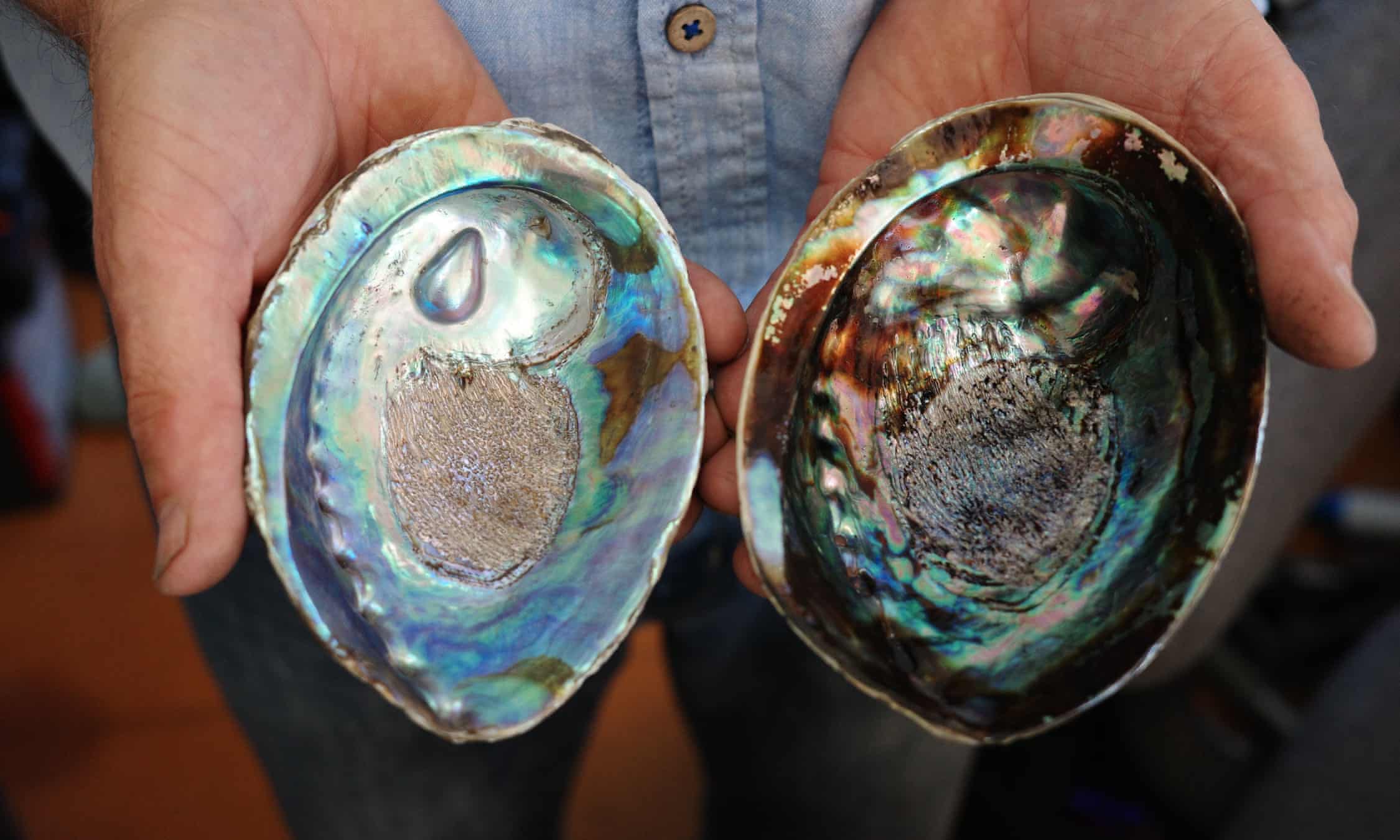
Photo: Shanti Mathias.
A farmed pāua shell with a pearl inside (L) held next to a wild pāua shell in New Zealand.
During the pandemic lockdown, there didn’t seem to be much point in dressing up or wearing jewelry. I certainly got comfortable with being casual all the time, and even now I mostly wear jeans. Except for funerals.
But the other day, I noticed my grandmother’s pearl necklace in a box and felt a little sorry that I hardly ever wear jewelry (unless from Suzanne’s company). I always liked pearls.
In today’s story, we learn about unusual blue pearls and how the reality of global warming suggests we better enjoy them now, while abalone can still make them.
Shanti Mathias writes at the Guardian, “Roger Beattie was diving off the Chatham Islands, about 800km [~500 miles] east of New Zealand, when he saw his first pāua pearl. Beattie was familiar with pāua, the Māori word for abalone, and their iridescent shells of shimmering purples and greens. But the pearl that had formed inside was unlike anything he had ever seen, gleaming with layers of the pāua’s natural colors. …
“That was in the early 1990s, and Beattie soon started experimenting ways of farming pāua, and creating pearls in the shell. A decade later, he began selling the so-called blue pearls commercially.
“Now a small industry exists in New Zealand cultivating the unique gems. They are rare, with only a handful of companies running farms, each producing only a few thousand pāua pearls each year. But the delicate operations are being made more complicated as changing conditions and warming seas alter the environments pāua need to survive.
“ ‘Warm waters cause physiological stress to the pāua,’ says Shawn Gerrity, an ecologist at the University of Canterbury who has studied the pāua.
“There are four species of pāua endemic to New Zealand. The blackfoot pāua is the biggest species, known for its vibrant shell and succulent flesh. All cultivated pāua pearls come from the blackfoot pāua. The pearls appear shades of blue, turquoise, purple and green.
“ ‘Only this abalone, in this water, produces such an unusual color of pearl,’ says Jacek Pawlowski, a jeweler in Akaroa, a seaside town southeast of Christchurch on New Zealand’s South Island. … ‘They have that rainbow, opal shine.’ …
“As juveniles, pāua are taken out of the water, where their flesh is pried up and a small implant placed under their shell for a pearl to form on. If their soft bodies are nicked, the pāua will bleed to death, so the process must be gentle. Only one in five pāua will create a jewelery-grade gem, Beattie says.
“Each mollusk needs to be fed vast quantities of kelp and live in water about 16 degrees for the three to four years it takes for a pearl to form. …
“But rising ocean temperatures pose a threat to their survival. … Marine heatwaves have dramatically increased in frequency around New Zealand, with a particularly severe event in 2017/18 causing thousands of sea creatures to die.
“Increased marine temperatures have caused mass die-offs of abalone species in other areas of the world, like California, where warming water has reduced abalone’s access to food and sped up the transmission of a withering disease. Beattie has had an algal bloom – which is more likely in warm water – kill a harvest of pāua by depriving them of oxygen.
“Gerrity says marine heatwaves ‘destroy habitats.’ …
“Gerrity has researched the recovery of pāua in Kaikōura, on the north-east coast of the South Island, where thousands of pāua died after the sea floor was lifted six metres [~20 feet] in a 2016 earthquake. Nine years later, with careful management, the population is healthy again. …
“Dr Norman Ragg, senior shellfish scientist at science organization Cawthron Institute, says pāua are a ‘really interesting quirk of nature’ that have remained unchanged for millennia. While New Zealand’s populations are still healthy, there is no room for complacency. … Ragg believes cultivating blue pearls could go some way to bolstering appreciation for pāua and securing its future in the face of climate change.”
More at the Guardian, here. With no paywall at the Guardian, donations are vital.

 Suzanne's Mom's Blog