Feeds:
Posts
Comments

Posts Tagged ‘penobscot’

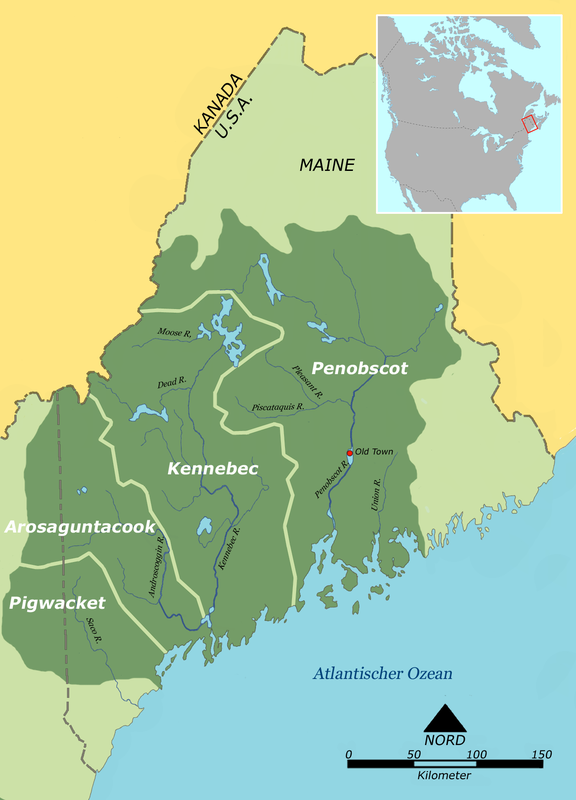
Map: Wikipedia.
Eastern Abenaki tribes (Penobscot, Kennebec, Arosaguntacook, Pigwacket/Pequawket). Indigenous people often exhibit the best stewardship of natural resources.

What can we learn from people who have been taught from infancy how to live in harmony with the natural world? In an op-ed at the Washington Post, Bina Venkataraman suggests that “in Maine, a return of tribal land shows how conservation can succeed. …

“On a recent morning at the Penobscot Nation headquarters, moose mating rituals dominated the office banter: the wacky way a lovesick moose had stumbled around someone’s pickup truck [when] he heard a hunter’s [mating call]. …

“The Penobscot Nation’s record of caring for nature while still using it — hunting moose and duck while keeping their populations steady, selectively harvesting timber to preserve forests and restoring rivers to support fisheries — inspired an effort to return a 31,000-acre tract of forested land to tribal ownership.

“Late last year, the Trust for Public Land, a conservation group, bought the parcel from an industrial timber company, and today it announced it will give the land to the tribe once it pays off $32 million in loans. …

“The land is close to Mount Katahdin, sacred in Penobscot tradition, and to an 87,000-acre national monument created in 2016 in the North Woods of Maine. It contains 53 miles of streams in the watershed of the Penobscot River, which has been for the tribe a central highway and a source of food and water.

“The transfer is part of a movement to return lands to Indigenous stewardship and work with tribal communities to protect biodiversity. The hope is both to restore justice for tribes that were long ago stripped of their ancestral homelands and to learn from long-standing Indigenous practices new ways to save a beleaguered planet. The pending land return in Maine, or ‘rematriation’ as some Indigenous people call itstands out because of its scale — many previous land returns in the eastern United States have been on the order of hundreds of acres — and because the Penobscot will decide how the land will be managed.

“This is a significant change. For most of the past two centuries, Western conservationists have largely ignored Indigenous people’s knowledge of landscapes and wildlife, along with tribes’ historic claims to the land. But that is no longer tenable. Worldwide, Indigenous-managed lands host 80 percent of the world’s biodiversity, by some estimates, and encompass much of the world’s remaining intact forests, savannas and marshes. If environmentalists and political leaders hope to conserve more natural landscapes … collaboration with tribal nation leaders is critical.

Modern environmentalism has been deprived of Indigenous knowledge, in part, because it has seen nature as something apart from humans.

“Early thinkers hold some responsibility for this. John Muir, long lauded as the father of the national parks, believed that natural landscapes needed to be stripped of the Native Americans who lived on them to create his ideal of pristine wilderness. In the Muir tradition, the U.S. government drove tribal people out of areas that today are considered America’s most beloved landscapes — Yellowstone, Yosemite, the Everglades — a history documented by David Treuer, an Ojibwe writer.

“The federal government created the National Bison Range in 1908 by evicting tribal members from more than 18,000 acres of the Flathead Indian Reservation — ignoring century-old practices for keeping up the bison herd. Only recently has the government returned the land to the Confederated Salish and Kootenai Tribes, whose successful traditional methods for maintaining the herd are featured in a forthcoming ABC documentary.

“When Henry David Thoreau … traveled to the Maine woods in the 19th century, he distinguished between ‘scientific men’ and Indian guides, even as he acknowledged the latter’s navigational expertise. It’s laughable now to think that communities that had inhabited a place for centuries, gaining intimate knowledge of the natural features, flora and fauna and passing down that knowledge across generations, could have less to offer scientifically than settlers encountering those lands for the first time. Yet it was only last year that the U.S. government formally recognized how much tribes can contribute to ecological knowledge of their ancestors’ landscapes. …

“For decades, tribal members in Maine advocated bringing down Penobscot River dams that once powered saw and paper mills to restore an Atlantic salmon fishery. The Penobscot method of timber harvesting, which leaves 75- to 100-foot buffers of trees around rivers and streams, creates ideal conditions for salmon. Salmon like to spawn upriver in shady pools, created by allowing the forest at a river’s edge to thicken and birch trees to fall into it. …

“Some evidence suggests that, globally, the track record for Indigenous management of wildlife is at least as good as that of formal conservation. Researchers have shown, for instance, that Indigenous-managed lands in Canada, Australia and Brazil contain biodiversity equivalent to that of areas designated for conservation.

“But perfect alignment between tribes and environmental groups doesn’t always happen. The economic challenges that many tribes face — and their efforts to acquire land to reclaim sovereignty — often force tough decisions about development, gambling and heavy industry. Some tribal nations have greenlighted oil and gas drilling. The Penobscot have allied with conservationists to oppose a proposed zinc mine in northern Maine because of its likely harm to fisheries. But several tribal members expressed to me their misgivings about wind farms, which most environmentalists see as essential to combat climate change.

“Penobscot leaders have varying visions about how they might one day develop the land that is now being returned to them. Some imagine using it to adapt to sea-level rise — by building housing or growing food; others envision ecotourism lodges or a cultural center that could be accessed by the general public. In the near term, tribal leaders aim to make it accessible to hikers and hunters with permits and to offer public access to the national monument via an old logging road.

“In other parts of North America, co-management of conservation areas is becoming more common. … Groups such as the Trust for Public Land and the Nature Conservancy are brokering more land returns and collaborating with tribes to manage ecologically important landscapes. But more private landowners, philanthropists, nonprofit groups and governments should mimic the efforts in Maine. …

“Environmental movements might have better protected nature if they had long sought to conserve cultures and communities along with land. Earning the trust now of people who have inherited wisdom for living in balance with nature will give conservation a fighting chance on a warming planet.”

More at the Post, here.

Read Full Post »

I love getting tips on blog-worthy topics. This week, Earle sent an article from the Stanford News about a truce between environmentalists and hydropower companies, a promising rapprochement. People on opposing sides of a critical issue working quietly together to find common ground.

Devon Ryan wrote, “A dialogue organized by Stanford that brought together environmental organizations, hydropower companies, investors, government agencies and universities has resulted in an important new agreement to help address climate change by advancing both the renewable energy and storage benefits of hydropower and the environmental and economic benefits of healthy rivers.”

The New York Times also covered the peacemaking. Here is Brad Plumer on the topic: “The industry that operates America’s hydroelectric dams and several environmental groups announced an unusual agreement Tuesday to work together to get more clean energy from hydropower while reducing the environmental harm from dams, in a sign that the threat of climate change is spurring both sides to rethink their decades-long battle over a large but contentious source of renewable power.

“The United States generated about 7 percent of its electricity last year from hydropower, mainly from large dams built decades ago, such as the Hoover Dam, which uses flowing water from the Colorado River to power turbines. But while these facilities don’t emit planet-warming carbon dioxide, the dams themselves have often proved ecologically devastating, choking off America’s once-wild rivers and killing fish populations.

“So, over the past 50 years, conservation groups have rallied to block any large new dams from being built, while proposals to upgrade older hydropower facilities or construct new water-powered energy-storage projects have often been bogged down in lengthy regulatory disputes over environmental safeguards. …

“In a joint statement, industry groups and environmentalists said they would collaborate on a set of specific policy measures that could help generate more renewable electricity from dams already in place, while retrofitting many of the nation’s 90,000 existing dams to be safer and less ecologically damaging.

“The two sides also said they would work together to accelerate the removal of older dams that are no longer needed, in order to improve the health of rivers. More than 1,000 dams nationwide have already been torn down in recent decades.

“The statement, the result of two years of quiet negotiations, was signed by the National Hydropower Association, an industry trade group, as well as environmental groups including American Rivers, the World Wildlife Fund and the Union of Concerned Scientists. Another influential organization, The Nature Conservancy, listed itself as a ‘participant,’ signaling that it was not prepared to sign the full statement but would stay engaged in the ongoing dialogue over hydropower policies.

“Bob Irvin, the president of American Rivers, which has long highlighted the harm that dams cause to the nation’s waterways, said that growing concern over global warming had caused some environmentalists to reassess their longstanding opposition to hydropower. …

Mr. Irvin emphasized that his group would still oppose any effort to build new dams on rivers. But that still left plenty of room for compromise.

“As an example, he pointed to the Penobscot River in Maine, where environmentalists, energy companies and the Penobscot Indian Nation reached a landmark agreement in 2004 to upgrade several dams in the river basin while raising money to remove two other dams that had blocked fish from migrating inland for more than a century. The result: The hydropower companies on the Penobscot ended up producing at least as much clean electricity as before, while endangered Atlantic salmon have returned to the rivers. (For more on that, read an article I acquired for my former magazine, here.) …

“Said Malcolm Woolf, president of the National Hydropower Association, ‘We’re now willing to talk about removing uneconomic dams, and environmentalists are no longer talking about all hydropower being bad.’

“Energy experts have said that adding more hydropower could provide a useful tool in the fight against climate change. While wind turbines and solar panels are becoming more widespread, they don’t run all the time, and hydroelectricity can offer a backstop as utilities clean up their electrical grids. …

“ ‘We’re not talking about the Hoover Dams of old,’ said Jose Zayas, a former Energy Department official who oversaw the study. ‘There have been some big technological advances that now let us produce more energy in a much more sustainable way.’ Some companies are designing new turbines that allow fish to pass safely through, while others are looking at ways to reduce oxygen depletion in the water caused by dams.

“One particularly promising approach is to build more facilities known as pumped hydro storage, an old technology that involves connecting two reservoirs of water, one at a higher altitude than the other. When there’s surplus electricity on the grid, these facilities use that power to pump water from the lower reservoir to the higher one. When electricity is needed, such as during lulls in wind or solar power, the water flows back downhill, spinning a turbine to generate electricity.”

More at the New York Times, here. And you can read Devon Ryan’s Stanford News interview with “Dan Reicher, a former U.S. assistant secretary of energy, and board member of the conservation group American Rivers, who launched and helped lead the meetings,” here.

Read Full Post »

If the five unexpected salmon are a sign of a comeback in the Connecticut River, this could be really exciting.

Nate Schweber writes at Al Jazeera America, “By the fall of 2015, the salmon of the Connecticut River were supposed to be doomed. The silvery fish … went extinct because of dams and industrial pollution in the 1700s that turned the river deadly. In the late 1800s a nascent salmon stocking program failed. Then in 2012, despite nearly a half-century of work and an investment of $25 million, the federal government and three New England states pulled the plug on another attempt to resurrect the prized fish.

“But five Atlantic salmon didn’t get the memo. In November, fisheries biologists found something in the waters of the Farmington River — which pours into the Connecticut River — that historians say had not appeared since the Revolutionary War: three salmon nests full of eggs.

“ ‘It’s a great story,’ said John Burrows, of the Atlantic Salmon Federation, a conservation group, ‘whether it’s the beginning of something great or the beginning of the end.’ …

“The streamlined wild Atlantic salmon, genetically different from their fattened domesticated counterparts, which are mass-produced for human consumption, are so rare that anglers spend small fortunes chasing them across Canada, Iceland and Russia. …

“The stocked salmon continued to die off through the early 1970s. Gradually, scientists began to learn the importance of different strains of salmon and their close relatives, trout. In 1976 the program was able to acquire Atlantic salmon eggs from the Penobscot River in Maine, the closest surviving population both physically and genetically. This strain was still different from the lost native strain of the Connecticut River, but less so than their Canadian cousins, previously stocked there. In 1978, 90 fish from the Maine strain managed to make the two-year, 6,000-mile migration out to the food-rich Labrador Sea off of Greenland and then return to the Connecticut River. …

“As only 54 salmon returned to the Connecticut River in 2012, the U.S. Fish and Wildlife Service pulled out of the restoration program. New Hampshire, Vermont and Massachusetts followed. Connecticut opted to continue stocking a small number of salmon …

“Then in the fall of 2015, biologists found five adult Atlantic salmon swimming past the Rainbow Dam on the lower Farmington River. On a hunch, they searched likely upstream spawning habitat and there found the three nests full of eggs.

In the spring of 2016 they will hatch the first wild salmon into that river in two centuries.”

More here.

Photo: Design Pics Inc / Alamy Stock Photo
In North America, Atlantic salmon migrate up rivers and streams to reach spawning grounds in New England and Canada.

Read Full Post »

Casey Kelly has a story at WBUR’s Only a Game on a sport enabled by the removal of dams on the Penobscot River in Maine.

The recent removal of two dams (and upgrades to others) in Maine’s Penobscot River made available over 1,000 miles of habitat for Atlantic salmon and other fish — and also made the river available to whitewater enthusiasts.

“The dam removal was the culmination of years of restoration efforts by several groups. The Penobscot Nation, for whom the river has been vital for centuries, helped lead that effort.

“ ‘The creator put us here, in the Penobscot River Valley,’ said James Eric Francis, Sr., the director of cultural and historic preservation for the Penobscot Nation. ‘We are surrounded by the sacred river.’

“Last month, paddlers from all over the country gathered for a race celebrating the removal of the dams.” More here, including a video.

Here’s how freeing the river came about. It was a major collaboration by disparate groups committed to identifying and acting on the values they held in common.

Photo: Craig Dilger for The New York Times  
The dismantling of the Veazie Dam is also giving 11 species of fish better access to 1,000 miles of spawning habitat.

Read Full Post »