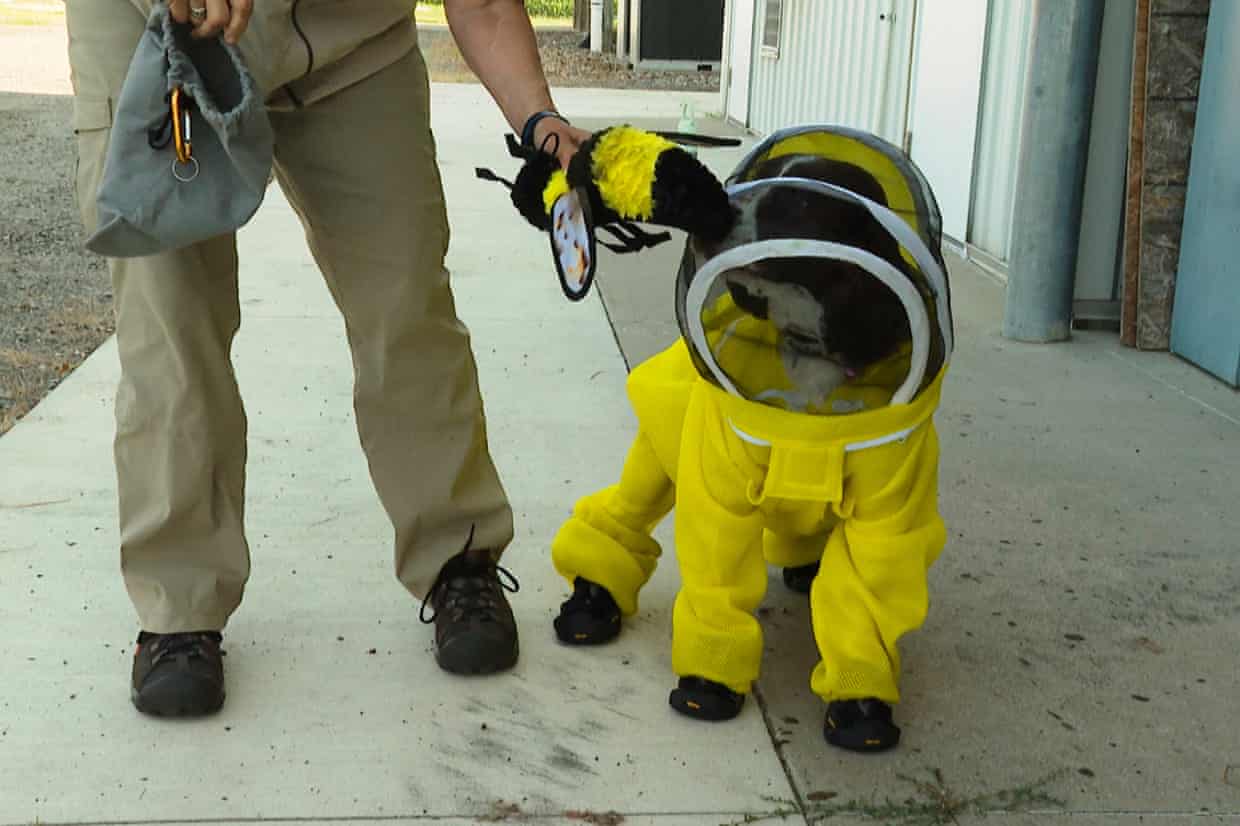
Photo: Mike Householder/AP.
Sue Stejskal lets Maple, an English springer spaniel, sniff a bee-themed dog toy at Michigan State University’s Pollinator Performance Center. Maple is part of an effort to screen and diagnose diseases that sicken honeybees.
It seems that over the past few years, I’m hearing more and more about bees — their importance to the food chain, their worrisome diseases. On Instagram I’ve been following the intrepid Erika Thompson @texasbeeworks, and after Sandra told me about an inspiring bee tour, I added @bodhis.bees in Rhode Island. Then, there’s my friend AJ, who shares honey from his hives when the black bear leaves them alone.
Keeping bees and other pollinators healthy is an important job that’s getting increasingly difficult as unaware humans damage their environment. In today’s story, a specially trained dog is helping protect bees.
Ramon Antonio Vargas reports at the Associated Press via the Guardian, “Maple, a springer spaniel aged nine, is earning news headlines by helping Michigan State University (MSU) researchers identify bacteria that is harmful for bee colonies. …
“Maple landed the role after spending seven years detecting human remains for a sheriff’s office. She had to retire from the sheriff’s office after suffering an injury on the job – leaving her handler, Sue Stejskal, in search of something to keep Maple busy.
“ ‘She’s a very over-the-top, enthusiastic, sometimes hard-to-live with dog because of her energy level,’ Stejskal, who has been training dogs for law enforcement and other uses for more than 25 years, said to the AP.
“Fortunately for Stejskal, MSU professor Meghan Milbrath was seeking out tools to screen and diagnose diseases that sicken honeybees, which her lab studies. A veterinarian who had taken part in a training about honeybees later put Stejksal and Milbrath in touch.
“And soon, the pair hatched a plan by which Stejskal taught Maple to apply her police canine detection methods in beehives to uncover American foulbrood – a bacterial disease that poses a deadly threat to honeybee larvae.
“The work Maple has since done for MSU’s Pollinator Performance Center has been crucial, with bees and other pollinators in a years-long decline stemming from diseases, insecticides, a lack of a diverse food supply and climate change driven by human emissions of greenhouse gases.
“ ‘American foulbrood [harms] young developing bees, and when a hive gets infected, it actually basically leads to death,’ Milbrath, an assistant professor in MSU’s entomology department. …
” ‘Beekeepers have had to burn tens of thousands of dollars of equipment due to this disease,’ Milbrath said to WILX.
“Maple carries out her duties in a distinctive, yellow protective suit. Her gear includes a veil for her head and four bootees worn on her paws to shield Maple in case she steps on a bee. …
“About 465 bee species are native to Michigan alone. Among the goals of training Maple to spot American foulbrood for the Pollinator Performance Center was to create a guidebook with which other dogs could be similarly taught, WILX noted.
“Stejskal told the AP, ‘I was over-the-moon excited because my dog would have joy in her life and would still be able to work,’ Stejskal said.” More at the Guardian, here.
You probably know there are things we can all do to help bees.
Many homeowners, for example, are giving up pesticides and herbicides. They are leaving the leaves on their lawns in fall to provide pollinator habitat in spring, and they’re committing to No Mow May. After all, as Bee City tells us, “The start of the growing season is a critical time for hungry, newly emerged native bees. Flowers may be hard to find. By allowing it to grow longer, and letting flowers bloom, your lawn can provide nectar and pollen to help your bee neighbors thrive.”
Please add bee tips if you know of some not covered here.

 Suzanne's Mom's Blog