Feeds:
Posts
Comments

Posts Tagged ‘petroglyph’

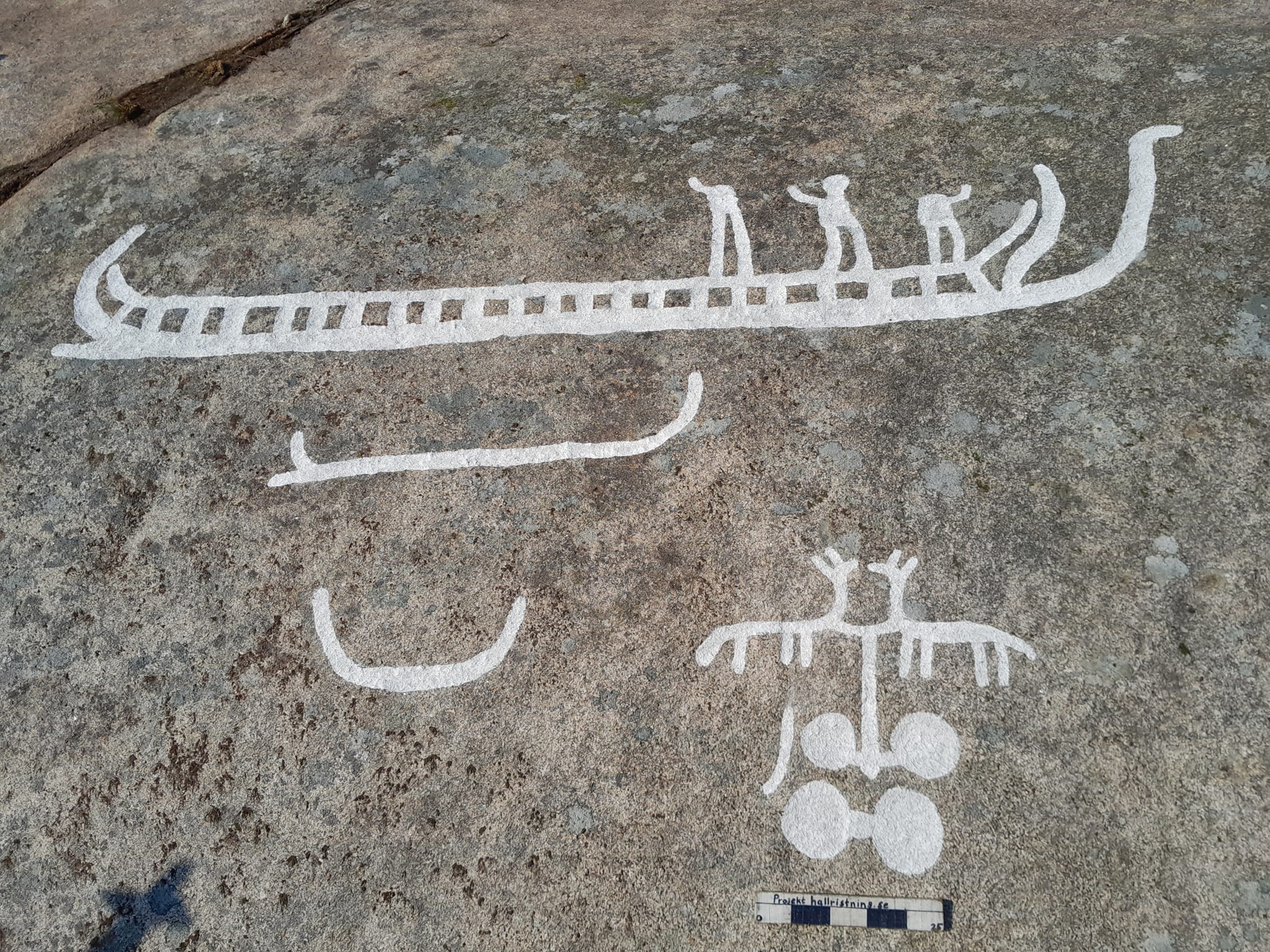
Photo: The Foundation for Documentation of Rock Carvings in Bohuslän.
One of the petroglyphs recently discovered on a farm in western Sweden.

Erik is from Sweden, so he takes Suzanne and the kids there every summer for about a month, where they connect with his sister’s lively family and his mother (Stuga40 on WordPress).

My husband and I paid Stuga40 a visit back in 2017, and one of the many fun things we did with her was visit a UNESCO World Heritage Site featuring ancient petroglyphs. (See a post on that here.)

It turns out that ancient civilizations in Sweden are not done revealing their secrets. Recently, researchers found more petroglyphs, startling the farmer who lives on the land and adding to the world’s pool of knowledge.

Richard Whiddington reports at Artnet, “In early May, a group of researchers scouring the western Swedish province of Bohuslän spotted irregular markings on a moss-covered rock face. They seemed man-made and so the team carefully removed the vegetation and uncovered scores of rock carvings, around 40 in total, depicting ships, animals, and people.

“The rock carvings, or petroglyphs, date back around 2,700 years and are the latest find in Bohuslän, an area known for its rock art, most notably the Bronze Age images at Tanum, a UNESCO site. …

“The recently discovered petroglyphs were found on a steep rock face that once formed the edge of an island before sea levels gradually dropped an estimated 40 feet over the course of several hundred years. This has led researchers to speculate the artists used boats, or a form of scaffolding laid on ice, to reach the rock surface. …

“The designs were made through a laborious process of smacking stones against the granite rock that exposed an underlayer of white. This color, in addition to their size, made them highly visible from both the mainland and passing ships.

“ ‘What makes the petroglyphs completely unique is that they are located three meters above today’s ground surface,’ Foundation for Documentation of Bohuslän’s Rock Carvings wrote in a statement. ‘The motifs lie on an even line that follows the height of the sea surface from approximately 700 to 800 BCE. The motifs are also stylistically consistent with this time period.’

“The latest group of petroglyphs found includes a 13-foot-long ship, as well as carvings of people, chariots, carts, and horses. Their meaning remains unknown. Sometimes petroglyphs were used to mark out territory, though researchers believe the repeated motifs carved into rocks outside the town of Kville may suggest they were used to tell a narrative.

“Lennart Larsson, on whose farm the rock carvings were found, was pleased by the discovery. ‘I haven’t actively been looking for petroglyphs, but it’s a lot of fun,’ he told SVT, the country’s national broadcaster in interview. ‘I can sit at home on the balcony and watch the stick figures and the ships outside.’ ” More at Artnet, here.

Also, at Live Science, Martin Östholm, a project manager with the foundation, noted that he petroglyphs include depictions of ships, people and animal figures, “including four-legged creatures that may be horses. … It’s not certain why people created the carvings, he said, but they may have served to mark ownership. …

James Dodd, a researcher at Aarhus University in Denmark and the Tanums Hällristningsmuseum’s Rock Art Research Centre Underslös in Sweden [said that] some of the motifs — including chariots, carts and animal figures — were depicted multiple times. … ‘On the basis of the repetition of the motifs, it is possible that this collection of figures forms a narrative,’ Dodd told Live Science in an email. Studies of other petroglyphs in the region have suggested that, in some cases, they may have been used in this way, but the exact meaning in this case is uncertain, he added.”

Artnet and Live Science have good pictures — and no firewalls.
Read Full Post »

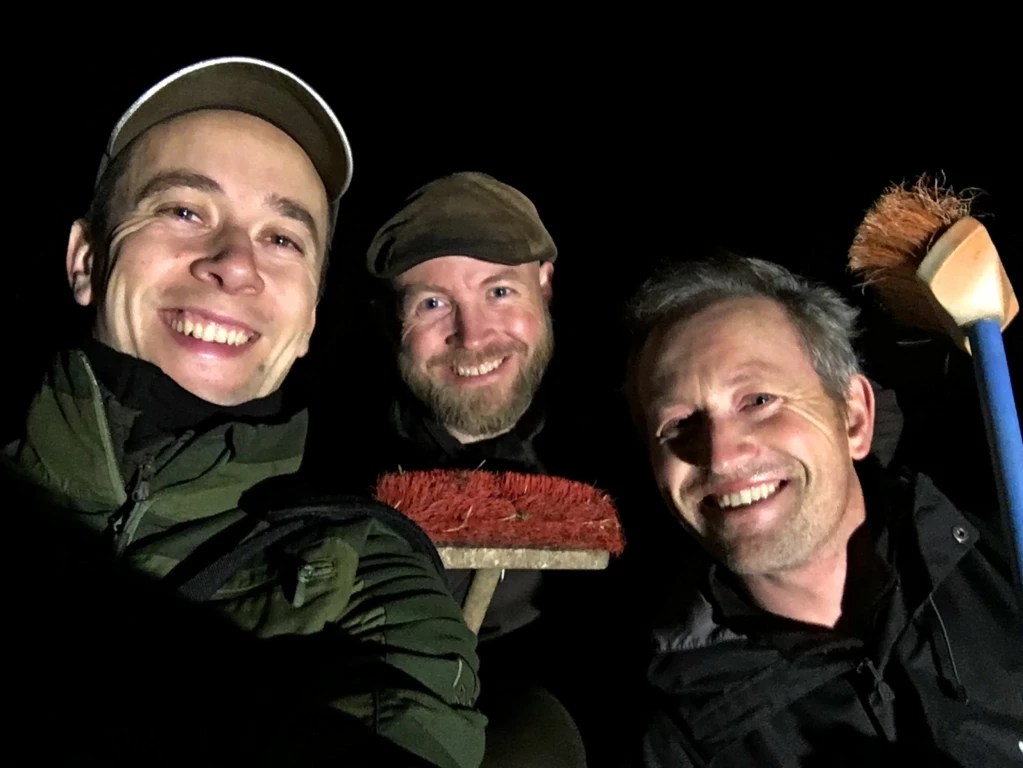
Photo: Science Norway.
According to Science Norway, all it took was a smart hypothesis and a few brooms. Together, the three friends have discovered hundreds of previously unknown rock carving sites in the Østfold landscape in the last 3-4 years.

Some good buddies hang out in a bar together. Some go bowling together or maybe running. The buddies in today’s story hunt Bronze Age petroglyphs. At night.

Lisa Abend writes at the New York Times, “It was December and the first snow of the season was falling when the three friends set out on their weekly hunt through the fields of Ostfold, in southeastern Norway. … Tromping across the blanketed farmland, the men came to a low outcrop of rock, a few feet wide. With a child-size plastic broom, they brushed away the newly fallen snow from the stone to reveal the outline of a ship, its curved keel carved into the granite roughly 3,000 years ago.

“It was just one of more than 600 Bronze Age rock carvings, known as petroglyphs, that Magnus Tangen, Lars Ole Klavestad and Tormod Fjeld have discovered. Since making petroglyph hunting their collective hobby in 2016, the three enthusiasts have transformed knowledge about prehistoric art in Norway, more than doubling the number of carvings known in their home region. And although they are motivated, in part, by the pleasures of friendship and the outdoors, their findings have also lent serious weight to theories about the mysterious petroglyphs’ meaning.

“Rock carvings from the Bronze Age (which in Scandinavia began around 2,000 B.C.) are common in parts of Sweden and Norway. Regions in both countries have been declared UNESCO heritage sites because of the density and the diversity of the images, which include human figures, animals, geometric shapes and, frequently, ships. Yet because they are commonly cut into granite that is low to the ground and easily obscured by leaves or snow, they often go unnoticed.

“Petroglyphs are also easier to see when the sun is not overhead — a realization that has been one of the keys to the three friends’ success. Because the hunt for them is a hobby rather than a career — Tangen is an archaeologist working in a different field, Fjeld a graphic designer, and Klavestad a landscape architect and artist — they make time for it at night. …

“The thrill of the hunt has naturally led them to speculate on the carvings’ meaning. Because the petroglyphs tend to be more visible in the slanted rays of dusk, or with angled artificial lights, Tangen said he believed that their creators had made deliberate use of shadow and light in their work. Thanks to the sun’s changing angle, petroglyphs can look different depending on the hour of the day, or season, he explained. ‘I think the images have to do with the awakening of people’s minds to time,’ he said.

“That is in keeping with findings from professional archaeologists about rock art and stone monuments, in places like British Columbia and Scotland, whose features are visible only at certain times of year. There is also evidence for another one of Tangen’s theories: that some of the images were meant to be seen in flickering light, so that they appeared almost animated.

“Kristin Armstrong-Oma, a professor of archaeology at the University of Stavanger, said that ‘in excavations around some carvings, archaeologists have found signs of burning or charcoal.’ That suggested fire was being used, almost like a movie camera. ‘The living flames give the carvings a feeling of movement,’ she said.

“The petroglyph-hunting trio got their start in 2016, when Fjeld, the graphic designer, was walking his dog in the countryside and found a strange mark in a rock. He wondered if it was made by humans, or nature. Trying to identify it online, he came across a website with photos of petroglyphs, and contacted its owner, Tangen, who suggested Fjeld’s find could be a Bronze Age cup mark — a simple, round carving that is a common motif in prehistoric art.

“His interest piqued, Fjeld started paying better attention on his walks, and soon found a carving that was unmistakably made by human hands: an image of a ship. ‘That was very, very fun,’ Fjeld said. ‘So I started going on a regular basis.’

“Tangen, who had made similar discoveries while walking his own dog, joined him, and before long suggested that they invite Klavestad, a local enthusiast who had found his first carving when he was 10.

“ ‘We didn’t know each other, but I hadn’t met anyone else with so much passion for it,’ said Klavestad. ‘We are, all three, very dedicated.’ “

More at the Times, here.

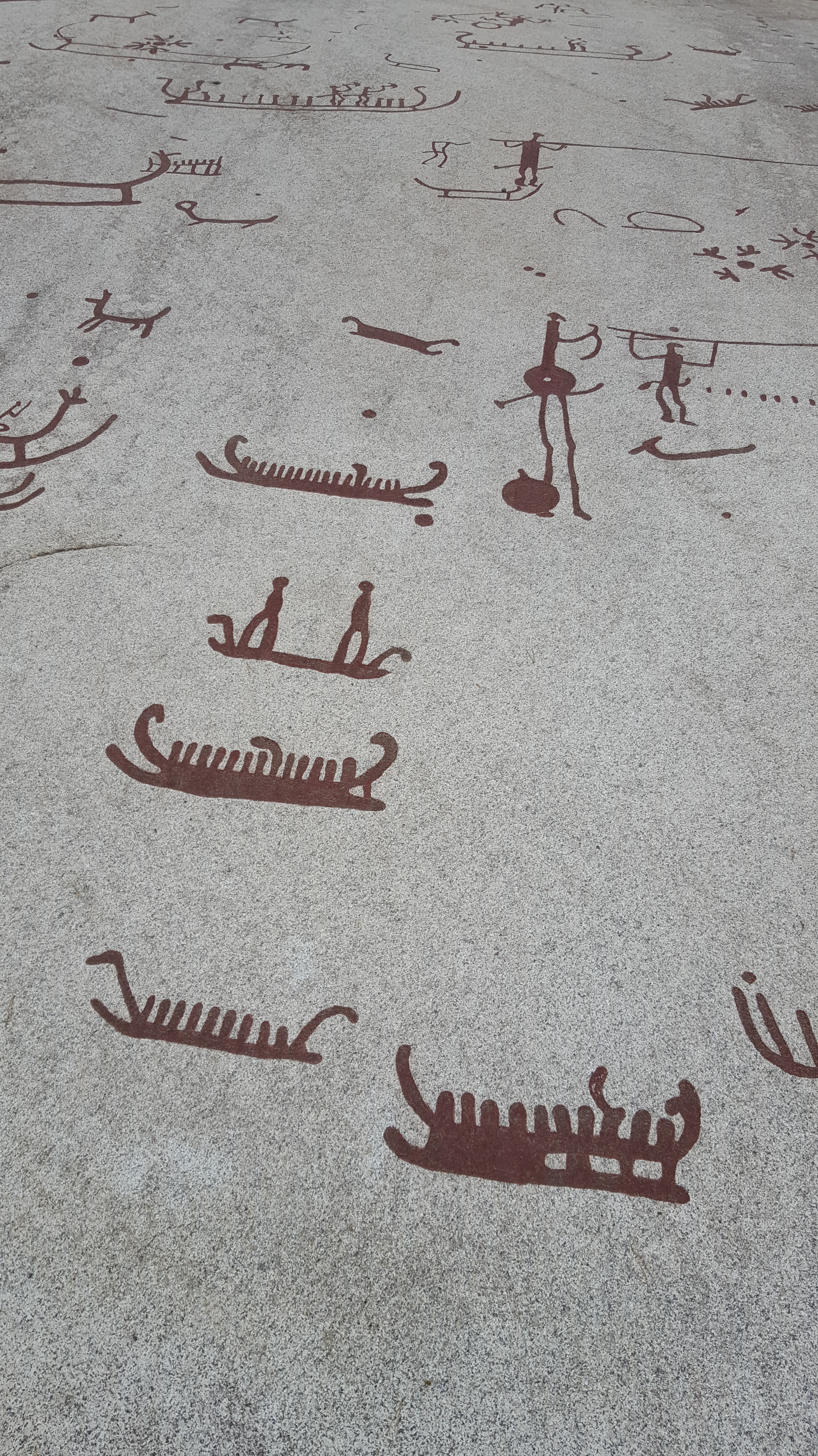
Petroglyphs I saw in 2017 at a UNESCO-protected World Heritage Site in Sweden. Some have been painted red to make them more visible for tourists, a practice which has drawn criticism.

060217-petroglyphs-by-Stuga40-Sweden

Read Full Post »