Feeds:
Posts
Comments

Posts Tagged ‘pets’

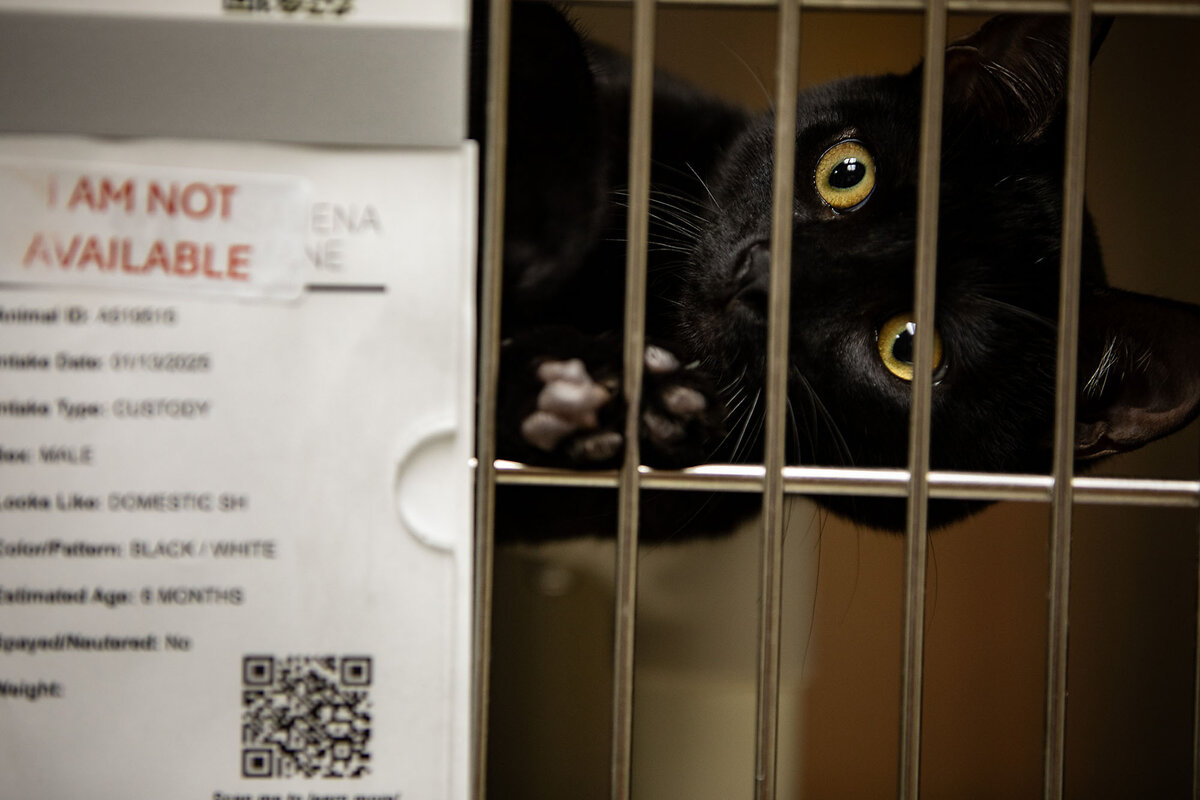
Photo: Melanie Stetson Freeman/CSM Staff.
A sign on the cage of a young black cat boarded at Pasadena Humane indicates that it belongs to someone who lost their home in the Eaton Fire. The organization took in about 500 pets right after the fires. As of March 8, there were about 170 still boarding, free of charge.

Speaking of those pets and other animals in the Latvian animated film Flow, what actually does happen to them in a disaster?

Whether it’s a catastrophic flood as in Flow, or a massive wildfire as in California last January, humane societies and lots of volunteers rise to the challenge.

Ali Martin wrote at the Christian Science Monitor, “Six weeks after the Los Angeles wildfires erupted, Chris Briffett was sifting through 10,000 volunteer applications. The director of volunteer services for Pasadena Humane, a nonprofit, is expected to bring on about 2,000 – giving the organization an ‘unprecedented chance, he says, to respond to the community’s needs. …

“When communities are devastated, people step up to help, often in ways that align with their own skills or interests. But in the past decade, more trained volunteers have been integrated with official disaster response, says Tricia Wachtendorf, co-director of the University of Delaware’s Disaster Research Center. The inclusion of volunteers in the government process of planning for emergencies, she adds, improves coordination in the midst of disaster.

“Christine Quesada, director of volunteer programs for LA County’s Department of Animal Care and Control, says volunteers were vital during the wildfire evacuations at LA Pierce College, which took in horses and other livestock. LA County’s Equine Response Team — volunteers trained to work with large animals — provided food and care; worked with organizations for donations of food and supplies; and cultivated relationships with owners. …

“During the January wildfires, the small staff at Pierce’s equine science center worked around the clock with about 20 volunteers a day, plus officers from the county’s Department of Animal Care and Control. After the first day, Pierce was at capacity with over 200 animals.

“Some belonged to Sarah Kern. She arrived with six horses and two donkeys after watching the glow of flames spread across the oak-covered hills surrounding her home in Topanga. Ms. Kern knew the stakes; she and her family lost a home in the 2018 Woolsey Fire.

“Their animals are a way of life, central to their daily activity and rhythms. With the horses and donkeys safe, she says, she could focus on caring for her family and protecting her property.

“ ‘Yes, you’re supporting animals,’ she says, ‘but you’re really supporting the people. … They’re both important.’

“Back at Pasadena Humane, Skinny Minnie is recovering from severe burns. She is one of nearly 170 animals still boarding here because of the fires.

“Owners Mark Pastor and Lisa De Lange evacuated their home in Altadena and managed to grab their other two cats – Beauregard and Stella – but little else, with flames melting the back of Mr. Pastor’s car as he pulled out of the driveway.

“Someone found Skinny Minnie in the burnt remains of their home and took her to the shelter, which posted her photo on its website, where it was discovered by Mr. Pastor. Either he or Ms. De Lange visit Skinny Minnie nearly every day.

“Skinny Minnie’s care has been extensive, and it’s all covered by Pasadena Humane. When they told him, Mr. Pastor says, he ‘broke down.’

“ ‘It’s like they care as much about us and our feelings as they do about the animals that they’re treating,’ says Mr. Pastor.”

More at the Monitor, here.

Read Full Post »

Photo: Sideshow/JanusFilms.
The movie Flow is all about animals — no humans and no verbal conversation — and it seems that domestic pets are mesmerized.

I had been wanting to see the movie Flow, so at Easter, Suzanne set it up for the kids and me while she attended to Bunny work.

It was fun to figure out with the grandchildren exactly what was happening in the film and to add our own sound track. But in the end, I don’t think they liked it much. I myself have a problem with ambiguous endings, gorgeous as the animation was.

Now I am fascinated to learn what the movie has meant to a different audience: household pets. Esther Zuckerman has a report at the New York Times.

“Search on TikTok and you’ll find a number of videos of dogs and cats alike viewing Flow alongside their owners, appearing to recognize themselves in the gentle saga, which tells the tale of an adorable black kitty who must work with a motley crew of other industrious animals to survive rising sea levels in a surreal landscape. The trend is a particularly cute coda to what was already one of the feel-good stories of awards season in which the dialogue-free indie — made on open-source software and directed by Gints Zilbalodis — triumphed over studio fare like Inside Out 2 and The Wild Robot, to earn Latvia its first ever Oscar.

“Watching Flow in the theater is a wonderfully immersive experience where the spectacle of the movie’s visuals are on full display. … Watching Flow at home (it is streaming on Max) with an animal is an equally delightful experience, but a different one. You may find your attention pulled in two directions as you try to contemplate what this all means to your pet as well as what it means to you.

“I, for one, tried to decipher just what was going on with [my dog] Daisy. Surely, she wasn’t understanding the climate change allegory, but her huge ears stood up straight as she gazed upon the heroic cat, and I caught her running up to the TV for a sequence in which it and its capybara ally go tumbling off their boat. Seeing — or perhaps just hearing — the characters in peril stressed her out on some level.

“Matiss Kaza, who produced and co-wrote the film, said in an email that he suspects that it’s the real animal sounds used in production that attract the attention of our domesticated friends. …

“When I spoke to social media users who posted clips of their household beasts responding to Flow, they explained that their animals aren’t usually this entranced by the screen.

“Chayse Orion, 24, had seen other TikTok posts about the film before he decided to watch it. He thought it was cute but wasn’t paying super close attention. His cat Fishbone was. ‘Fishbone was so engrossed in the movie,’ Orion said. ‘He was just so into it, which was really weird because I’ve never seen him interact with a show like that.’ …

“Orion knew it would make great internet content. Not only did he start to film Fishbone, he moved the cat’s tower closer to the TV for a better view, one that put Fishbone at eye level with his animated brethren. ‘I actually put it on again yesterday for him to watch while I was working,’ he said. ‘It’s definitely his favorite movie now, for sure.’ …

“Celine Orosco, 29, found that her dog Samson, a golden retriever, was also invested in Flow. She said it was the first movie he ever watched all the way through. He was particularly excited, she noticed, whenever the Labrador that joins the cat’s group of travelers came onscreen. ‘He really loved that dog,’ she said.

“Of course, we don’t know what any of our animals are actually thinking when they watch Flow. Did Gao’s black cat actually recognize herself? Hard to say. My boyfriend at first inferred that Daisy liked the lemur who has a basket full of trinkets, then thought perhaps she was upset by it. I know that she didn’t follow the plot — I love her, but she’s not that intuitive. She did, however, hear the so-called voices of the characters, and reacted to whatever they were conveying. …

“We love to watch our pets watching Flow for the same reason we love to watch Flow. The film understands that delicately anthropomorphizing these animals is a powerful tool. Their movements are carefully calibrated to replicate the way the creatures would behave in real life, but their actions are just human enough to make the story feel relatable.

“Would a cat, a dog, a capybara, a large bird and a lemur all team up to save one another should massive floods happen? Hard to say. But it’s a good metaphor about how empathy can be salvation.”

More at the Times, here. If you’ve already seen the movie and can bear a negative review, check Asakiyume’s reservations, here. But be warned: there are spoilers.

Read Full Post »

Photo: Andrea Lightfoot via Unsplash.

For Valentine’s Day this year I thought I would post about the love people have for pets. The article I found at Yale University’s human relations website is a little research-y, but it shows just how far back in history humans have felt that kind of love.

“The human love of pets is a powerful and global phenomenon. For many pet owners, their furry (or scaly) domestic companions transcend any simple categorization of non-human animal. Indeed, research shows that it is a growing global trend for pet owners to consider their animals to be full members of their families; to dote upon them as they would children or romantic partners, both emotionally and financially; and to thereby develop strong bonds of dependency, love, and support.

“Gray and Young (2011) conducted a broad cross-cultural study of human–pet dynamics around the world utilizing … a stratified random sample of 60 culturally, linguistically, and geographically diverse societies represented in eHRAF [Human Relations Area Files] World Cultures. Their study revealed that ‘dogs, birds, and cats were the most common pets, followed by horses, other hoofed mammals such as water buffalo, rodents, nonhuman primates, and pigs.’ … Attitudes and sentiments towards the domesticated animals vary, with many societies attaching spiritual meaning to their birds, cats, or dogs. …

“The emotional connection between pets and their owners is worthy of cross-cultural attention. For example, it has been discovered that dogs are able to read emotional cues from the faces of their owners and to respond accordingly. Other recent studies have shown that people tend to have more compassion for animals who are suffering than for adult humans in similar circumstances, treating the hurt dogs akin to helpless infants who need protection. Based on global data, researchers in this telling social experiment concluded that, by and large, subjects ‘did not view their dogs as animals, but rather as “fur babies” or family members alongside human children.’

“As to the origins of human-pet relationships, anthropologists suggest that our propensity for keeping pets, as well as our finely honed empathy for their emotional state, stems from the process of animal domestication in early human history, beginning with dogs and continuing to horses, sheep, goats, and others:

” ‘In each case, humans had to learn to put themselves in the minds of these creatures in order to get them to do our bidding. In this way our senses of empathy and understanding, both with animals and with members of own species, were enhanced. Our special relationship with animals is revealed today through our desire to have pets (McKie 2011).’ …

“Evidence of ancient burials from eHRAF Archaeology supports recognition of a longstanding bond between humans and animals far back into prehistory. For example, in ancient Egypt (5000-2000 BCE), Rice finds that, ‘amongst the graves at Helwan are examples of the burials of dogs and donkeys; as these do not seem to be the subject of cult or religious observance, it may be that they were family pets, since the Egyptians always kept animals about them, as members of their households’ (1990: 131). Similarly, on the other side of the world, the purposeful interment of animals in prehistoric settlements is known throughout the American Southwest and northern Mexico. According to Woosley and McIntyre, at the Wind Mountain site in New Mexico dating back to 2000-600 BP, the animals buried included dogs, bears, turkey, golden eagles, hawks, mourning doves, and scarlet macaws (1996: 281).

“Edmund Leach’s seminal work, Animal Categories and Verbal Abuse (1964), presents the human relationship to animals in terms of social distance. Attitudes towards different animals reflect our familiarity with them, so that the most familiar or ‘closest’ to ourselves are subject to ritual provisions or prohibitions because they are considered ‘taboo.’ They are also most worthy of human-like care and devotion. This is why people generally avoid eating the animals that they might also keep in their homes as pets. …

“The dynamic of intimacy in the human relationship to animals recurs in the ethnographic literature. The closeness of human-animal relationships is evident around the world with instances of beloved species being cared for as fondly and tenderly as human babies.”

Check out more at Yale’s Human Relations Area Files, here. No paywall.

Read Full Post »

tmg-article_tall

Photo: YouTube/Field of Vision
Karollyne, who works at the dog-rescue nonprofit founded by Glenn Greenwald and David Miranda in Brazil, is shown with one of the homeless dogs she cares for in an abandoned building.

Nothing humanizes homeless people more for us than seeing them interact with a pet. The panhandler who used to set up a blanket with his dog near Providence’s Kennedy Plaza always seemed cheerful whether he got money or not, and many passersby stopped to pat the dog and exchange a few friendly words. I haven’t seem him lately and can’t help wondering if his dog helped him to get it together and move off the street.

Consider a couple articles I’ve been reading on homelessness and the power of a pet. In the first article, reporter Candace Pires gathered the stories of four homeless people for the Guardian.

Heather, 22, told Pires, “Before we found Poppy, I didn’t feel like I had anything to wake up for. I was going through a rough time in my life and didn’t care about myself. I’d been homeless since my parents told me to leave our family house in June 2016 and was so miserable in my situation. Everywhere I go people shun me and tell me to leave.

“Then, last March, I was walking around downtown Seattle with my boyfriend when we saw a group of guys with two dogs. They were yelling at one of them and she was shivering and obviously scared. I went into a store and when I came out my boyfriend had the dog. I was confused. He said to me: ‘I made a life choice without you; we’re keeping the dog.’ He’d paid the guys $5 for her. …

“We moved from sleeping in a doorway to a tent. I stopped stealing food from stores when we were desperate; I didn’t want to go to jail for something dumb and risk losing her. I’ve applied for food stamps and now have a case manager helping me get on a housing list and get Poppy registered as a service animal so that we’re protected from being split up. …

“She wakes up so excited every morning and gets so happy about the littlest thing, like rolling around in the grass or even just the weather being nice. Seeing her like that reminds me to stay happy for simple things too. In my mind she’s a little angel that saved me as much as I saved her.”

Pires wrote up three more stories by homeless pet owners in America here.

Meanwhile, the journalist Glenn Greenwald has written at the Dodo about the dog-rescue nonprofit he and David Miranda founded in Brazil, where homeless people who love dogs are hired as caregivers.

“In the last two years,” Greenwald reported, “our work with animals has taken on a new focus: working with homeless people who live on the streets with their pets. At first glance, this situation can seem grim and depressing: Many assume that animals who live on the street with homeless companions are mistreated or deprived.

“But, far more often, the truth is the opposite: The bond that forms between homeless people and their homeless pets is often [more] strong, deep and more profound than many can imagine. The mutual need, and resulting intense devotion, that homeless people and their animals develop for one another is inspiring and can be unlike what one might find in any other context.

Leslie Irvine, a sociology professor at the University of Colorado, has devoted much of her academic career to studying this unique relationship, and even named her book on the topic, ‘My Dog Always Eats First.’ ”

Greenwald wrote more here.

Did you ever see a person you thought you couldn’t relate to until you saw the person’s relationship with a pet? I’d love to hear stories.

Read Full Post »