Feeds:
Posts
Comments

Posts Tagged ‘poaching’

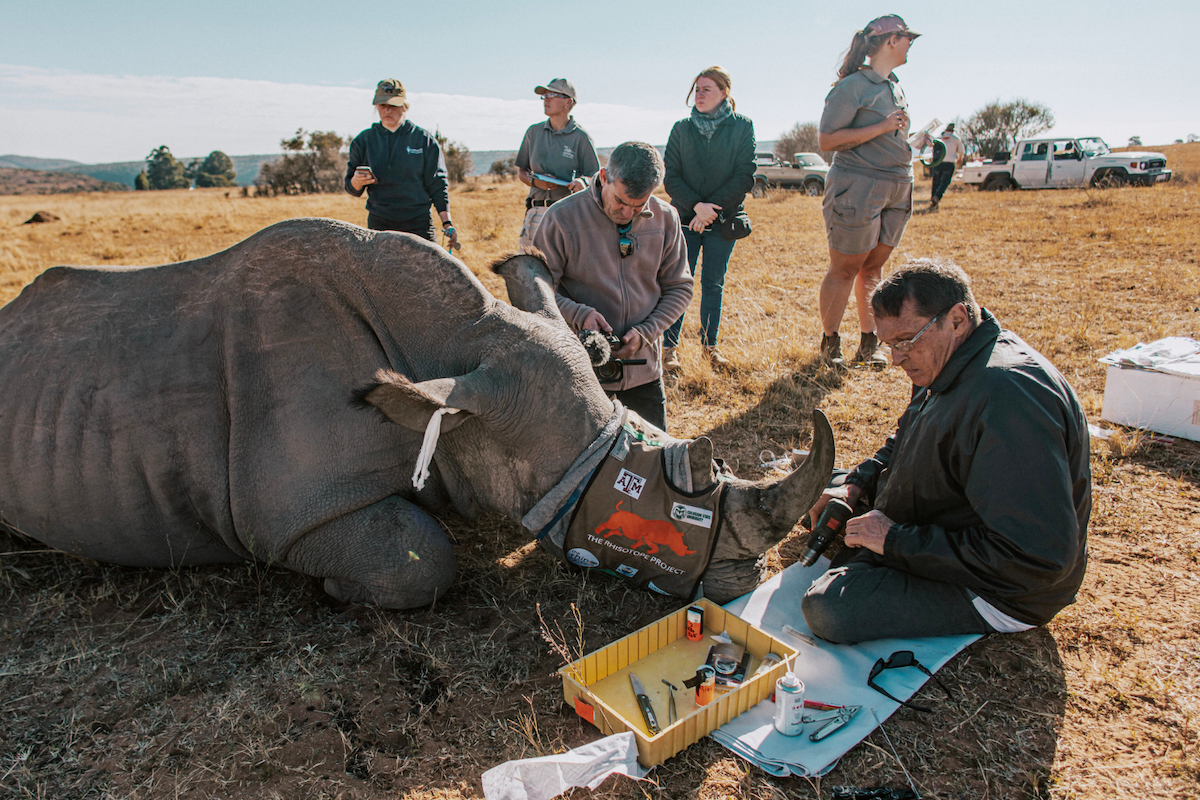
Photo: University of the Witwatersrand.
To protect rhinos and scare off poachers, researchers add radioisotopes to a rhino horn at the Waterberg Biosphere Reserve in South Africa. 

Who would think of protecting endangered rhinos by injecting something radioactive into their horns? Researchers in Africa, that’s who.

YaleEnvironment360 reports that “South African researchers have inserted radioactive material into the horns of 20 live rhinos. Their goal: to track horns from rhinos that were hunted illegally.

“Researchers say radioisotopes added to horns would be picked up by radiation detectors at airports, harbors, and border crossings, and so would send up a red flag. There are more than 11,000 such detectors at ports of entry around the globe, part of a vast infrastructure aimed at stemming the flow of illicit nuclear material. And the thousands of security personnel devoted to operating these detectors far outnumber officials working to stem the illegal wildlife trade.

“ ‘Ultimately, the aim is to try to devalue rhinoceros horn in the eyes of the end users, while at the same time making the horns easier to detect as they are being smuggled across borders,’ said project lead James Larkin, of the University of the Witwatersrand in Johannesburg.

“ ‘Every 20 hours in South Africa a rhino dies for its horn. These poached horns are then trafficked across the world and used for traditional medicines, or as status symbols,’ Larkin said. ‘This has led to their horns currently being the most valuable false commodity in the black-market trade, with a higher value even than gold, platinum, diamonds, and cocaine.’ “

The University of the Witwatersrand website adds: “These radioisotopes will provide an affordable, safe and easily applicable method to create long-lasting and detectable horn markers that cause no harm to the animals and environment. At a later stage, the work will expand to elephants, pangolins and other fauna and flora. …

“Starting on Monday, 24 June 2004, Professor Larkin and his team carefully sedated the 20 rhinos  and drilled a small hole into each of their horns to insert the non-toxic radioisotopes. The rhinos were then released under the care of a highly qualified crew that will monitor the animals on a 24-hour basis for the next six months. ‘Each insertion was closely monitored by expert veterinarians and extreme care was taken to prevent any harm to the animals,’ says Larkin. ‘Over months of research and testing we have also ensured that the inserted radioisotopes hold no health or any other risk for the animals or those who care for them.’    

“The development and application of the Rhisotope Project nuclear technology has the capacity to help deter poaching, increase the detection capabilities of smuggled horns, increase prosecution success, reveal smuggling routes and deter end-user markets.

“Rhino poaching reached crisis levels since 2008 where close to 10 000 rhinos were lost to poaching in South Africa, with wildlife trafficking being the third biggest organized crime globally.

“Professor Lynn Morris, the Deputy Vice-Chancellor: Research and Innovation at Wits University says: ‘This is an example of how cross-disciplinary research and innovation makes a real difference. This novel approach pioneered by Prof Larkin and his colleagues has the potential to eradicate the threat of extinction our unique wild-life species, especially in South Africa and on the continent. This is one of many projects at Wits that demonstrates research with impact, and which helps to address some of the local and global challenges of the 21st Century.’

“The Rhisotope Project at Wits was set up by a small team of likeminded individuals as a South African-based conservation initiative in January 2021 with the intention of becoming a global leader in harnessing nuclear technology to protect threatened and endangered species of fauna and flora as well as communities of people.

“Aside from developing a solution to combat the illicit trade and trafficking of wildlife products, the Rhisotope Project seeks to provide education and social upliftment to empower people and local communities. A special focus is aimed at uplifting the girls and women of rural communities, who are often the backbone of these communities in the remote areas where endangered species are found and are the greatest components of success in changing the hearts and minds of local communities thereby creating rhino ambassadors and champions.”

More at Yale e360, here, and at the university’s website, here.
Read Full Post »

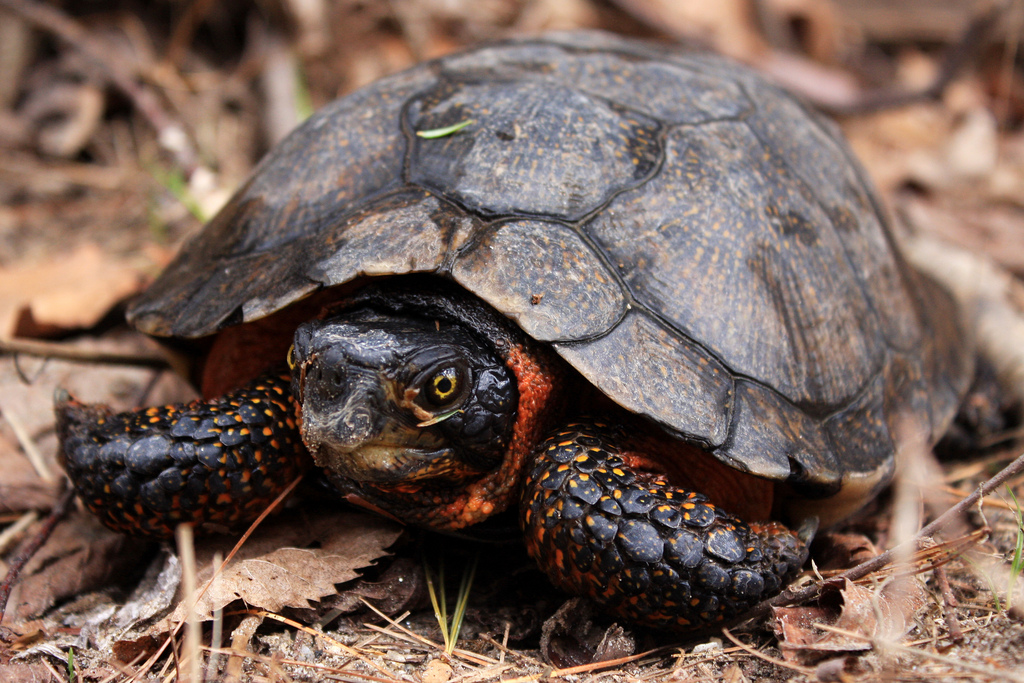
Photo: Regional Conservation Needs.
Wood turtles are said to make nice pets. Too nice for their own good: their reputation leads to poaching.

There’s a popular kind of turtle that’s losing habitat, like so many species these days. Here’s a story about a man who was determined to preserve his own land for these turtles, particularly for one specimen — his friend Stumpy.

Sadie Dingfelder reports at the Washington Post, “With his brow furrowed, Tom, 70, stomps on the damp leaf litter — thump, thump, thump, thump — and then we wait. A woodpecker cackles; bluebells tremble in the breeze. Stumpy is nowhere to be found. …

“A wild turtle, Stumpy has been meeting up with Tom in these West Virginia woods every spring for more than 30 years. Like his fellow wood turtles, Stumpy spends his winters brumating (the reptile equivalent of hibernating) in a clear, fast-moving stream. As days warm, he emerges from his aquatic home and roams the nearby woods in search of food ⁠— first tender leaves, then flowers and, finally, berries. Early on Stumpy’s circuit is Tom’s former house, where the human tosses him huge, juicy strawberries — months before the wild berries are ready to eat.

“It took a while for Tom to figure out Stumpy’s species, because Stumpy’s shell is worn and scuffed. Usually, wood turtles have gorgeous shells that appear to have been hand-carved from mahogany.

‘He was already old when I first saw him, so he must be really old now,’ says Tom. ‘Of course, he could say the same thing about me.’

“Curious, personable and uncommonly pretty, wood turtles are highly sought-after as pets, says Andrew Walde, chief operating officer of the Turtle Survival Alliance, whom I called after my first visit to Stumpy Acres. This combination of characteristics makes them vulnerable to poachers, who sell them as pets. ‘Whenever anything gets published about a particular population, that population is done for,’ Walde says. (To protect Stumpy and the other wood turtles from poachers, we aren’t publishing his exact location or his human friends’ last names.)

“The eastern panhandle of West Virginia is among wood turtles’ last strongholds, Walde says. Across most of their range, they are in steep decline. Indeed, half of the world’s 357 turtle species are threatened with extinction due to habitat loss, poaching and other human pastimes. This is an animal that survived not one, but two mass-extinction events. …

“Tom no longer lives in Stumpy’s territory. Last spring, he sold his house and moved to a more remote spot, high on a nearby mountain. He loved being by the river, but the pandemic brought an influx of tourists and new homeowners. The noise and traffic were bad enough, but worst of all was their aggressive landscaping.

‘One family clear-cut all the way down to the river,’ Tom says. ‘They didn’t want any brush or shrubbery — they are afraid of snakes or this or that — and they kinda destroyed the habitat.’

“He was determined to find a buyer who would be a good steward of the land — not just for vague environmental reasons, but for Stumpy’s sake, too. Luckily, the first person who came to look at the house fit the bill. Tommy, a 28-year-old computer programmer from D.C., told Tom about the sea turtle conservation project he had worked on one summer in Costa Rica, and he promised not to clear-cut the property to get a river view or better internet access. …

“Does Stumpy represent nature? Survival against the odds? The relentless ravages of time? Tom dismisses all these possibilities. ‘Stumpy is just Stumpy,’ Tom says. ‘He’s an individual. That’s what makes him special.’

“We drive to Tommy’s house and commence stomping. Stumpy should really be out of hibernation by now, but he’s not in their meeting spot near a large fallen tree, and he’s not on the berm by the river. He’s not basking on his basking log, and neither is he napping beneath the papaw trees. …

“If you spend time outdoors, you’ll eventually see something brutal, and you’ll be forced to accept it with equanimity, because nature is obviously beyond our judgment. Loving nature also feels a little tragic, because no matter how much you care about it, it will never care about you.

“But perhaps I’m wrong, because suddenly I hear a rustle in the leaves. Tom makes an excited sound. ‘There he is!’ he says, pointing. About 10 feet in front of us, a little brown turtle is running on his tiptoes — who knew turtles could run? And even though I’m closer and I’m also carrying strawberries, he’s beelining straight to Tom. …

“Pretty soon, Stumpy’s face is covered in pink pulp, and he’s got half a strawberry hanging from his chin. His species may be threatened, his habitat may be imperiled, but in this moment Stumpy seems delighted. ‘He’s such a messy eater,’ says Tom. ‘Do you see that? What a pig.’ Stumpy usually hangs out for a few weeks, making intermittent appearances, Tom says. As to where he goes afterward, no one knows — but Tom has a theory. ‘Maybe he visits lots of people, up and down the river, and we all think he’s ours.’ ”

More at the Post, here.

Read Full Post »

I’ve never managed to catch the herring run, but I’d like to see it with grandchildren sometime. The celebration for the Mystic River herring migration offers all sorts of extras, as I learned from the newsletter of the Mystic River Watershed Association, or MyRWA. (I’ve been receiving the newsletter since John’s stint on the board some years back.)

“The annual Herring Run and Paddle includes a 5K run/walk race, three paddling races (3, 9, and 12 miles), educational booths, children’s activities, and more. All events are held at the [Department of Conservation and Recreation] Blessing of the Bay Boathouse in Somerville.”

MyRWA reports, “The Mystic River Watershed supports two species of herring: Alewife (Alosa psuedoharenous) and Blueback Herring (Alosa aestivalis). Both species, collectively called river herring, are anadromous. This means they spend most of their lives at sea and return to rivers—like the Mystic—to spawn, or lay their eggs.

“In colonial times and earlier, herring in the Mystic River were extraordinarily abundant.  But from the 1900’s until today a much smaller population of river herring is present. …

“According to the Herring Alliance some river herring runs on the Atlantic Coast have declined by 95% or more over the past 20 years. In 2006 the National Marine Fisheries Service designated river herring as a species of concern. Population decline may be associated with numerous factors including by-catch [catching them by accident when fishing for something else], habitat loss and degradation, water pollution, poaching, access to spawning habitat, and natural predators.”

Read more here. And remind me next May that I want to visit a fish ladder.

Read Full Post »