Feeds:
Posts
Comments

Posts Tagged ‘pocket forest’

Photo: Suzanne Kreiter/Globe Staff.
Lacey Kohler, Urban Greening Projects co-ordinator and Cristiane Caro, cofounder of Pearl Street Garden Collective, worked in the new microforest in Providence, Rhode Island.

I have posted a lot about Miyawaki urban forests in Massachusetts, thanks to my friend Jean (Biodiversity Builders), who showed me several she’s helped to create. I didn’t know that similar work was afoot in nearby Rhode Island.

These efforts are all about what a dense little forest can give to a city neighborhood where there’s very little nature left. It can remove dangerous carbon from the atmosphere while spreading biodiversity all around, making the city a healthier place for both humans and critters.

Ed Fitzpatrick reports on the Rhode Island venture at the Boston Globe, “The asphalt grid of South Providence is lined with multifamily homes and concrete sidewalks. But along Pearl Street, one lot stands out.

“It’s lush and green, with nearly 270 trees packed into a 1,000-square-foot lot. Officially called the Pearl Street Garden, it contains a tiny forest in the middle of the urban jungle.

“ ‘Microforests’ like this one are cropping up in places ranging from Elizabeth, N.J., to Cambridge, Mass., to Pakistan. South Providence has two, both along Pearl Street, created by Groundwork Rhode Island and the Pearl Street Garden Collective. …

“ ‘This isn’t habitat restoration on the scale that is needed in terms of the world,’ said Jacq Hall, director of special projects at Groundwork Rhode Island … but it is a really great way, especially in a city, for people to become very in close touch with biodiversity and why it’s important and why it’s also beautiful.’

“In May, more than 100 people came out to plant the microforest. …

“The pocket forests adhere to the ‘Miyawaki method’ devised in the 1970s by Japanese botanist Akira Miyawaki, which calls for planting a wide variety of local trees in large numbers and in very tight quarters. …

“Massachusetts now has at least 20 microforests, according to Alexandra Ionescu, a Providence resident who is associate director of regenerative projects at Biodiversity for a Livable Climate, a Cambridge-based nonprofit that promotes ecosystem restoration to address climate change. …

“Rhode Island is the smallest and second most densely populated state in the nation, and a 2022 study found it contains 139 square miles of asphalt, concrete, and other hard surfaces, amounting to 13 percent of its land area. Hall said the benefits of forests and tree-lined streets are not distributed evenly in Rhode Island. …

“[Hall said], ‘We’re trying really hard to go back into those places that have been aggressively paved over and try to work in little bits of nature to bring those benefits to more people.’ …

“Hall said microforests help combat climate change because they grow so quickly. With plants packed close together, they both collaborate and compete for resources, racing to reach the sun first. She said research shows forests grown using the Miyawaki method grow 10 times faster than a traditional landscape planting. …

“Hall said projects such as this received a big boost in funding from the federal Inflation Reduction Act of 2022. ‘It was a historic moment,’ she said. …

“Groundwork Rhode Island and the Pearl Street Garden Collective are now looking for other funding sources” because of federal curbacks.

More at the Globe, here. And if you want to know more, search this site for “Miyawaki.” Or just click here.
Read Full Post »

Photo: Nick Jaramillio/Billy Penn.

When Hannah saw an October post about mini urban forests, here, she was reminded of something similar going on in Greater Philadelphia, the Manayunk area to be exact. Wednesday she sent me an article about what people are working on there.

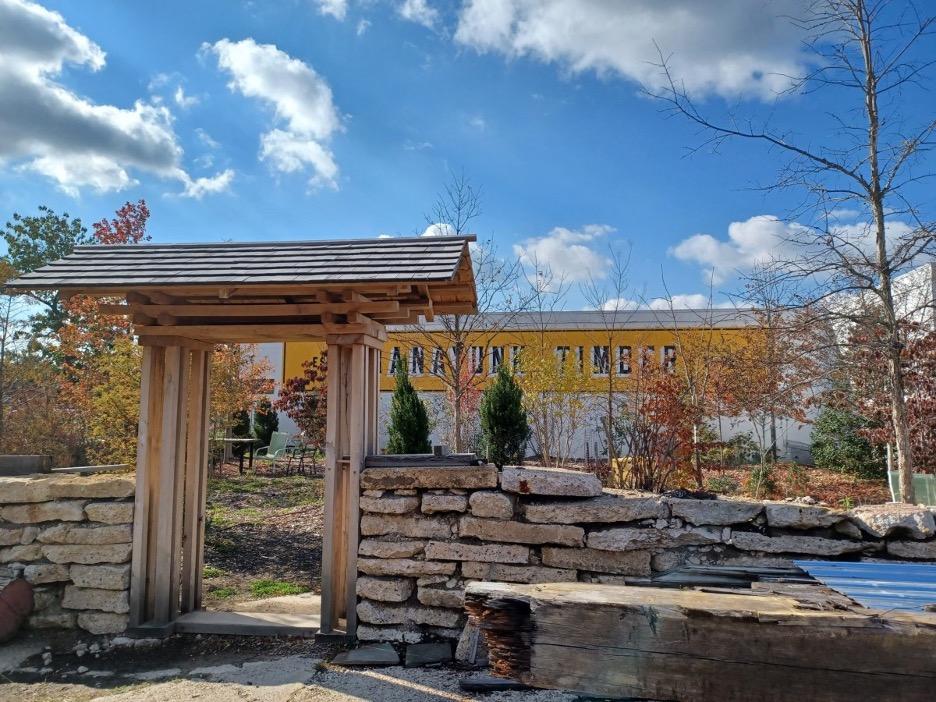
Nick Jaramillio reports at WHYY’s Billy Penn neighborhood newsletter, “A parking lot is being transformed into a thriving indigenous forest at Manayunk Timber, and will feature a new gate entrance with sculptures from internationally renowned wood artist Roger Wing.

“ ‘The forest that they planted is a poetic metaphor for what’s going on here,’ Wing told Billy Penn. ‘So much of what happens in the forest is unseen to our eyes. It’s the microbes, the animals that come out at night, the seeds, the germination in the soil, and the changing of the seasons.’

“A project from the team behind Manayunk Timber, Philly’s only sustainable sawmill, the burgeoning forest has benches where the public can sit and appreciate the surroundings, or enjoy a bite from the new bread shop next door.

“Manayunk Timber owner Steve Ebner decided to transform the former parking lot a year ago. At first, he wanted to plant an orchard.

“The plan changed when John Cox, a local wholesale florist, introduced him to the Miyawaki method, a technique developed by Japanese ecologist Akira Miyawaki to cultivate fast-growing native vegetation. Cox also gave Steve a book on ‘pocket forests’ that showed the method could be replicated on smaller plots of land.

“A typical Fairmount Park forested area has about one plant every square foot, per Cox. The plot at Manayunk Timber is about 3,500 square feet, so Ebner calculated it would need about 3,500 plants to become a mature forest. Currently, it has around 250, he said — a work in progress. 

“The project so far has cost around $30,000, Ebner estimated, which included tearing up the concrete, building a ‘rubble wall’ out of the broken-up concrete, putting in the topsoil, and buying tree specimens. 

“Native tree species already planted include cedars, hawthorns, red oaks, maples, witch hazel, winter king, American beech, honey locusts, hornbeams, and buckeyes. 

“Sculptor Wing, who is based in West Philly, hopes his contribution by creating a notable gate will help make the forest a hub for landscapers, designers, and developers who share Manayunk Timber’s commitment towards sustainability. …

“By wintertime Ebner hopes to start cultivating the ‘undergrowth,’ adding small trees and low-lying plants like shrubs and mosses to enrich the soil and provide food and shelter for small animals. Eventually, the 70-year-old entrepreneur wants to open a bookstore. 

“He’s ready for his daughter Rebecca to take over the urban sawmill business. …

“ ‘I hope this forest shines a light on what’s possible for what was: a non-used, ugly, concrete area,’ Rebecca added. So far the forest has been a hit. Ebner’s newest tenant, the wholesale bakery Dead King Bread, just celebrated the new location with an open house and live music. Tables, chairs, and a fire pit was set up in the forest for attendees.

“This is the first time Wing gets to carve pieces from Manayunk Timber. As a sustainable sawmill, it only processes wood from fallen trees or reclaimed antique beams.

“For the gate, Wing is working with timber salvaged from an 150 year-old warehouse. The wood survived a fire, giving it a blackened rippling surface wherever it was charred. ‘It’s almost too beautiful to cut into,’ the sculptor told Billy Penn. …

“ ‘Manayunk Timber has become this nexus for people interested in sustainability, forest ecology, and making ourselves better stewards living with the forest,’ Wing said. ‘Rather than dominating the entire ecosystem, we can live within the ecosystem, as part of the whole.’ ”

More at Billy Penn, here.

Read Full Post »