Feeds:
Posts
Comments

Posts Tagged ‘popular’

Photo: Stas Levshin.
One Russian magazine called The Kholops the “rare instance where the public and the professional community converged,” declaring it the best in Russia.

I seem to be gravitating to theatrical stories at the moment, and I’m wondering if they are somehow comforting to other people, too. I noticed that blogger/historian Robin liked the post about Miss Piggy (“porcine Muppet diva”) and shared it on the site formerly known as twitter.

Today I’m pondering a theatrical conundrum from Russia: to wit, why a popular show that’s obviously critical of Putin has been hands-off to government censors.

Ivan Nechepurenko, reporting from St Petersburg for the New York Times, writes, “When an obscure play called The Kholops opened in St. Petersburg, Russia, in 2024, many Russians raced to see it, fearful that the authorities would quickly shut down the production. The play’s exploration of a censored and repressive society resonated deeply with those living in Vladimir V. Putin’s Russia, and the production seemed ripe for a crackdown.

“But nearly two years later, the doors remain wide open and the seats packed for The Kholops, written in 1907 by the Russian playwright Pyotr Gnedich.

“Critics have fallen in love with the play. One magazine said the production’s director, a leading light in contemporary Russian theater named Andrei Moguchiy, had transformed ‘a half-forgotten chamber play into a sweeping and tragic symphony.’ Another said The Kholops was a ‘rare instance where the public and the professional community converged.’ …

“On a recent evening, limousines lined the curb out front. Chauffeurs ushered out government officials, business leaders and other members of the country’s upper crust, all arriving to spend more than four hours taking in a production that attacks, slyly but patently, the system of which they are beneficiaries.

The Kholops (the title means The Serfs) is performed only a few times every other month, a standard timetable in Russia. … The typically zealous Russian authorities, who have forced the closure of many productions critical of modern Russia, have kept their hands off the play. The reasons are most likely manifold.

“The Kholops became a hit so immediately that officials seemed to recognize that closing it would incite a scandal, and they appear to have taken comfort in the fact that tickets are not only expensive but also scarce, so far limiting how many everyday citizens can actually see it. … At the same time, many critics and theatergoers in Russia have posited that The Kholops has avoided intense scrutiny because, as scathing as the play is toward Russian society under Putin, its judgments arrive largely indirectly.

The Kholops tells the story of a noble family living in the dark period of early-19th-century Russia, when the country was briefly ruled by the mercurial Czar Paul I, a paranoid tyrant who so bewildered his court that its members murdered him with the help of his own son. …

“Moguchiy worked as the Bolshoi Drama Theater’s artistic director until 2023, when the country’s Ministry of Culture apparently deemed him insufficiently loyal to the Kremlin and decided not to renew his contract.

“But he is still permitted to produce plays at the theater, and The Kholops highlights themes deeply familiar here: widespread tyranny, oppression and corruption; a perpetual longing to abandon the country for a freer, less provincial place (while knowing that its emotional hold is inexorable); a self-defeating loyalty to authority. …

“One of the play’s central tenets is what many Russians see as a nearly eternal feature of their society: Everyone, from the poor and powerless to the wealthy and connected, is owned by someone. When the czar banishes an influential prince for taking more than a few days to procure new army uniforms, the prince delivers a speech that certainly strikes a chord with Russia’s privileged class.

“ ‘Why do I, a rich and independent man, find myself in the position of the last serf?’ he asks. ‘Why have I been a lackey all my life?’ …

“The success of The Kholops is all the more notable because contemporary theater has become an especially perilous business since Moscow invaded Ukraine in 2022. In July 2024, the playwright Svetlana Petriychuk and the director Zhenya Berkovich were each sentenced to six years in prison for ‘justifying terrorism’ through Petriychuk’s play Finist the Brave Falcon, which interweaves a Russian fairy tale with the story of a woman falling in love with a radical extremist online.”

More at the Times, here.
Read Full Post »

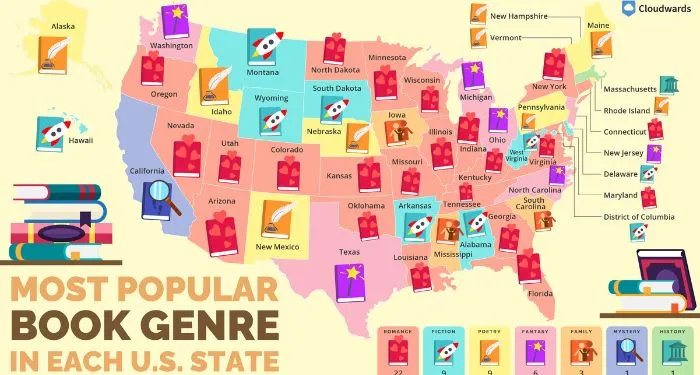
Map: Cloudwards.

Using Google searches to analyze which books are most popular in each US state seems about as flaky a brand of research as can be, but it’s kind of fun anyway. I mean: The favorite genre in Texas is fantasy? I need to ponder that for a while.

Kelly Jensen writes at Book Riot, “Are there different preferences for book genres depending on what state you’re in? According to new research from Cloudwards, there are trends in book preferences based on location.

“Utilizing Google Trends data over the last 12 months, Cloudwards explored the most searched genre in each of the 50 states, plus the District of Columbia. All searches were limited to Google Trends ‘Books and Literature’ category, and the researchers used a variety of common genre terms to determine the frequency of interest in them by state. Some of the genre categories were a little unconventional for the average reader –- how do you determine the difference between ‘fiction’ and ‘family’ as terms -– but the major genres were included, including romance, fantasy, mystery, and so forth.

“Romance dominated in terms of genre popularity across the US, with 22 states seeing it as their top searched genre. In terms of geographic region, romance was especially popular in the south, with states like Florida, Georgia, Louisiana, Tennessee, Kentucky, and Virginia ranking it as their top genre.

“Fiction and poetry tied for next most popular genres, each either nine states reporting it as the most searched genre. The researchers note that these findings aren’t surprising, given that fiction is broad and encompassing. As for poetry, it is likely not surprising to see people looking for more information about poetry; the research here isn’t about poetry being the most read genre, but rather, one of the most researched genres.

“The next most popular genres were fantasy (six states), family (3 states), mystery (1 state), and fantasy (1 state).

“It should come as little surprise there is so much national interest in romance. It is a genre that consistently sells well across all of its subgenres, and in 2023, print romance books sold upwards of 39 million copies. …

“One of the most surprising findings might be that only one state ranked historical fiction as its most popular genre. That state was Massachusetts. It is a perennially popular genre among readers, and it is a genre that has been a long-running staple on best-of and awards lists. …

“The researchers note that their methodology lacks scientific scrutiny but shows a general idea of interest in different reading genres. Among some of the weaknesses of this study are the loosely-defined genres, as well as the lack of nuance when it comes to format of genre. It’s not clear whether or not the researchers looked into genres outside of those which ranked among the top in the US, as there’s no full list of utilized search terms. There is no indication in the research, for example, whether or not science fiction or westerns were researched, and while horror is a mood and not a genre, it is surprising to see zero representation for horror here, either.

“Furthermore, poetry encompasses a wide variety of genres, as it is a format, rather than a genre. It’s also worth wondering where and how graphic novels in their myriad genres fit in with reader popularity.

“If there’s a takeaway, it’s this: no matter how frequently romance novels can be derided or belittled in pop culture, it’s a genre that is thriving, that is growing, and that tops the list of genres readers are interested in in nearly half of the United States.”

This is fun, but I really think that a more useful study would analyze books sales and library book preferences, don’t you?

It’s hard for me to name a book genre that is my favorite. I love fantasy, but I read many more mysteries than fantasies as there are so few good fantasies. I love certain kinds of biography but read more fiction than biography. I live in Massachusetts but hate historical fiction. If asked about your favorite genre, how would you answer?

More at Book Riot, here. See unscientific results for individual states here.

Read Full Post »

Photo: John and Suzanne’s Mom.
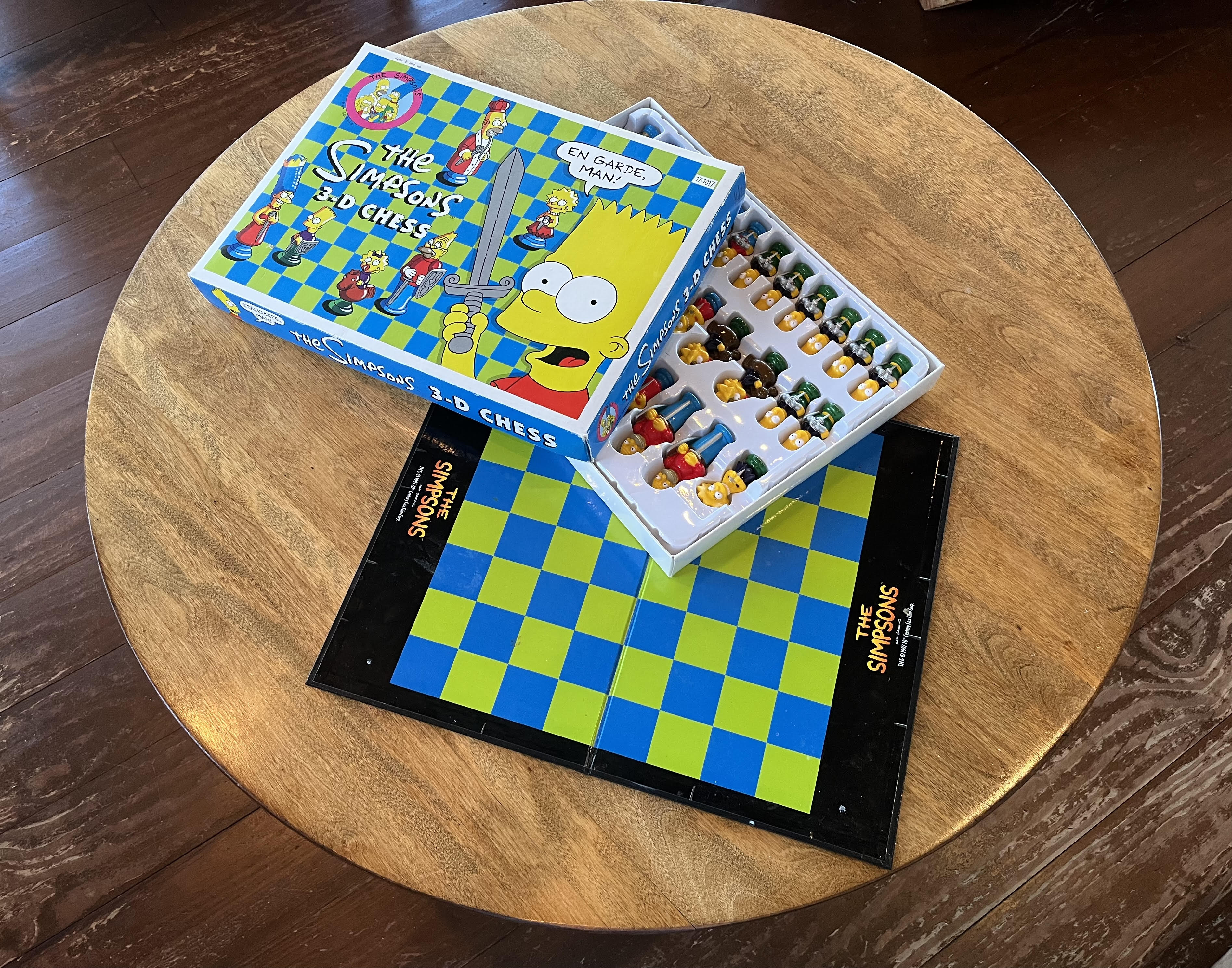
The Simpsons play chess, too.

One of my grandsons lives and breathes chess. He will represent his state and age group in a national competition in Grand Rapids this July. I told him his idea of beach reading is Ten Thousand Tried and True Pawn Structures to Terrify Your Opponent, and he couldn’t disagree.

Turns out, he is not alone.

Hannah Natanson writes at the Washington Post, “Jeffrey Otterby, a middle school teacher in Illinois, is facing an epidemic of student distraction. When his seventh-graders are supposed to be learning social studies, they are glued to their school-issued Chromebooks. He has taken to standing in the back of the room to monitor their screens, where he can see the online game they’re all playing:

“Chess.

“ ‘I guess I’m happier they are playing chess rather than some shoot-’em-up game. Actually, I love it,’ said Otterby, a chess enthusiast. ‘I just need them to do it at a better time.’ …

“Across the country, students from second grade to senior year have stumbled across a new obsession, which is, in fact, a centuries-old game. Interviews with teachers and students in eight states paint a picture of captivated students squeezing games in wherever and whenever they can: at lunch, at recess and illicitly during lessons, a phenomenon that is at once bemusing, frustrating and delighting teachers.

“Data from Chess.com, whose usership is the highest it’s ever been, and anecdotal evidence nationwide suggest a fervid, growing base of young users. This month’s U.S. Chess Federation National High School Championships in D.C. had to add overflow rooms to accommodate a record 1,750 attendees — spurring fears of a shortage of participation medals.

“A California school librarian this year set aside a portion of her library for chess-playing students to indulge their habit during lunchtime. An Illinois teacher bought 24 chess sets to meet surging student demand. And in Hawaii, passion for chess is messing up the morning routine. …

“It’s unclear what is driving the sudden adoration of chess among tweens and teens. Students and chess spectators point to the influence of chess stars and social media personalities such as Levy Rozman, whose YouTube channel GothamChess has more than 3.5 million subscribers; Hikaru Nakamura, an American grandmaster with 1.9 million YouTube subscribers; and the Botez sisters, elite American Canadian players who boast a combined following of close to 2 million on YouTube and Twitch.

“Max Magidin, a 15-year-old attending California’s Burlingame High School, said chess content began showing up on his and his friends’ TikTok feeds early this year. Almost immediately, it seemed everyone in the Bay Area’s San Mateo Union High School District was playing the game — including Magidin, who nowadays fits in between two and four hours of chess daily. …

“Chess has always been something of a faddish sport, said David Mehler, president of the U.S. Chess Center. He recalled a big jump in interest in the early 1990s after the release of the movie Searching for Bobby Fischer, which tells the story of a 7-year-old chess prodigy and is based on the life of Joshua Waitzkin.

“More recently, chess experienced a spike in popularity among adults at the start of the coronavirus pandemic, and again when many people confined to their homes streamed The Queen’s Gambit, a Netflix series, said Erik Allebest, the chief executive and a founder of Chess.com. After the virus arrived, Chess.com’s average daily user count of 1.5 million rose to between 5 million and 7 million, he said. …

“As of April, Chess.com is averaging 12 million users a day, Allebest said. Chess.com does not track users’ ages, Allebest said, but as best he and Chess.com staffers can tell, the latest wave of fandom is dominated by middle and high school students. …

“He sent links to viral Reddit posts in which K-12 teachers lament an outbreak of chess enthusiasm and grade school students share tales of administrative crackdowns limiting access to Chess.com. (The Washington Post found no examples of the latter.) Allebest also noted that his own son, 15, has become a chess convert — not because of his father’s job but through watching GothamChess on YouTube.

“Some teachers have mixed feelings about the clandestine playing of chess in their classes.

“Justine Wewers, a high school geography teacher in Minnesota’s Anoka-Hennepin district, said she has seen a wearying number of student infatuations over the years, including video games, ‘Uno’ and fidget spinners. By comparison, the chess craze strikes her as a healthy activity for young minds. …

“James Brown, a teacher in New York’s South Colonie Central School District, sees nothing but positives. Brown, who teaches computer science and programming at Sand Creek Middle School, has long set Fridays aside as a free period for children to pursue activities of their choice. Since January, many students have chosen chess, leading Brown to buy three more chess sets to augment the 10 he already owned. …

” ‘It’s all things we want to instill in the student,’ Brown said. ‘If they’re doing that on their own, in a format that is fun for them, it ties right into what I’m trying to do. I don’t see it as a distraction; I see it as a benefit.’

“Another benefit of playing chess is its transcendence of social groups, said Maurine Seto, a librarian at California’s Burlingame High School. In early 2023, she said, students started stampeding into her library before school, during lunch and in snatches between classes to play chess at a handful of tables.

“ ‘It pairs different sets of kids together that you don’t normally see,’ Seto said. ‘They come up and say, “Hey, do you wanna play chess?” and I normally would never see those two kids interact.’ ”

More at the Post, here.

Read Full Post »

3-nocrop-w1024-h2147483647

Photo: Michelle Groskopf
Scenes from the fifth annual Write On Song Camp at Atlantic Records in Los Angeles. From left, Federico Vindver, Angel Lopez, Oscarcito, Sam Derosa, and Adriel Favela.

I know almost nothing about popular music these days or the names of current stars, but I thought this article about songwriting camps was interesting. The artists’ collaborative process might be fun for creatives in other arts to try once in a while.

Steve Knopper writes at Vulture, “At a studio in 2016, Dave Longstreth was working by himself on a chord progression, as he usually does when writing for his band, Dirty Projectors.

” ‘It’s normally a pretty solitary process,’ he says now. But that time, Solange was there, as were Sampha, a British songwriter and producer; Blue, Solange’s engineer; and a bunch of other creative people, all part of what Longstreth calls ‘the camps,’ to make Solange’s 2016 album, ‘A Seat at the Table.’

“ ‘I’d have a melody from her, and would be just harmonizing on it, and she would come over and say, “Ooh, I really love this chord and that chord, but this one is too dissonant,” ‘ he recalls. ‘To be just a spoke on the wheel was a novel experience, and to be thinking in a collective way was just really fresh for me.’

“As long as there has been indie rock, songwriters have worked in their own band bubbles. … But over the past decade, the genre’s biggest names … have substantively contributed to albums by Beyoncé, Rihanna, Kanye West, Lady Gaga, and others. Many of these connections happen by serendipity — Beyoncé’s ‘They don’t love you like I love you’ hook in ‘Hold Up,’ [was] the result of Koenig tweeting a slightly misremembered line from Yeah Yeah Yeahs’ 2003 single ‘Maps,’ then recording it with Diplo. …

“When I walked into a room at the Lakehouse Recording Studios in Asbury Park, New Jersey, in late June,” reporter Knopper continues, “my eyes took a few seconds to adjust from the fluorescent hallway lighting. Through flickering candles, I made out Chelsea Jade, a New Zealand singer-songwriter, dressed in black, singing in a high, glassy pitch; Danny Mercer, a Colombian-American guitarist and singer, tapping out a Depeche Mode–style riff on a keyboard; and Randy Class, a Bronx producer, capturing everything on a laptop and looping it back. This was the BMI songwriters’ camp, which split up ten top writers into groups of three or more with the hope of regurgitating multiple daily songs. … Jade improvised: ‘I’m a psychopath.’ Class quickly discerned a double meaning about a ‘psycho’s path.’ Mercer fleshed out the melody with Spanish-guitar runs. …

“Ben Dickey, manager of Future Islands, Washed Out, and other indie-rock stars, believes the trend begins with hip-hop, in which artists are more experimental and willing to take chances than those in any other genre. Whereas a songwriter in a rock band can be stuck in a routine, collaborating with the same people in the same configurations, West, Drake, and Beyoncé pick the best material from whoever inspires them at the time. ‘You come up with what can be a really interesting song that has way more diverse influences than what one singular singer-songwriter would come up with — then you have Kanye or Drake come in and rap over it,’ Dickey says.” Read more at Vulture, here.

Read Full Post »

You don’t have to love everything that someone calls a poem to believe that it’s a great thing to encourage poetic expression and enjoyment of poetry in all walks of life.

One of the memorable aspects of Jason Elliot’s book on Iran, Mirrors of the Unseen, at least for me, was how many ordinary people in that country were interested in the great poets of their culture and could recite ancient verse.

Meanwhile, in Miami, there’s a poetry festival that aims to touch everyone.

William Grimes at the NY Times says, “If you live in Miami and you do not read, recite or listen to a poem in April, something has gone seriously wrong. For the third year, the O, Miami Poetry Festival will flood the city with words, using any pretext to accomplish its mission of putting all 2.6 million residents of Miami-Dade County in contact with at least one poem. …

“Poems will be pasted on the mirrors of public bathrooms and positioned at congested intersections, so drivers stuck in traffic jams can get some uplift while their engines idle. …

“One of last year’s most popular events, run with WLRN, the local public radio station, was a poetry contest in which citizen-poets were asked to contribute lines dedicated to the theme: ‘That’s so Miami.’ The winner in the ‘best ode to Miami Spanglish’ category was Lauren Fernandez: ‘Exciting and Extravagant/Guajiros in Bentleys./Tostones and Champagne. That’s so Miami.’

“This year contestants must pick a location between the Palm Beaches and the Keys and enshrine it in verse, incorporating the words “this is where.” Winners will see their work published in The Miami Herald. …

“Ivan Lopez, an actor, will dress as the poet and revolutionary José Martí, mount a white horse and ride down Calle Ocho handing out roses with poems attached. That’s so Miami.”

More  at the Times.

Photo: Ting-Li Wang/NY Times
Reading poetry. Can you identify the poet? Hint: He’s not so Miami.

Read Full Post »