Feeds:
Posts
Comments

Posts Tagged ‘population’

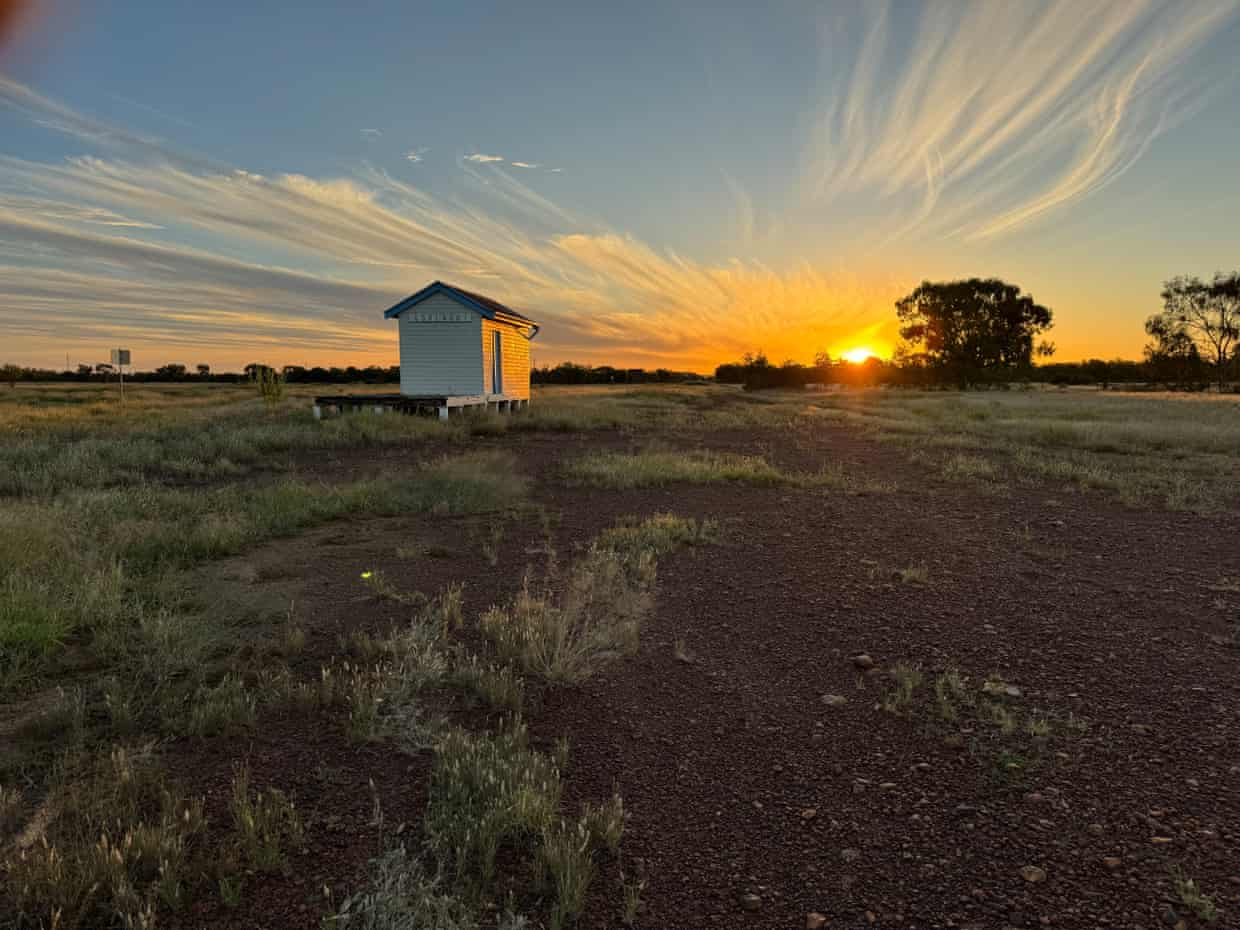
Photo: The Guardian.
The entire population of Australia’s Cooladdi (two residents) has packed up, and the town is officially for sale.

Are you up for a completely different lifestyle? Perhaps you would like to buy this town in Australia. It has a postal address, but at the moment, no residents. It does get visitors from time to time.

Ima Caldwell reports at the Guardian, “In the heart of outback Queensland in Australia, more than [500 miles] west of Brisbane, sits a town with its own postcode and exactly two residents. Now, the entire population of Cooladdi is packing up – and the town is officially for sale.

“For [US$280,000, UK£200,000] buyers will get the Foxtrap Roadhouse, a four-bedroom home, and the keys to the town. …

“Cooladdi – whose name reportedly stems from a local Indigenous word for ‘black duck’ – is one of Australia’s smallest towns. Its official status is anchored by the local post office, which operates out of the roadhouse. Because of this, Cooladdi retains its own postcode: 4479.

“The town’s two residents, Carol Yarrow and Jo Cornel, took over the roadhouse in February 2023. They had a three-year plan to bring the quiet stopover back to life. Now, that time is almost up. … They are ready to hand over the reins.

“The new owners will wear many hats. Running Cooladdi means serving as the postie, the publican, the cook and the shopkeeper.

“ ‘The food and the pub are probably one of the main jobs; we also do the mail runs as part of the post office,’ says Yarrow, who grew up on a station between Quilpie and Windorah. No stranger to remote hospitality, she has spent years running motels and hotels. …

“Cooladdi was once a bustling railway hub with a population that peaked at roughly 270. But as the local sheep industry shrank and the trains eventually stopped coming, the town slowly emptied out. The school closed its doors for good in 1974.

“Around that time, Beryl and Bob Fox built the Foxtrap Roadhouse. It was an unusual investment, but it made sure Cooladdi remained a key meeting point. …

“Managing the sale is Becky Jeisman from Charleville Real Estate. Located within the Murweh Shire Council, Cooladdi’s closest major centre is Charleville, a town of 3,000 where an average house sells for about $210,000. Jeisman says the roadhouse would suit empty nesters, a keen young group, or a family wanting a lifestyle change.

“The new buyer has the potential to drastically change the town’s population. … ‘If a group of four people buy it, then the population will double.’

“For those tired of city life, Yarrow says Cooladdi offers a great ‘change of pace’ and a laid-back lifestyle.

“Beyond the titles of publican and postie, Jeisman says that the new owners will inherit a far more important role: maintaining the ‘general camaraderie’ at the heart of an isolated community.

“As she and Cornel prepare to wipe down the bar and pour their final beers, there is hope that Australia’s smallest town has some life left in it yet.” More at the Guardian, here.

It’s an amusing idea, buying a town, but I can’t really imagine it working out well. I’m afraid some folks in Australia are having trouble facing reality.

Read Full Post »

Photo: Gerry Hadden/The World.
The town of Libros, in northeastern Spain, has a population of 60.

What are you reading?

Sometimes that question is my way of greeting someone: “Hi. What are your reading?”

Books are so important to me, I make the mistake of assuming they’re important to everyone. Right now I’m reading Fresh Water for Flowers, recommended by Suzanne, who liked the French bestseller (translated) about a woman who was a cemetery caretaker.

Books are important to a town in Spain, too. How could they not be, with a name like Libros? And now the town is now planning to rebuild its economy on the back of books.

Gerry Hadden has the story at Public Radio International’s The World.

“On a typical winter’s day in the village of Libros, in northeastern Spain, about the most exciting thing that happens is the hourly ringing of the church bell, which startles flocks of pigeons living in the belfry. …

“Libros has a population of 60. But once upon a time, some 2,500 people lived here. The majority of residents worked on farms, or in the nearby sulphur mines, which closed in the 1950s. But like lots of villages in the Teruel region, most of the older population has died off over the years, while the young emigrated, said Arana, who is an electrician by trade. …

“To attract newcomers, Arana thinks the key to the town’s salvation is in its name: Libros translates to ‘books,’ and he wants to open the town’s first ever library. 

“The library’s location has yet to be determined, but Arana has already started building its collection. A year ago in June, Arana made a plea for book donations on social media with the hashtag, Libros para Libros, or ‘Books for Books,’ which went viral.

“Since then, over 70,000 volumes — including novels, kids’ books, nonfiction and encyclopedias — have poured in from all over the world — from Argentina to Germany. Twelve boxes alone came in from Mexico.

“At one point, Arana said, the postman was coming by so many times a day that they gave him a key to town hall. Books were piled up all over the building, to the point where Arana could barely reach his office. So, late last year, he worked with volunteers to move a bunch of the books to a warehouse. …

“Adrian Soriano, 37, the town’s handyman, pointed to a big, red shipping container on the edge of town. It was filled to the ceiling with books.

“Arana said that he paid $3,000 for the container, money the tiny town can’t spare. And this is where the success and euphoria of the online book drive meets the economic realities of a small village.

“ ‘Now, we just need the library itself,’ Arana said. ‘The regional government likes the idea. But they say it will cost some $4 million to build it. We don’t have the money, but I am sure we’ll find it.’

“Arana said that they’ll apply for funds from the European Union if need be. His idea is to combine the library with a hotel to pay the salary of a librarian.  

“ ‘The library hotel will generate jobs. People need work, which is why they leave to begin with. If we can bring back just seven or eight families, well, they’d count as villagers.’

“Someone, he said, needs to organize the collection. Arana said that he’s confident because there’s proof that literary tourism can work here.

“For example, bestselling Spanish author Maribel Medina talked to Teruel TV about a project she runs called My Town Reads. It stages literary events in tiny villages, including Libros, inviting famous authors to visit, sign books and spend the night.

“Libros has hosted four events with Medina’s help. Arana said that hundreds of people showed up each time.

“ ‘It seems that because of our little literary boom, folks are starting to fix up the houses here,’ he said. ‘On weekends, more people are returning.’ …

“Libros native Santiago Perez, 81, who lives past a bunch of crumbling homes, pointed to a house with scaffolding around it. ‘One of my boys has set out to fix up that one. He’s making a really nice home for himself.’ “

Is this dream unrealistic? Well, that’s another thing about books — they encourage big dreams. And big dreams are a necessary step for big accomplishments.

More at PRI’s The World, here.

Read Full Post »