Feeds:
Posts
Comments

Posts Tagged ‘Portuguese’

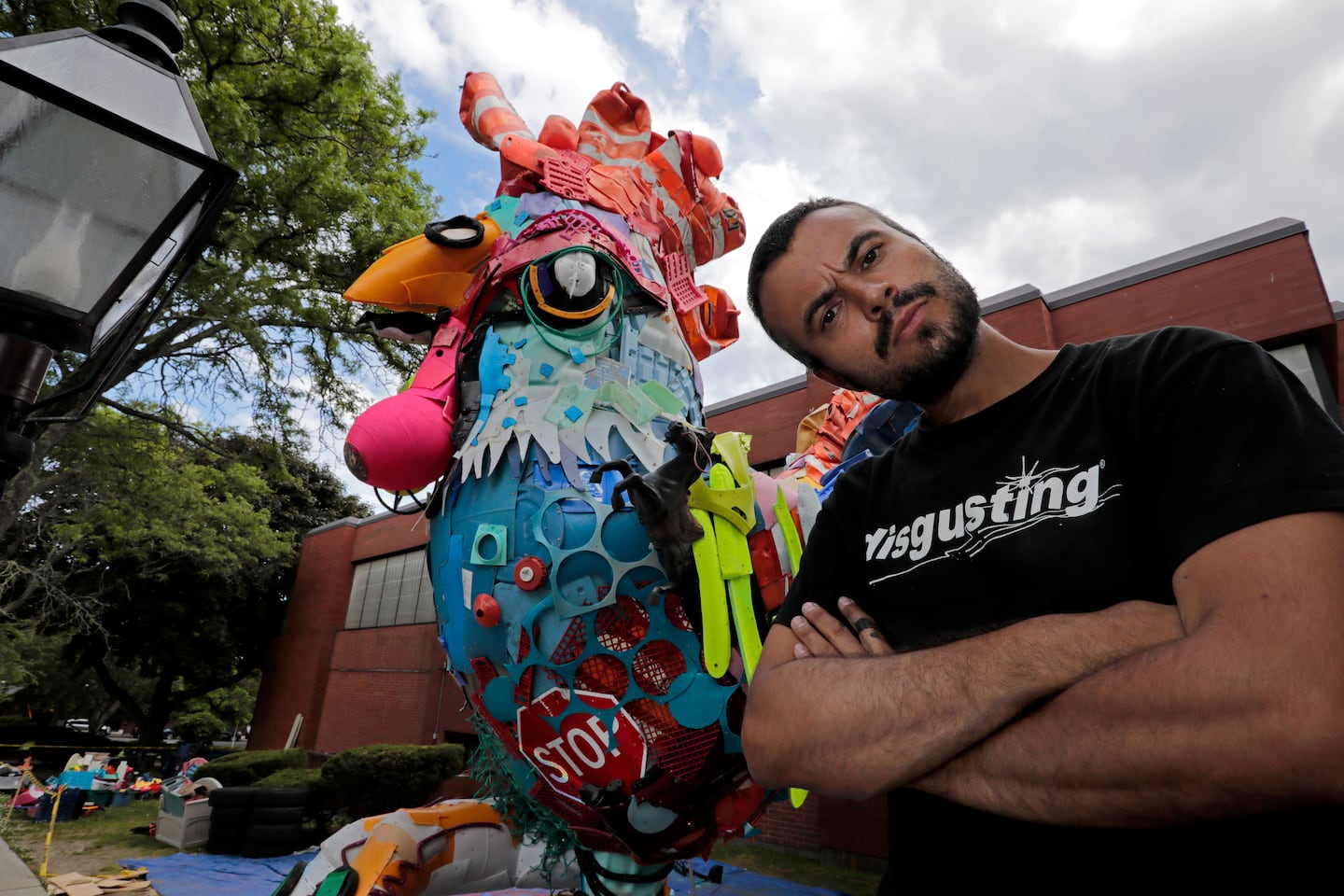
Art: Bordalo II.
Photo: Pat Greenhouse/Boston Globe.
I’ve been following this Portuguese sculptor on Instagram for several years. Now he’s worked with high school students to create a sculpture for Portuguese-speaking New Bedford, Mass., not too far from where I live.

I have been curious about this artist, age 36, for a long time. He makes vibrant sculptures from trash and shows them on Instagram.

Cate McQuaid wrote recently at the Boston Globe about Bordalo II’s “Plastic Rooster.” 

“There’s a new rooster in town,” she says, “and he’s close to 20 feet tall and kind of trashy. Portuguese artist Bordalo II’s ‘Plastic Rooster’ sits beside the New Bedford YMCA, the centerpiece of Massachusetts Design Art and Technology Institute’s (DATMA) ‘TRANSFORM: Reduce, Revive, Reimagine’ public-art initiative through Oct. 14. …

“Bordalo has traveled the world, from Bora Bora to Montreal, painting and building gaudy, charismatic animal sculptures out of waste materials. He was in town in mid-June putting finishing touches on ‘Plastic Rooster.’ The giant bird is clad in nautical refuse, plastic, street signs, and more collected by locals. He wears a plastic penguin under his beak like a bowtie, and his talons are cut from bright-pink safety cones. …

“[He says] ‘My grandfather, he was an artist. I was really young and I always tried to dig into his studio and steal his paints and draw stuff.’

“The artist, whose first name is Artur, calls himself ‘Bordalo II’ as a tribute to his grandfather, Real Bordalo. At 11, the younger Bordalo became a graffiti artist.

“ ‘It shaped the person I am, the way we do everything,’ he said. “Not being afraid to risk, to really do it. The scale. The sense of how it connects with the street.’ …

“The artist’s lighthearted characters carry messages about over-consumption and conservation. ‘With the big trash animals, it’s like you make portraits of the victims with what destroys them or their habitats,’ he said. …

“ ‘Plastic Rooster’ was commissioned by DATMA, which has partnered with local landfill management departments and the Greater New Bedford Regional Vocational Technical High School to involve the community.

“Bordalo sent his rooster image to the school’s 11th-grade Metal Fabrication students, who built the structure from steel and wood.

“ ‘After that we have a list of plastic trash materials that we know we’re going to need, and we ask the local production team to collect all those materials,’ Bordalo said. ‘My team starts to cover it, to make the first skin. I join them in the middle of the process, and I make more skin, more volumes, all the details. I make the head, the eyes, the nose.’ …

“Public art and programming presented around New Bedford by Massachusetts Design Art and Technology Institute through Oct. 14, www.datma.org/transform.”

I am adding more fromWikipedia, as I felt I had more questions.

“He studied painting at the Faculty of Fine Arts at University of Lisbon in Lisbon for eight years, but never finished the course, instead experimenting with ceramics, sculpture, and other materials. …

“His work has been shown in solo and group exhibitions and mounted in streets across the world, including Singapore, the United States, French Polynesia, and Europe. In the 10 years between 2012 and 2022, he used over 60 (or 115, by another estimate) tons of waste materials to create around 200 sculptures of animals.

“Bordalo’s work is focused on the themes of ecology, waste, and recycling, and makes use of garbage in his work as a method of critiquing over-consumption in the world. Using materials such as old tires, pieces of wrecked cars, discarded appliances, plastic waste, and aluminum cans, he challenges materialism and consumerism in the modern world. …

“Bordalo supports Portuguese refugee advocacy organization Humans Before Borders, which helps to fund five medical NGOs working in refugee camps on the Greek islands of Lesbos and Samos.

“A short documentary film entitled Bordalo II: A Life of Waste was released by the Irish Film Board in 2017.”
More at the Globe, here, and at Wikipedia, here.

Read Full Post »

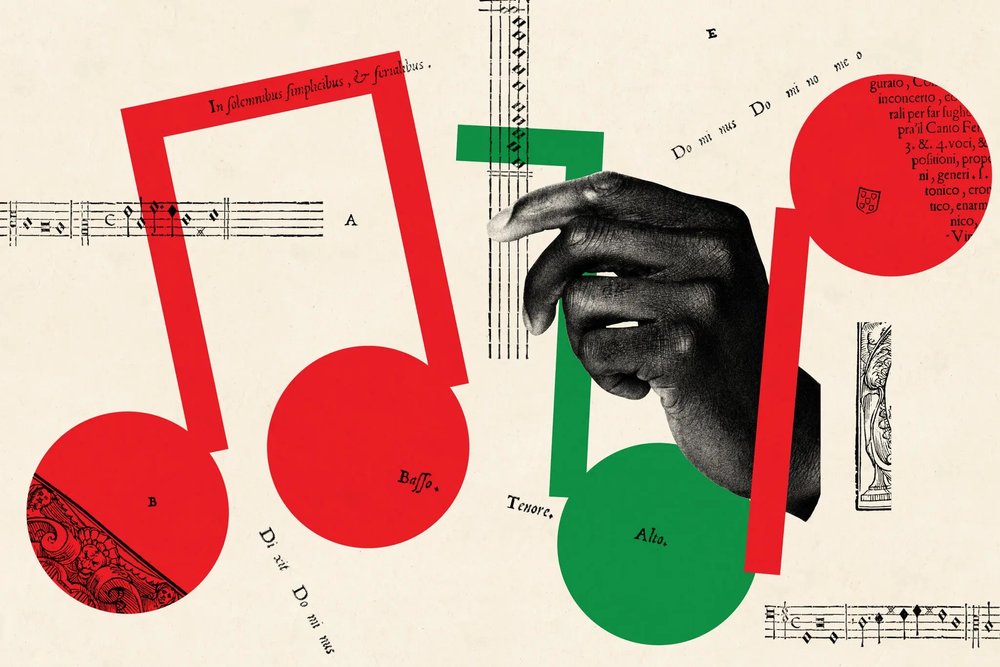
Illustration by Cristiana Couceiro at the New York Times. Photo: Getty Images.

A black musician who composed sacred and secular vocal music more than 400 years ago is getting attention at last, thanks to the internet. Garrett Schumann recently wrote for the New York Times about composer Vicente Lusitano.

“On a day in June 2020, Alice Jones was in her Brooklyn apartment getting ready to attend a Black Lives Matter rally. Dr. Jones, a flutist and composer who serves as an assistant dean and faculty member at the Juilliard School, was adamant about expressing herself as a Black classical musician. …

“Dr. Jones designed a sign that listed Black composers throughout history. After adding Joseph Boulogne, Chevalier de Saint-Georges, the 18th-century subject of the upcoming film ‘Chevalier, she faintly remembered another, older name: Vicente Lusitano.

“Lusitano was an African-Portuguese composer and music theorist who was most likely born between 1520 and 1522, and who died sometime after 1562. Probably the child of an enslaved African woman and a Portuguese noble, Lusitano traversed Europe in a career that saw him depart the Iberian Peninsula for Rome as a Catholic priest in 1550 and, around a decade later, relocate from Italy to Germany as a married Protestant.

“He wrote sacred and secular vocal music, taught extensively and produced scholarship that includes a unique manuscript treatise on improvised vocal counterpoint. …

“It took until the late 19th century for new scholarship to revisit Lusitano’s printed works, beginning a 150-year-old reclamation project. Important strides were made in the 1960s and ’70s as new sources emerged, most notably a 17th-century manuscript that describes Lusitano as ‘homem pardo,’ a historical Portuguese term for certain mixed-race people of African descent. And since 2000, the internet has become increasingly important to Lusitano scholarship; the summer of 2020 saw the onset of a new and ongoing flurry of interest whose roots are entirely digital.

“Dr. Jones’s demonstration sign played a part in the current wave of activity: A picture of her placard went viral on social media and broadcast Lusitano’s name to a new audience. Joseph McHardy, a Scottish-Congolese conductor and early music specialist based in London, was stunned when he saw Dr. Jones’s post. ..

‘Learning about Lusitano reminded me of the feeling I got when I learned there were Black people in the Roman Empire.’

“After seeing the sign, McHardy quickly searched for scores of Lusitano’s music to perform with his church choir, but could only find scans of the 16th-century originals. So, he spent that summer making his own updated versions. He’s one of many experts and enthusiasts who produced the first modern editions of Lusitano’s compositions and shared them on free online databases. The result was a burst of new performances in the months that followed. Nearly five centuries after Lusitano’s death, dozens of choirs in the United States, Canada and Europe performed his music for the first time, largely because his scores were finally accessible.

“Britain has been the epicenter of Lusitano’s current musical resurgence. In June, McHardy partnered with the Chineke! Foundation to produce a tour highlighting Lusitano’s sacred works with an ensemble composed entirely of vocalists of color. The motets’ beauty astonished McHardy, who said, ‘We had no idea Lusitano’s pieces would be so enjoyable to sing.’

“His collaborators, too, were impressed. ‘I have fallen in love with Lusitano’s music,’ said Malcolm J. Merriweather, an American baritone and conductor who performed on the tour.

“The Marian Consort, another British choir, led by the conductor Rory McCleery, preceded McHardy’s tour with a 2021 concert series featuring one of Lusitano’s works, which they also performed at that year’s BBC Proms. …

“Today, Lusitano is not easy to study, even if you can find performances of his music on YouTube. Little correspondence and few records of his life are known to have survived, both because earlier scholars had no interest and because his sociopolitical disenfranchisement constrained the production of such documents. Contextual evidence is critical, especially with respect to his identity.

“We know other pardo people existed in 16th-century Portugal. At the time, thousands of African and African-descended people, most of whom were enslaved, lived in the country. … Lusitano’s experience as a historical figure illustrates the kind of collective activity that has traditionally excluded composers of African descent from classical music’s conventional performance and academic institutions. Melanie Zeck, a reference librarian at the Library of Congress’s American Folklife Center and former reference librarian at the Center for Black Music Research, emphasized that the first historians of Black classical music responded to these exclusionary tendencies by developing what she called a ‘totally separate practice from mainstream academic scholarship.’ …

“Now, the internet and social media can empower these principles of Black music scholarship, though, as Dr. Zeck said, ‘misinformation abounds.’ But for Lusitano, these technologies nevertheless have helped the truths of his life and music become more accessible than ever, 500 years after his birth.”

More at the Times, here.

Read Full Post »

screenshot2-1587647268-30

Photo: VAN

How’s your Latin? It might help in appreciating this post about 16th century classical music. Then again, you don’t need Latin to understand that a black classical composer from that long ago should not be forgotten. Garrett Schumann reports the story at an online magazine called VAN.

” ‘Only then can his creative genius begin redounding, as it should, to the glory of Black music history,’ writes the musicologist Robert Stevenson in his 1982 article, ‘The First Black Published Composer.’

“Stevenson’s subject was Vicente Lusitano (ca. 1520-ca. 1561), an African-Portuguese priest and musician who enjoyed an international career. Stevenson heralds works like the motet ‘Heu me domine”’ (1551), which exemplifies the composer’s unusual embrace of chromatic counterpoint. …

“Of Lusitano’s compositions, ‘Heu me domine’ has received the most attention from modern scholars and performers, but it is not the only example of his remarkable creativity. In a 1962 essay, Stevenson reproduces a passage from Lusitano’s motet ‘Regina coeli’ to highlight its adventurous chromatic writing, and notes that other works in Lusitano’s 1551 motet collection feature extremely uncommon combinations of accidentals. Musicologist Philippe Canguilheim, in a 2011 essay regarding Lusitano’s unpublished counterpoint treatise, writes that Lusitano is ‘particularly tolerant’ of dissonance, a practice he justifies in the text by citing Pythagoras and Boethius.

“The alluring counterpoint and voice leading of ‘Heu me domine’ connect to improvisation techniques which Lusitano outlines in his counterpoint studies. As Canguilheim notes, these works make pioneering arguments regarding canons and the productive interplay between composition, free improvisation, and structured improvisation.

“ ‘Heu me domine’ is one of just two pieces in Lusitano’s output that 20th-century scholars have transcribed into modern notation — until last month, it was the only piece of his to be recorded. The other work, a 1562 madrigal called ‘All’hor ch’ignuda,’ was recently arranged for woodwind trio and recorded by multi-instrumentalist Misty Theisen. …

“Ironically, Lusitano’s obscurity originates in the most famous episode of his career. In 1551, while in Rome, Lusitano was drawn into an aesthetic dispute by fellow composer Nicola Vicentino (1511-ca.1576), an argument which gained so much attention that a Vatican tribunal convened to issue a verdict. Lusitano won, and Vicentino paid a fine, but, for years afterward, Vicentino published egregiously disingenuous descriptions of the proceedings with the aim of damaging Lusitano’s reputation.

“A 17th-century source in Rome attests that Lusitano’s name was scratched off copies of the widely-published introduction to his counterpoint treatise, and it is plausible he faced other reprisals that went undocumented. These developments likely led to Lusitano’s relocation to Germany sometime after 1553,  where he converted to Protestantism, married, and continued his career until his death. …

“Lusitano’s obscurity also shows the influence of collective action on a composer’s legacy. Vicentino worked hard to distort and erase Lusitano’s achievements, but these efforts only retained their impact because other scholars and artists have — perhaps out of convenience or ignorance — uncritically reproduced Vicentino’s version of the facts.

“Whether any of these developments are related to racial bias is difficult to prove. Nevertheless, composers with historically excluded identities, like Lusitano, have been extraordinarily underserved by institutions of classical music performance and scholarship. Reports from Bachtrack.com analyzing programming from more than 160,000 classical performances around the world between 2014 and 2019 show a population of just 15 white men constitute the 10 most-programmed composers in each of those five performance seasons. Recent research by Philip Ewell exploring the intersection of music theory and critical race theory also compellingly asserts that institutionalized music scholarship is structured in a way that ignores the achievements of women and people of color.”

It’s a long article, but interesting. Read it here.

Hat Tip: Arts Journal.

Douglas Lawrence leads the Australian Chamber Choir at St Martin-in-the-Fields in “Heu me domine” (1551), by Vicente Lusitano, the first published Black classical composer.

Read Full Post »