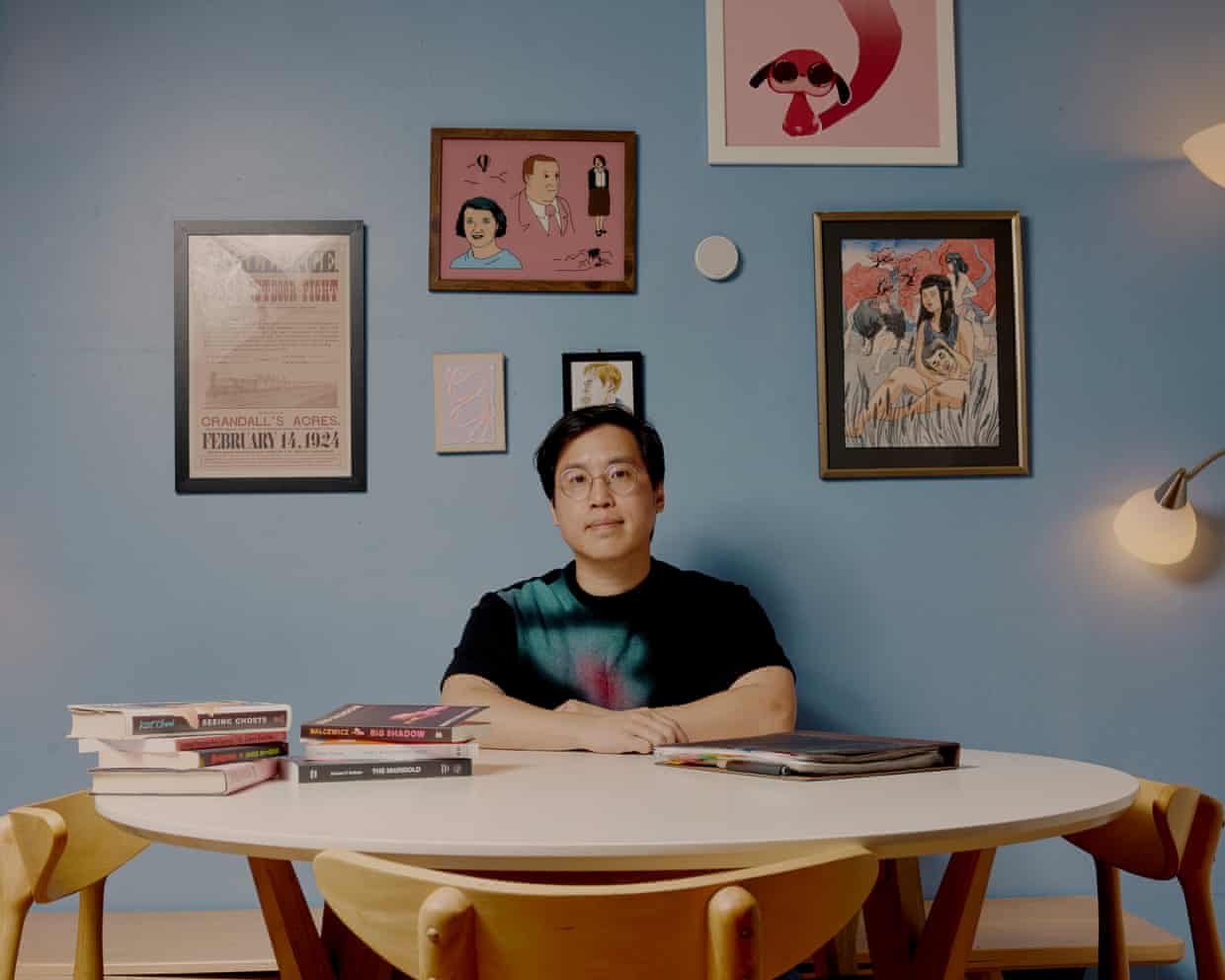
Photo: Vincent Tullo/The Guardian.
Tony Tulathimutte won the Whiting award for his first novel, Private Citizens. To support his writing, he gives workshops that have launched other writers.
The other day I heard a watercolor artist talk about having an MBA and an investment career before switching to art. Several people in her audience noted that most painters don’t have such a good foundation for income and often support themselves with more menial jobs.
A recent interview in the Guardian shows a Brooklyn novelist finding a still different way to support his art.
Isabel Slone writes, “The list of past guest speakers at Crit, the writing workshop that author Tony Tulathimutte runs out of his Brooklyn apartment, reads like a veritable who’s who of 21st-century literary greats. … And while Tulathimutte describes himself as ‘literally just some guy’ on his website, he’s won an O Henry award, and former students like Beth Morgan and Rax King have gone on to earn lucrative book deals and win highly prestigious prizes.
“Tulathimutte, 39, founded Crit in 2017 after winning the Whiting award for his first novel, Private Citizens. While he had previously taught courses at Sarah Lawrence College and the University of Massachusetts, and led workshops for indie companies like Sackett Street Writers, these gigs came and went.
“Running his own school seemed like a more sustainable way to make a living while maintaining his career as an author (Tulathimutte announced the sale of his second novel, Rejection, earlier this year). According to the US Bureau of Labor Statistics, writers and authors earn on average $69,510 a year, while an alarming Authors Guild survey showed that its members drew a median income of $6,080 in 2017, down 42% from 2009. …
“Crit accepts nine students per session. They meet twice a week (Wednesdays and Fridays) over the course of two months. Spots cost $800, netting Tulathimutte approximately $30,000 per year. He supplements his income by accepting freelance writing assignments and visiting-faculty positions. He is currently a thesis adviser at Brooklyn College.
“In the six years since Crit’s inception, Tulathimutte has managed to build not just a successful side hustle, but a thriving community of writers. He hosts book swaps, parties, even a dedicated Slack channel where alumni can chitchat, form casual writing groups and perhaps land a connection to the agent or editor who will launch their career.
“Guardian: What was the impetus for founding Crit?
“Tulathimutte: I just thought I could design the class I would have wanted to take. Most MFA programs function more like book clubs or discussion groups, where people are reading your work and giving feedback. I try to do formal pedagogy in the class, so I came up with 16 lectures breaking down different aspects of craft and process, such as ‘What is plot? or ‘What is dialogue?’ Students find the career-oriented class especially of interest because [practical matters] very often get neglected in the academy. It’s the last class of the course and it goes on indefinitely. My record is 11 hours and 45 minutes.
“Why is it important for you to teach practical skills like money management?
“Most working writers I know slap together a bunch of different sources of income. On the side, I take visiting faculty gigs, pitch articles, freelance as a novel editor and writing consultant, and shoot author photos. Plus, there’s the very occasional windfall from book-related things like speaking engagements and selling foreign rights or film and TV options.
“I teach students how to cobble together different income streams to create something workable. Usually I talk about whatever grants, fellowships, residencies, contests, funded MFAs and other things I think are worth applying for, but I’ve also talked about Roth IRAs, eligible tax deductions from writing income, speakers bureaus, negotiating freelance rates, loan forgiveness programs and so on.
“Does it feel harder to make a living as a writer now than it did in the past?
“It’s definitely harder now, with so many media companies and publication venues folding and ever fewer places to publish book-related content. …
“Crit students have landed 12 book deals to date. What about your classes gives them a competitive edge?
“I think that a lot of my students would have succeeded just fine eventually. I could point to some writers and say, ‘I introduced them to their agent,’ to others, ‘I made X and Y notes on their manuscript,’ but who knows if that increased or decreased their selling prospects. …
“How have you managed to get the word out?
“In the beginning, my only marketing strategy was to ask a couple of my more famous friends, like Jenny Zhang [and] Carmen Maria Machado, to retweet me. The slight bump in visibility was enough to get a handful of people signing up for the first few classes. After the first year, the balance shifted to 50/50 Twitter and word of mouth. Now it’s almost entirely word of mouth.
“How do you manage to convince people like Jonathan Franzen to visit your class?
“I email them. … Jonathan Franzen was a massive get, obviously. He asked me to moderate one of his book launch events for Crossroads in 2021 and after the event I asked if he’d like to guest and he said yes. I just figure there’s no harm in asking.”
More at the Guardian, here. No firewall. Can’t agree it’s harder now. Read New Grub Street.
 Photo: Steve Swayne/
 Suzanne's Mom's Blog