Feeds:
Posts
Comments

Posts Tagged ‘prehistoric’

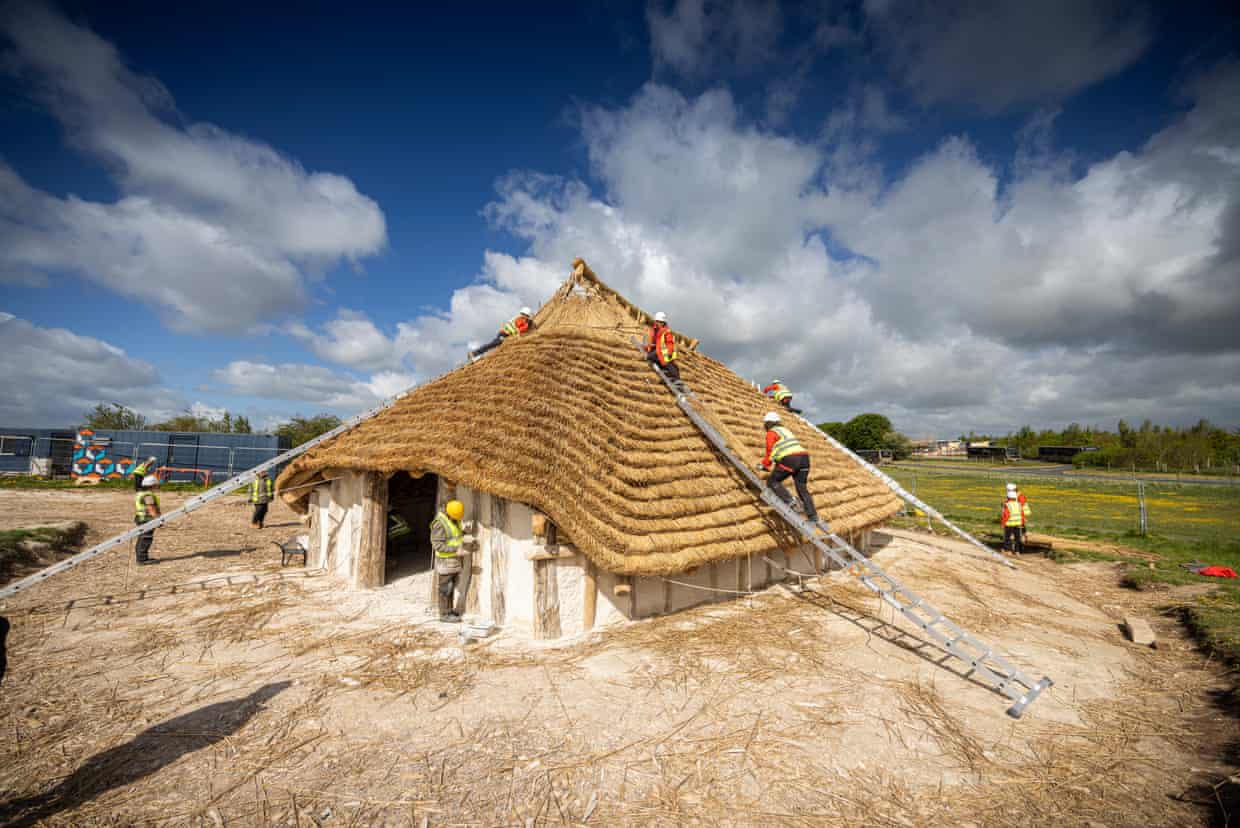
Photo: Christopher Ison/English Heritage/PA.
The seven meter-high Kusuma Neolithic Hall is based on archaeological evidence of a large prehistoric structure that was discovered two miles away from Stonehenge. 

(My older granddaughter noticed I had no post on July 17, which meant that I broke my streak: 15-plus years of daily posts. It had to happen someday. Here is the entry I finished but somehow failed to schedule.)

There’s always something new to learn about the people who built Stonehenge.

Jamie Grierson wrote recently at the Guardian about a nearby structure from the same time period.

“It may have been a place for ceremony or a barn for pack animals. It could have been a place for weary laborers to rest their heads. Or perhaps there was no building at all.

“English Heritage has unveiled a 7-meter-high [~23-foot] reconstruction of what a 4,500-year-old Neolithic hall may have looked like at Stonehenge, offering visitors a glimpse into the lives of the prehistoric builders who raised the world’s most famous stone circle.

“The £1m [~$1.4 million] project is in its final stages of construction near the Stonehenge visitor centre on Salisbury Plain. Built entirely by hand over nine months by a team of more than 100 volunteers, the Kusuma Neolithic Hall will open to the public this summer before transforming into an immersive, historical learning space for schools.

“The structure is based on the archaeological footprint of an anomaly known as Durrington 68, a unique ‘square in the circle’ building discovered two miles away near Woodhenge, another Neolithic site. First excavated in 1928 by Maud Cunnington, and re-examined in 2007 by the Stonehenge Riverside Project, the original site features a horseshoe-shaped ring of post holes surrounding four massive internal roof support pillars.

“Because centuries of ploughing destroyed the original floor and hearths, its true purpose remains a mystery. However, discoveries of animal bones and grooved ware pottery nearby point towards winter feasting, ritual gatherings or even communal storage.

“Luke Winter, an experimental archaeologist, who analyzed European Neolithic carpentry and prehistoric pollen data to design the hall, explained the construction’s rigorous scientific backing.

“ ‘Everything in that building was growing in this landscape 5,000 years ago,’ he said. …

“Like the nearby stone circle, the building perfectly aligns with the winter solstice. ‘When we got the frame in on the solstice morning, I was here, and I stood there, my shadow cast on the middle post at the back,’ Winter said.

“The project forms the first phase of an educational expansion by English Heritage. Alongside the hall, a new learning center housing the Clore Discovery Lab and Weston Learning Studio is scheduled to open by the end of 2026. …

“ ‘The Neolithic period is firmly on the national curriculum,’ [Iona Keen, English Heritage’s head of learning and interpretation] said, adding that the interactive hall would allow children to ‘step back in time’ by gathering around an open fire to make prehistoric cheese and pinch pots. …

“Stonehenge’s curator, Win Scutt, said Stonehenge and the barrows and dwellings surrounding the Neolithic monument were driven by a ‘society that wanted connection. … This whole thing is about social society, not science,’ with the camaraderie and ‘feeling of belonging’ generating the motivation to build. Rather than being ‘obsessed with individualism’ like modern society, these groups used massive cooperative projects as a medium for collective representation, he said.”

More at the Guardian, here. No firewall. Please consider donating to the Guardian.

Read Full Post »

Sindya N. Bhanoo writes at the NY Times about a surprising discovery under the waters of Lake Huron.

“A 9,000-year-old stone structure used to capture caribou has been discovered 120 feet beneath the surface of Lake Huron. Researchers say it is the most complex structure of its kind in the Great Lakes region. …

“The remarkable structure consists of a lane with two parallel lines of stones leading to a cul-de-sac. Within the lines are three circular hunting blinds where prehistoric hunters hid while taking aim at caribou. …

“The site was discovered using sonar technology on the Alpena-Amberley Ridge, 35 miles southeast of Alpena, Mich., which was once a dry land corridor connecting northeastern Michigan to southern Ontario.

“In their paper in the Proceedings of the National Academy of Sciences, the researchers suggest that the hunting structure was used in the spring, when large groups of hunter-gatherers assembled.”

Hard to imagine life 9,000 years ago. Anthropological archaeologists have the best fun. More here.

Photo: University of Michigan via Associated Press

Read Full Post »

There is always so much to share from Andrew Sullivan’s site.  In a recent entry he pointed to a book called The Art Instinct, by Denis Dutton.

“Micah Mattix reviews

“The first feature of our inclination toward art is that we seem to have a universal love of landscape paintings — and not just any landscape, but landscapes similar to those our ancestors would have encountered on the African savanna. A central pillar of evidence for his argument is a 1993 study commissioned by Russian painters Vitaly Komar and Alexander Melamid that surveyed people from ten diverse countries and found a surprising number of consistent aesthetic preferences. …

“Dutton suggests that this seemingly universal preference for paintings depicting open spaces, trees, water, and animals is related to our ancestors’ search for food and safety. Such landscapes would have presented opportunities for cultivation; and the presence of water and climbable clusters of trees — which could have served as lodgings for game and provided safety from predators — would have been preferred by hunter-gatherers to either a dark forest or desolate plains.” More.

Evolutionary psychology often seems like a stretch, but it’s fun to think about. I do like landscapes.  I also like abstraction. In any case, I’m sure my ancient Picts and Celts ancestors, if such they were, would have liked the 19th century painting Andrew picked to go with his entry.

Who can resist a Turner?

Image: Petworth Park: Tillington Church in the Distance, J. M. W. Turner, c. 1830, via Wikimedia Commons


Read Full Post »

On Wednesday, according to Todd Feathers in the Boston Globe, a New Hampshire scallop fisherman found something unusual in his catch.

“As Mike and Padi Anderson sold their catch of scallops on the dock Wednesday night in Rye Harbor, N.H., it was not just their shellfish that drew people’s interest. It was an ­object that looks like a 6-inch-long tooth that Mike had dredged up from the ocean earlier that day. …

“A crew member e-mailed a picture to a geologist from the University of New Hampshire, and a short while later the verdict came back: The tooth almost certainly belonged to a woolly mammoth. …

“The tooth weighs about 5 pounds and still has remnants of the root that connected it to the mammoth’s gums, Mike Anderson said in a phone interview from the deck of his boat, the F/V Rimrack. …

“The Andersons, who are married, will have to wait until William Clyde, the geologist, ­returns from a trip to South America before they can confirm that the tooth once belonged to a mammoth, but for them, the preliminary ruling is enough.”

Anderson seems excited to head back out for more archaeology. More.

Reminds me of John Hanson Mitchell and his book Ceremonial Time, which describes his attempts to sense and experience 15,000 years of life around his home in Massachusetts.

Finding a woolly mammoth tooth must really make one pause and think about big things.

Photograph of scallop fisherman Mike Anderson: Ionna Raptis/ Portsmouth Herald via AP

Read Full Post »