Feeds:
Posts
Comments

Posts Tagged ‘preserve’

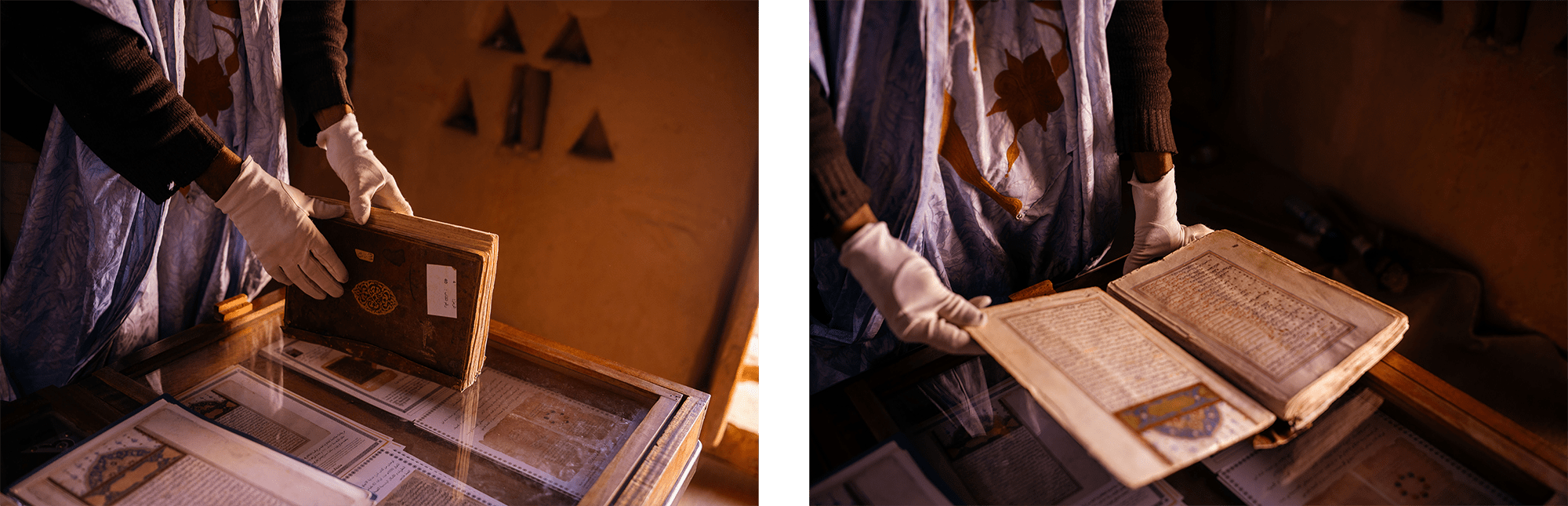
Photo: Kang-Chun Cheng.
Habott opening a book on Sufism interpretation in the family library.

I had to do a little research before sharing today’s article about a family’s work to preserve ancient manuscripts. I’m sorry to say that my geography is weak, and I didn’t know where to find Mauritania.

According to Wikipedia, Mauritania is a country in Northwest Africa, situated in the middle of Mali, Senegal, Algeria, and Western Sahara. Its full name is the Islamic Republic of Mauritania.

At the Dial recently, Kang-Chun Cheng described the history of the manuscripts and focused on why climate change and desertification is threatening them.

“Dressed in a boubou, a traditional Arab robe, ” Cheng writes, “Mohammed Abdullah Ould Gholam Habott, 51, puts on gloves before delicately handling the ancient manuscripts. He opens a book about Sufism, a mystical practice within Islam, and then another about its interpretation. Gingerly, he thumbs through the pages of Arabic script.

“Habott is the custodian of his family’s library and has been for 24 years. The size of a large sitting room, the library contains more than 1,000 pieces of Quranic manuscripts, legal texts and scientific writings –– some of the oldest in West Africa — ranging from mathematics to astronomy. It’s one of three such libraries still open to the public in Chinguetti, an ancient desert village in northern Mauritania.

“Established around 777 AD, Chinguetti — meaning ‘spring of horses’ in the extinct Azayr language — is home to roughly 4,800 people. The unforgiving environment makes survival feel like a concession; temperatures can exceed 43 degrees Celsius [109.4 F] during the day, then plummet down to 10 degrees after the sun sets. …

“Designated as a UNESCO World Heritage site in 1996, Chinguetti once served as an important trading outpost for the Mediterranean Timbuktu caravan route and a resting spot for religious pilgrims en route to Mecca. Small libraries were built to maintain and organize holy writings left behind by generations of transient pilgrims. Today, tourists and researchers travel great distances to look at them.

“Books are stored in storage cabinets, on open shelves and in wood and glass display cases. With few windows, the libraries are kept relatively dark and the texts out of the hot sun, but the rooms are far from temperature controlled. These simple preservation methods may not be enough to withstand changes to the desert climate.

“Temperatures here are rising up to 1.5 times faster than the global average, rainfall is plummeting, and sandstorms are becoming more common. While the texts are relatively safe in the arid desert air, the fates of the libraries themselves are precarious. Desertification threatens to bury towns. With fewer trees and vegetation, sand can more easily migrate onto the streets. In some places, dunes reach window height and pour into people’s homes.      

“The libraries in Chinguetti are owned and overseen by families, custodial positions passed down through generations. From a young age, Habott was captivated by stories that his grandfather told him of pilgrimages to Mecca and traveling to Andalusia, Spain, to purchase Moorish texts. His family’s library has existed since the 1800s and, as the eighth custodian, Habott tells me he felt proud of the culture and heritage the libraries carried. …

“His two sons, aged 12 and 18, don’t share this dream. Chinguetti’s remoteness and lack of resources (access to electricity only stabilized in 2013) mean there are very few economic opportunities. Many young people have little incentive to stay; the city’s population has been steadily declining for years as youth travel elsewhere for blue-collar work and a larger life. …

“ ‘An ocean of sand is coming,’ Habbott says from the dry coolness of his library. ‘I ask Allah to keep this family going.’ ”

A nice collection of photos may be enjoyed at the Dial, here. No firewall.

In case, like me, you had never heard of the Dial, here’s what they say about themselves: “We created The Dial in 2023 to make space for daring writing unconstrained by geography. English-language journalism is growing perilously small in voice, in ambition and in subject. We see an opportunity to publish stories from the point of view of those on the ground — with the world itself as our center of gravity, rather than Brooklyn. We trained as editors at The New York Review of Books, Politico’s European newsroom and the Atlantic.” I like the sound of their goals!

Read Full Post »

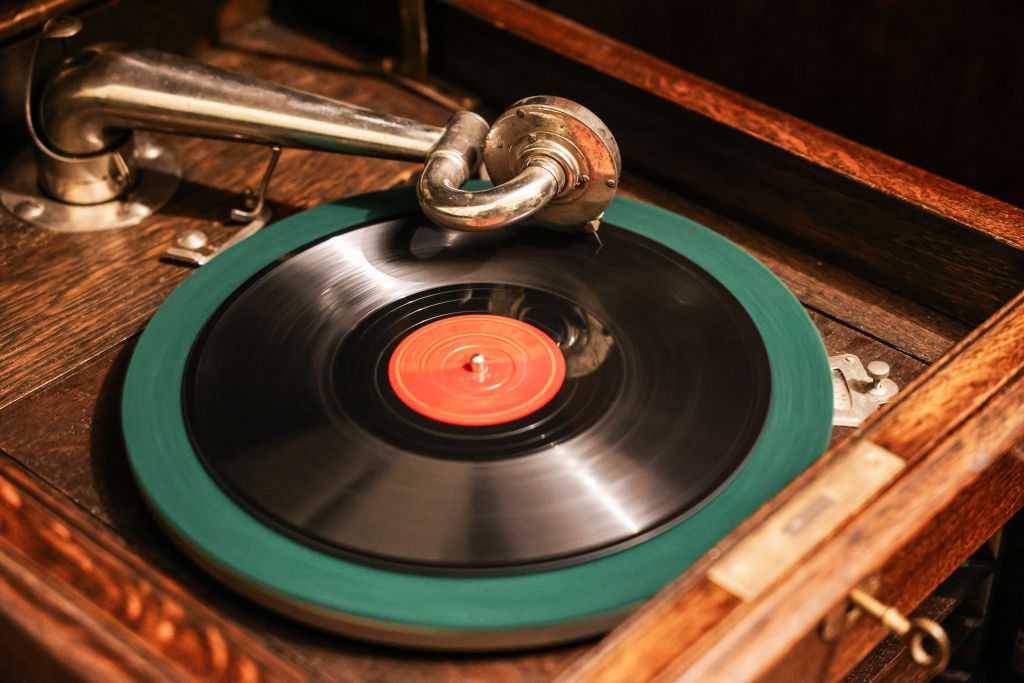
Photo: picture alliance.
An old-time record player playing a 78 rpm record. This is shellac — ie, before vinyl.

Maybe it’s because I still feel guilty about how my brother and I made a game of smashing our grandfather’s shellac records when we were children, but I can’t help taking sides in the court battle described below. Now that I’m a grownup, I believe that we should protect these oldies, and let the public get at them.

Ashley Belanger reports at Ars Technica that the Internet Archive’s battle with music publishers has ended in a settlement that will, in my view, be to the public’s benefit.

“A settlement has been reached in a lawsuit where music publishers sued the Internet Archive over the Great 78 Project, an effort to preserve early music recordings that only exist on brittle shellac records.

“No details of the settlement have so far been released, but a court filing on Monday confirmed that the Internet Archive and UMG Recordings, Capitol Records, Sony Music Entertainment, and other record labels ‘have settled this matter.’ …

“Days before the settlement was announced, record labels had indicated that everyone but the Internet Archive and its founder, Brewster Kahle, had agreed to sign a joint settlement, seemingly including the Great 78 Project’s recording engineer George Blood, who was also a target of the litigation. But in the days since, IA has gotten on board, posting a blog confirming that ‘the parties have reached a confidential resolution of all claims.’ …

“For IA — which strove to digitize 3 million recordings to help historians document recording history — the lawsuit from music publishers could have meant financial ruin. Initially, record labels alleged that damages amounted to $400 million, claiming they lost streams when IA visitors played Great 78 recordings.

“But despite IA arguing that there were comparably low downloads and streams on the Great 78 recordings — as well as a music publishing industry vet suggesting that damages were likely no more than $41,000 — the labels intensified their attacks in March. In a court filing, the labels added so many more infringing works that the estimated damages increased to $700 million. It seemed like labels were intent on doubling down on a fight that, at least one sound historian suggested, the labels might one day regret.

“Notably, the settlement comes after IA previously lost a court fight with book publishers last year, where IA could have faced substantial damages. In that fight, IA accused book publishers of being unable to prove that IA’s emergency library had hurt their sales. But book publishers, represented by the same legal team as music labels, ultimately won that fight and negotiated a judgment that similarly included an undisclosed payment.

“With both legal battles likely ending in undisclosed payments, it seems likely we’ll never know the true cost to the digital library of defending its digitization projects.

“In a court filing ahead of the settlement in the music label fight, IA had argued that labels had added an avalanche of infringing works so late into the lawsuit to create leverage to force a settlement.

“David Seubert, who relied on the Great 78 Project and manages sound collections at the University of California, Santa Barbara library, previously told Ars that he suspected that the labels’ lawsuit was ‘somehow vindictive,’ because the labels’ revenue didn’t seem to be impacted by the Great 78 Project. He suggested that perhaps labels just ‘don’t like the Internet Archive’s way of pushing the envelope on copyright and fair use.

” ‘There are people who, like the founder of the Internet Archive, want to push that envelope, and the media conglomerates want to push back in the other direction.’ “

More at ArsTechnica, here. Of related interest, at My Dad’s Records, here, my nephew once preserved the old R&B vinyl 78s of the same naughty brother who was guilty with me, but my nephew let the tumblr site go years ago. Check it out anyway.

Read Full Post »

Photo: Rasha Al Sarraj.
Ghulam Hyder Daudpota teaching his craft to students at a ceramics class in Karachi. 

Part of the effort to save artistic and cultural treasures has to be keeping alive the ability to make them in the future. It involves passing on the skills to new generations. Consider today’s story.

Saeed Kamali Dehghan reports at the Guardian, “The small city of Nasarpur in Pakistan has a centuries-old reputation for its ceramics. That’s why, when the ceramic worker Ghulam Hyder Daudpota decided to come all the way to London to master his craft, he says ‘it seemed futile.’ But, he adds: ‘It turned into a life-changing opportunity.’

“Daudpota grew up with eight siblings in a city where the mosques and shrines are embellished with terracotta and blue glazed tiles, known as the art of kashikari. He spoke little English until the age of 27 and his parents had ‘no deep pockets’ to pay his tuition fees.

“But the talented Pakistani secured a full scholarship at the King’s Foundation school of traditional arts (KFSTA) in east London, before returning to his country and helping to revive the dying craft.

“ ‘Kashikari is ubiquitous across [the province of] Sindh, but when I was growing up it was considered a dying craft and only a few craftsmen were practicing. If it wasn’t for my time at KFSTA, I wouldn’t be where I am at the moment,’ Daudpota says from his Nasarpur workshop, which now employs 40 people.

“Believed to have originated in the Iranian city of Kashan, kashikari involves making biomorphic patterns on terracotta clay by dabbing graphite on perforated paper, before applying turquoise metallic pigments found in copper and cobalt oxides.

“ ‘If you go back 100 years, we had a variety of glazes and techniques – masterpieces that we see today in Shah Jahan mosque in the city of Thatta – but we had no proper patronage and we lost our skills, we lost our knowledge,’ Daudpota says.

“Daudpota has since worked on designs at Islamabad airport, Pakistan’s pavilion at Dubai Expo 2020 and on restorations at prominent mosques and mausoleums. In 2010 he was awarded the Jerwood prize for traditional arts for a tile fountain inspired by kashikari panels found in Nasarpur’s old mosque. Daudpota sold the fountain for £5,000 [~$6,600] and received £2,500 in prize money, which he took back to Pakistan and opened a workshop.

“It was a long way from what he had expected from life. Daudpota did not perform well at school and his parents apprenticed him to a local craftsman. An encounter while working on a commission at a private mansion changed the course of his career. ‘It was a turning point in my life,’ he says.

“The house was owned by a teacher at the National College of Arts (NCA) in Lahore. He told Daudpota that his experience would qualify him to study for a master’s degree, provided he learned English within the next four months. He took classes at sunrise every day and passed the test.

“The NCA has a longstanding arrangement with KFSTA, sending one student to London every year for almost three months. Daudpota was chosen for the 2008 program. …

“KFSTA promotes ‘the living traditions of the world’s sacred and traditional art forms,’ such as Persian miniature painting, Moroccan zellige mosaic tilework and Egyptian Mamluk woodcarving. …

“ ‘Teachers in my country were discouraging me from pursuing traditional arts; they were saying it was primitive. The school broadened my perspective, and gave me the training platform to understand how we can turn a dying tradition into a living tradition.’ ”

More at the Guardian, here. No paywall. Donations encouraged.

Read Full Post »

The Seed Zoo

cloverlawn

Photos: Richters.com
The company behind the SeedZoo for rare species offers a range of services, including replacing lawns with edible plants.

I recently learned that in addition to Norway’s Seed Vault, where 400,000-plus seeds are (we hope) safe from global warming and other disasters, there is also a seed bank that individuals around the world can contribute to.

It’s the SeedZoo at a company called Richters. And depending on the level of your concern about invasive species, you can buy unusual seeds there or contribute your own.

From the website: “Richters is proud to introduce SeedZoo™, a project to preserve traditional and indigenous food plants from around the world. Teaming up with botanical explorers and ethnobotanists, we are searching for rare and endangered food plants that home gardeners can grow and enjoy, and help to preserve.

“Of the 7,000 or so species of food plants known to man, only 140 are cultivated commercially, and of those, most of the world’s supply of food depends on just 12.

Even as the world increasingly speaks about food security, incredible varieties that are known only to a single tribe or in small and remote localities are being lost forever.

“We sent plant explorers across the world in search of rare beans, squashes, melons, greens, and grains. They have been to the jungles of Borneo, to small farms in Japan and Italy, and to the bustling food markets of Africa. In the coming months they will visit India, Vietnam and beyond. Many of the rare and exotic plants that they bring back don’t even have names and can only be called landraces — plants with unique features found in only one region or sometimes in just one village.

“Often our explorers can bring back only a handful of seeds, sometimes fewer than 100. Because these seeds are so rare and from such remote regions of the world, they are sold on a ‘first come, first served’ basis. Once they sell out they may never be available again. …

“Join us in this grand project to preserve a part of the world’s food diversity. Try some of the planet’s treasures, and enjoy the culinary adventure. And please save some seeds and share them with your friends.”

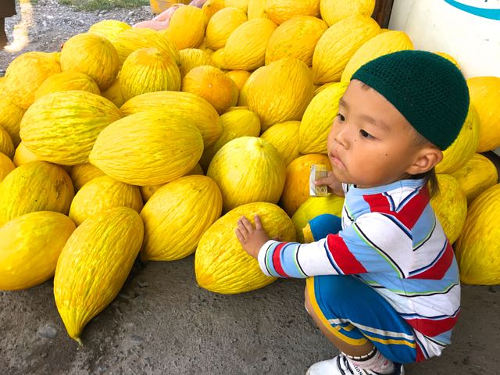
Let me give you an example from the Richters website. How do you like the idea of the Kyrgyzstan Banane Melon?

Richters calls it a “gorgeous casaba type melon from southern Kyrgyzstan near the city of Osh. It is one of many local variations of melons found throughout central Asia. The yellow fruits have a creamy white flesh that is very sweet and delicious. It should be as easy to cultivate as other melons. Assume about 100-110 days to maturity. Will likely do best in warmer slightly drier areas. Fruit sweetness is enhanced when there is not too much water available. Fruits are picked when mature and deep yellow, and the stem begins to dry up. They are usually eaten fresh but the flesh is also dried as and used in the winter.”

I’m worried what Jean will say about this idea, but I’m pretty sure Jill will be up for it.

More here.

The Kyrgyzstan Banane Melon, with an admirer.

x9564


Read Full Post »

As I noted the other day, the approach to saving the Harlem home of Langston Hughes is online fund-raising.

Meanwhile in France, the home of James Baldwin may be saved by a squatter and a quirky French law.

Shannon Cain writes at LitHub.com, “To clean the floor of James Baldwin’s guest room would take 32 disposable cleaning wipes. I figured this out on my hands and knees, estimating the square footage of the terra cotta tile surface. There were 40 wipes in the package. If I used one wipe per roughly two square feet, I’d have enough. I was camping here without running water or electricity, but damned if I was going to live inside a dusty mess.

“Four days earlier, struggling under the weight of a camping backpack laden with supplies, a duffel of linens, bag of books and a deluxe inflatable bed, I’d pushed aside the unlocked wire barrier of the ten-acre property and entered the 17th-century stone house, illegally.

“It wasn’t hard to do; the door had been busted off its frame long before I arrived and the place was wide open. I was sweating, exhausted and elated; I’d spent the previous six hours traveling by trains and buses from Paris, stressing hard about this moment, worried I’d be detected. …

“I needed to establish my squatters’ rights, which according to French law would be mine after 48 hours. The cancelled postage on the postcard I was about to send to myself would serve as one of these proofs. … To send a letter, one addresses it to the Ancienne Maison Baldwin, chemin du Pilon, St. Paul de Vence 06570. It seems the post office, at least, remembers James Baldwin. …

“The squatter’s law in France is meant to dissuade land speculation and absentee ownership. It is perhaps one of the purest manifestations of socialism. For seven years, the real estate developer that owns the Baldwin house has let this historic structure and its magnificent gardens go to seed. In the meantime, they’ve been busy with other projects, including the construction of an enormous American-style shopping center in Nice, all superstores and parking lots, reputedly built within a flood plain.

“In my research over the last months I have heard nothing but disdain and outright hatred for this corporation among the local people. ‘He’s a bandit, that one,’ muttered a local business owner.”

Read the whole crazy adventure and how Cain outfoxes the “bandit,” here.

Photo: Shannon Cain
Former home of writer James Baldwin on the French Côte d’Azur.

Read Full Post »

How great an idea is this? Somerville’s League of Urban Canners gleans neglected fruits from city lots and neighbors’ trees and turns them into jellies, jams, and preserves.

Writes Kathleen Weldon in the Boston Globe, “The group is the brainchild of Sam Katz-Christy of Somerville, who was struck by inspiration last fall after receiving 10 pounds of plums from a neighbor who happened to have an unusually productive backyard tree. Armed with little more than a cookbook and a bit of courage, he and his family preserved their windfall in glistening Mason jars. The committed locavore, who commutes by bike to his job in Cambridge’s Central Square, began to notice just how much unused fruit was hiding in plain sight among the squares and one-way streets he traveled. His daily rides became a treasure hunt.

“After recruiting a posse of workers from his network of food-loving friends, he began knocking on doors, offering an unusual deal to the owners of neglected one-tree orchards: the League would pick their crop, can the harvest, and give residents back 10 percent of the results. The volunteers keep the rest.

“The initiative has proven remarkably successful. More than 220 sites are currently listed in the League’s database, representing more than 3,500 pounds of collected fruit. …

“Though at first the League expected to reap mostly apples and grapes, soon it became clear that Somerville, Cambridge, and Jamaica Plain were rich with ripe possibilities from mulberries to pears, raspberries to quince. A single tree in Harvard Square yielded 245 pounds of apricots, which turned into countless jars of jam.” Read more.

Suzanne loved the mulberries growing in our neighborhood when she was about five. I wonder how we might get our hands on mulberry preserves.

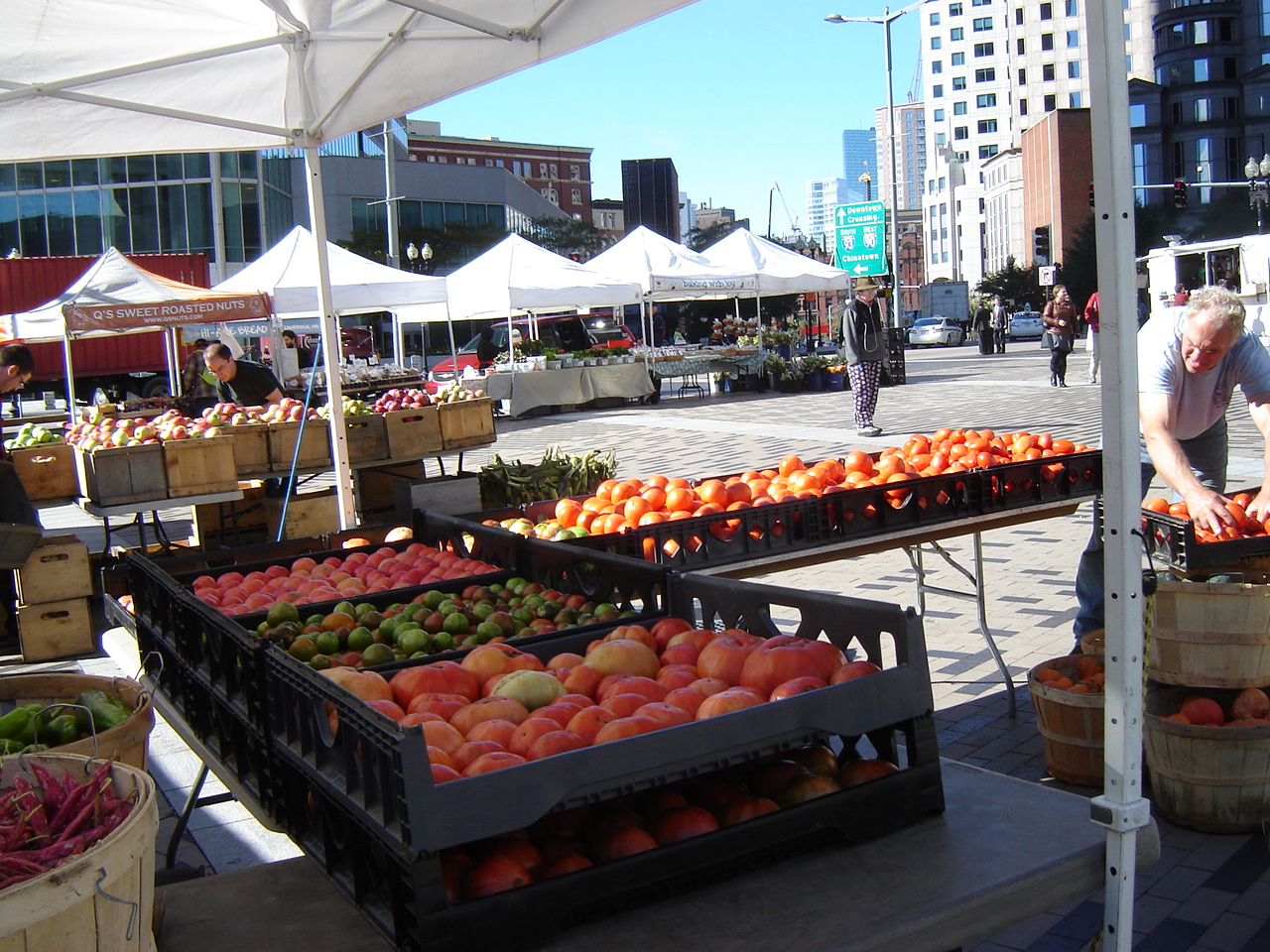
Mulberry season is long past, but there’s still plenty of produce out there, as evidenced by the hardy farmstands at the farmers market today.

Read Full Post »