Feeds:
Posts
Comments

Posts Tagged ‘protected’

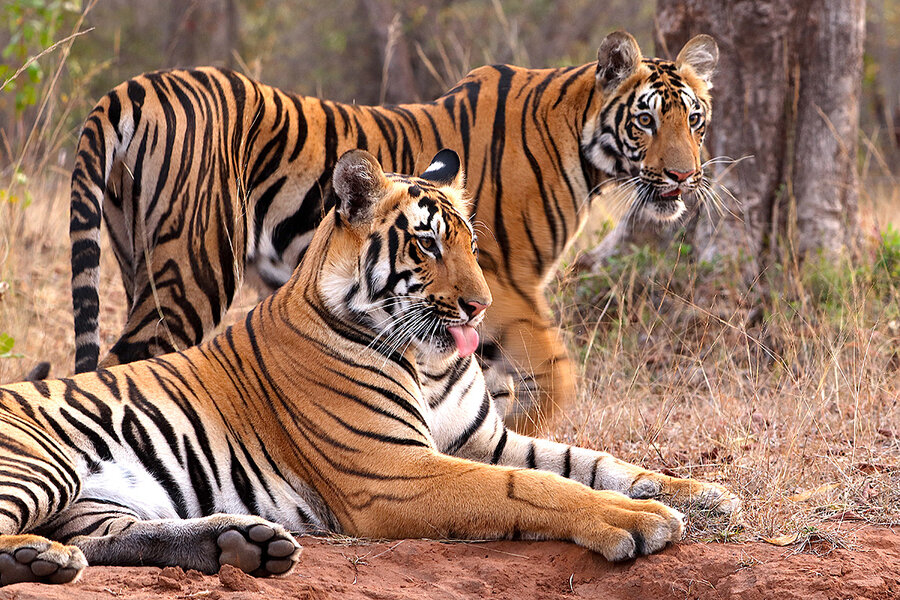
Photo: Charukesi Ramadurai.
Tigers at Kanha National Park in central India.

With its huge population, extremes of wealth and poverty, and religious suppression, India has more than its share of challenges. But one thing it seems to be getting right is its approach to protecting the national animal, the tiger.

Charukesi Ramadurai reports for the Christian Science Monitor, “On a misty winter morning in a central Indian forest, a soft caw-caw punctuates the silence. Dozens of grazing deer perk up their ears, then join in the staccato warning screeches of the langur monkeys and birds high up in the trees. As the chorus of animal alarms reach a crescendo, a frisson of excitement runs through the humans seated on the safari jeeps, bulky cameras and pricey binoculars at the ready. The urgency of these calls can only mean that a predator has been spotted. 

“The tourists let out a collective gasp when the tiger finally emerges from the thickets, the orange and black fur gleaming in the muted morning sunlight. …

“All eyes are on the king of Indian jungles as the country marks the 50th anniversary of Project Tiger, a program founded in April 1973 to save the species from extinction. Five decades later, India houses the world’s only stable and growing tiger population … with numbers expected to pass 3,000. India also now boasts 53 tiger reserves across 18 states, encompassing about 2.4% of the country’s total land. It’s a success story marked by unwavering hope. 

“ ‘Back when it started, nobody could have imagined that we would have more than 50 protected tiger reserves in this country,’ says conservationist and wildlife tourism expert Amit Sankhala, who is also the grandson of Kailash Sankhala, the first director of Project Tiger. ‘These habitats exist just for the tiger to exist.’ …

“India’s tiger population dwindled from over 40,000 in the 1930s to a mere 1,827 by the end of the 1960s, due to organized hunting and habitat destruction. Spurred on by the World Wildlife Fund (WWF), the Indian government announced the landmark Wildlife Protection Act in 1972, paving the way for Prime Minister Indira Gandhi to launch Project Tiger the following year. Authorities established nine tiger reserves and implemented a blanket ban on hunting, and the tiger was declared India’s national animal.

“Despite the program’s early success, progress has been inconsistent. In fact, tiger numbers dipped to an all-time low of 1,411 in 2008 because of continued habitat loss outside protected areas, as well as unchecked poaching, which wiped out tiger populations in major reserves such as Panna in the central state of Madhya Pradesh and Sariska in the west Indian state of Rajasthan.

“That sparked an urgent push to increase public awareness through celebrity campaigns, and the conservation reins were handed over to a special task force known as the National Tiger Conservation Authority. With stricter wildlife policies and improved monitoring, numbers have been rising slowly but steadily since then. Every consecutive four-year census has shown an increase of a few hundred tigers; according to the 2018 census, India has a tiger count of 2,967, a figure which accounts for nearly 75% of all tigers in the wild.

“Reputed naturalist and wildlife guru Hashim Tyabji calls India’s success in preventing tigers’ extinction ‘a miracle in conservation.’ The project, he says, is a testament to India’s expertise in capturing and relocating tigers from their home areas to forests where numbers are lower and more space is available for these solitary, territorial animals to roam freely. … ‘We have modern tools like camera traps to track tigers. And not to forget, there are many many people who are hugely committed to conservation, and practice responsible tourism.’ …

“The uptick in tiger populations is especially impressive considering India’s rapid rate of development, says Aly Rashid, director at Jehan Numa Wilderness, which operates sustainable wildlife lodges in Madhya Pradesh. 

“ ‘We have 1.4 billion people living here, and the [human] population has doubled since 1973. Given all this pressure on land and resources, I would say this is a huge achievement,’ he explains.

“Although the WWF reports that wild tiger populations are growing globally, the solitary predator isn’t out of the woods yet. It’s still classified as endangered, and in India, degradation of critical tiger corridors and human-tiger conflict pose serious challenges. But Mr. Rashid is hopeful that with community buy-in, India can overcome these challenges. …

“That hope extends beyond tigers, which Mr. Sankhala, the conservationist, calls ‘poster boys for wildlife.’ The apex predator has also helped draw attention to India’s other endangered species, he says, including red pandas and Asiatic lions. Recent amendments in the original 1972 wildlife act have made it possible to protect and nurture various animals, from the barasingha (swamp deer) and gaur (Indian bison) in the heart of the country, to the one-horned rhinoceros in the eastern reaches. …

“ ‘Once you save the tiger, you save everything around it,’ Mr. Sankhala says.”

More at the Monitor, here. No firewall.
Read Full Post »

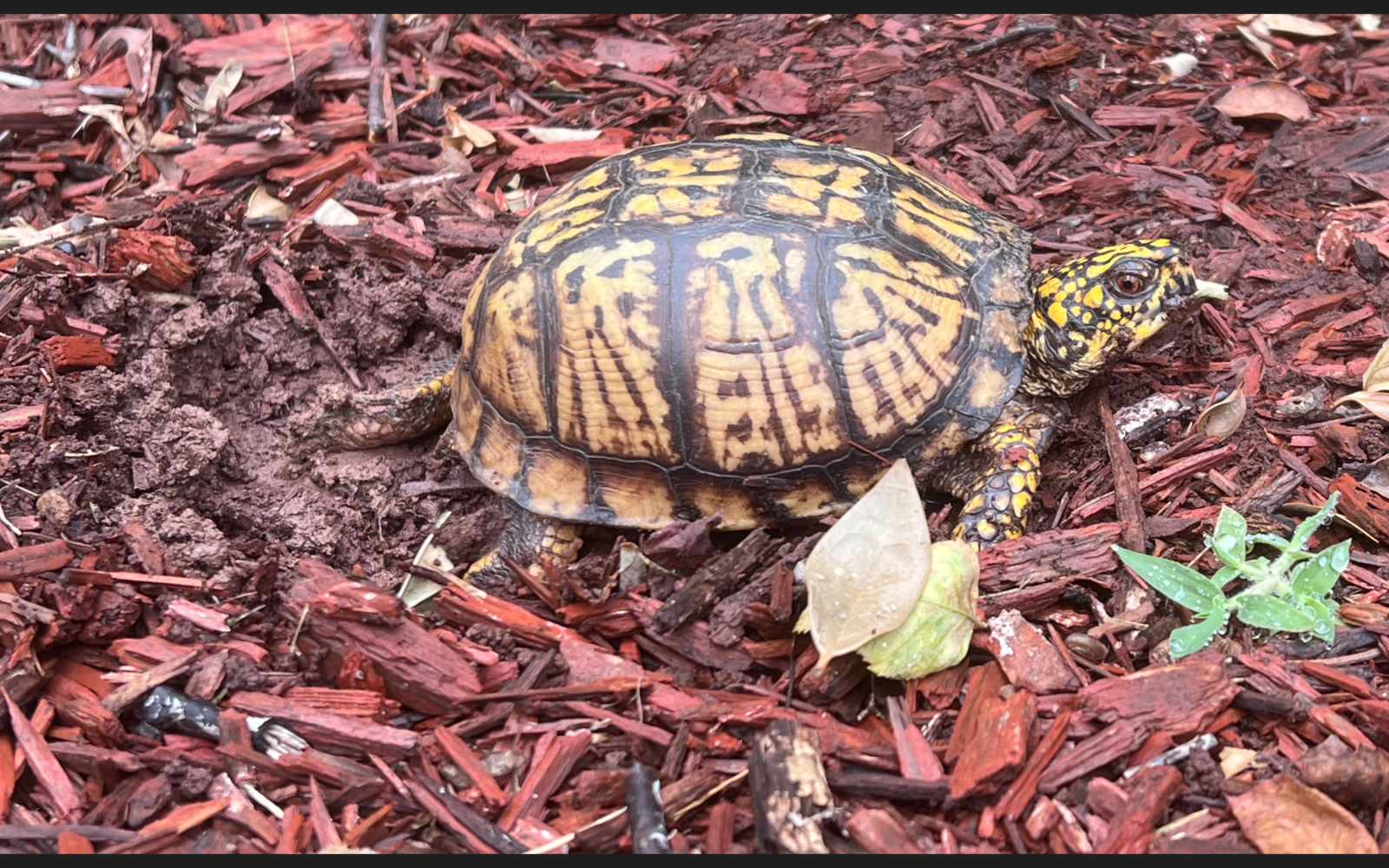
Photo: Pandbambooguy.
Female box turtle digging a hole with her back legs to lay eggs. Eastern box turtles are a popular species in the illegal world of wildlife poaching. 

Unsurprisingly, Erik couldn’t believe that global criminal gangs selling endangered species had ties to turtle thieves in little old Rhode Island. I know. It sounds pretty implausible — and grandmothers do tend to sensationalize news stories to entertain the kids.

But it’s all true. Just ask the state herpetologist. (Who knew Rhode Island had an official herpetologist?)

As Frank Carini reported at ecoRI News this month, “Rhode Island’s reptiles and amphibians face pressure from numerous threats, and for many species, removal of even a single adult from the wild can lead to local extinction, according to the state’s herpetologist.

“Since the local and/or regional future for many of these species — eastern spadefoot toad, northern leopard frog, northern diamondback terrapin, to name just a few — is in doubt, removing them from nature to keep as a pet or to sell is against the law. It’s illegal to sell, purchase, or own/possess native species in any context, even if acquired through a pet store or online, according to Rhode Island law.

“Turtles are especially vulnerable, according to Scott Buchanan, who became the state’s first full-time herpetologist in 2018, because some species must reproduce for their entire lives to ensure just one hatchling survives to adulthood. The Rhode Island Department of Environmental Management (DEM) staffer said it takes years, sometimes a decade or more, for turtles to reach reproductive age, if they make it at all.

“Buchanan recently told ecoRI News that ‘broadly, across taxa’ the illegal taking, or poaching, of wildlife is a ‘huge issue. … Globally, it’s considered one of the driving forces of population declines and even extinctions,’ he said.

“Wildlife trade experts and conservation biologists such as Buchanan point to poaching — driven by demand in Asia, Europe, and the Unified States — as a contributing factor in the global decline of some freshwater turtles and tortoises. …

‘Before you take a photo of a turtle in the wild, turn off the geolocation on your phone. If you post a turtle photo on social media, don’t include information about where you found it.’ 

“Of the 360 known turtle and tortoise species, 52% are threatened, according to the International Union for Conservation of Nature Red List of Threatened Species.

“A group of global turtle and tortoise experts published a 2020 paper that noted ‘more than half of the 360 living species [187] and 482 total taxa (species and subspecies combined) are threatened with extinction. This places chelonians [turtles, terrapins, and tortoises] among the groups with the highest extinction risk of any sizeable vertebrate group.’

“Turtle populations are ‘declining rapidly’ because of habitat loss, consumption by humans for food and traditional medicines, and collection for the international pet trade, according to the paper’s authors. Many could go extinct this century.

“Buchanan’s involvement in dealing with the impact of poachers is primarily around North American turtles. He noted turtle diversity is high globally and in the eastern United States — in the Southeast more than the Northeast, however.

“But state and federal law enforcement officials and wildlife biologists consider the illegal collection of turtles to be a conservation crisis occurring at an international scale, according to Buchanan, who is the co-chair of the Collaborative to Combat the Illegal Trade in Turtles (CCITT), formed in 2018 within Partners in Amphibian and Reptile Conservation. …

“In Rhode Island, Buchanan said, there are four turtle species of concern: the eastern box turtle; the spotted turtle; the wood turtle; and the northern diamondback terrapin.

Eastern box (species of greatest conservation need): This turtle spends most of its time on land rather than in the water. They favor open woodlands, but can be found in floodplains, near vernal pools, ponds, streams, marshy meadows, and pastures. They reach sexual maturity by about 10 years of age. Females nest in June and lay an average of five eggs in open areas with sandy or loamy soil. Eggs hatch in late summer.

Spotted (species of greatest conservation need): These turtles are sensitive to disturbance. They are usually found in shallow, well-vegetated wetland habitats, such as vernal pools, marshes, swamps, bogs, and fens. …

Wood (species of greatest conservation need): For part of the year they live in streams, slow rivers, shoreline habitats, and vernal pools, but in the summer they roam widely across terrestrial landscapes. …

Northern diamondback (state endangered): Their population has suffered greatly due to poaching and habitat loss. They are found in estuaries, coves, barrier beaches, tidal flats, and coastal marshes. They spend the day feeding and basking in the sun and bury themselves in the mud at night. They reach sexual maturity at about 6. Females lay a clutch consisting of 4-18 eggs. Some females will lay more than one clutch in a season and hatching usually occurs in late August. The young spend the earlier years of life under tidal wrack (seaweed) and are rarely observed. …

“Other turtle species that can be found in Rhode Island include eastern painted, common snapping turtle, and eastern musk. …

“ ‘We have a lot of turtles for a small state,’ Buchanan said. …

“In late September environmental police officers from DEM’s Division of Law Enforcement found 16 eastern musk turtle hatchlings, a species native to Rhode Island and the eastern United States, in the home of a West Warwick man suspected of illegally advertising them for sale on Craigslist and Facebook.

“The case resulted from a week-long investigation, during which the suspect offered two hatchlings to undercover environmental police officers for purchase, according to DEM. The suspect was charged with 16 counts of possession of a protected reptile or amphibian without a permit. The turtles were taken to the Roger Williams Park Zoo, which has a room and equipment dedicated to the care of turtles seized from the illegal turtle trade. The turtles will be released back into the wild after clearing health screenings and disease testing, according to DEM. …

“To help protect Rhode Island’s native species, you can submit observations of amphibians and reptiles to DEM scientists online.”

More at ecoRI News, here. No firewall.

Read Full Post »