Feeds:
Posts
Comments

Posts Tagged ‘protein’

Photo: Suzanne and John’s Mom.
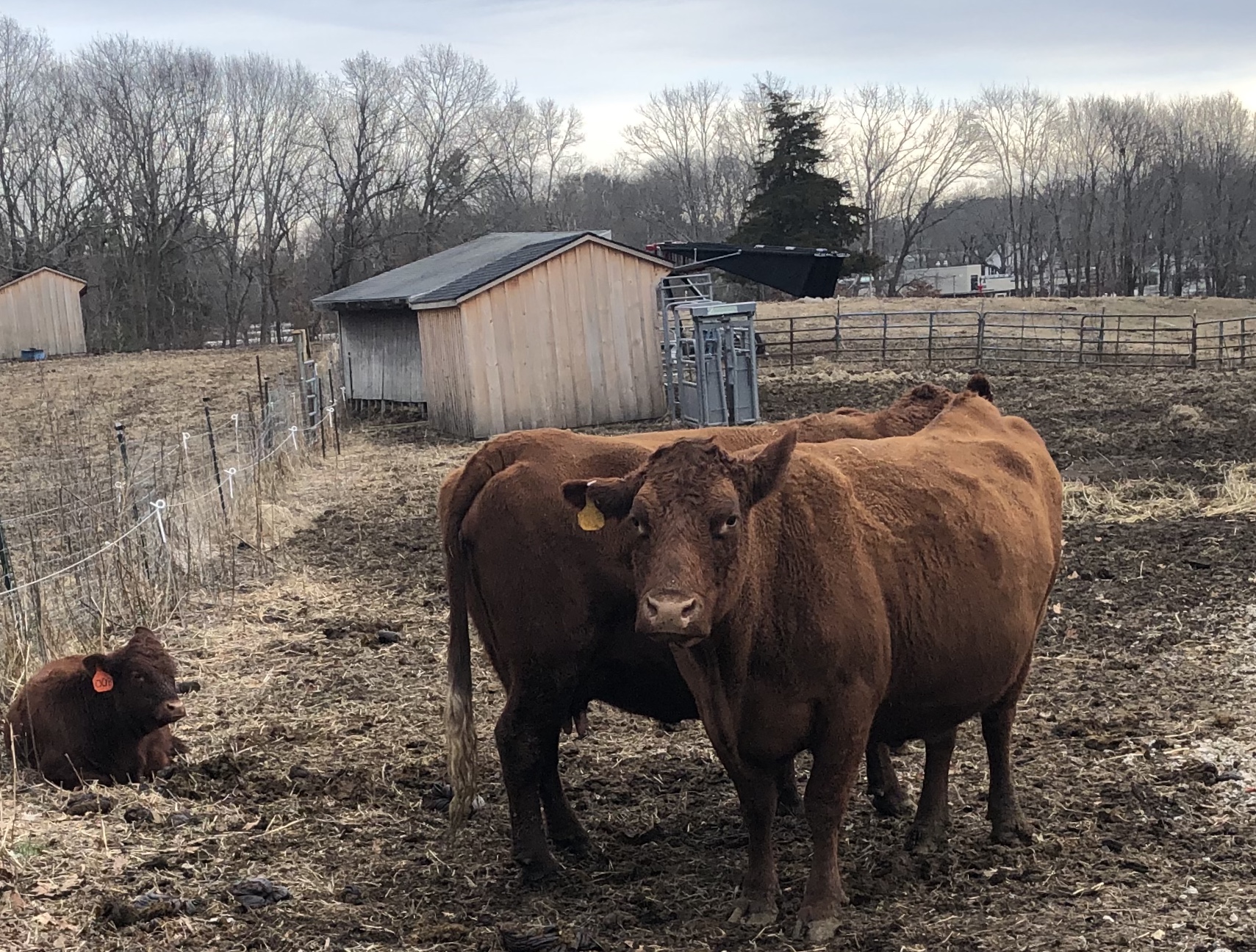
Cattle at Codman Farms, Lincoln, Mass. “Cows are often described as climate change criminals,” says Grist, “because of how much planet-warming methane they burp.” But, Grist adds, raising ruminants can also lead to deforestation, making alternatives to meat doubly important.

The other day at dinner, my husband regaled Sally and me with the latest on Europe’s use of mealworms as alternative proteins. The idea of eating mealworms — straight, no chaser — was not appealing to me even though I know they often sneak into the packaged nut and grain products we buy at the store. Which is why I freeze those products for 24 hours. I suppose I eat frozen mealworms that way, but it’s inevitable.

Grist magazine reported recently on the damage that livestock agribusinesses do to the planet when they cut down trees to graze more animals.

Max Graham says, “To feed the world’s growing appetite for meat, corporations and ranchers are chopping down more forests and trampling more carbon-sequestering grasslands to make room for pastures and fields of hay. … The greenhouse gases unleashed by this deforestation and land degradation mean food systems account for one-third of the world’s human-generated climate pollution.”

At Nature magazine I learned that alternative proteins are gaining traction in France, of all unlikely places. The focus is not on eating insects straight.

Rachael Pells writes at Nature about “the world’s largest vertical insect farm — home to at least 3 trillion mealworm beetles (Tenebrio molitor). The company’s chief executive and co-founder, Antoine Hubert, says that the beetles have a good life, as far as being an insect goes. Each of their stacked plastic trays is kept at an optimal 60% humidity and a balmy 25–27 °C. Nutrition, growth and moisture levels are all recorded for analysis, and human visitors are allowed to inspect the trays only from a distance — to prevent contamination of this prized ecosystem.

“The beetles are raised in this way from larvae to adult, at which point they meet a quick death in steam before being harvested into oil, protein and fertilizer.

“Insects have come under the spotlight over the past few years, as scientists seek alternative sources of protein to feed the rapidly expanding global population. A direct nutritional comparison shows that edible insect species have greater protein potential than do conventional meat products — 100 grams of mealworm larvae produces 25 g of protein, whereas 100 g of beef contains 20 g of protein. Insects also have a high food-conversion ratio when compared with livestock.

“To produce the same amount of protein, for example, crickets require around six times less feed than do cattle, four times less than sheep, and half that of pigs and chickens. But various attempts by companies to market insects as a mainstream food source in Europe and North America have fallen flat and largely been dismissed as a fad. And some researchers have concerns about the effects on the environment, ranging from whether escaped insects might disrupt local ecosystems to the impact of insect ‘factories.’ So why farm insects at all?

” ‘The world is facing a huge food sustainability crisis,’ explains Huber, an environmental engineer. ‘Insect protein is one very realistic and obvious solution to mitigating some of those challenges,’ he says.

“With the global population expected to reach almost 10 billion by 2050, United Nations forecasters have warned that food production will also need to increase by as much as 70%.

“However, because mealworm burgers are, at the moment, unlikely to sell out in your local supermarket, Ÿnsect grows insects for animal feed. This is given to fish, pigs and poultry, taking the pressure off conventional agricultural land use.

“The use of vertical farming has grown rapidly over the past few years, spurred on, in part, by advances in LED lighting, the cost of which fell by 94% between 2008 and 2015. Several start-ups (including Infarm in Berlin and Aerofarms in Newark, New Jersey) use the system to produce vegetables such as lettuce for human consumption. And the global market of the vertical-farming industry is expected to grow from US$3.7 billion in 2021 to $10.5 billion in 2026.

“Meanwhile, sales of plant-based alternatives to meat that are designed to reduce the demand for cattle farming — an industry responsible for 65% of all livestock emissions — seem to be stalling. When meat-substitute company Beyond Meat in El Segundo, California, went public on the stock market in 2019, its share price rose by 163%. But after the initial excitement, sales slowed, and they have remained about the same since 2020.”

As with most innovations, there are caveats. Get the details at Nature, here. And for a report on livestock and deforestation, check out Grist, here. No paywalls for either one.

Read Full Post »

Photo: Plantible Foods.
Duckweed to feed the world.

I admit I have not yet found a plant-based hamburger or vegan chicken that I really like, but since inventors keep working on better-tasting meat substitutes, I have hope. Today’s story is about a company investing in new protein sources — for example, duckweed.

Michael J. Coren is Climate Advice Columnist at the Washington Post.

He writes, “I came to this aquatic farm an hour outside of San Diego because I wanted to see what could be the future of humanity’s protein supply. At the moment, it looks more like a meth lab out of the drama Breaking Bad, jokes Tony Martens Fekini, the chief executive of Plantible Foods.

“Decrepit recreational vehicles squat on the property. In one corner, people tend to vials, grow lights and centrifuges in a trailer lab. More than a dozen big ponds filled with duckweed, a tiny green plant, bask in the Southern California sunshine.

“But the only thing cooking here is protein.

“Within each tiny floating aquatic plant is a molecule colloquially called rubisco. Without it, most life on Earth would cease to exist.

“Plants use rubisco protein — technically known as Ribulose-1,5-bisphosphate carboxylase/oxygenase — as the catalyst for photosynthesis, combining CO2 from the air with the building blocks for sugars and carbohydrates composing the base of our food chain.

“Rubisco is arguably the most abundant protein on the planet. Every green leaf has it. But this tireless molecule is locked inside plants’ cells, spoiling almost as soon as it comes into contact with the outside world. At the moment, eating salads is the only way to consume much of it.

“But Plantible’s farm may change that. If it succeeds, duckweed may become humanity’s first new major crop in more than a century. …

“Rubisco doesn’t just provide the protein we crave. It’s one of the world’s most versatile proteins, shape-shifting into forms resembling egg whites, meat, milk, gluten or even steak — all extracted from leaves. …

“The world grows more than enough food to feed everyone on Earth. Much of it goes to livestock. About half of the corn and soybeans grown in the United States are fed to cows, pigs and chickens to support meat-rich diets.

“This is not changing anytime soon. Even as protein alternatives proliferate, global meat consumption reached a record high in 2021, roughly doubling since 1990. The typical American consumed about 260 pounds of meat and 670 pounds of dairy last year, according to government statistics.

“Advising people to eat less of it isn’t likely to do much. In country after country, as incomes rise, meat consumption follows virtually in lockstep.

“That comes at a steep cost to ecosystems and the climate. Meat, at least how most of it is raised today, is the driver behind 57 percent of all food production emissions. …

“The challenge, then, is not to persuade people to eat more vegetables. It’s how to make plant proteins taste better than their animal counterparts.

“For a moment, it seemed like ‘alternative meat’ might succeed. Highfliers like Impossible Foods and Beyond Meat, after seeing sales soar in 2020, have faltered. Retail sales of alt-meat dropped more than 10 percent in 2022 amid health questions and high prices. Plant-based milk, while stealing market share from traditional dairy, still accounts for just 9 percent of the volume sold in the United States. …

“Plant proteins aren’t a perfect substitute. They can impart grainy textures, ‘vegetal’ off-flavors or fall short of the savory appeal of eggs, dairy and meat.

“So food producers are searching for the holy grail of plant proteins, one that combines the best of plant and animal proteins: affordable, abundant and easy to grow, with the physical properties that make a hamburger or milkshake so alluring. Rubisco might just be it. …

“Rubisco’s composition is a nearly ‘ideal’ protein for humans, according to the U.N. Food and Agriculture Organization, boasting an amino acids profile rivaling egg whites or casein in milk. Unlike the most common plant protein in soy, wheat and peas, it offers a non-allergenic, easily digestible and complete set of all nine essential amino acids our body can’t produce on its own.

“In contrast to alt-meats, rubisco is a versatile shape-shifter on the human palate. … As a binder in plant-based meats, it retains the delicious bite of a juicy burger. In a fluffy omelet or whipped meringue, it replicates the function of eggs. …

“The problem, however, has been getting it out of the leaf. As soon as a leaf is cut, its compounds bind to rubisco, rendering it unusable as a food ingredient. At the industrial scale, harvesting rubisco has proved to be a formidable challenge.

“ ‘You just have to process the plant material reasonably quickly so you don’t end up with a brown sludge,’ says [Grant Pearce, a protein chemistry researcher at the University of Canterbury in New Zealand]. Sugar beet leaves, cauliflower, kale, broccoli stems, radishes and even invasive plant species have all been harvested as protein sources. None proved economical. And some are skeptical it will ever be. …

“Duckweed, or lemna, doesn’t get much respect in most of the world. While eaten in parts of Southeast Asia, the pond vegetation is regarded as a nuisance elsewhere. That reputation belies the plant’s remarkable biology.

“The family’s 35 or so species thrive on nearly every continent, surviving at near-freezing temperatures in water conditions lethal to many others. As the world’s smallest known flowering plant, it consists of a single floating leaf, an oval not much larger than the tip of a pen. Its delicate roots dangle millimeters below the surface. In ideal conditions, it grows at a ferocious rate, doubling in mass every two or three days.

More at the Post, here.

Read Full Post »

Having given myself a serious scare reviewing the film Revolution (on the planet’s race to extinction through practices such as destroying critical forests), I was happy to read about a positive forestry initiative started in India and expanded to Haiti and Kenya. The pressures are the same in those countries as in Madagascar, which was featured in Revolution, but there is also a recognition that trees are life-giving.

Gregory M. Lamb writes at the Christian Science Monitor, “Aviram Rozin was excited. He had just returned from Haiti where the 80,000 Maya nut trees that volunteers with Sadhana Forest had planted there during the past five years had started to flower. Before long each tree would be producing huge quantities of nuts high in protein and other nutrients. One tree could supply enough yearly protein for a family of five.

“The nonprofit Sadhana Forest, cofounded by Mr. Rozin and his wife, Yorit, follows three simple strategies:

“• Plant indigenous trees in arid regions that once had been forested but have become barren, useless land.

“• With few exceptions, do the work using volunteers, both local and from around the world.

“• Since trees don’t grow overnight, plan on staying around for a long, long time to see the project through.

“The Rozins started Sadhana Forest in 2003, the year after they moved to India from Aviram’s native Israel to live in Auroville, an experimental township in southeast India that emphasizes sustainable living and has attracted immigrants from all over. The couple bought 70 acres of degraded land and set about creating a community dedicated to reforestation. …

“The aim of Sadhana Forest isn’t to buy and reforest massive tracts of public land. Rather, it is to teach local people how to grow trees on their own land. Faced with the dry climate, Rozin has come up with a simple, yet innovative, way to water the trees: wick irrigation. A two-liter plastic bottle filled with water is planted up to its neck next to each sapling or tree. A piece of cotton rope fed through a tiny hole in the bottom of the bottle acts as a wick, slowly moistening the soil. Loosening or tightening the bottle’s cap can control the rate of flow. …

“Each wick bottle becomes ‘a personal watering system for each tree,’ Rozin says, yet the materials are readily available locally and cost almost nothing. …

“Rozin, who studied psychology and later worked in management for an Israeli medical device company, does not have a degree in forestry but says that may have been a blessing in disguise.

“ ‘We found out that, in a way, ignorance is bliss because we’re very open to learning,’ he says. ‘We don’t think we know everything. A lot of innovation comes from listening to people, to being open.’ ”

More here.

Photo: Sadhana Forest
Volunteer Nixon Casseus (l.) and Sadhana Forest cofounder Aviram Rozin show off the first flowering Maya nut tree in Haiti.

Read Full Post »