Feeds:
Posts
Comments

Posts Tagged ‘public housing’

Photo: Alyssa Schukar/for NPR.
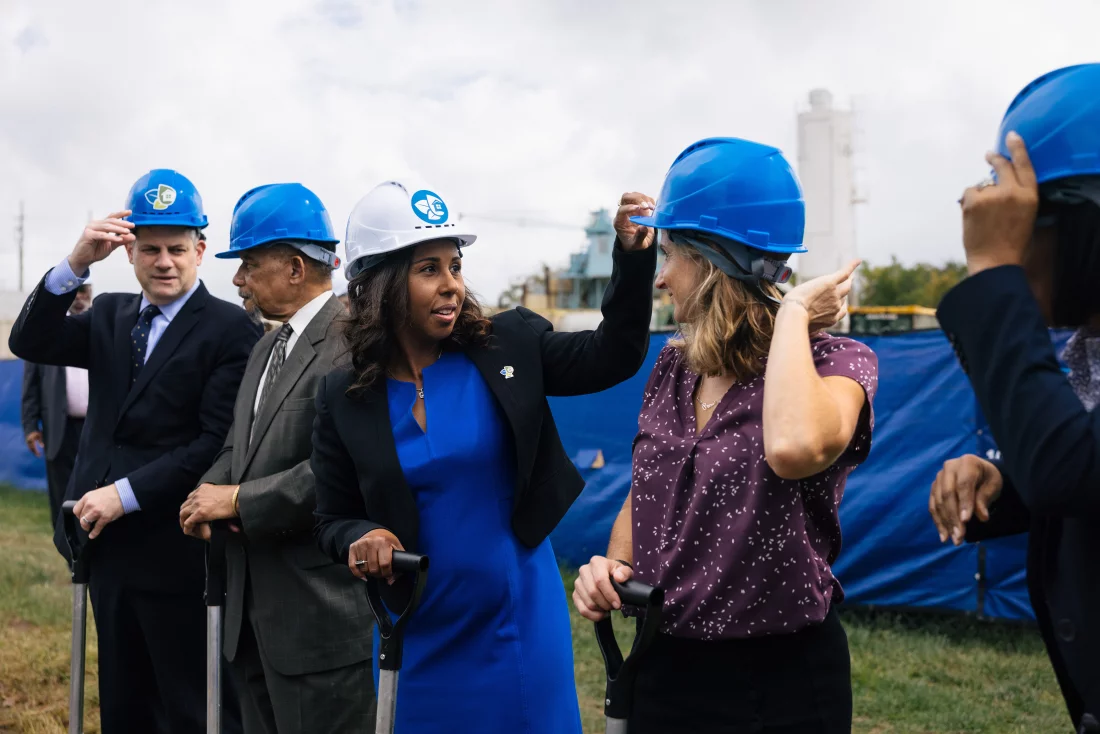
Chelsea Andrews (white hat), president and executive director of Montgomery County’s Housing Opportunities Commission (HOC), at groundbreaking for the Hillandale Gateway housing development in Maryland. The HOC owns 9,400+ home rental properties and provides subsidized housing for 9,300+ households.

Here’s how communities can build enough housing for residents: Don’t wait for the the feds.

Jennifer Ludden writes at National Public Radio, “A few miles outside Washington, D.C., a large dirt and gravel lot dotted with construction equipment was the site of a recent celebration. … It marked the kickoff for construction of Hillandale Gateway: 463 new mixed-income apartments that will be majority owned by Maryland’s Montgomery County.

“It’s public housing. Although this is a far different model than traditional, federally funded housing for only the very poor. …

“Montgomery County is a wealthy community, and it’s long focused on housing for lower-earning families. Still, it hasn’t built nearly enough to keep up with demand, and the gap is growing. So a few years ago, it took an unusual step: It created a $100 million revolving fund to dramatically ramp up construction.

“That means it can develop and finance its own projects ‘instead of waiting for Congress to give us a whole bunch more money,’ says Zachary Marks, the senior vice president for real estate with the county’s Housing Opportunities Commission. The public agency owns the controlling stake in these apartments.

“Congress has moved away from funding public housing for decades. And while there are federal incentives to help the private market build lower-cost apartments, ‘we’re using them all up every year and it’s not enough,’ Marks says.

“Now, by financing its own construction, the county doesn’t have to rely on private investors, either. Marks and others say that’s a major advantage in a boom-and-bust industry where volatility can stall financing for new projects. With the new housing production fund, he says, the amount of local money needed for a project is pretty small. And the county offers cheaper financing with a lower rate of return than private investors would demand.

“But the mixed-income model is what makes this all work in the long run. The market rate rents ‘come to us instead of flowing out to the private sector,’ says Marks, allowing other tenants to pay less. …

” ‘The people who will be living here are my seniors, my kids, my middle-aged adults, the workforce,’ says Chelsea Andrews, HOC’s president and executive director. ‘This is a community that will be inclusive on all economic levels but also in terms of our diverse communities.’ …

“Hillandale is the second project financed by the county’s fund. The first apartments, The Laureate, opened last year about a half hour’s drive away. …

“The building looks nothing like the image of U.S. public housing, most of which is generations old and severely underfunded. Among other amenities, there’s a full gym with yoga studio, a pet washing room and a courtyard pool.

“[Christina] Cooley says she immediately noticed the pool has a lift at one corner, to lower people with a disability safely into the water. … She says she has a traumatic brain injury and one side of her body is partially paralyzed.

” ‘Living here has changed my life,’ she says.

“Cooley is 43 and works part time as a teacher’s aide, but her main income is from disability. …

“Rents at The Laureate range from about $1,335 for a smaller one-bedroom — far below the county median — to $3,885 for a larger two-bedroom.

“A quarter of the units are for people making up to 50% of the area median income. In Montgomery County, that’s $77,350 for a family of four. An additional 5% of the units are called ‘workforce’ housing, for those who make up to 120% of area median income.

Importantly, says Marks at the housing commission, these apartments will be affordable permanently.

“By contrast, federal tax credits expire and lower-rent housing built with them can revert to market rate after 15 or 30 years.

” ‘There’s been a lot of uptake and interest for this model from jurisdictions of all shapes and sizes around the country,’ says Paul Williams, who heads the Center for Public Enterprise. He founded the group to push for more public development generally, including mixed-income housing financed at the local level. These projects are profitable, he says, and don’t use up other, scarce federal funding. …

“Other places that have considered or taken up the idea — sometimes called social housing, as it’s referred to in Europe — include New York and Massachusetts, as well as Chicago and Chattanooga, Tenn.”

More at NPR, here.
Read Full Post »

Photo: Melanie Stetson Freeman/CSM.
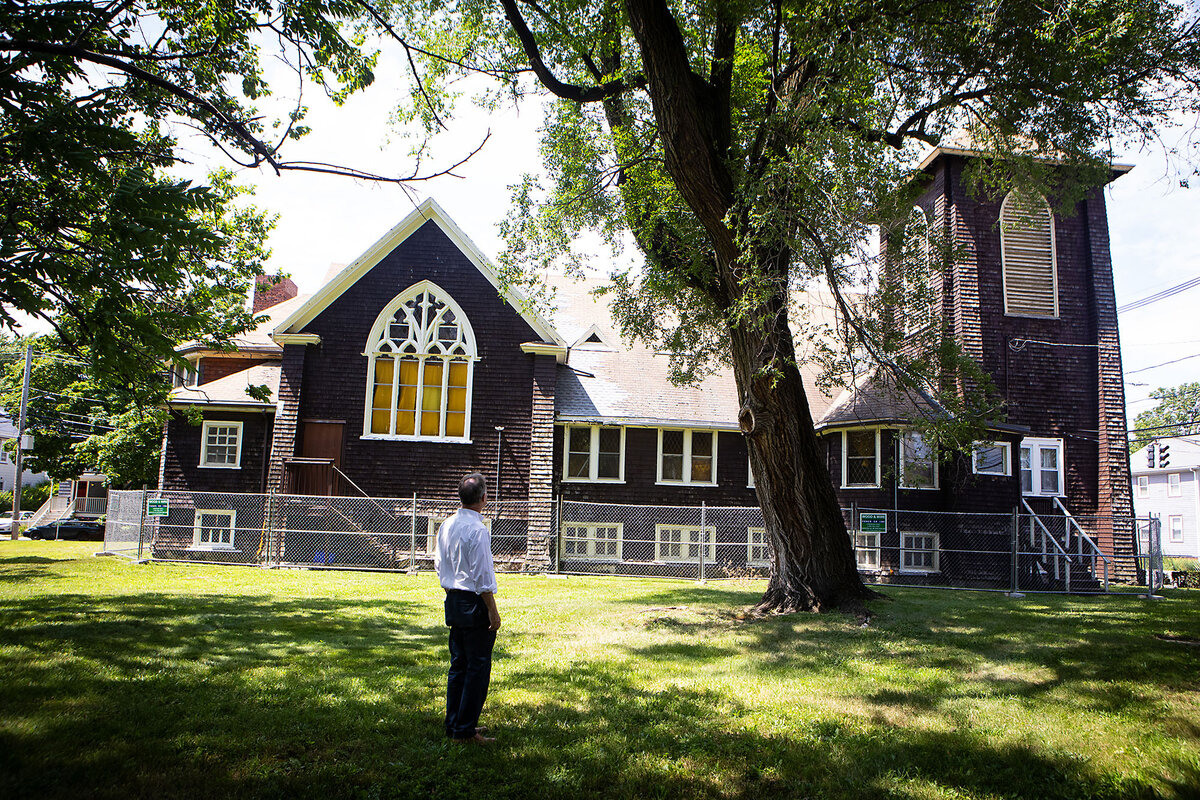
John Woods, director of Allston Brighton Community Development Corp. in Massachusetts, stands in front of Hill Memorial Baptist Church in July. The church and grounds are being turned into a housing complex for older adults.

My 9-year-old granddaughter assures me that the best place to stay overnight in Nova Scotia is a converted church. The light from the stained glass was beautiful, she says, and so was the rest of the building.

Her family’s rental was privately owned, but in today’s story we learn about a Boston-area initiative to turn other unused churches into subsidized housing. And Boston is not alone.

Troy Aidan Sambajon reports for the Monitor, “With its 58-foot bell tower standing sentinel, Hill Memorial Baptist Church has witnessed Allston-Brighton’s dramatic transformation. Upscale apartments and condos now stand on the site of once-bustling stockyards. Gourmet food shops have replaced affordable grocery stores. Now, the 120-year-old church is set for its own transformation. … The church is finding a new role in the community: much-needed affordable housing for older people.

“Churches and faith communities across the United States are increasingly closing their doors. Five years ago, The American Baptist Churches of Massachusetts, noting a dwindling congregation in Allston-Brighton, considered downsizing or repurposing the land. The choice was ultimately left to Hill Memorial’s congregation.

“In a final act of generosity, members chose to sell the land to fulfill the church’s ‘mission of giving back to the Allston community in the form of senior housing,’ says the Rev. Catherine Miller, former pastor, over email. With the blessing of its former congregation, the site will become 50 apartments for older adults on a fixed income. Today, the average price to rent a one-bedroom apartment in Allston is $2,786 per month, according to Apartments.com. The average wait time for senior housing in Boston currently stretches more than five years.

“ ‘Something good needed to happen here,’ says John Woods, executive director of Allston Brighton Community Development Corp., a housing developer. …

“Across the country, more faith communities are opening their doors to creative affordable housing solutions: Some are building homes on underutilized land or converting unused residences.

“In California, the grassroots ‘Yes in God’s Backyard’ movement led to the Affordable Housing on Faith Lands Act. This makes it legal for faith-based institutions to build affordable, multifamily homes on lands they own by streamlining the permitting process and overriding local zoning restrictions.

A federal version, the Yes in God’s Backyard Act, was introduced this spring by Ohio Sen. Sherrod Brown. …

” ‘It’s sad when a church closes,’ says Donna Brown, executive director of the South Boston Neighborhood Development Corp., which is leading the conversion of a former convent. ‘When they sit empty, it leaves a real void in the neighborhood. But when a building can be converted to housing so that people can stay in that community – it can be a wonderful thing to knit a community back together.’

“The U.S. is not building housing fast enough to support America’s aging population, according to Housing America’s Older Adults 2023 report, recently released by Harvard University’s Joint Center for Housing Studies. … By 2030, Americans age 65 and older will make up more than 20% of the population, according to Census Bureau projections. The need for affordable housing for this demographic will only grow. Meanwhile, homelessness is rising among older adults. …

“Sometimes, those being priced out of a neighborhood have lived there for decades. Moving means leaving not only friends but also support structures. Take Allston-Brighton, which was once a very affordable neighborhood, says Karen Smith, president of Brighton Allston Elderly Homes Inc. With rising rent costs and the cost of care, it’s tough for older adults on a fixed income to stretch their budgets thousands of dollars more a year. …

“In densely populated cities, the space to build affordable housing is often far from where it is needed most, says the Rev. Patrick Reidy, associate professor of law at the University of Notre Dame. However, faith communities and former churches are typically located in high-density areas that are accessible to the most people.

“ ‘These kinds of adaptive reuse projects for affordable housing are a win-win-win,’ says Professor Reidy. ‘The local governments that are desperately in need of land for affordable housing are given access by faith communities seeking to live out their religious mission, and those who need affordable housing don’t always have to uproot their lives from their neighborhood.’

“Boston is a prime example of this trend. The transformation of former churches … illustrates how adaptive reuse can unite communities in finding solutions to the housing crisis. The locations of older church properties in New England are unique for other reasons. Many are quite literally older than zoning laws, which were first passed around the 1920s.

“Blessed Sacrament Church sits at the heart of the historic Latin Quarter. It is set to become a sanctuary of affordable living, with 55 income-restricted units, along with a performance and community space.

“The building sat empty for years. High restoration costs prompted its owners to contemplate selling it to developers on the open market to become high-end apartments. Former parishioners and residents opposed the sale and advocated for community input. In the end, after meetings attended by hundreds in the area, the selected proposal from developer Pennrose aimed to preserve the historic exterior of the church while renovating the interior to create affordable housing.”

More at the Monitor, here. No firewall. Subscriptions are reasonable. For more on repurposing old church buildings, see the other part of the Monitor series, here.

Read Full Post »

Photo: Richard Conway/Bloomberg CityLab.
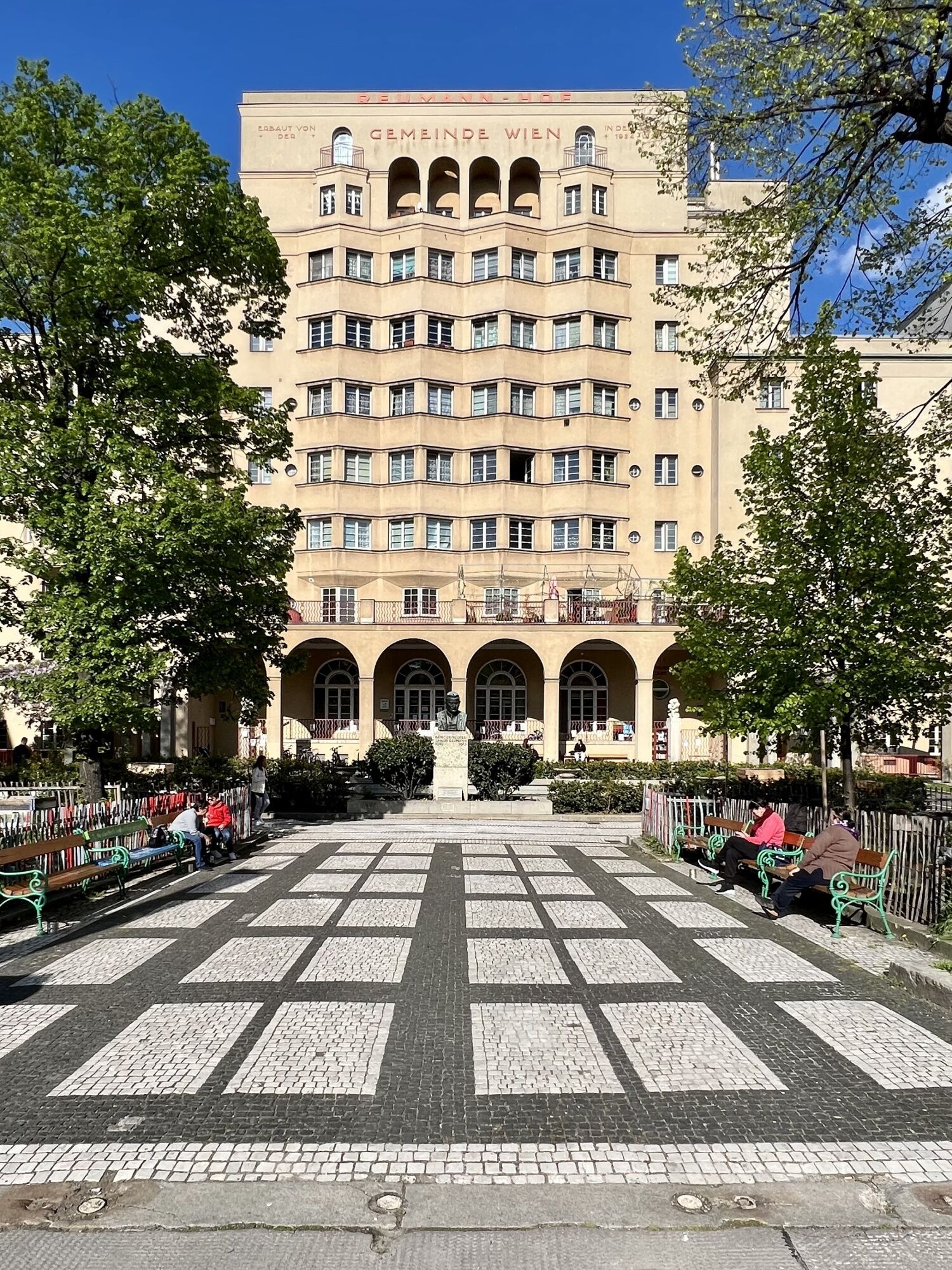
The 478-unit Reumannhof, public housing completed in 1926, was named for Vienna’s first Social Democratic mayor, Jakob Reumann.

Making sure all residents have decent housing is a challenge for cities around the globe. Richard Conway at Bloomberg CityLab says Vienna pretty much figured it out in the 1920s. He maintains it’s the reason Vienna is such a livable city today.

“The housing crunch that the growing city of Vienna faced a century ago,” he writes, “might seem strikingly familiar today: Private developers in the Austrian capital were good at building elegant luxury residences and substandard tenements for the poor, but they’d failed to create enough units to allow average residents to live in decent comfort at an affordable price.

“In response, Vienna’s Social Democratic government pursued a solution that modern cities still struggle to emulate: a massive construction program for public housing.

“The municipal apartment complexes they built, known as Gemeindebau, provided new homes at a volume and level of quality never seen before, and rarely seen since. The long-term results not only saw conditions for the average Viennese skyrocket, they also provided a hugely influential example for cities from Moscow to Manhattan.

These cities-within-a-city included medical facilities, schools, libraries, post offices and theater spaces.

“The Viennese Gemeindebau — plural Gemeindebauten — emerged in a city already in flux. Following Austria’s defeat in World War I, the country’s empire had dissolved and its monarchy was replaced by a democracy, in which the Social Democratic Workers Party (SDAPÖ) had the largest number of seats, both nationally and in Vienna. Once in power, the Social Democrats started addressing an issue central to their base: the overcrowding plaguing the new republic’s capital.

“In the 40 years leading up to 1918 … working-class families often lived in tenements known as Bassena, so named after the communal sinks found in their hallways. While they could look grand from the street, six or seven people might pack into a single apartment; often, each household shared a toilet and a sink and lacked electricity or heating beyond coal and wood stoves. They weren’t cheap, either: About 25% of a tenant’s wages went toward monthly rent, according to a 2022 MIT study.

“Starting in 1919 and continuing through to 1934, the Social Democrats launched a series of wide-reaching urban reforms focused on improving living conditions, education and social services. This period of SDAPÖ rule, widely known as Red Vienna, was informed by non-Bolshevik Austro-Marxism, which emphasized democracy, parliamentary politics and public investment. The Gemeindebauten, or municipal housing projects, were born.

“In the early days of the administration, there were two competing types of Gemeindebau. The first was associated with the settler movement: a group of low-income Viennese and refugees displaced from Austria’s fragmenting empire who occupied squatter settlements on the city’s periphery in an era of postwar political and social disruption. Viennese authorities eventually took over these informal communities, formalizing and planning them using elements of the Garden City philosophy.

“It was a second, much more common type of Gemeindebau, however, that came to define Vienna — the superblock-scaled Volkswohnungspaläste (‘people’s apartment palaces’). …

“Neither elaborately decorative like Vienna’s prewar tenements nor strikingly spare like the glass-and-steel apartments of the later International Style, the Gemeindebau often straddled an intriguing line between late 19th historicism and 20th century modernism. …

“Like older tenements, the buildings were typically aligned with streets, accessorized with some decorative features such as fancy brickwork or statuary and grouped around shared common yards. But while Bassena courtyards tended to be narrow, treeless and drab, the huge courtyards of the Gemeindebauten were spacious enough to serve as as combined garden, sports facility and public square, all accessible and sheltered from street noise. …

“In general, the shared areas within the superblocks were in fact as important as the individual homes, reflecting the Viennese administration’s social philosophy. These cities-within-a-city included medical facilities, schools, libraries, post offices and theater spaces. Curved staircases connected large floors — often as many as seven — and spacious landings. …

“The individual apartments, while varying in layout, shared key features. They included a living room, a bedroom, a kitchen, and some had small entrance hallways inside the front door. Almost all units featured running water, while many had large windows and balconies. Each apartment usually housed an individual family.

“Vienna employed nearly 200 architects to build more than 380 Gemeindebau complexes between the wars, a construction boom that created 60,000 new municipal apartments. In her book The Architecture of Red Vienna 1919-1934, Harvard professor Eve Blau describes how the municipal government was able to do this through expropriation, the use of tax policies to reduce land values and zoning laws. By 1931, it owned a third of the city’s area.

“Working-class citizens might now expect to live in airy apartments and access shared facilities. Indeed, the urban philosophy of Gemeindebauten is neatly captured by a term carved by artist Mario Petrucci into a statue outside a housing project: … ‘Light in the home. Sun in the heart.’ This was more than just a slogan; it represented an entire worldview.”

More at CityLab, here. No paywall. Interesting pictures.

Read Full Post »

Here’s an idea that could give a welcome boost to underprivileged children: a free connection to the Internet at their home.

It seems that Google, in the spirit of its discontinued motto “Don’t be evil,” is piloting a new public service.

Matt Hamblen at Computerworld reports, “Google Fiber [recently] announced free gigabit Internet service to residents of selected public housing projects connected to its fiber optic service in U.S. cities.

“The program was launched at West Bluff, an affordable housing community in Kansas City, Mo., where 100 homes have been connected to Google Fiber. Across the Kansas City area, Google is now working with affordable housing providers to connect as many as nine properties that could reach more than 1,300 local families.

“Google described the program as an extension of its work with ConnectHome, an initiative of the U.S. Department of Housing and Urban Development (HUD) and the Obama administration. …

“In addition to free Internet, eligible residents will work with ConnectHome partners like Connecting for Good and Surplus Exchange to be able to purchase discounted computers and learn new computer skills, Google said.” More here.

Depending on what the housing developments are like to live in and whether they provide supports like the Family Self-Sufficiency program to move people to independence, this could be a useful piece of the difficult poverty-reduction puzzle. So, good on Google!

Photo: ConnectHome 
A resident of West Bluff in Kansas City and her son are among the first of 1,300 families in area affordable housing units to receive Google Fiber gigabit Internet service at no cost.

Read Full Post »