Feeds:
Posts
Comments

Posts Tagged ‘publisher’

Photo: Howard LaFranchi/The Christian Science Monitor.
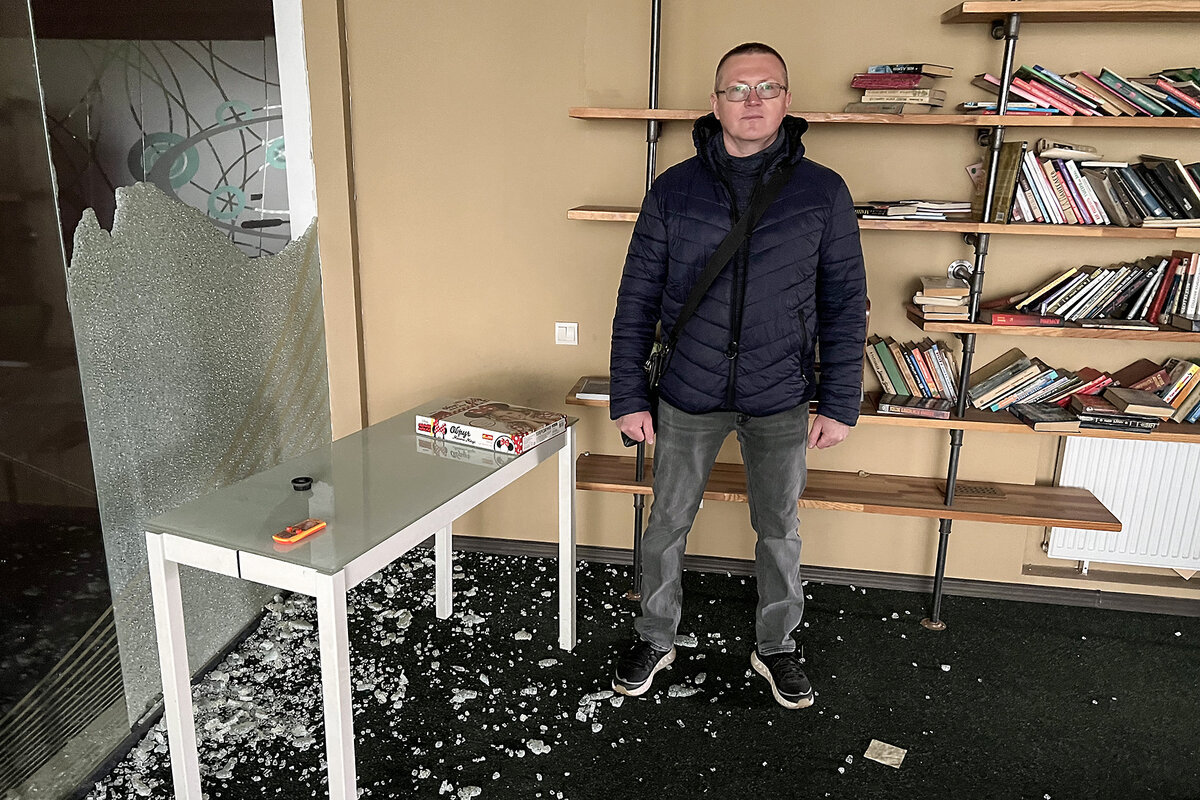
Ihor Pohorielov, commercial director of Ranok Publishing, at the company’s bomb-damaged offices, in Kharkiv, Ukraine, Nov. 4, 2024.

If ants can keep working and rebuilding after we’ve knocked over their anthill, how much more humans in war zones?

Among the many buildings damaged or destroyed by the Russian invasion in Ukraine are publishers of books. But books remain strong and Ukrainians keep reading.

Here’s a story by Howard LaFranchi at the Christian Science Monitor.

“Across Ukraine, but especially in Kharkiv, the country’s publishing capital, Russia’s war has been something of a boon to the nation’s publishing industry. More Ukrainians are seeking solace and distraction in books, and interest in Ukrainian literature and Ukrainian-language books is spiking.

“Many of the country’s publishing houses – from textbook-publishing giants to boutique operations specializing in culture – are keeping busy. And this despite the fact that Russian President Vladimir Putin has made publishing houses a key target of his war on Ukrainian culture.

“Publishers say a combination of their resolve to keep operating and a reawakened enthusiasm for books among a variety of readers is keeping the presses running.

“ ‘The war is reminding Ukrainians that books are an outlet for joy, for culture, for travel, when other outlets are closed to us,’ says Yuliia Orlova, general director of Vivat Publishing.

“ ‘We hear all the time about people rediscovering the joys of books as they spend less time on their computers and phones,’ she says. ‘People want to distract themselves from all the sad and depressing things going on around them, so they turn to fiction and fantasy. It’s their way to escape.’

“One night in November, Ihor Pohorielov was awakened by a Russian bomb blast that nearly shook him out of bed. His thoughts went to the modern offices and cavernous storage facilities where he works as the commercial director for Kharkiv’s Ranok Publishing, and which had already been the target of Russian air strikes. …

” ‘I thought of the orders we need to get out and the clients we need to serve – so I came into work’ the next day. …

“Across Ukraine, but especially in Kharkiv, the country’s publishing capital, Russia’s war has been something of a boon to the book publishing business.

“As more Ukrainians seek solace and distraction in books, and as interest in Ukrainian literature and Ukrainian-language books spikes, many of the country’s publishing houses – from textbook-publishing giants to boutique operations specializing in culture – are keeping busy.

“And this despite the fact that Russian President Vladimir Putin has made publishing and printing houses a key target of his war on Ukrainian culture.

“Kharkiv’s publishing industry was shaken to its core last May when a Russian S-300 missile struck the giant Faktor-Druk, one of Europe’s largest printing houses. The blast destroyed presses, incinerated some 100,000 books, and knocked out the three publishing companies housed there. …

“But the sense of devastation was short-lived. In a show of solidarity, several European publishers offered to print Ukrainian books for distribution to millions of Ukrainian refugees around Europe.

“An American philanthropic organization, the Howard G. Buffett Foundation, quickly agreed to pick up the tab for Faktor-Druk’s reconstruction. …

“ ‘Printing in Kharkiv is hanging on despite the almost daily attacks on the city,’ … says Yuliia Orlova, general director of Vivat Publishing, a division of the Faktor Group. …

“Ms. Orlova does not hide the fact that the war has been devastating for Ukrainian publishing in many ways, especially for the people who work in the sector. ‘The attacks and the destruction in the city have a big impact on the mental health of our workers. People don’t sleep and they are constantly worried for their families,’ she says. …

“Since 2022, the number of registered publishers in Ukraine has plummeted from about 1,600 to 150, Ms. Orlova says. …

“But Ms. Orlova cites another statistic that underscores the bright side of Ukrainian book publishing: Over the same period, the total number of books printed grew by 70%.

“The reasons for that jump are largely related to the war. Russia’s systematic destruction of Ukraine’s infrastructure has meant widespread power outages and spotty access to the internet, Ms. Orlova says. ‘We hear all the time about people rediscovering the joys of books as they spend less time on their computers and phones,’ she says. …

“Mr. Putin’s war on Ukrainian culture – targeting museums, churches, universities, and publishing houses – is feeding a renewed interest in history, language, art, and literature that confirm Ukrainian nationhood, publishers say.

” ‘Interest among Ukrainians in who we are was already starting to grow, but it was the full-scale invasion that really encouraged this desire to know more about our history and culture,’ says Oleksandr Savchuk, whose specialty Kharkiv publishing house carries his name.

“ ‘For many Ukrainians, the picture of who we are was like a puzzle with lost pieces,’ he says. ‘But now people are finding those pieces so we can complete the full picture.’

“To help nurture that process, in 2023 the philosophy professor and publisher opened a facility he calls a ‘Book Strongroom,’ a combination bookstore, event space, and neighborhood bomb shelter adjacent to his publishing operations. …

“Oleksandr Savchuk is a small player who has published about 50 titles over the last decade. … ‘For the 12 years before the invasion I was suffering to try to show people their great history and culture. It was a hard-going process,’ he says. … ‘I see now that I’m being heard.’ “

More at the Monitor, here. No firewall, reasonable subscriptions rates for a paper unusually strong in international news.

Read Full Post »

Photo: Joel Goodman/The Guardian.
Kevin Duffy has built a publishing business in his home that focuses on ten books a year, many of them prize contenders.

Do you know the Aesop fable in which animal mothers brag about the number of their children? According to MIT Classics, “A controversy prevailed among the beasts of the field as to which of the animals deserved the most credit for producing the greatest number of whelps at a birth. They rushed clamorously into the presence of the Lioness and demanded of her the settlement of the dispute. ‘And you,’ they said, ‘how many sons have you at a birth?’ ”

And the Lioness said, “I have only one. But that one is a lion.”

That is my introduction to a story about a publisher who publishes only ten books a year.

Helen Pidd, North of England editor of the Guardian, writes, “The two-up, two-down terraced house on a cobbled Hebden Bridge street does not look like the headquarters of a multi award-winning publishing house.

“There is no gleaming edifice, no sign and certainly no reception desk. The green front door leads straight into Kevin Duffy’s living room, the nerve centre of Bluemoose books, his independent literary hit factory.

“It is at a cluttered table in the corner that Duffy has built a business with a success rate that billion-pound publishers regard with envy. Each year, Bluemoose puts out no more than 10 titles, but a remarkable number end up in contention for major literary prizes.

“Each author is handpicked by Duffy, 62, a self-confessed ‘control freak’ from Stockport, Greater Manchester, who spent years as a salesperson for big publishers before remortgaging his house to start Bluemoose in 2006. …

“It was Duffy who published Benjamin Myers’ The Gallows Pole, which has been made into a BBC series that was given five stars by the Guardian. …

“In March, Bluemoose won best northern publisher at the Small Press of the Year awards. In April, a Bluemoose title – I Am Not Your Eve, the debut novel by Devika Ponnambalam, which tells the story of Paul Gauguin’s child bride and muse, Teha’amana – was shortlisted for the £25,000 Walter Scott prize for historical fiction. …

“Bluemoose’s current bestselling author is Rónán Hession, a former musician who balances his writing career with being the assistant general secretary of the department of social protection in the Irish government.

“Hession’s 2019 debut Leonard and Hungry Paul, a funny and tender story about kindness, has sold more than 125,000 copies worldwide. A bestseller in Germany, it has also attracted fans in Hollywood – Duffy recalls receiving an email from someone claiming to be Julia Roberts’s agent. …

“ ‘Then her PR person got in touch saying she wanted to get in touch with Rónán because she loved the book. … How wonderful is that? She just wanted to say thank you,’ he said. …

“Another Bluemoose success story with a day job is Stuart Hennigan, a librarian from Leeds. Ghost Signs, an eyewitness account of the impact of the early days of the pandemic on those living in poverty, made the shortlist of the Parliamentary Book awards.

“Duffy shares an anarchic streak with Hennigan, finding it hilarious when he turned up to the Tory-packed ceremony in a T-shirt that said: ‘Still hate Thatcher.’ …

“Duffy remains Bluemoose’s only employee, drawing a ‘tiny’ salary, working with five freelance editors, including his lawyer wife, Hetha.

“He is happy that way. ‘I don’t want to be the next Penguin. I don’t want to be a huge business. I just want to publish eight to 10 books a year, make a bit of a profit and invest it all back into the business to find new writers,’ Duffy said.

“Running Bluemoose is a seven-day-a-week vocation. On an average day, Duffy receives 10-20 unsolicited pitches, usually the first three chapters of a new book, all of which, he insists, he reads. Perhaps four in a month will grab his attention enough for him to ask for the full manuscript.

“Duffy insists that there remains a ‘class ceiling‘ in the publishing of literary fiction. LGBTQ+ writers are being given deals, as well as people of color, he says, but working-class writers are not being heard. …

“ ‘The people making those publishing decisions, because of their educational background and their life background, are not reading books about people in the rest of the country. You know, 93% of the people in this country don’t go to private school. There’s a reading public out there that wants books about themselves and the areas they live in.’

“Myers, he notes, originally signed with Picador, which would not publish Pig Iron, his third novel about a Traveling community in the north-east. ‘Because, they said, “who would be interested in a working-class character from a small northern town?” That small northern town was Durham, theological capital of Europe for 2,500 years.

“ ‘Pig Iron went on to win the inaugural Gordon Burn prize. Ben’s next book, Beastings, won the £10,000 Portico prize. Then The Gallows Pole won the world’s leading prize for historical fiction. Then all the agents were interested,’ he said.”

As a reader who turns to Dickens whenever in doubt, I am surprised to find that I actually have read (and liked) one of these: Leonard and Hungry Paul. That’s because Wendy Greenberg, a prolific UK reader on Goodreads, wrote about it.

More at the Guardian, here.

Read Full Post »

Photo: Jennifer Croft via the First News.
The translator Jennifer Croft will no longer work with publishers who don’t put her name on the cover.

There’s a book by French-to-English translator Kate Briggs called This Little Art. Briggs and others have been opening my eyes lately to the notion that translators are almost on the level of the author they translate. They write a new version of the book. It’s an art.

Alexandra Alter wrote an interesting story at the New York Times about another translator, Jennifer Croft. She knows her worth.

“When Jennifer Croft talks about translating the Polish novelist Olga Tokarczuk’s novel Flights, she sometimes affectionately refers to the book as ‘our love child.’

“ ‘It’s Olga’s, but also it has all of these elements that are mine, these stylistic elements and these decisions that I made,’ she said in a recent interview.

Flights was a labor of love for Croft, who spent a decade trying to find a publisher for it. It was finally released by Fitzcarraldo Editions in Britain in 2017 and Riverhead in the United States in 2018, and was celebrated as a masterpiece. The novel won the International Booker Prize and became a finalist for the National Book Award for translated literature, helping Tokarczuk, who was later awarded the Nobel Prize, gain a much larger global audience.

“But Croft also felt a twinge of disappointment that after devoting years to the project, her name wasn’t on the book’s cover. Last summer, she decided to make a bold demand:

“ ‘I’m not translating any more books without my name on the cover,’ she wrote on Twitter. ‘Not only is it disrespectful to me, but it is also a disservice to the reader, who should know who chose the words they’re going to read.’

“Her statement drew wide support in the literary world. Croft published an open letter with the novelist Mark Haddon, calling on publishers to credit translators on covers. The letter has drawn nearly 2,600 signatures. … Her campaign prompted some publishers, among them Pan Macmillan in Britain and the independent European press Lolli Editions, to begin naming all translators on book covers.

“Croft’s latest published translation is Tokarczuk’s The Books of Jacob, a 900-plus page historical novel about an 18th-century Eastern European cult leader named Jacob Frank, whose story unfolds through diary entries, poetry, letters and prophecies. …

“This time, Croft’s name appears on the cover. Riverhead added her after she and Tokarczuk requested it. Croft is also being paid royalties for The Books of Jacob, which she didn’t receive for Flights. (Translators, who typically receive a flat, one-time translation fee, don’t automatically get a share of royalties from most publishers.) …

“ ‘She is incredibly linguistically gifted,’ Tokarczuk said in an email. ‘Jenny does not focus on language at all, but on what is underneath the language and what the language is trying to express. So she explains the author’s intention, not just the words standing in a row one by one.’ …

“For Croft, the campaign to bring greater recognition to translators isn’t just a plea for attention and credit, though it’s partly that. Croft also believes that highlighting translators’ names will bring more transparency to the process and help readers evaluate their work, the same way they might assess an audiobook narration for not just the content but for the performance.

“Translation isn’t just a technical skill, but a creative act, she argues. ‘We should receive credit, but also have to take responsibility for the work we have done,’ she said. …

“That work often entails much more than rendering sentences and syntax from one language to another. Translators also find themselves in the role of literary scout, agent and publicist. Many are constantly reading in the languages they’re fluent in to find new authors and books, then pitch them to publishers. When English-language versions come out, translators are often called upon to facilitate interviews and join authors on book tours and manage their social media accounts in English.

“Translated literature accounts for just a fraction of titles published in the United States. Despite the success of books by international stars like Elena Ferrante, Haruki Murakami and Karl Ove Knausgaard, many publishers still worry that American readers are put off by translations. …

That belief has become something of a self-fulfilling prophecy. Since 2010, fewer than 9,000 English-language translations of fiction and poetry have been published, and in 2021, just 413 translations were released, according to a database of English-language translations that is compiled and maintained by Chad W. Post, the publisher of Open Letter Books, and is available on Publishers Weekly’s website. …

“An even smaller number of titles feature translators on the cover. Less than half of the English-language translations released in 2021 had translators’ names on the covers, Publishers Weekly reported last fall.”

More at the Times, here.

Read Full Post »

Barefoot Books, the children’s book publisher, opened its retail store in Concord this past spring.

In addition to selling books, the shop offers storytelling and pottery every day and numerous other activities, like music, dance, and yoga for children. There is a puppet theater play area, a kitchen for food events, and toys. Note the list of August activities in the photo.

The neighbors, by and large, loved the way the company decorated this long-empty building. And they especially loved the new landscaping.

Read Full Post »