Feeds:
Posts
Comments

Posts Tagged ‘publishing’

Photo: Maxine Wallace/The Washington Post.
Books with decorated page edges (spredge) are becoming increasingly popular.

Although I always liked the designs on the edge of pages in fancy, old-time books, I never thought about all the ways you can use so-called “spredges” to convey the appeal of your book in the bookshop.

Sophia Nguyen writes at the Washington Post that the phenomenon has recently gained adherents.

“Sumptuous fore-edges — sprayed a bright color, stenciled with city skylines, made to look like pointy teeth — used to be relatively rare. But in recent years, publishers have brought decorated edges to the masses. Edge-painted books are now so widespread that you can find them at Walmart. The feature has spread from romance and fantasy to horror, thrillers and even literary fiction; it’s spread from works by famous authors with ravenous followings to those by debut novelists hoping to make a splash. It even has a (horrifying) portmanteau: spredges. On social media, readers show off floor-to-ceiling shelves crammed full of these books — spines facing inward, of course.

“Jim Sorensen, president of Lakeside Book Company, the largest book manufacturer in North America, recalled the time a decade ago, when a colleague brought back edge-printing samples from a work trip to Europe. ‘Honestly, there wasn’t a whole lot of interest’ from clients, Sorensen said. Times have changed. …

“The surge was driven by a few corners of the publishing world. Subscription companies, such as LitJoy Crate and Illumicrate, seeded interest (and a sense of exclusivity) among readers as they printed relatively small runs that quickly sold out. Self-published authors, selling special editions of their books on their personal websites or at conventions, also helped to popularize the look. This prompted publishers to invest in the trend. When, in 2023, Bloom Books sprayed the pages of Elle Kennedy’s Off-Campus novels in powder blue, the set hit the bestseller lists — an unusual success for a collector’s bundle. …

“Barnes & Noble, after seeing the trend take off with the exclusive editions sold by its sister chain Waterstones, now devotes an entire section of its website to decorated, stenciled and sprayed edges. Decorated edges have ‘developed into an extension of the book experience itself,’ said Shannon DeVito, director of books at Barnes & Noble.

“The printed-edge craze has also opened up a new business niche. Inspired by DIY videos, Stephanie Moreno launched an edge-painting service this year, including live painting at author events. What, after all, could be more limited than an edition only offered at a single local signing? …

“For designers, the edge gives a whole new surface to play with and another opportunity to make a book recognizable. ‘From a creative standpoint, it’s thrilling,’ said Molly Waxman, executive director of marketing for adult fiction and nonfiction at Sourcebooks. Logistically, there were some kinks to work out, she added — such as building in time for ink to dry, so pages don’t curl unattractively.

“As printed edges have flooded into stores, ramping up the competition for eyeballs, ‘the bigger race is being able to manage all of these specs and still hold a price point that’s not going to be so difficult for a consumer,’ [Bloom editorial director Christa] Désir said. …

“When, in the 1500s, people in the English-speaking world started storing their books upright and on shelves — moving them from chests and lecterns — they stored them just as many TikTokers do: with pages facing out. Title information was printed there in ink, said Mark Purcell, director for research and collections at Cambridge University’s libraries and archives.

“Then, starting around the early 1600s in England, modish bookbinders started gilding titles on the spines of books, and so collectors started to reverse their displays. The practice spread gradually and unevenly over a century-and-a-half in what’s called ‘the Great Turnaround.’ 

“ ‘It depends where you are, how up-to-date you are, how fashionable you are, how wealthy you are, what your library is like, all sorts of things,’ Purcell said. …

“He did note one possible practical consideration favoring the old way: Some libraries threaded chains through their collections for security reasons, and the system only worked with the pages facing out.”

More at the Post, here.
Read Full Post »

Photo: Claudia Wolff/Unsplash.
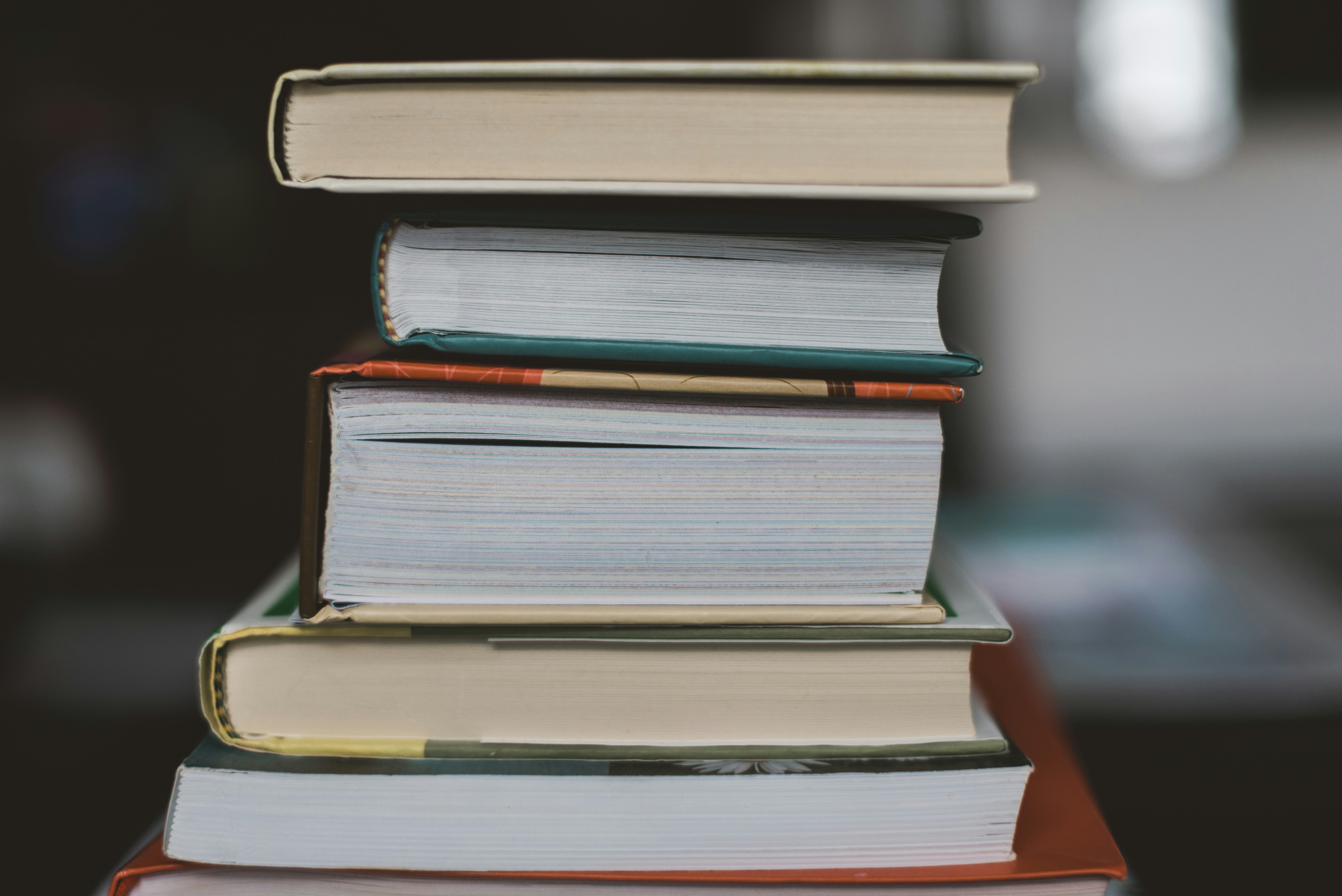
Do books use too much paper?

Those of us who still prefer a solid book to a pale, digital imitation may sometimes wonder whether we are encouraging the use of too much paper, especially since overstocks can end up in landfills.

Curiously, at least one publisher is thinking along the same lines.

Elizabeth Segran writes at Fast Company, “Over the past three years, HarperCollins’s designers have put their skills toward a new mission: saving paper. In an effort to reduce the carbon footprint of each book, they’re tweaking fonts, layout, and even the ink used. The goal is to pack more into each page, while ensuring that the pages are as readable as ever. And so far, these subtle, imperceptible tweaks have saved 245.6 million pages, equivalent to 5,618 trees.

“HarperCollins’s Christian publishing division, Zondervan Bibles, first came up with the idea of using design to save paper. Bibles have historically used upwards of 2,500 pages. In 2015, Zondervan’s designers determined that if they used different fonts and adjusted the page layout, they could reduce the number of sheets used. It would also cut HarperCollins’s printing costs. They developed a new compact typeface called the NIV Comfort Print. Ultimately, it saved more than 350 pages per bible, resulting in a total savings of 100 million pages in 2017. Stacked up, that would be the equivalent to four times the height of the Empire State Building.

“Tracey Menzies, the VP of creative operations and production at HarperCollins, wanted to see if the company could apply these learnings to other kinds of books. … The team got to work. They tested their theories with a large book in their catalog — more than 600 pages — by creating 50 versions of it using different fonts. HarperCollins uses a wide range of off-the-shelf fonts in its books, rather than custom ones. As the team ran the experiments, they observed that some fonts were more compact, resulting in fewer total pages, while remaining easy to read. So they curated a list of 15 fonts they determined are the most eco-friendly, which will be the preferred fonts from now on.

“In the end, the designers found that clever font selection, coupled with a thoughtful layout design that reduced white space, resulted in more words per page. For instance, in one example, the same text set to Garamond Pro resulted in many more words on the page compared to Bembo. Both fonts are fairly similar, with a classic serif look. And when you place them side by side, the differences are imperceptible. ‘The goal is to make these changes without the reader even seeing the difference,’ says Menzies.

“But there were also many complexities in the process. For instance, they had to consider the heaviness of the font. One font they used frequently is Bodoni, which was first created in 1798, and appears frequently in HarperCollins books. As a very heavy font, they realized they could fit more words on a page, while keeping it readable. But they also found that with very large letters, like subheadings, the ink would bleed through the paper, making it hard to read the words on the next page.

“ ‘The designer is always balancing out not just a single page, but also what’s on the page before and the page after,’ says [Leah Carlson-Stanisic, associate director of design at HarperCollins]. ‘Ultimately, this ended up with finding fonts that used less ink, in addition to less paper, which is also better for the planet.’

“Still, there is complex math involved with cutting pages from books. Printers produce very large sheets, which are then cut and folded into what ultimately becomes segments of 16 pages. When trying to cut pages from the book, designers need to be able to remove multiples of 16 pages. For the book So Fetch, for instance, using a more eco-friendly font saved nearly a million pages in total over the entirety of its print run. ‘We want to make sure our big titles, by prominent authors, are using these eco-fonts,’ says Carlson-Stanisic. ‘It adds up a little bit at a time, saving more and more trees.’ …

” ‘When we experimented with these fonts, we realized they weren’t a limitation at all,’ Menzies says. ‘It was simply a different approach that didn’t sacrifice aesthetics. Now, our designers are constantly questioning how we do things and thinking about ways to make things more sustainable.’

More at Fast Company, here.

Read Full Post »