Feeds:
Posts
Comments

Posts Tagged ‘quahog’

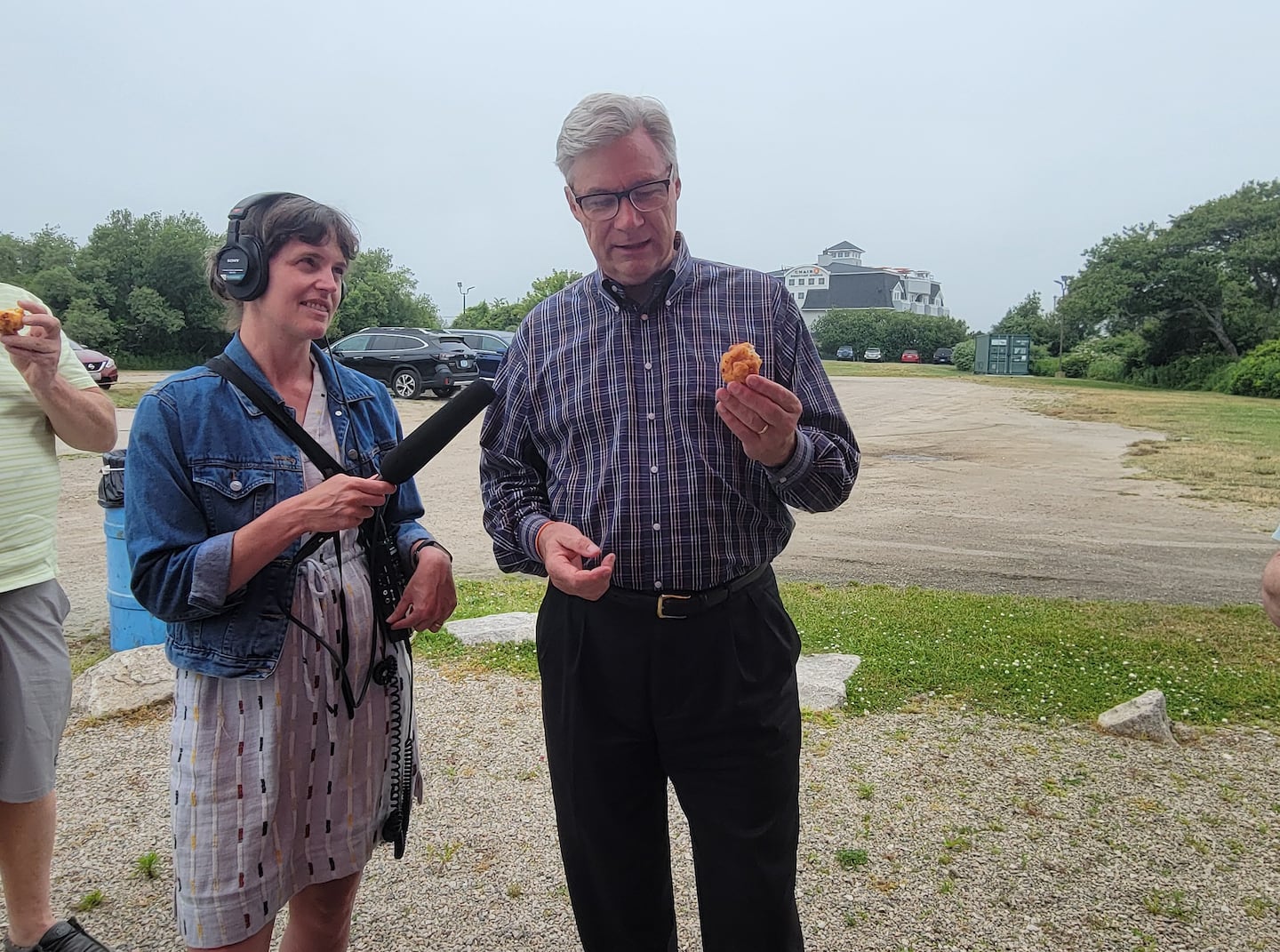
Photo: Lil Rhody Clam Cake Crawl.
Megan Hall, left, producer of the Rhode Island Report podcast, listens as US Senator Sheldon Whitehouse analyzes a clam cake as part of the 10th Lil Rhody Clam Cake Crawl.

Rhode Island is justly proud of its clam cakes, which is why local enthusiasts launched an annual hunt for the very best.

At the Boston Globe, Ed Fitzpatrick wrote about one distinguished guest who lent his opinions to fellow Rhode Island “Clamarati” during the 10th Lil Rhody Clam Cake Crawl.

“As they stood outside Aunt Carrie’s Restaurant,” Fitzpatrick wrote, “Renee Bessette asked US Senator Sheldon Whitehouse why he had agreed to join the 10th Lil Rhody Clam Clake Crawl.

“ ‘A momentary lapse in judgment,’ Whitehouse replied with a laugh.

“But the Senate Judiciary Committee member grew serious when it came time to judge Rhode Island clam cakes using a rigorous seven-point rubric that includes ‘clam-to-cake ratio’ (does it have a lot of clams?), ‘clambiance’ (as an overall experience, would you go here again?), and ‘nubbins’ (Does it have protrusions, often clams, that can also be used as a handle as you eat?).

“ ‘Less on crispy. Smaller. More on tenderosity,’ Whitehouse said as he contrasted an Iggy’s clam cake with an Aunt Carrie’s clam cake.” Read all of the Senator’s insights at the Globe, here

Blogger Hunter Gather Cook also has a Rhode Island clam cake post, which includes a recipe that recommends using freshly ground clams if at all possible.

“Think clam beignet, or donut hole,” writes Hunter Gather Cook. “Only savory. Crispy, golden brown on the outside, pillowy and light on the inside. Steam rises from the first bite. The slightest aroma of brine surrounds you. Tiny chunks of clam nestle themselves in the folds of the pillow, offering surprising bites of chewy meatiness as you down one of these little glories after another. And another.

“With the possible exception of the Pacific Northwest, no region can boast mastery of the humble clam like New England. And within New England, it is Rhode Island that does it best. I have never seen these clam cakes any other place. They are a masterpiece of street food. …

“They are to me the gateway food of Block Island, which is the place I learned to forage and the place whose natural beauty I still hold closest to my heart. My fondest wish is to die an old man in a little cottage on that island. But not just yet.

“I am 3,100 miles from Block Island right now, a long way from Galilee and Rhody clam cakes. A few days ago, as I drove home from Bodega Bay, laden with clams, I realized that this was my first real chance to make clam cakes with fresh clams I had caught since I’d moved West years ago.

“I looked at my bucket of horseneck clams, dug an hour before. While they are certainly not the glorious quahog of my youth, they would do just fine in a clam cake — after all, you grind the clams anyway. …

“My recipe has no corn. More clams than the typical fritter, cake flour instead of all-purpose, and a touch of maple syrup. Maple syrup? Trust me. You need it.

“Now normally Rhode Island clam cakes are served with Tabasco and tartar sauce. … I am more of a Tabasco man. But I could not keep thinking about how much these were like New Orleans beignets. So I decided to break from Rhode Island tradition and add a little bit of the Big Easy to this recipe: Remoulade.

“If I thought I loved clam cakes before this, I may now be a clam cake junkie. … The recipe I made was way too much for Holly and I to eat at one sitting, but I decided to make them all anyway. We gorged ourselves on clam cakes until we were about to burst. I put the leftover cakes in the fridge.

“And you know something? They fried up almost as good the next day. Popped back in the deep fryer for 2-3 minutes, they came out fine.”

Any clam cake recipe including remoulade will horrify RI clamarati, but here goes. It starts with “canola or other vegetable oil for frying, 3 beaten eggs, 1/2 cup buttermilk, 1/2 cup clam broth, 1/2 cup cold beer, 2 teaspoons maple syrup, 1 1/2 cups chopped or ground clams, 1 teaspoon salt, 2 1/2 teaspoons baking powder, and 3 1/2 cups cake flour, or all-purpose flour.”

More at Hunter Gather, here.
Read Full Post »

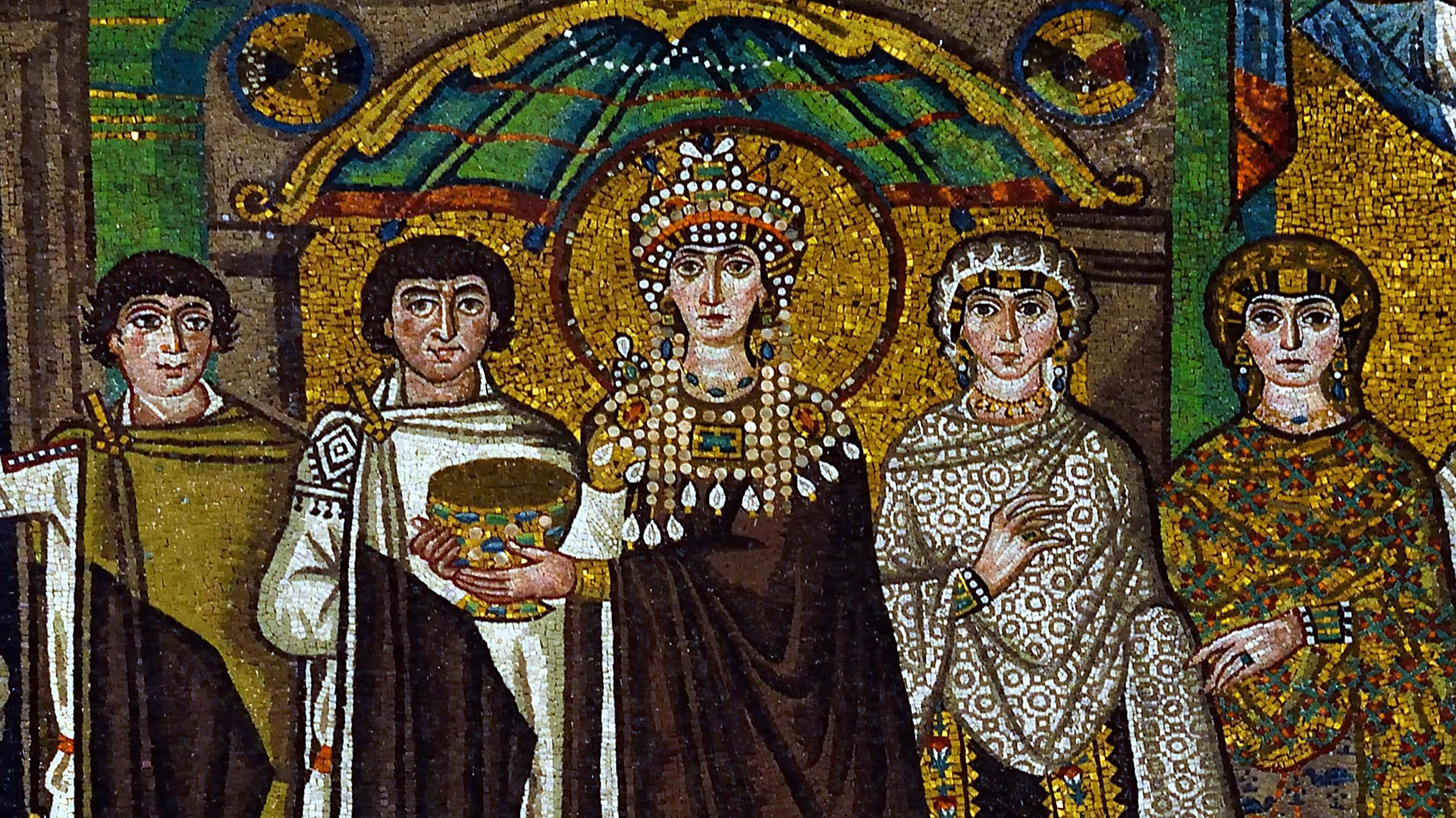
Photo: Alamy.
A mosaic of the Byzantine empress Theodora from 547 AD. The purple color was once considered more precious than gold. (It seems a bit brown in photos.)

Today’s story about a valuable pigment that comes from mollusks made me think of “wampum,” the jewelry/currency made from quahog shells by indigenous people in North America. The difference is that to get this royal purple, it was the insides of snails that were used.

Zaria Gorvett reports at the BBC, “For millennia, Tyrian purple was the most valuable color on the planet. Then the recipe to make it was lost. By piecing together ancient clues, could one man bring it back?

“At first, they just looked like stains. It was 2002 at the site of Qatna – a ruined palace at the edge of the Syrian desert, on the shores of a long-vanished lake. Over three millennia after it was abandoned, a team of archaeologists had been granted permission to investigate – and they were on the hunt for the royal tomb.

“After navigating through large hallways and narrow corridors, down crumbling steps, they came across a deep shaft. On one side were two identical statues guarding a sealed door: they had found it. Inside was a hoard of ancient wonders – 2,000 objects, including jewelery and a large golden hand. But there were also some intriguing dark patches on the ground. They sent a sample for testing – eventually separating out a vivid purple layer from the dust and muck.

“The researchers had uncovered one of the most legendary commodities in the ancient world. This precious product forged empires, felled kings, and cemented the power of generations of global rulers. The Egyptian Queen Cleopatra was so obsessed with it, she even used it for the sails of her boat, while some Roman emperors decreed that anyone caught wearing it – other than them – would be sentenced to death.  

“That invention was Tyrian purple, otherwise known as shellfish purple.

But though this noble pigment was the most expensive product in antiquity – worth more than three times its weight in gold, according to a Roman edict issued in 301 AD – no one living today knows how to make it.

“By the 15th Century, the elaborate recipes to extract and process the dye had been lost. But why did this alluring color disappear? And can it be resurrected?

“In a small garden hut in north-eastern Tunisia, just a short distance from what was once the Phoenician city of Carthage, one man has spent most of the last 16 years smashing up sea snails – attempting to coax their entrails into something resembling Tyrian purple. …

“Ancient authors are particular about the precise hue that was worthy of the name: a deep reddish-purple, like that of coagulated blood, tinged with black. Pliny the Elder described it as having a ‘shining appearance when held up to the light.’ …

“It was so central to the success of the Phoenicians it was named after their city-state Tyre, and they became known as the ‘purple people.’ … In 40 AD, the king of Mauretania was killed in a surprise assassination in Rome, ordered by the emperor. Despite being a friend to the Romans, the unfortunate royal had caused grave offense when he strode into an amphitheatre to watch a gladiatorial match wearing a purple robe. The jealous, insatiable lust that the color ignited was sometimes compared to a kind of madness. …

“Tyrian purple could be produced from the secretions of three species of sea snail, each of which made a different color: Hexaplex trunculus (bluish purple), Bolinus brandaris (reddish purple), and Stramonita haemastoma (red). …

“Accounts of how colorless snail slime was transformed into the dye of legends are vague, contradictory and sometimes obviously mistaken – Aristotle said the mucous glands came from the throat of a ‘purple fish.’ To complicate matters further, the dyeing industry was highly secretive – each manufacturer had their own recipe, and these complex, multi-step formulas were closely guarded. …

“The most detailed record comes from Pliny, who explained the process in the 1st Century AD. It went something like this: after isolating the mucous glands, they were salted and left to ferment for three days. Next came the cooking, which was done in tin or possibly lead pots on a ‘moderate’ heat. This continued until the whole mixture had been boiled down to a fraction of its original volume. On the tenth day, the dye was tested by dipping in some fabric – if it emerged stained with the desired shade, it was ready. 

“Given that each snail only contained the tiniest amount of mucous, it could take some 10,000 to make just a single gram of dye. Mounds of billions of discarded sea snail shells have been reported in areas where it was once manufactured. In fact, the production of Tyrian purple has been described as the first chemical industry – and this not only applies to the scale of the operations, but their exacting nature.”

More at the BBC, here.

Read Full Post »

According to Frank Carini at EcoRI, the humble quahog clam is keeping Rhode Island running. Carini waxed poetic about the quahog after a shellfish-focused event last fall meant to help the state manage its hardest-working resource more efficiently.

Speaker Bob Rheault “noted that the farming and harvesting of shellfish doesn’t require antibiotics and fertilizers. He referred to them as a healthy ‘super food,’ and called bivalves the ‘vacuum cleaners of our oceans.’ …

“The shellfish that inhabit Rhode Island waters are part of the Ocean State’s social and cultural fabric,” adds Carini, “and are integral pieces of a marine ecosystem that provides economic, employment, recreational and environmental benefits. …

“ Despite the obvious economic and environmental benefits provided by the state’s shellfish industry, it has long been, for the most part, operating as a collection of individual parts. …

“To get a better handle on the state’s shellfish industry and to make sure it remains sustainable, [several] agencies have invested more than a million dollars and teamed up with an array of individuals and organizations to develop the Rhode Island Shellfish Management Plan. … Quahoggers are collaborating with scientists to resolve some of the doubts about the biology of the resource. A cooperative study funded by the Southern New England Collaborative Research Initiative enrolls commercial quahoggers to pull bullrakes alongside the hydraulic clam dredge utilized by DEM to measure the density of quahogs on the bottom — a measurement that is then used to inform stock assessment calculations.”

Questions remain. “For example, should aquaculture be recognized as agriculture to clarify ownership and rights to harvest? What does Rhode Island gain in terms of economic value by restoring shellfish populations? How will restoration success be measured? …

“Among Rhode Island’s diverse collection of shellfish, the quahog is the most economically important resource harvested from Narragansett Bay. In fact, Ocean State quahogs once supported the largest outboard-motor fishing fleet in the world. But the price of quahogs hasn’t changed much over the years, making it increasingly difficult for quahoggers to stay in business.

“In Rhode Island, the state’s aquaculture industry, which is largely oysters, is approaching $3 million in annual sales. In fact, this sector of the local shellfish industry is one of the few growth industries in the state, growing by about 15 percent annually during the past decade.”

In 2013, “the number of farms in Rhode Island increased from 43 to 50, and oysters remained the top aquaculture product, with 4,303,886 sold for consumption, according to the CRMC’s 2012 report. …

“ ‘We have to understand the system to manage it and achieve the proper balance,’ [Coastal Resource Management Council] director Grover Fugate said. ‘We have to balance the uses while protecting the resource. We need to develop a better management regime, and because of climate change we will always be adjusting this regime.’ ”

More here.

This morning my two-year-old granddaughter woke up and told her parents she wanted clams. (But that’s another story.)

Photo: Wikimedia
Quahogs

Read Full Post »