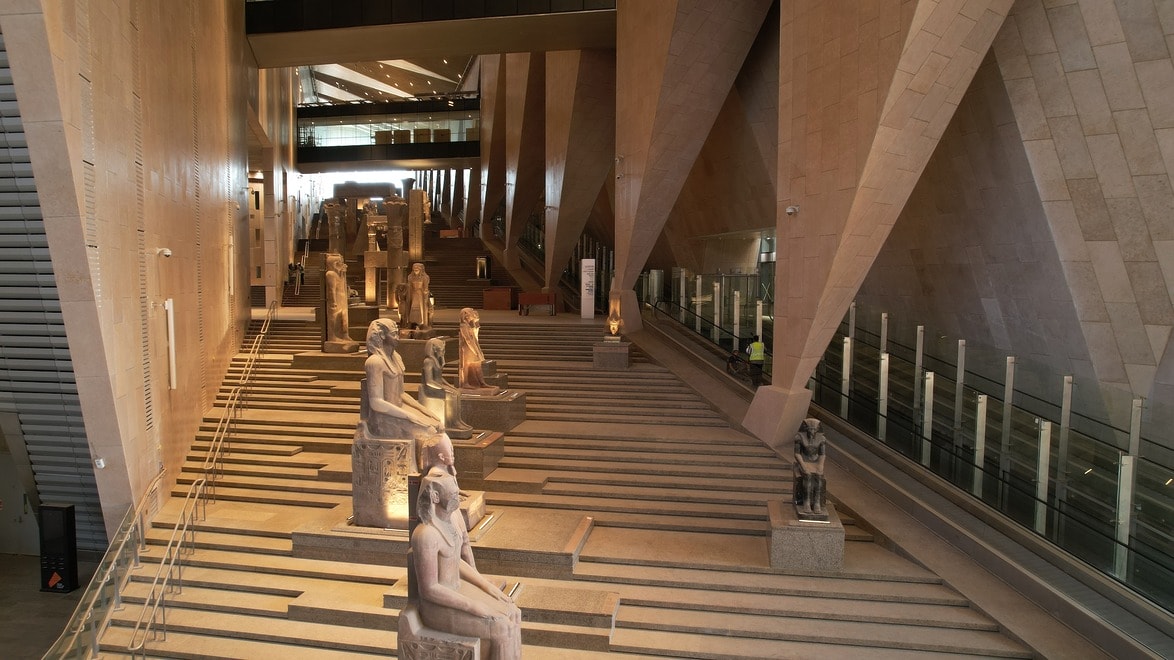
Photo: Grand Egyptian Museum via Galerie magazine.
Grand Staircase at the Grand Egyptian Museum, opened in 2025 after decades of work.
One thing that struck me when I read this article on the opening of the Grand Egyptian Museum was that even though it took many years to build and the original architects left the project in 2014, “the building’s overall structure and dynamic has prevailed.” How many people who departed from such a massive project could say that?
Caroline Roux has a review at Galerie magazine.
“It takes a while to drive past the Great Egyptian Museum (GEM), which officially opened at the beginning of November, and runs alongside the busy main road from Giza to Cairo. As its soaring slanting facade — an elegant tessellation of triangles in stone and glass — comes into view, there’s plenty of time to snap a few pictures. The structure is a staggering 2,600 feet long.
“Like the Great Pyramids, which stand majestically behind it on the Giza Plateau, the museum has also been constructed as a mighty treasure house for Egyptian artifacts. Designed to house 100,000 objects with 17 specialized laboratories dedicated to their conservation, GEM is the world’s largest archaeological museum dedicated to a single civilization.
“For the first time since their excavation in 1923, all 5,000 objects taken from Tutankhamun’s tomb are reunited here. Among them is the king’s iconic gold mask, with its decoration in blue and black, that has endured as the de facto symbol of ancient Egyptian civilization. In the grand entrance hall presides the 3,200-year-old statue of Rameses II, which stands 36 feet high and is carved from 83 tons of ancient red granite. The entire site covers five million square feet — roughly equivalent to nine soccer fields. It’s all about scale.
“The museum has also, rather famously, taken years to complete. The Irish-American architecture practice Heneghan Peng, based between Dublin and Berlin, won the international competition for the building in 2003, against over 1,500 applications from 82 countries. Now, over 20 years and $870 million later, it is open to the public, showing off the vast trove of breathtaking objects dating from 3100 BCE to 410 CE.
“Two tumultuous decades go a long way to account for the delay. Disruptions included the Arab Spring of 2011; the coup d’etat of 2013; the pandemic; economic collapse and raging inflation; and at least five changes at the top. …
“The space, though cavernous, is not wasted. Crowds course up the stupendous six-story staircase, flanked by escalators that create an upward-sloping landscape dotted with heroic statuary and architecture installed on the steps in a genius act of display. There are ten statues of King Senusret 1, a beautiful black granite sculpture of the Sphinx of King Amenemhat III, and the perfectly preserved doorway to his grandfather’s tomb. All are striped with dazzling slashes of sunlight that glimmers across the exhibits from skylights many feet above.
“At the top, an enormous window frames breathtaking views of the Great Pyramids of Giza, and to the right is the entrance to the twelve galleries housing the thousands of objects that reveal the complexities of the ancient Egyptian world.
Among the regulations posted on the door are ‘In an earthquake, stay away from large objects.’ …
“It is the minutiae of daily life that enchants the most. There are sets of bronze tools to thrill even today’s DIY enthusiast, models of hairstyles from bobs to up-dos designed to show elaborate earrings, travertine vessels that most likely contained make-up, and hundreds of beetle-shaped seals. Intricate plaster models reveal the tiniest details of boats and their oarsmen. A dollhouse-sized grain store comes complete with workers. On the grander side are the breathtaking spoils of burial: luxurious jewelry in glass beads and gold, leather garments, elaborately painted sarcophagi, porcelain shabtis (figurines), and gold-and-jade amulets.
“Tutankhamun commands his own gallery, starting with a fleet of bronze-and-gold chariots so sophisticated that one can only wonder why it took modern civilization another 2,000 years to invent the motorcar. State-of-the-art screens detail the tomb’s discovery, but the objects prove to be the biggest draw: the golden throne, the king’s own armor of overlapping leather scales. …
“The architects, Róisín Heneghan and Shih-Fu Peng, … perhaps would notice myriad changes. Was the monotony of material on the interior — acres of the same Egyptian marble — in their original plan? Or the ground floor’s airport-like procession of Starbucks and [pastry shops]? Still, the clever skylights, slanting walls, and direct axial relationship to the pyramids beyond feel firmly in place. …
“According to Dr. Zahi Hawass, Egypt’s minister of tourism and antiquities, the museum is still incomplete. ‘I need three objects to come back,’ he told the BBC. ‘The Rosetta Stone from the British Museum, the Zodiac from the Louvre, and the Bust of Nefertiti from Berlin.’ Even without them, the value of Egypt’s extraordinary ancient history remains as appealing as ever.”

 Suzanne's Mom's Blog