Feeds:
Posts
Comments

Posts Tagged ‘giza’

Photo: Asem Salama / Scientific Reports..
A diagram of the inside of the Great Pyramid of Giza in Egypt.

Today’s story about the brilliant design of the the Great Pyramid of Giza reminds me that people living in the 21st century should never assume they are more intelligent than people centuries ago. Many of our ethical stances show improvement. We have advanced gadgets and skills. But we have lost ancient skills needed to manipulate ancient gadgets.

And what about building construction? The high rise in New York City that threatens to collapse is surely an example of inferior design capability.

Compare that to the pyramids. Richard Widdington writes at Artnet, “Over the past 4,600 years, the Great Pyramid of Giza has weathered a dozen or so major earthquakes. … Cumulatively, seismic activity is one factor that explains why the structure has lost around 30 feet in height since it was completed at the peak of Egypt’s Old Kingdom.

“Otherwise, the wonder of the ancient world has endured relatively unscathed. Unlike the earlier Step Pyramid at Saqqara or the aptly named Bent Pyramid at Dahshur, the Great Pyramid of Giza is free from earthquake-induced structural damage. A new study led by seismologists at Egypt’s National Research Institute of Astronomy and Geophysics measured such resilience and concluded that it might be partly by design.

“[Researchers] used an accelerometer to measure natural vibrations at 37 locations inside and around the pyramid, including on its exterior stones, within its chambers, and in the surrounding soil. They found the majority of the vibrations inside the structure exhibited ‘exceptional homogeneity’ and ranged between 2.0 and 2.6 hertz. This means the stress of an earthquake is distributed evenly throughout the pyramid. Crucially, this differed from the surrounding soil, which averaged 0.6 hertz, effectively offering the ground as a natural shield that prevents seismic energy from amplifying as it passes into the monument. Building on top of a carefully leveled limestone bedrock, researchers noted, also helped to anchor the structure. The results were published in Scientific Reports in May.

“ ‘The Great Pyramid behaves as a single, cohesive unit that naturally vibrates at a fundamental frequency of approximately 2.3 Hz,’ one of the researchers, Asem Salama, said over email. ‘The frequency difference prevents the destructive phenomenon of resonance, the primary culprit behind the collapse of modern buildings, when a structure’s frequency matches the earthquakes vibrations.’

“Another factor preventing shockwaves from amplifying as they rise through the pyramid is a series of five rooms built directly above the King’s Chamber, which sits at the heart of the structure. Known as weight-relief chambers, they were designed to protect the hallowed space from the immense weight of the stone blocks above it. In the context of earthquakes, however, they act as a built-in ‘shock absorbers,’ diminishing the vibrations that reach them.

“Last, there’s the Great Pyramid of Giza’s most visibly obvious advantage: its bottom-heavy, symmetrical shape. This ensures weight and stress are distributed evenly throughout the structure.

“​ ‘The earthquake resilience of the Great Pyramid of Giza is not a historical fluke, but the pinnacle of an ancient engineering evolution,’ Salama said. ‘Much like modern engineering advances through iterative science and lessons learned from past structural failures, Egyptian architects refined their techniques over generations. Prior disasters, such as the collapse of the Meidum Pyramid, provided critical data. By the time the Great Pyramid’s architects broke ground, they had mastered the physics of permanence.’ ”

More at Artnet, here. No firewall.
Read Full Post »

Photo: Grand Egyptian Museum via Galerie magazine.
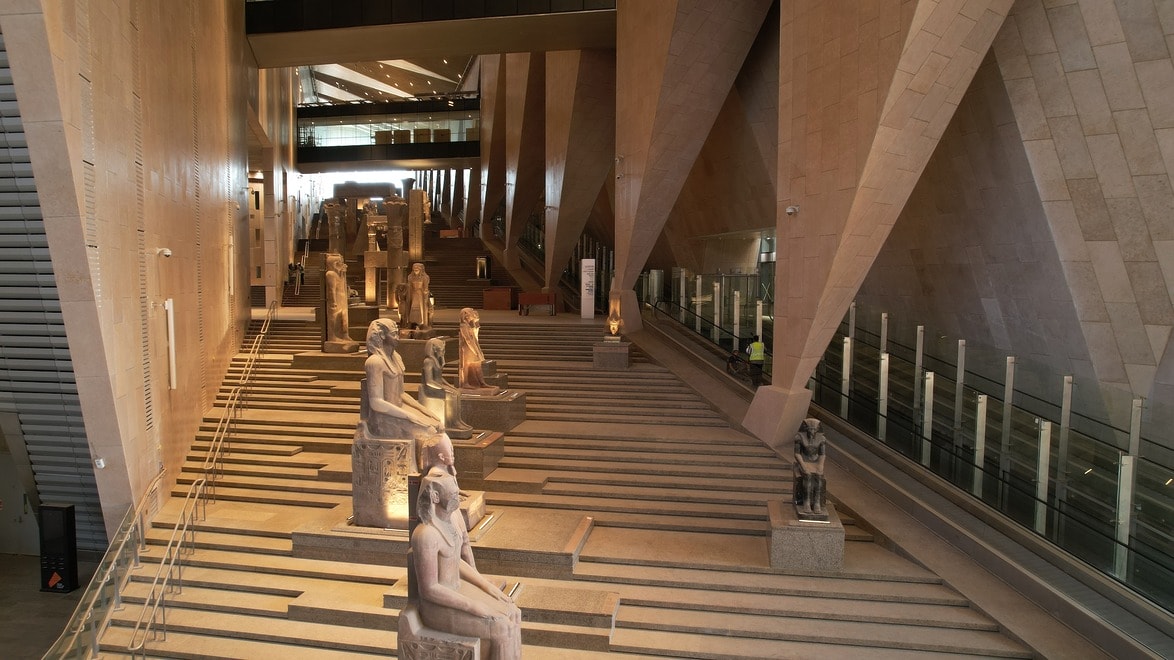
Grand Staircase at the Grand Egyptian Museum, opened in 2025 after decades of work.

One thing that struck me when I read this article on the opening of the Grand Egyptian Museum was that even though it took many years to build and the original architects left the project in 2014, “the building’s overall structure and dynamic has prevailed.” How many people who departed from such a massive project could say that?

Caroline Roux has a review at Galerie magazine.

“It takes a while to drive past the Great Egyptian Museum (GEM), which officially opened at the beginning of November, and runs alongside the busy main road from Giza to Cairo. As its soaring slanting facade — an elegant tessellation of triangles in stone and glass — comes into view, there’s plenty of time to snap a few pictures. The structure is a staggering 2,600 feet long.  

“Like the Great Pyramids, which stand majestically behind it on the Giza Plateau, the museum has also been constructed as a mighty treasure house for Egyptian artifacts. Designed to house 100,000 objects with 17 specialized laboratories dedicated to their conservation, GEM is the world’s largest archaeological museum dedicated to a single civilization.

“For the first time since their excavation in 1923, all 5,000 objects taken from Tutankhamun’s tomb are reunited here. Among them is the king’s iconic gold mask, with its decoration in blue and black, that has endured as the de facto symbol of ancient Egyptian civilization. In the grand entrance hall presides the 3,200-year-old statue of Rameses II, which stands 36 feet high and is carved from 83 tons of ancient red granite. The entire site covers five million square feet — roughly equivalent to nine soccer fields. It’s all about scale. 

“The museum has also, rather famously, taken years to complete. The Irish-American architecture practice Heneghan Peng, based between Dublin and Berlin, won the international competition for the building in 2003, against over 1,500 applications from 82 countries. Now, over 20 years and $870 million later, it is open to the public, showing off the vast trove of breathtaking objects dating from 3100 BCE to 410 CE.   

“Two tumultuous decades go a long way to account for the delay. Disruptions included the Arab Spring of 2011; the coup d’etat of 2013; the pandemic; economic collapse and raging inflation; and at least five changes at the top. …

“The space, though cavernous, is not wasted. Crowds course up the stupendous six-story staircase, flanked by escalators that create an upward-sloping landscape dotted with heroic statuary and architecture installed on the steps in a genius act of display. There are ten statues of King Senusret 1, a beautiful black granite sculpture of the Sphinx of King Amenemhat III, and the perfectly preserved doorway to his grandfather’s tomb. All are striped with dazzling slashes of sunlight that glimmers across the exhibits from skylights many feet above. 

“At the top, an enormous window frames breathtaking views of the Great Pyramids of Giza, and to the right is the entrance to the twelve galleries housing the thousands of objects that reveal the complexities of the ancient Egyptian world.

Among the regulations posted on the door are ‘In an earthquake, stay away from large objects.’ …

“It is the minutiae of daily life that enchants the most. There are sets of bronze tools to thrill even today’s DIY enthusiast, models of hairstyles from bobs to up-dos designed to show elaborate earrings, travertine vessels that most likely contained make-up, and hundreds of beetle-shaped seals. Intricate plaster models reveal the tiniest details of boats and their oarsmen. A dollhouse-sized grain store comes complete with workers. On the grander side are the breathtaking spoils of burial: luxurious jewelry in glass beads and gold, leather garments, elaborately painted sarcophagi, porcelain shabtis (figurines), and gold-and-jade amulets. 

“Tutankhamun commands his own gallery, starting with a fleet of bronze-and-gold chariots so sophisticated that one can only wonder why it took modern civilization another 2,000 years to invent the motorcar. State-of-the-art screens detail the tomb’s discovery, but the objects prove to be the biggest draw: the golden throne, the king’s own armor of overlapping leather scales. …

“The architects, Róisín Heneghan and Shih-Fu Peng, … perhaps would notice myriad changes. Was the monotony of material on the interior — acres of the same Egyptian marble — in their original plan? Or the ground floor’s airport-like procession of Starbucks and [pastry shops]? Still, the clever skylights, slanting walls, and direct axial relationship to the pyramids beyond feel firmly in place. …

“According to Dr. Zahi Hawass, Egypt’s minister of tourism and antiquities, the museum is still incomplete. ‘I need three objects to come back,’ he told the BBC. ‘The Rosetta Stone from the British Museum, the Zodiac from the Louvre, and the Bust of Nefertiti from Berlin.’ Even without them, the value of Egypt’s extraordinary ancient history remains as appealing as ever.”  

Great photos at Galerie. More pictures at ArchDaily, here.

Read Full Post »

ArtsJournal recently highlighted this article from the Guardian about the pyramids.

“Egypt never seems to stop revealing its ancient wonders and mysteries,” writes Jonathan Jones. “Now, it seems we may be on edge of new discoveries as marvellous as when Howard Carter opened the tomb of Tutankhamun in 1922. …

“The dazzle of Tutankhamun’s gold probably satisfied the tomb’s discoverers – and besides, it has taken 21st-century technology to find the new mystery: traces of what may be well-hidden and still unopened chambers behind the tomb of the boy king.

“Egyptologist Nicholas Reeves believes – controversially – that the hidden space may be the lost tomb of Queen Nefertiti, who may have been young Tut’s mother. If Reeves is right, the sands of Egypt could be about to yield one of their greatest secrets – something epochal.

“And that’s not all. Archaeologists scanning the pyramids at Giza have found ‘thermal anomalies’ that may also reveal hidden chambers, including one deep within the Great Pyramid. So the pyramids too (which are considerably older than the tombs of Tutankhamun and, perhaps, his mother) are apparently still full of marvels ready to be uncovered.”

More here.

Photo: Hassan Ammar/AP  
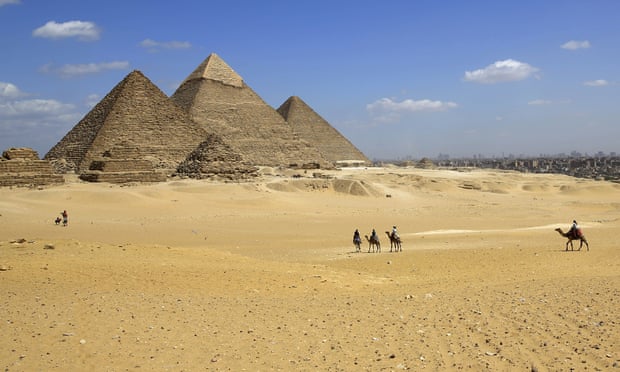
The pyramids of Giza.

Read Full Post »

Public Radio International’s “The World” had a delightful story today on a young Egyptian who looks like he might be a real “contenda” for a sumo wrestling title.

Clark Boyd reports, “His real name is Abdel Rahman Ahmed Shaalan. But in Japan, they call him Osunaarashi, or ‘Great Sandstorm.’

“Shaalan is 21-year-old professional sumo wrestler who hails from Giza in Egypt. After a few years of training at the club level in Egypt, Shaalan left Egypt to try to break into the Japanese professional ranks. …

“Osunaarashi is currently fighting in a tournament in Tokyo, but here’s the thing: He is also a devout Muslim, and this is the holy month of Ramadan. And that means Osunaarashi is fasting.”

The radio report goes on to say that although sumo has always been an intensely tradition-bound sport, the people at the residence where Osunaarashi is living with other wrestlers have made accommodations in deference to his religion. For example, a typical stew that sumo wrestlers are served to bulk them up is chock full of pork, but the chefs now make it with chicken and fish.

More.

Photo: Phlyz/Wiki Commons
Osunaarashi, the Egyptian sumo wrestler, after a Tokyo tournament in May

Read Full Post »